Citizen satisfaction survey questions residents use to rate city services
A citizen satisfaction survey asks residents to rate the services their city, county or town provides, one by one, and to name the one that needs work most. Begin with the 12-question core, around five minutes for a resident, then add the nine-question counter form, or the budget set when spending plans are due.
- 39questions
- 12in the core
- 5 minto answer the core
- 9on the counter form
By Michael Hodge, BSc Psychology Updated September 2026
The city-wide core, the counter form and the budget set
Every core question starts ticked. Pick extra sets, or individual rows; every row spells out its answer scale and the service problem a weak result usually points to. Your selection can open as an online survey, print for a mailing to households, or be pasted into whatever form software the city runs today.
The city-wide core12 questions
One overall rating, a list of the services the household used, seven service ratings and a question on value for taxes, then the one thing to improve first and an open question. The questions say "the city"; swap in county, town or council in the builder.
-
Overall, I am satisfied with the services the city provides.
Strongly disagree12345Strongly agree1 = Strongly disagree, 5 = Strongly agreeThe headline number for the council report. Keep it first and word it the same way every year, because moving it changes the answers.2
-
Which of these have you or your household used in the past 12 months?
Trash or recycling pickupWater or sewer serviceA park or recreation centerThe public libraryPublic transitA city office, by phone or in personNone of theseTick all that applyLets you read each rating among the people who used that service. A resident who never borrows a book can still rate the library, but a borrower knows it.
-
I am satisfied with trash and recycling pickup.
Strongly disagree12345Strongly agree1 = Strongly disagree, 5 = Strongly agreeThe service nearly every household touches every week. A low score usually traces back to missed pickups on particular routes, so split it by neighborhood.
-
I am satisfied with the condition of streets and sidewalks.
Strongly disagree12345Strongly agree1 = Strongly disagree, 5 = Strongly agreeStreet condition is one of the most visible jobs a city does. Read it next to the budget picks: residents often rank it high for attention too.
-
I am satisfied with police services in my neighborhood.
Strongly disagree12345Strongly agree1 = Strongly disagree, 5 = Strongly agreeAsked about the neighborhood, not the department as a whole, so the answer reflects what residents see near home.
-
I am satisfied with fire and emergency medical services.
Strongly disagree12345Strongly agree1 = Strongly disagree, 5 = Strongly agreeIn the 2024 Manassas survey it rated higher than any other service. A strong score gives the council something to point to beside the areas to fix.4
-
I am satisfied with water and sewer service.
Strongly disagree12345Strongly agree1 = Strongly disagree, 5 = Strongly agreeCovers supply, pressure and billing in one line. When it scores low, the open question usually says which of the three is the problem.
-
I am satisfied with parks and recreation.
Strongly disagree12345Strongly agree1 = Strongly disagree, 5 = Strongly agreeOne line for the whole park system. If it drops, a dedicated parks survey finds out which park or program is behind it.
-
I am satisfied with the public library.
Strongly disagree12345Strongly agree1 = Strongly disagree, 5 = Strongly agreeRead it among library users from question 2. Non-users tend to answer in the middle, which flattens the result.
-
I get good value for the local taxes and fees I pay.
Strongly disagree12345Strongly agree1 = Strongly disagree, 5 = Strongly agreeValue, not the tax rate. Residents who rate most services well but score this low are asking to see what their money buys.
-
Which one should the city improve first?
Streets and sidewalksTrash and recyclingPolice and safetyParks and librariesWater and sewerOne pick forces a priority. With five options it also runs as a live poll at a council meeting or town hall.
-
What is one thing the city could do to serve you better?
Open answerSort the answers into piles such as potholes, noise or opening hours and count them. The biggest pile often names a small, cheap fix.
Public service feedback form (after a visit, call or online request)9 questions
Answered straight after someone uses a service: at the counter, when a phone call ends, or on the last screen of an online form. The statements follow the federal customer experience standard (OMB Circular A-11 Section 280) with small edits, so city and agency results line up.
-
How did you contact us today?
In personBy phoneOnlineBy email or mailSplit every other answer by channel. A slow phone line and a fast website can average out to a middling score that hides both.
-
I am satisfied with the service I received today.
Strongly disagree12345Strongly agree1 = Strongly disagree, 5 = Strongly agreeThe overall score for this visit, in the wording federal agencies use, so your result can sit beside theirs.1
-
This visit increased my trust in the city.
Strongly disagree12345Strongly agree1 = Strongly disagree, 5 = Strongly agreeThe trust measure the federal standard asks for. It moves more slowly than satisfaction, so track it over several quarters.1
-
My need was addressed.
Strongly disagree12345Strongly agree1 = Strongly disagree, 5 = Strongly agreeDid the visit do its job? A friendly visit that leaves the problem unsolved scores high on staff and low here.
-
It was easy to complete what I needed to do.
Strongly disagree12345Strongly agree1 = Strongly disagree, 5 = Strongly agreeEase of the process: forms, steps and finding the right desk. Low scores point to the form or the website, not the staff.
-
I got this done in a reasonable time.
Strongly disagree12345Strongly agree1 = Strongly disagree, 5 = Strongly agreeSpeed as the visitor judged it. Compare it with your wait-time logs to see whether the problem is the wait or the expectation.
-
I was treated as fairly as anyone else would be.
Strongly disagree12345Strongly agree1 = Strongly disagree, 5 = Strongly agreeThe equity driver in the federal standard. Break it down by language and neighborhood once enough people have answered.
-
The staff I dealt with were helpful.
Strongly disagree12345Strongly agree1 = Strongly disagree, 5 = Strongly agreeDrop it from online forms where no person was involved. Read it next to "my need was addressed" to see whether staff had the power to fix things.
-
What is one thing we could have done better?
Open answerThe federal standard allows one or two open questions. One is enough here, and people answer it while the visit is fresh.
More services to rate5 questions
Add the services your city runs that the core leaves out. Drop any your city does not provide.
-
Public buses and trains get me where I need to go.
Strongly disagree12345Strongly agree1 = Strongly disagree, 5 = Strongly agreeCoverage and routes, asked from the rider side. Read it among residents who ticked public transit in question 2.
-
Snow and ice are cleared from streets quickly.
Strongly disagree12345Strongly agree1 = Strongly disagree, 5 = Strongly agreeWinter cities only. One bad storm can sink the rating for a year, so note the date the survey went out.
-
Street lighting on my block is good enough at night.
Strongly disagree12345Strongly agree1 = Strongly disagree, 5 = Strongly agreePoints crews to dark blocks when split by neighborhood. Pair it with the after-dark safety statement.
-
Getting a permit or inspection from the city was straightforward.
Strongly disagree12345Strongly agree1 = Strongly disagree, 5 = Strongly agreeAsk only residents who applied for one. Builders and home owners feel permit delays long before the council hears about them.
-
Streets in my area drain well after heavy rain.
Strongly disagree12345Strongly agree1 = Strongly disagree, 5 = Strongly agreeStanding water marks blocked drains and undersized pipes. Split it by neighborhood and send the lowest areas to the stormwater crew first.
Budget priorities (for the next two years)4 questions
Three picks and one question on taxes. Together with the core ratings they give each service an importance-satisfaction rating, worked through further down.
-
Which service should the city focus on most over the next two years?
Streets and sidewalksTrash and recyclingPoliceFire and EMSWater and sewerParks and recreationLibraryTransitFirst choice. Add the shares for first, second and third choice to get each service's importance.3
-
Which service should come second?
Streets and sidewalksTrash and recyclingPoliceFire and EMSWater and sewerParks and recreationLibraryTransitSecond choice, counted the same way as the first.3
-
Which service should come third?
Streets and sidewalksTrash and recyclingPoliceFire and EMSWater and sewerParks and recreationLibraryTransitThird choice. Three picks keep one popular service from swamping the list.3
-
Which comes closest to your view on local taxes and services?
Keep both about where they areRaise taxes to improve servicesCut services to lower taxesNot sureThe trade-off councils face, asked directly. Read it next to the value-for-taxes question in the core.
Feeling safe in the neighborhood3 questions
Three statements on how safe residents feel, which is not the same as crime figures. Keep them in the same order every year.
-
I feel safe walking in my neighborhood during the day.
Strongly disagree12345Strongly agree1 = Strongly disagree, 5 = Strongly agreeThe baseline. Most residents agree, so a neighborhood where they do not stands out at once.
-
I feel safe walking in my neighborhood after dark.
Strongly disagree12345Strongly agree1 = Strongly disagree, 5 = Strongly agreeUsually lower than daytime. The gap between the two often comes down to lighting, which the city can fix.
-
I feel safe in the downtown and shopping areas.
Strongly disagree12345Strongly agree1 = Strongly disagree, 5 = Strongly agreeTells the business district and the police which areas feel unsafe, even where reported crime is low.
Keeping residents informed3 questions
For a communications plan or a new city website. Ask everyone, including residents who have never contacted the city.
-
I know where to find information about city services.
Strongly disagree12345Strongly agree1 = Strongly disagree, 5 = Strongly agreeWhen this is low, residents cannot use services they would rate well. A better website or mailer can lift several scores at once.
-
The city asks residents for input before big decisions.
Strongly disagree12345Strongly agree1 = Strongly disagree, 5 = Strongly agreeWhether residents feel consulted. It tends to move with trust, so read it next to the value-for-taxes question.
-
How would you like to hear from the city?
Email or text alertsCity websiteSocial mediaMailed newsletterLocal newsNeighborhood meetingsTick all that applySpend the outreach budget where residents will look. Split it by age: older and younger residents rarely pick the same channels.
About you (optional)3 questions
For comparing neighborhoods and groups. Publish a group only when enough people answered that nobody can be identified.
-
Which neighborhood or ZIP code do you live in?
Open answerThe most useful split in a city survey: services are delivered by route and district, so problems cluster by area.
-
What is your age?
18 to 3435 to 5455 to 6465 or olderMailed surveys draw older residents. Compare the mix with census figures before you report a single total.
-
Do you own or rent your home?
OwnRentOtherOwners pay property tax directly and renters mostly do not, so the two groups often read the value question differently.
A city-wide survey or a counter form?
Most cities need both, and they answer different questions. Use this table to decide which one to send first.
| City-wide citizen survey | Public service feedback form | |
|---|---|---|
| What it tells you | How residents rate every service, and what to fund | How one visit, call or online request went |
| Who answers | A random sample of households, users and non-users | Everyone who just used the service |
| When | Every year or two, before the budget | All year, straight after each visit |
| Questions | The core, plus safety, information and budget sets | The nine-question feedback form |
Federal agencies have a fixed recipe for the second one. OMB Circular A-11 Section 280 asks for a trust statement and a satisfaction statement on a five-point scale, one statement for each driver of the experience, and at most two open questions, in no more than 15 questions and five minutes.1 The feedback form above meets that with nine. For a 311 line or a phone help desk, the call center survey questions go deeper on hold times and transfers.
When one service needs a closer look, follow the core with a dedicated survey: household water use questions before a conservation plan, or access to health care questions for a county health department.
Making a citizen survey count
Four habits drawn from the federal service standard, survey research on public services and the cities that survey residents every year.

Ask while the visit is still fresh
The feedback form works best at the end of the visit, not weeks later. The federal standard for service feedback tells agencies to ask as close to the transaction as possible: a prompt at the end of an online form, a message soon after a call, or a kiosk near the exit.1 Put the counter five on a card by the door and the full form on the last screen of your online forms, and people answer before they have moved on.
Residents satisfied with each service, Manassas, Virginia, 2024
Rate each service on its own line
One overall score hides the story. In the 2024 Manassas survey, 91% of residents were satisfied with fire and rescue and 84% with trash and recycling, while traffic flow stood at 37%.4 A single "how is the city doing" question averages those into a number nobody can act on. The core rates seven services separately, and question 2 notes which services each household has used, so the library rating can be read among borrowers.
Keep the order and the wording from year to year
Where a question sits changes how people answer it. In a split-ballot experiment, Van de Walle and Van Ryzin found that moving questions around shifted both the service ratings and overall satisfaction, and even changed which services looked like the drivers of overall satisfaction.2 Settle the order once (this set asks the overall question first) and reuse it untouched in every round, which keeps comparisons across years fair.

Publish what you heard and what will change
Residents answer again when the last survey visibly changed something. In a study of 38 cities and counties that had run the National Citizen Survey, 20 of the 22 that set out to improve communication with residents and published their results could name a specific outcome.5 Post the chart on the city website, run it in the newsletter and pin it to the notice board at city hall, next to the one or two changes you chose.
One question for a council meeting, a town hall or a community fair? Run a live poll and residents vote on their phones while the results fill the screen. Posting it on the city social media pages or website? Each one is explained on our poll making and sharing page.
Line up the service ratings
With the returns counted, type the number of residents behind each score on the nine core ratings. You get a one-page chart of the services residents are happy with and the two that need work, ready to hand to the council.
- 1Agree and strongly agree count as satisfied; the panel turns them into a percentage of the residents who rated that service.
- 2Leave out people who skipped a service they never used. Their blanks are not a vote either way.
- 3Repeat it for each neighborhood or ZIP code. Trash routes, patrol beats and water mains all run by area, so a problem often sits in one part of town.
- 4Take the two lowest services and the answers to the open question together. The comments usually say what went wrong.
Citizen survey results
Rank services for the budget
ETC Institute, a firm that runs resident surveys for cities and counties, ranks services with an importance-satisfaction rating.3 The budget set and the core ratings give you both halves of it.
- Importance: add the shares of residents who picked a service first, second or third in the budget set.
- Satisfaction: the percentage giving that service's core statement a 4 or 5, leaving out people who skipped it.
- Multiply importance by one minus satisfaction. The highest ratings go to services many people care about and few are happy with.
| Service (Manassas, 2024) | Top three, satisfied | Rating |
|---|---|---|
| Traffic flow and getting around | 46% and 37% | 0.46 x 0.63 = 0.29 |
| Streets, sidewalks and infrastructure | 26% and 62% | 0.26 x 0.38 = 0.10 |
| Parks and recreation | 15% and 63% | 0.15 x 0.37 = 0.06 |
| Police services | 21% and 76% | 0.21 x 0.24 = 0.05 |
| Fire and rescue | 5% and 91% | 0.05 x 0.09 = 0.0045 |
The figures come from the published charts of the City of Manassas, Virginia, 2024 community survey, rounded.4 Traffic flow tops the list because 46% of residents ranked it among their three priorities and 37% are satisfied with it. Fire and rescue lands at the bottom for the opposite reason, which is good news: keep doing what works there.
ETC reads a rating of 0.20 or more as a service that should get much more emphasis, 0.10 to 0.20 as more emphasis, and anything lower as keep going as you are.3 Put the ranked list in front of the council with the budget draft.
A card for the permit desk: five questions
People leaving a permit desk or hanging up from a call will answer five questions, not twenty. Print these on a card by the exit, or add them to the last screen of an online form.
- 01I am satisfied with the service I received today.
- 02My need was addressed.
- 03It was easy to complete what I needed to do.
- 04I got this done in a reasonable time.
- 05What is one thing we could have done better?
A household mailing with a prepaid envelope
Mail matters for a city-wide survey: plenty of residents never see a council email or post. Send the questionnaire with a prepaid return envelope and a short web address for anyone who prefers a phone, and tally what comes back on the worksheet.
Mailing a shorter version?
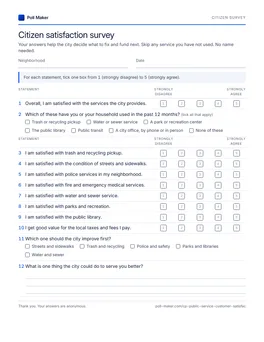
Citizen questionnaire
Sheet one carries the city-wide core as tick boxes. The counter form and every other set run on from sheet two, so a mailing can leave them out.
Download PDF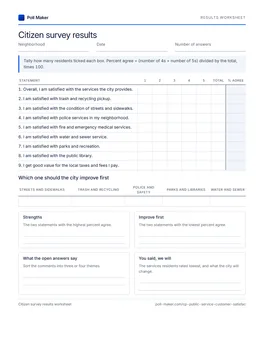
Results worksheet
Mark each returned form on the grid for the nine core ratings and the improve-first pick, then record the services that need work and the message going back to residents.
Download PDFWhat city and county staff ask
Short answers for city managers, council staff and public agencies planning their first survey.
What is a citizen satisfaction survey?
A survey residents answer about the services their city, county or town provides: how satisfied they are overall and with each service, whether they get value for their taxes, and what should improve first. Councils use the results to set budgets, plan and measure performance.
What is the purpose of a public service satisfaction survey?
Survey researchers Miller and Miller list six reasons local governments run one: to assess community needs and allocate resources, to guide long-range planning, to guide short-term planning, to check communication with residents, to evaluate services, and to test support for policies.5 Pick one or two before you choose questions, and the rest of the survey follows from them.
Which questions do federal agencies have to ask?
Under OMB Circular A-11 Section 280, high impact service providers ask for a trust score and a satisfaction score on a five-point scale, plus statements on the drivers of the experience: whether the need was met, ease, time, fairness and helpful staff. One or two open questions are allowed, with a limit of 15 questions and five minutes.1 The feedback form on this page follows that pattern.
How often should a city survey its residents?
Run the city-wide survey every year or two, timed so the results arrive before budget decisions. Keep the feedback form running all year and read it every month or quarter. Keep the wording and the order identical between rounds so results compare.
Citizen survey questions worth fixing
Four wordings that turn up on many city surveys, and a version residents can answer. More before-and-after examples are in the survey questions guide.
How satisfied are you with the Department of Public Works?
I am satisfied with trash and recycling pickup.
I am satisfied with the condition of streets and sidewalks.
Residents know the truck and the pothole, not the department on the organization chart. Name the service they can see.
How satisfied are you with city services and communication?
Overall, I am satisfied with the services the city provides.
I know where to find information about city services.
Two questions in one. A resident happy with services and lost on the website has no honest answer.
Do you agree the new recycling program has been a success?
I am satisfied with trash and recycling pickup.
The wording tells people what to think. A neutral statement on the service gives a number you can defend at a public meeting.
Would you support higher taxes for better roads?
Which service should the city focus on most over the next two years?
Which comes closest to your view on local taxes and services?
Almost everyone wants better roads and few want higher taxes. A ranked choice plus a clear trade-off shows what residents would give up.
Hear from residents before the budget is set
Start from the city-wide core in the builder and tick the extra sets your council wants, or download the printable version for a household mailing and put the counter five at the front desk.