Water usage survey questions on home use and saving water
A good water usage survey sticks to what a household can count: people at home, shower minutes, laundry loads, garden watering, fixtures and leaks. The core 12 takes about four minutes, and the answers convert to gallons a day.
- 34questions
- 12in the core
- 4 minfor the core
- Ownersand renters
By Michael Hodge, BSc Psychology Updated September 2026
All 34 water usage questions, with answer choices
The home water core is ticked for you. Add the bathroom, kitchen and laundry set for a conservation campaign, bills and meters for a utility, or shortages and restrictions for drought planning. Answer choices sit under each item, with a note on what a high or low count would mean for your program.
Home water core12 questions
Six questions in countable units, five statements for the results report, then a single open question. From these twelve you learn who uses water, where it goes and how much room there is to save.
-
How many people live in your home, including you?
12345 or moreThe number of people is the strongest single predictor of how much water a home uses, so divide every total by it before you compare homes.3
-
How long was your last shower?
Under 5 min5 to 7 min8 to 10 min11 to 15 minOver 15 minMinutes are easy to recall and easy to turn into gallons. Measured showers in US homes averaged 7.8 minutes, so the middle band is typical.1
-
How many loads of laundry does your home wash in a typical week?
0 to 23 to 45 to 67 to 910 or moreA load is a unit people remember. Clothes washers take about a sixth of indoor water, so this answer drives the estimate.1
-
Which of these does your home have?
Low-flow showerheadLow-flow toiletTap aeratorsEfficient washerDishwasherNot sureTick all that applyEfficient fixtures, not changed habits, explain most of the fall in household water use since 1999. A crowd of "Not sure" answers is a case for a fixture check.1
-
When did anyone last check your home for leaks?
In the last monthIn the last yearLonger agoNeverNot sureLeaks were 13% of indoor use in metered homes, and a silent leak goes unnoticed without a check. This shows how many homes a leak campaign would reach.1
-
In summer, how often is your lawn or garden watered?
Every dayA few times a weekOnce a weekRarely or neverNo lawn or gardenOutdoor use is about 30% of household water nationally and higher in dry areas, so this question splits the high users from the rest.5
-
I know roughly how much water my home uses.
Strongly disagree12345Strongly agree1 = Strongly disagree, 5 = Strongly agreePeople tend to guess low. Read a high score next to the bill and meter module before you trust it.2
-
We run the washer and dishwasher only when full.
Strongly disagree12345Strongly agree1 = Strongly disagree, 5 = Strongly agreeThe easiest habit to change without spending money. A low score points to a simple reminder campaign.
-
Everyone in my home tries to save water.
Strongly disagree12345Strongly agree1 = Strongly disagree, 5 = Strongly agreeHomes that report a shared habit of saving water use less on the meter, so this is a household question, not a personal one.3
-
Drips and running toilets get fixed quickly here.
Strongly disagree12345Strongly agree1 = Strongly disagree, 5 = Strongly agreeRenters usually wait on a landlord for repairs, so split this answer by the own-or-rent question.
-
Saving water at home is easy for us.
Strongly disagree12345Strongly agree1 = Strongly disagree, 5 = Strongly agreeLow ease with high willingness means a practical barrier. The barriers question in the next module names it.
-
What would make it easier for your home to use less water?
Open answerAnswers name real fixes: a new showerhead, a rain tank, a clearer bill. Group them and the top three become the plan.
Bathroom, kitchen and laundry5 questions
For conservation campaigns that need detail on daily habits indoors, room by room.
-
On a typical day, how many showers are taken in your home in total?
12345 or morePairs with the shower length question to give daily shower minutes for the whole home.
-
How often do you turn off the tap while brushing your teeth?
NeverRarelySometimesOftenAlwaysA small habit, but one people can picture exactly, so answers are honest.
-
How are dishes usually washed in your home?
DishwasherBy hand, tap runningBy hand, in a filled sinkA mixHand washing under a running tap is the pattern to target. A dishwasher uses about 6 gallons a load.1
-
Which change would save your home the most water?
Shorter showersTurning taps offFixing leaksNew fixturesLess garden wateringMost people name cutting back rather than new fixtures, the reverse of what experts advise. The spread shows what to explain first.2
-
What makes it hard to use less water at home?
HabitsOld fixturesCost of new fixturesOthers in the homeNot sure howNothingTick all that applyNames the barrier to remove. Cost points to rebates, habits to reminders, "not sure how" to plain advice.
Garden and outdoor water4 questions
For dry regions, summer watering programs and homes with lawns, where most of the peak demand sits.
-
How is your garden or lawn usually watered?
Hose by handSprinkler on a timerDrip systemWatering canNot wateredTimers run whether or not it rained. This answer tells you who to offer a smart controller or a timer check.
-
What time of day is it usually watered?
Early morningMiddayEveningIt variesNot wateredShows whether a watering-time message has an audience before you print it.
-
Do you collect rainwater or reuse household water outside?
Rain barrel or tankReused household waterBothNeitherCounts homes already cutting mains water outdoors, and the ones a rain barrel offer could reach.
-
Would you swap part of your lawn for plants that need less water?
Already haveYesMaybeNoNo lawnA first read on interest before costing a lawn swap rebate.
Bills and meters5 questions
For water utilities and councils. It shows who sees a bill, who could read a meter, and who would use better usage data.
-
Who pays the water bill for your home?
We pay it directlyIt is in the rentShared with neighboursNot surePeople who never see a bill cannot react to its price. Report renters separately.
-
Does your home have its own water meter?
Yes, its ownA shared meterNo meterNot sureOnly homes with their own meter can run the meter checks below, or see their own use on a bill.
-
How often do you look at how much water your bill says you used?
Every billSometimesRarelyNeverI never see itThe bill is the only usage feedback most homes get. "Never" answers are the audience for a clearer bill.
-
Compared with a year ago, your water bill is:
HigherAbout the sameLowerNot sureCurrency free, so the set works in any country. Read "higher" next to the leak questions.
-
I would check an app that shows my daily water use.
Strongly disagree12345Strongly agree1 = Strongly disagree, 5 = Strongly agreeMeasures demand for smart meter data before a utility pays to offer it.
Water shortages and restrictions5 questions
For drought planning, a water shortage questionnaire, or a class project on water scarcity.
-
In the past year, how often has your home had low pressure or no water?
NeverOnceA few timesOftenNot sureSupply problems as households live them. Map the answers by area to find the weak parts of the network.
-
Are there water restrictions where you live right now?
YesNoNot sureHomes in areas recently under drought restrictions used less water. "Not sure" measures how far the message reached.3
-
I would know where to find the rules if restrictions began.
Strongly disagree12345Strongly agree1 = Strongly disagree, 5 = Strongly agreeTests the channel before a shortage, not during one.
-
In a shortage, what would your home cut first?
Garden wateringCar washingShower timeLaundry loadsPool fillingNothingTick all that applyShows which cuts people accept, so restrictions can start with those.
-
What would help your home most during a water shortage?
Open answerSurfaces needs a plan can miss: stored water for someone unwell, a rule that is unclear, a garden someone depends on.
About your home (optional)3 questions
Use these to compare groups. Ask for an area rather than an address so no home can be picked out.
-
What type of home do you live in?
HouseApartment or flatTownhouseOtherApartments rarely have gardens or their own meters, so compare them with houses separately.
-
Do you own or rent your home?
OwnRentOtherRenters can change habits but rarely fixtures. Offer each group a different next step.
-
Roughly how old is your home?
Under 10 years10 to 30 yearsOver 30 yearsNot sureNew homes built to water-efficiency standards used about 110 gallons a day against 138 for the average home.1
Four rules for water questions people can answer
Households are poor judges of gallons and good judges of minutes, loads and fixtures. Build the survey around that and the answers hold up.
Ask for minutes, loads and counts
In a national survey of 1,020 Americans, people underestimated the water used by household activities by a factor of 2 on average, and by most for the biggest uses.2 A comparison of phone questionnaires with seven-day water diaries found answers agreed best for frequent activities and for ones with standard durations or settings.4 So the core never asks for gallons. It asks for shower minutes and laundry loads, which you can convert later.
Where indoor water goes in US homes
Cover the fixtures, not only the habits
Toilets, faucets and showers take nearly two thirds of indoor water, and leaks take another 13%.1 The fall in household use since 1999 came mostly from efficient toilets and washers rather than from changed behaviour.1 Yet when asked how to save water, most people name shorter showers and turning taps off.2 A survey that only asks about habits misses where the savings are.

Count the people before you compare homes
In a study of 1008 households with metered use, the number of people living there was the most important predictor of water use.3 A family of five using twice as much as a couple may be the more careful home. That is why the first question counts the people, and why results should be reported per person.

Pair the survey with a leak check
The average household loses more than 9,300 gallons a year to leaks, and nine percent of homes have leaks wasting 50 gallons or more a day.7 Survey answers cannot find a silent leak, but a ten-minute dye test can. Send the checks below with the survey link and ask households to report what they found.
Opening a community meeting or a science lesson? Shower length gets everyone guessing. Show it on screen as a live phone poll, then reveal how long the room really showers. Setting up a quick poll takes about a minute.
Converting the answers into gallons a day
Three answers map to measured averages from the Residential End Uses of Water study, which logged meter data in US homes.1 Multiply, add, and hold the total up against the bill.
| From the survey | Multiply by | Gives you |
|---|---|---|
| Showers a day x shower minutes | 2.5 gallons a minute | Shower gallons a day |
| People in the home | 5 flushes x 2.6 gallons | Toilet gallons a day |
| Laundry loads a week | 31 gallons, then divide by 7 | Washer gallons a day |
Shower minutes and laundry loads are in the core. The number of showers a day is the first question in the bathroom, kitchen and laundry set, so add that set when you want the estimate.
A worked example
A home of three takes three 8-minute showers a day: 3 x 8 x 2.5 = 60 gallons. Toilets add 3 x 5 x 2.6 = 39 gallons. Five loads of laundry a week add 5 x 31 / 7 = 22 gallons. That is about 121 gallons a day before taps and leaks. The measured average in the study homes was 138 gallons a day indoors, with 2.65 people per home.1 For litres, multiply gallons by 3.8.
The 2.5 gallons a minute is the efficiency line for showers in that study, and a fifth of the study homes did not meet it.1 If the fixture question shows a low-flow showerhead, the shower line is close; if it shows "Not sure", treat the estimate as a floor.
Awareness, habits, repairs or ease: find the weak spot
Type in the counts from the five statements in the home water core. Every statement is phrased so a householder who agrees is doing well, and a short bar marks the weak spot to work on first: awareness, habits, repairs or ease.
- 1Count the answers to each statement. The chart shows what share of households agreed or strongly agreed.
- 2Compare "I know roughly how much water my home uses" with the bill questions. High confidence with no meter reading is a guess.
- 3Put the leak statement next to own-or-rent. If renters score low, the fix is a landlord message, not a household tip.
- 4Group the open answers into three or four fixes and quote a couple when you share the chart.
Home water check
Three home checks to send with the survey
Numbers from a meter beat any answer. Each takes a few minutes with a phone timer, food colouring or a bucket.
- The meter test. Note the meter reading, use no water for two hours, then read it again. If it moved, there is probably a leak.7 Reading it at the same time on two days in a row gives the home's daily use.
- The dye test. Put a few drops of food colouring in the toilet tank. Colour in the bowl after 10 minutes means the toilet leaks.7
- The bucket test. Hold a bucket under the shower for 10 seconds, measure what it caught, and multiply by 6 for the flow per minute. Use that figure in place of 2.5 in the estimate above.
Add a short open question at the end of the survey, such as "What did the meter or dye test show?", so every result lands in one place.
Doorsteps, library tables and garden show stalls
Paper works for doorstep surveys, library tables, stalls at a garden show and classrooms without devices. Each PDF fits US letter and A4 paper.
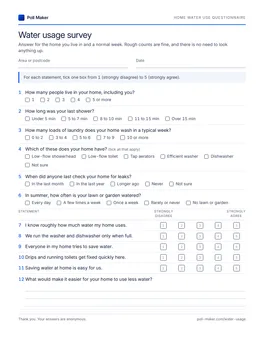
Home water use questionnaire
Page one holds the home water core as tick boxes. The indoor habits, garden, bills, shortage and home sets follow on later pages.
Download PDF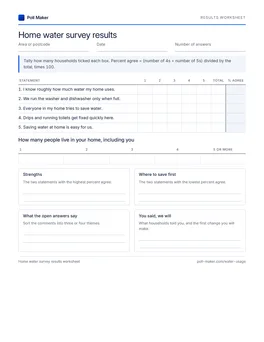
Results worksheet
Count the paper responses for each of the five statements, work out the percent agreeing, and circle where to save first.
Download PDFA water use survey for a class or thesis project
Students searching for a water usage survey usually need a plan as well as questions. This one runs over two weeks.

Survey, then diary
Week one: each student answers the core 12 for their own home and asks one adult at home to answer too. Week two: keep a two-day diary of every shower, flush and load, then compare it with the survey answers. The gap between what people guess and what they log is the finding most teachers remember.
Research questions that fit this set
Do larger households use less water per person? Do homes with low-flow fixtures report shorter showers or longer ones? Do renters and owners fix leaks at different speeds? Each one uses questions already in the core and the about-your-home set.
Working on water scarcity?
If the assignment asks you to pick an environmental problem and design a survey, add the shortage set to the core. Tell people why you are asking at the top of the form, and get a teacher to sign off the final list before it goes out. Studying waste as well? The household waste survey uses the same kind of countable questions for bins and bags.
Ask for loads and minutes, not gallons
The first one comes up in survey design courses as a question to fix. Our question writing guide applies these repairs to every question type.
Do you waste water in your household every day?
How long was your last shower?
When did anyone last check your home for leaks?
Loaded and vague. Nobody admits to waste, and "waste" means something different to everyone. Ask about behaviour you can count.
How many gallons of water does your household use per day?
How many loads of laundry does your home wash in a typical week?
People guess gallons badly. Loads, minutes and people can be counted and turned into gallons afterwards.
Do you save water and electricity at home?
We run the washer and dishwasher only when full.
Two topics in one question, with an answer everyone gives. A specific statement tells you who actually does it.
How satisfied are you with your water?
In the past year, how often has your home had low pressure or no water?
Satisfied with the taste, the price or the supply? Ask about one thing a household has experienced.
Common questions about surveying household water use
For utility staff, councils, green groups and students.
What questions should a water usage survey ask?
Ask how many people live in the home, how long showers take, how many laundry loads go on each week, how often the garden is watered, which water-saving fixtures the home has and when it was last checked for leaks. Finish with statements about shared habits and an open question asking what would help.
How much water does one person use a day at home?
The EPA puts it at an average of 82 gallons a day per American at home.6 The average American family uses more than 300 gallons a day, about 70% of it indoors.5 Your own survey results will vary with climate, gardens and fixtures.
How do you measure household water use without a survey?
Read the water meter at the same time on two days in a row and subtract. For leaks, read it before and after two hours with no water running. The survey then explains the number: who uses the water and on what.
Can students use this water usage survey for a project?
Yes. Take the core 12 plus the about-your-home set, add the shortage set for a water scarcity topic, and pair it with a two-day diary. Every item is written by us, so name this page as the source of your questionnaire.
How many questions should a water conservation survey have?
Twelve is enough for most homes, and they take about four minutes. Add one set for the job at hand, such as bills for a utility or garden watering for a summer campaign. All 34 take around ten minutes.
Find out where your community's water goes
Load the home water core into the builder, pick the extra set your project needs, and send the link to households this week. Print copies for doorsteps and classrooms.