Questions for a resident satisfaction survey in apartments, public housing and HOAs
A resident satisfaction survey asks the people who live in your community how repairs, notices, staff, safety and rent are working, and whether they mean to renew. Run the core 12 as your yearly survey and add a short set after a repair, a move-in or before renewal.
- 35questions
- 12in the core set
- 4 minto answer the core
- Onlineor on paper
By Michael Hodge, BSc Psychology Updated September 2026
Repairs, notices, safety and rent: the resident question bank
Every row shows the wording residents read, their answer choices, and the decision each answer informs. Tick what fits, then build it online, print it for doors and lobbies, or copy it as plain text.
The core 1212 questions
Nine statements on repairs, response, notices, shared areas, safety, respect and value, then the renewal question, an improvement vote and a free-text question. On their own, these twelve cover a full annual resident survey.
-
Repairs in my home are done right the first time.
Strongly disagree12345Strongly agree1 = Strongly disagree, 5 = Strongly agreeFirst-time fix as residents see it. Every second visit costs them another day waiting at home.
-
When I report a problem, I am told when it gets fixed.
Strongly disagree12345Strongly agree1 = Strongly disagree, 5 = Strongly agreeSeparates slow repairs from repairs nobody explained. Silence after a request reads as no response at all.
-
Emergencies like no heat or a leak are fixed quickly.
Strongly disagree12345Strongly agree1 = Strongly disagree, 5 = Strongly agreeThe repairs with the most at stake for a household. Split this one by building before you change an on-call rota.
-
I can reach the office staff when I need them.
Strongly disagree12345Strongly agree1 = Strongly disagree, 5 = Strongly agreeOffice hours, phone and messages in one statement. Where it scores low, look for the channel residents name in the open answers.
-
I get notice of planned work and shut-offs in time.
Strongly disagree12345Strongly agree1 = Strongly disagree, 5 = Strongly agreeCommunication measured by its use: a notice that arrives after the water goes off counts as no notice.
-
Hallways, laundry and other shared areas are clean.
Strongly disagree12345Strongly agree1 = Strongly disagree, 5 = Strongly agreeThe part of the property every resident walks through daily. A low score points to a cleaning schedule, not a capital project.
-
I feel safe walking around the property after dark.
Strongly disagree12345Strongly agree1 = Strongly disagree, 5 = Strongly agreeLighting, locks, gates and parking in one statement. Follow a low score with a night walk of the grounds.
-
Staff treat me with courtesy and respect.
Strongly disagree12345Strongly agree1 = Strongly disagree, 5 = Strongly agreeHow service is given, from the office desk to the technician at the door. Read it next to the repair statements to see whether the problem is speed or manner.
-
The rent I pay is fair for what I get here.
Strongly disagree12345Strongly agree1 = Strongly disagree, 5 = Strongly agreeValue for money, not the rent figure you already know. High service scores with a low score here point to price, not maintenance.
-
If your lease ended next month, what would you most likely do?
RenewProbably renewNot sureProbably moveMove outRenewal intent from the people who hold the lease. Cross it with the repair statements to see which gaps are costing renewals.
-
Which improvement would you most like to see this year?
Faster repairsCleaningSecurityParkingPackage lockersOne choice forces a priority, so the budget follows what most residents want rather than the loudest request.
-
What is one change that would make you want to stay here longer?
Open answerTurns the renewal question into a fix list. Group the answers into themes; the biggest theme is next year's first project.
After a repair4 questions
Ask these no more than two days after a work order closes, while the visit is fresh. Split the answers by trade, technician or building to find where repeat problems start.
-
Was the problem fixed on the first visit?
YesNo, it took more than one visitNo, it is still not fixedThe factual version of the first-time-fix statement. Every "still not fixed" answer needs a call back, not a report.
-
How long did it take from your request to the finished repair?
Same day1 to 2 days3 to 7 daysLongerStill waitingIn AppFolio's 2026 renter survey, 79% of residents satisfied with maintenance had issues resolved within a few days, while 53% of dissatisfied residents waited weeks or more.1
-
The quality of the repair work was good.
Strongly disagree12345Strongly agree1 = Strongly disagree, 5 = Strongly agreeSpeed and quality are separate. A fast repair done badly shows up here, not in the time question.
-
Were you told before anyone came into your home?
Yes, with a time slotYes, no time givenNoI let them inEntry notice is about privacy as much as service. Read every "No" answer in full and check it against the work order.
The first 30 days4 questions
For new residents about a month after move-in, when first impressions are still sharp and small faults are still cheap to fix.
-
My home was clean and ready on move-in day.
Strongly disagree12345Strongly agree1 = Strongly disagree, 5 = Strongly agreeTests the unit turn. A low score here is a checklist problem for the make-ready team, found before it becomes a review.
-
Rent, fees and deposits were explained before I signed.
Strongly disagree12345Strongly agree1 = Strongly disagree, 5 = Strongly agreeA fee surprise in month one colors every later answer about value.
-
How many things in your home needed fixing in the first week?
None1 or 23 to 5More than 5A count is easier to act on than a rating. Several faults in week one point back to the unit inspection before move-in.
-
What surprised you most in your first month here, good or bad?
Open answerNew residents still compare you with the place they left. Their surprises show what the tour and the listing promised.
Before the lease ends3 questions
Send about three months before a lease ends, before the renewal offer goes out, so there is still time to act on what residents say. The last question is for residents who have already given notice.
-
What will matter most in your decision to renew?
Rent increaseRepairsSpaceLocationLife changeSeparates reasons you can influence from ones you cannot. Only the first three belong on an action plan.
-
I know my renewal options and when I need to decide.
Strongly disagree12345Strongly agree1 = Strongly disagree, 5 = Strongly agreeIf residents do not know their options or the deadline, the renewal offer is not reaching them. A low score calls for a clearer notice, not a price cut.
-
If you have given notice, what is the main reason you are leaving?
RentBuying a homeSpaceWork or familyThe propertyKeeps preventable move-outs apart from life events, so the turnover you could have stopped is visible.
Public and affordable housing5 questions
For housing authorities and affordable housing owners. The checklist asks about problems residents saw this month, which they can report reliably; the rest cover recertification, accommodations, play space and the neighborhood.
-
In the past 30 days, which of these have you had in your home?
A room without enough heatA water leakMold or mildewMice, rats or roachesA lock that does not workNone of theseTick all that applyA factual checklist, not an opinion. In HUD's pilot, residents' reports of home conditions agreed with trained inspectors on most items.2
-
Staff explain the yearly income recertification clearly.
Strongly disagree12345Strongly agree1 = Strongly disagree, 5 = Strongly agreeThe paperwork every household faces each year. Confusion here shows up later as late files and missed deadlines.
-
I know how to ask for a reasonable accommodation.
Strongly disagree12345Strongly agree1 = Strongly disagree, 5 = Strongly agreeResidents with a disability can ask for changes to rules or to their home. A low score means the process is not reaching them.
-
Children here have a safe place to play outside.
Strongly disagree12345Strongly agree1 = Strongly disagree, 5 = Strongly agreeIn HUD's voucher survey, families with children replied least often, so chase their answers before you read this one.3
-
How much of a problem is crime or drug activity near your building?
No problemA small problemA big problemNot sureReport "Not sure" on its own. In HUD's voucher survey, 19.9% of households chose "don't know" on a similar question.3
Condo and HOA owners4 questions
Owners answer these about the association and the company that manages it. Use them in place of the rent statement when residents own their homes.
-
I understand how my dues and assessments are spent.
Strongly disagree12345Strongly agree1 = Strongly disagree, 5 = Strongly agreeOwners pay dues whatever they think of them, so this is the value question for an association.
-
The board applies the rules the same way to every home.
Strongly disagree12345Strongly agree1 = Strongly disagree, 5 = Strongly agreeFair enforcement, asked without naming any neighbor. A split answer here is worth a board discussion.
-
Exterior change requests get a timely decision.
Strongly disagree12345Strongly agree1 = Strongly disagree, 5 = Strongly agreeArchitectural review is where owners deal with the board one to one, and delays feel personal.
-
I have a real say in decisions about our community.
Strongly disagree12345Strongly agree1 = Strongly disagree, 5 = Strongly agreeMeetings, votes and how the board listens, in one statement. If it scores low, check whether meeting times and voting methods suit owners.
About you (optional)3 questions
Only to compare groups, such as buildings or new and long-standing residents. Report no group so small that one household could be picked out.
-
How long have you lived here?
Under 6 months6 to 12 months1 to 3 yearsOver 3 yearsNew residents rate the move-in; long-standing ones rate the years since. Compare them before you read a trend.
-
Who lives in your home?
Just meAdults onlyAdults and childrenPrefer not to sayFamilies with children answered HUD's voucher survey least often: 45% against 68.2% of elderly households. Check they are not missing from your results.3
-
How would you like to get building news?
EmailTextApp or portalPrinted noticeMeetingSend next year's survey, and the notice of what changed, through the channel most residents pick.
Which survey to send, and when
One long annual survey misses the moments residents remember. Pair the core 12 with short sets timed to what just happened in their home.

| Moment | When to send | What to send |
|---|---|---|
| A new resident settles in | About 30 days after move-in | The first 30 days set |
| A work order is closed | Within two days | After a repair set |
| Every household, once a year | The same month each year | The core 12, plus the public housing or HOA set where it fits |
| A lease is coming up for renewal | About three months before it ends | Before the lease ends set |
| A resident gives notice | When notice arrives | The reason for leaving question |
Keep the annual survey in the same month every year, so heating season or pool season does not look like a change in service. A household that answered a repair survey last week can skip this month's pulse: one survey a month per home is plenty.
Getting replies from most of your residents
The core leads with repairs and notices for a reason, and HUD's own resident surveys show how to get most households to answer.
Renters planning to renew their lease
Why repairs and notices come first
In AppFolio's 2026 survey of 3,002 US renters, 56% of residents satisfied with maintenance planned to renew, against 31% of those who were not. For communication the split was 55% against 38%.1 That is why five of the nine core statements cover repairs, response and notices, and why the renewal question comes straight after them.

Address every household, then follow up twice
HUD tested this in a 1998 mail survey of about 4,000 public and FHA-assisted households. The net return reached 61.2%. Questionnaires addressed to the resident by name came back more often than ones addressed to "Current Resident" (68.0% against 59.7% by mail), many residents replied only after one or two follow-ups, and replies kept arriving for eight weeks or more.2 For an online survey, copy the pattern: a personal invitation, a reminder a week later, then a paper copy for every home still missing.
Chase the households that answer least
Replies are rarely even. In HUD's national survey of voucher households, 68.2% of elderly households replied but only 45% of families with children.3 Offer paper and a link, in the languages your residents read, and hold the About you counts up against your rent roll before you read results. When buildings reply at different rates, weight each one by its occupied homes divided by its responses, as HUD did for each housing agency, so the building that answers most does not speak for everyone.3
Show residents what changed, then ask again
The HUD report cites a study at a housing development where residents' ratings set the priorities for site changes and a second survey checked the result. Overall satisfaction rose, the features that were changed scored higher, and the features left alone did not.2 After every survey, post a short notice with three things residents said and what you are doing about each one.
Holding a resident meeting? Run the improvement question as a live poll that residents vote in from their seats, and the budget talk starts from their ranking. First poll? Five steps to a poll gets you from one question to a link residents can open.
A five-question pulse between annual surveys
Mid-year, send just these: two on repairs, one on notices, the renewal question and one open question. Residents finish in about a minute, and the trend shows whether last year's fixes held.
- 01Repairs in my home are done right the first time.
- 02When I report a problem, I am told when it gets fixed.
- 03I get notice of planned work and shut-offs in time.
- 04If your lease ended next month, what would you most likely do?
- 05What is one change that would make you want to stay here longer?
A results report for staff and residents
Key in each statement's tallies from the paper forms or your online results. The chart flags where the property is strong and where to act first; print it for a staff meeting or pin it up by the mailboxes.
- 1Tally every statement from the returned forms, point by point. Percent agree appears on its own: residents at 4 or 5, over all who replied to that line.
- 2Compare statements with each other, and this year with last year. The two weakest statements become this year's service goals.
- 3Split the results by building when you manage more than one. A property average can hide one building that drags it down.
- 4Within a month, post the results and the changes they led to. Residents who see their answers used reply again next year.
Resident results
Reading renewal answers against repairs
The renewal question says how many residents might leave. Crossing it with one repair statement shows why, and which fix to make first.
A worked example
A 200-home community gets 120 surveys back. The manager splits the renewal answers by how each resident rated "Repairs in my home are done right the first time."
| Repair answer | Total | Renew | Unsure | Move |
|---|---|---|---|---|
| Agree | 70 | 49 | 14 | 7 |
| Neutral | 20 | 9 | 6 | 5 |
| Disagree | 30 | 8 | 7 | 15 |
Agree means a 4 or 5 and disagree a 1 or 2. Renew counts "Renew" and "Probably renew"; Move counts "Probably move" and "Move out". Seven in ten residents who agree plan to stay. Among those who disagree, about one in four do, and half expect to leave. The figures are invented to show the method; your own counts go in the same table.
What to do with the split
- If the disagree row is large and leans toward moving, repairs are the renewal problem. Pull the repeat work orders for those buildings before renewal offers go out.
- Run the same split for notices and for respect. Whichever statement shows the biggest difference between its agree and disagree rows is the first fix.
- Report rows, never single homes, and keep survey answers out of renewal pricing, so residents keep answering honestly.
Common resident questions, reworded
All four weak versions are common on resident surveys. For other audiences, browse more satisfaction survey questions.
How satisfied are you with maintenance?
Repairs in my home are done right the first time.
When I report a problem, I am told when it gets fixed.
Maintenance is several services at once. Two specific statements show whether the fix or the follow-up is failing.
How happy are you with our staff and amenities?
Staff treat me with courtesy and respect.
Hallways, laundry and other shared areas are clean.
Staff and amenities are two topics. A resident who likes the staff and dislikes the laundry room has no honest answer.
Do you agree the new gate has made the community safer?
I feel safe walking around the property after dark.
Naming the gate and hinting at the answer collects polite agreement. The neutral statement measures safety and compares with last year.
Is your rent too high?
The rent I pay is fair for what I get here.
A price question invites a yes and tells you nothing new. Asking about value shows whether the service justifies the rent.
A paper copy for every door
Paper still reaches residents who never open an email. Slide a copy under each door with a return envelope or a lobby drop box, and add your own survey link to the cover note if you also run it online.
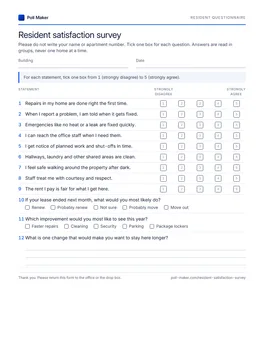
Resident questionnaire
A Building box heads the first sheet, above the core statements, and each optional set prints on the sheets behind it.
Download PDF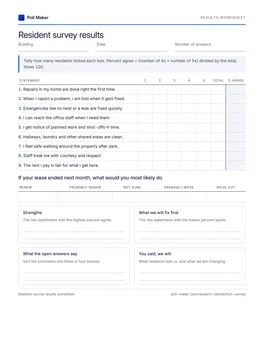
Results worksheet
Tally paper forms by building, turn each statement into a percent agree figure, and count renewal intentions on a single sheet.
Download PDFHow often, how many replies, and whether to go anonymous
Short answers before the first survey goes out.
How often should you survey residents?
Send the core 12 every year in the same month, and add short surveys at the moments that matter: about 30 days after move-in, within two days of a repair, and about three months before a lease ends. Keep any one household to one survey a month.
What is a good response rate for a resident survey?
Aim high. HUD's 1998 mail pilot heard back from 61.2% of public and FHA-assisted households,2 and its national survey of voucher households averaged 51.7% over three years.3 Plan the reminders from day one: in the pilot, many replies came only after a follow-up.
Should a resident satisfaction survey be anonymous?
Make it confidential. Ask for the building but not the apartment number, report only groups large enough that no household stands out, and keep a separate way to request a repair, so the survey is never a resident's only channel.
How can I improve resident satisfaction?
Start where your results point. Residents satisfied with maintenance and communication are far more likely to plan to renew,1 so the repair and notice statements are the usual first targets. Fix the weakest one, tell residents what changed, and ask again next year.
Can I use these questions for senior living or a city survey?
The core fits most rented housing. For a community that provides care, the assisted living survey asks residents about help, meals and activities. For a city or county asking residents about public services, use the citizen satisfaction survey.
Your resident survey, ready to send
Email the core 12 to every household today, or print a questionnaire for every door in the building.