Water pollution questionnaire for residents
A good water pollution questionnaire asks residents what they can see, smell and taste, in the glass at home and in the river down the road. Tap and river both fit into the core 12, a four-minute survey, with extra sets on rivers, wells and pipes, household habits or your water supplier.
- 39questions
- 12in the core
- 4 minfor the core
- Residentsin town or country
By Michael Hodge, BSc Psychology Updated September 2026
From the tap to the river: 39 questions
Questions in the core start out ticked. Add the rivers set for a pollution study, the views set for a class project, wells and old pipes for rural or older homes, drains and gardens for a clean water campaign, or drinking water at home for a supplier. Answer options appear below every item, together with a note on reading the results.
The core 12: tap water and the water nearby12 questions
Where the water comes from and what people drink, what they have noticed, seven statements for the results chart, a single overall rating and an open question to finish. It stands on its own as a complete survey.
-
Where does the water from your taps come from?
A public supplyA private wellA shared wellA rainwater tankNot sureDecides who tests the water. A public supplier tests and reports on it; private wells serving fewer than 25 people fall outside the federal drinking water law, so the owner arranges the tests.1
-
What do you mostly drink at home?
Tap water as it comesFiltered tap waterBoiled tap waterBottled waterSomething elsePeople who mainly drink bottled water tend to rate their tap water lower, and the two habits feed each other. Split every rating below by this answer.1
-
In the past 12 months, which of these have you noticed in your tap water?
Bad or rotten egg smellOdd or salty tasteCloudy, frothy or coloredStains on sinks or laundryNone of theseTick all that applyEach sign points to a different test, from hydrogen sulfide to iron and manganese. The table under the question list turns these ticks into a testing plan.5
-
My tap water tastes fine to me.
Strongly disagree12345Strongly agree1 = Strongly disagree, 5 = Strongly agreeHow people judge their water rests mostly on its sensory qualities, flavor above all, so this statement tends to pull the overall rating with it.2
-
Water from my taps is clear in a glass.
Strongly disagree12345Strongly agree1 = Strongly disagree, 5 = Strongly agreeColor and cloudiness are the first things people see. Low scores bunched in one area usually lead back to pipes or mains work there.
-
I feel safe drinking water straight from my tap.
Strongly disagree12345Strongly agree1 = Strongly disagree, 5 = Strongly agreeThe safety question. Read it next to taste and clarity: safety worries with no taste or look complaints often trace back to news, past problems or what friends said.2
-
My supplier tells me clearly when something goes wrong.
Strongly disagree12345Strongly agree1 = Strongly disagree, 5 = Strongly agreePeople who remember hearing from their supplier, other than on a bill, rate their water as safer. A low score is a communication job before it is an engineering one.1
-
I know how to find out what is in my water.
Strongly disagree12345Strongly agree1 = Strongly disagree, 5 = Strongly agreeTests whether the yearly water quality report, or a well test, reaches people. Low scores mean results exist that residents never see.
-
Local rivers and beaches are clean enough to swim in.
Strongly disagree12345Strongly agree1 = Strongly disagree, 5 = Strongly agreeBrings the water around people into the survey. A low score can sit next to high tap scores, and the two need different messages.
-
I know what I can do at home to keep local water clean.
Strongly disagree12345Strongly agree1 = Strongly disagree, 5 = Strongly agreePrevention starts with knowing what not to pour, flush or spray. Low scores make the case for the drains and gardens set.
-
Overall, how would you rate your tap water?
ExcellentGoodFairPoorVery poorOne headline number to track from year to year. Report the share saying excellent or good, and read it by water source and by area.
-
What would make you more confident about the water where you live?
Open answerPeople name the fix: a test, a clearer notice, a cleaned-up creek. Sort the answers into three or four piles and quote a few.
Rivers, lakes and the coast6 questions
The water pollution questionnaire itself: what residents have seen in local water, what they think causes it, and whether warnings reach them.
-
In the past 12 months, how often have you swum, fished or paddled in local water?
Every weekEvery monthA few timesNeverSeparates people who use the water from people who walk past it, so you know whose sightings come from close up.
-
In the past 12 months, which of these have you seen in a river, lake or beach near you?
Litter or plasticOily filmFoam or scumGreen waterDead fishNone of theseTick all that applyHarmful algal blooms can look like foam, scum, mats or paint on the water. Named sightings in a set time frame give you evidence to map.8
-
What do you think pollutes the water near you most?
SewageFarm runoffFactoriesStreet runoff and litterNot sureA belief, not a finding, but it tells you which cause people will accept a message about. It works well as a live poll at a meeting.
-
In the past 12 months, have you stayed out of the water because of a warning sign?
YesNoI never go inShows whether warnings are seen and followed at the places people swim.
-
I know who to contact if I see pollution in the water.
Strongly disagree12345Strongly agree1 = Strongly disagree, 5 = Strongly agreeA low score means sightings go unreported. A phone number on signs at access points is a cheap fix.
-
Which stretch of water near you worries you most, and what have you seen there?
Open answerGives places, not opinions. Map the answers and walk the two spots named most before you plan anything.
Views on water pollution (class projects)3 questions
Opinion questions that suit a school or college project on water pollution. Keep them after the sightings, so views do not colour what people report.
-
How serious is water pollution where you live?
Very seriousSomewhat seriousNot very seriousNot a problemNot surePut it beside the sightings question to see whether concern comes from what people saw or from what they heard.
-
Who should do the most to keep local water clean?
HouseholdsBusinesses and farmsLocal councilNational governmentEveryone equallyTells you who people expect to act, which decides whether a campaign asks for help or reports progress.
-
Would you join a clean-up of a local river or beach?
YesMaybeNoI already doA volunteer list in one question. Add a contact line only if someone will follow up within a month.
Wells, tanks and old pipes5 questions
A risk check for homes on a well or tank, and for older homes on any supply. It answers the question of which homes to test first.
-
When was your well or tank water last tested by a lab?
This past year1 to 3 years agoLonger agoNeverNot sureEPA advises testing a private well every year for coliform bacteria, nitrates, dissolved solids and pH. Anything older than a year is due.5
-
Which of these are close to your well or tank?
Septic tankFarm or cropsFuel tankSalted roadNoneTick all that applyEPA says to test when conditions near a well change, and links a heavily salted road to a chloride and sodium test. Any tick is a reason to check the last test date.5
-
In the past 12 months, has flood water reached your well or tank?
YesNoNot sureFlooding near a well is one of the times CDC says to test, whatever the date of the last test.9
-
When was your home built?
Before 19861986 or laterNot sureLead pipes are more likely in homes built before 1986. Lead has no taste, smell or color, so this answer, not the taste questions, flags the homes to test.7
-
What is the pipe from the street to your home made of?
LeadCopperPlasticGalvanized steelNot sureWhere a lead service line exists, it is usually the biggest source of lead in the water. A crowd of "Not sure" answers is the audience for a pipe check.7
Drains, gardens and habits5 questions
For clean water campaigns and stormwater programs: what households pour, flush and spray, and whether they would change it.
-
What do you usually do with leftover cooking fat or oil?
Sink drainTrashDrop-off pointCompostNot sureFat poured down a sink sets hard in sewer pipes. The share who pour it away is the audience for a fat and oil campaign.
-
What do you do with medicines you no longer need?
Take-back drop-offTrashFlush themKeep themNot sureFlushed medicines can pass through treatment into rivers. Few drop-off answers point to a take-back reminder.
-
How often do you use fertilizer or weed killer outdoors?
Monthly or moreA few times a yearOnce a yearNeverNo gardenGarden chemicals wash off in the rain. Frequent users are the people to reach before the wet season.
-
Where is your car usually washed?
At a car washOn the driveway or streetOn the lawnNo carStreet drains in many towns carry water to a creek without treatment. Driveway washers are the audience for a car wash message.
-
I would change a habit if it kept local water cleaner.
Strongly disagree12345Strongly agree1 = Strongly disagree, 5 = Strongly agreeWillingness to act. High scores here with low scores on knowing what to do mean people are waiting to be told how.
Drinking water at home6 questions
For water suppliers and councils: how much tap water people drink, whether notices and reports reach them, and how they want to hear about problems.
-
How often do you drink tap water at home, filtered or not?
Several times a dayAbout once a dayA few times a weekRarelyNeverFrequency, not preference. People who drink more tap water tend to trust their supplier more and pay less attention to changes in it.1
-
In the past 12 months, have you been told to boil your tap water?
YesNoNot sureShows how far a boil-water notice traveled. "Not sure" in an area that had one means the alert missed people.
-
Have you seen your supplier's yearly water quality report?
Yes, and read itYes, not readNoNot sureIn the US every community water system must send this report by July 1 each year. This answer says whether anyone opens it.6
-
Other than a bill, has your water supplier contacted you in the past 12 months?
YesNoCan't rememberResidents who recalled recent contact from their utility were three times as likely to say their water had become safer over five years.3
-
How would you most like to hear about a problem with your water?
Text messageEmailPhone callSocial mediaDoor noticePick the channel before the next problem, not during it. Split by age before you choose.
-
Who would you trust most to tell you your water is safe?
My water supplierHealth departmentScientistsLocal newsNeighborsNationally, 70% trust their water utility for information about their water and 68% trust scientists. Your result shows who should front the message.3
About you (optional)2 questions
Two questions for splitting results. Publish figures for a group only when it holds enough households that none stands out.
-
Do you own or rent your home?
OwnRentOtherRenters are more likely to see their tap water as unsafe, and they rarely control the pipes. Report the two groups separately.1
-
Which neighborhood or postal area do you live in?
Open answerAsk for an area, never an address. Pipe and river problems cluster by place, so this answer is what makes the map.
What residents notice, and what to test for
Question 3 in the core follows EPA's list of signs that call for a private well test.5 Use it to turn a tick into a test.
| Residents report | EPA suggests testing for |
|---|---|
| A rotten egg or other bad smell, or an odd taste | Hydrogen sulfide, corrosion, metals |
| Stains on sinks, fixtures or laundry | Iron, copper, manganese |
| A salty taste, or a heavily salted road nearby | Chloride, total dissolved solids, sodium |
| Cloudy, frothy or colored water | Color, detergents |
All four signs are answer options in core question 3; the salted road also appears in the wells set, for homes that draw their own water.
When nothing seems wrong
On a public supply, the supplier tests the water and sends a yearly Consumer Confidence Report, due by July 1 in the US; call the supplier or use EPA's search tool to find it.6 On a private well, the owner is the tester. EPA advises a test every year for total coliform bacteria, nitrates, total dissolved solids and pH, and more often when small children, older adults or someone pregnant or nursing lives there.5
Lead needs its own test on any supply, because it has no taste, smell or color. Ask the water utility about testing, especially in homes built before 1986.7
A water survey that ends in action
These four habits turn a stack of complaints into a plan: which tests to order, which stretch of river to walk, and what to tell people afterwards.
Ask what people notice, then test the water
People judge tap water mostly by its flavor, then by smell and look.2 A 2022 review for HUD found that the measured quality of the water has little bearing on how people rate it; one Canadian study compared 100 households' opinions with 2,091 water samples and found no link at all.1 So read the answers as a map of where to test. A tick for a rotten egg smell or stained laundry tells you which test to order. Lead is the exception: nobody can see, taste or smell it, which is why the wells and pipes set asks when the home was built.7
US adults who worry a great deal, by problem
Open with the tap, then go outdoors
Pollution of drinking water tops Gallup's 2026 list of environmental worries: 56% of US adults worry about it a great deal, and 50% say the same about rivers, lakes and reservoirs.4 The questionnaire follows that order. It opens with the water people drink every day, which everyone can answer, and reaches the river once people are used to the scale.
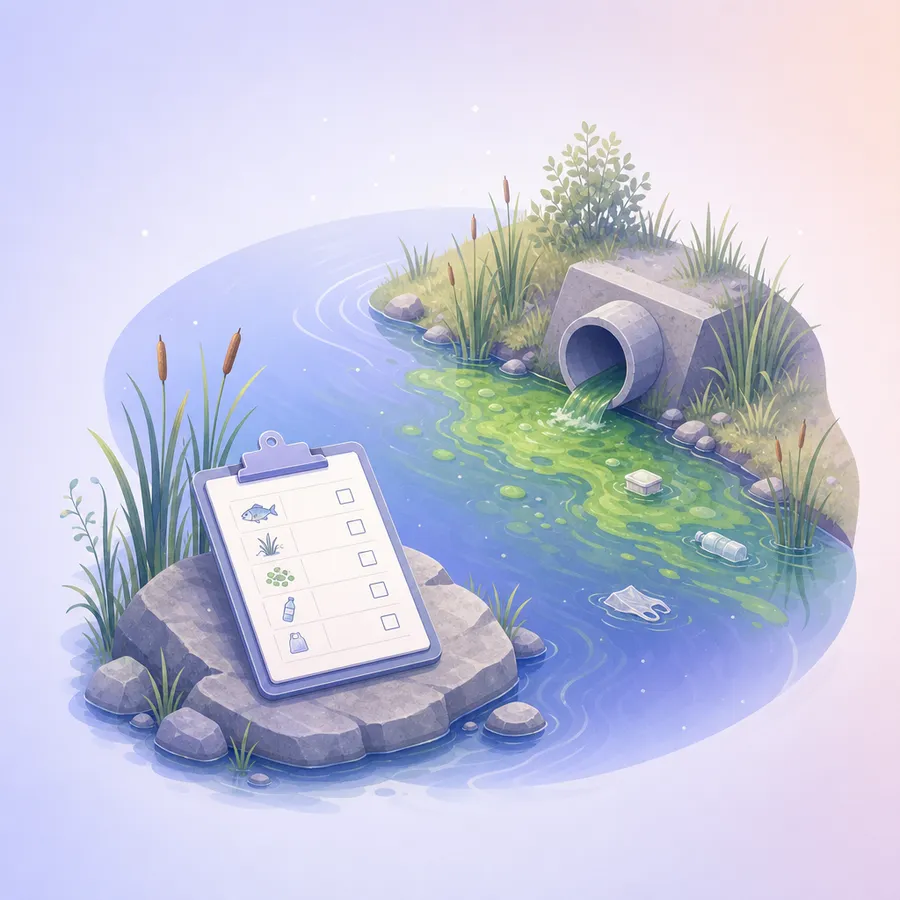
Ask for sightings with a time frame
"Is the river polluted?" gets an opinion. "Over the last year, which of these did you spot?" gets evidence you can map. Describe what to look for in plain words: CDC says harmful algal blooms can look like foam, scum, mats or paint on the surface, and can turn water green, blue, brown or red.8 Ask which stretch of water people mean, then go and look at the spots named most.
Tell residents what you found
In AWWA's 2024 national poll of 2,010 adults, people who remembered recent communication from their water utility were three times as likely to say their water had become safer over five years, and 70% trusted their utility for information about their water.3 Post the results where the survey ran, name one thing that will change, and give the date you will ask again.
Opening a residents' meeting or a geography lesson? Ask the room what pollutes the local water most with a free live poll: phones out, votes on the screen, then hold the result up against the sightings. Making a poll from scratch takes a few clicks.
Door to door, at a clean-up or in class
Paper suits door-to-door surveys, a table at a river clean-up and classrooms without devices. Print either one on the paper you have, letter or A4.
Going door to door?
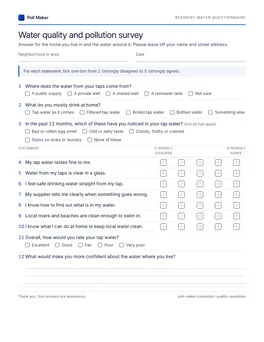
Resident water questionnaire
Tick-box versions of all 39: the core first, then rivers, views, wells and pipes, habits and drinking water.
Download PDF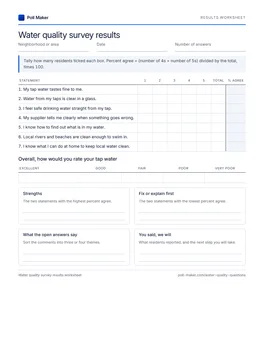
Water survey tally sheet
Tally the seven statements with a pen, turn each into a percent agreeing, add up the overall ratings and circle what to fix or explain first.
Download PDFA class project on local water pollution
Geography and science projects often pair a questionnaire with a visit to the water. This plan fits two or three weeks.
Pick two groups to compare
Survey homes close to a river and homes further away, or upstream and downstream of a town. Aim for similar numbers in each group, at least 20 each if you can, so the comparison means something.
Open with a consent line
Say who you are and why you are asking, promise that no names are recorded, and tell people they may leave any question blank. Show the final version to your teacher before it goes out.
Add what you saw at the water
Visit the same stretch on two different days and note the color, smell, litter, foam and any drain pipes. Then set your notes beside what residents reported. Any gap between your notes and their answers is worth a paragraph in the write-up.
Comparisons worth making
Do people living near the river report more sightings? Do bottled water drinkers rate their tap water lower? Do renters feel less safe drinking from the tap? Each one draws on the core plus the rivers and about-you sets. Looking at litter too? The waste and recycling survey asks the same homes about bins and bags.
Charting how residents rate their water
Enter the counts for the seven agree statements from the core. Agreement on any of them is good news for local water, and the two lowest bars are where the work starts.
- 1For each statement, type how many residents picked each number. The chart shows the share who agree and flags the two lowest.
- 2Read taste, clarity and safety as a group. Low safety beside high taste and clarity points to worry from news or past problems, which calls for information rather than repairs.
- 3Split every statement by the own-or-rent answer and by what people drink before you decide anything.
- 4Set the swimming statement next to the open answers about local water, and look for the stretch named more than once.
Resident water check
Room on a water bill? Use these five
Room for five on a water bill, a flyer or a library poster? Ask where the water comes from, what people noticed, whether they feel safe, the overall rating, and what would help.
- 01Where does the water from your taps come from?
- 02In the past 12 months, which of these have you noticed in your tap water?
- 03I feel safe drinking water straight from my tap.
- 04Overall, how would you rate your tap water?
- 05What would make you more confident about the water where you live?
Weak water pollution questions, rewritten
Four mistakes turn up again and again in water surveys, and each one shows up in class questionnaires too. The survey question guide shows the same repairs for other question types.
Is your water polluted?
In the past 12 months, which of these have you noticed in your tap water?
Residents cannot judge pollution, but they can report a smell, a stain or cloudy water. Named signs also tell you which test to order.
What is the pH of your tap water?
When was your well or tank water last tested by a lab?
Lab readings such as pH, hardness and chlorine are numbers few households have ever seen. Ask about testing, then get the readings from the lab or the supplier report.
Don't you agree that factories are poisoning our rivers?
What do you think pollutes the water near you most?
This one hands people the answer and uses a loaded word. A neutral list with "Not sure" lets people disagree.
Is your tap water safe and good to drink?
I feel safe drinking water straight from my tap.
My tap water tastes fine to me.
Taste and safety are packed into one question. A resident who dislikes the taste but trusts the safety has no honest answer.
Questions about water quality surveys
For students, community groups, councils and water suppliers.
What questions should a water pollution questionnaire ask?
Start with where the water comes from and what people drink. Then ask what they noticed over the last year in their tap water and in local rivers or beaches, how they rate taste, safety and information, and close by asking what would raise their confidence in the water.
How can I check the water quality at home?
Notice changes in taste, smell and color first, since any change is a reason to test. On a public supply, read the yearly water quality report or ask the supplier.6 On a private well, order a lab test every year for bacteria, nitrates, dissolved solids and pH.5 Lead needs a test even when the water seems fine.7
What are some yes or no questions about water pollution?
Several here work as yes or no: whether a boil-water notice reached people, whether they stayed out of the water because of a warning sign, and whether they would join a river or beach clean-up. A list of specific sightings tells you more than a plain yes or no, so keep one of those too.
Can students use this questionnaire for a school project?
Yes. Take the core 12, the rivers set and the views set, add a short consent note above the first question, and have your teacher approve the final list. We wrote every item for this page, so cite it when you describe your method.
How long does a water quality survey take to answer?
Around four minutes for the twelve core questions. Most surveys need one extra set: drinking water for a supplier, wells and pipes for rural homes, or rivers for a pollution study. All 39 questions take around twelve minutes.
See your local water through residents' eyes
Put the tap water core in the builder, attach whichever set your project calls for, then send residents the link or leave paper copies at stalls, doorsteps and lessons.