Waste management survey questions and answers for homes and schools
A good waste management survey asks what people actually do with their rubbish: what they sort, how many bags go out, where food scraps and batteries end up, and what makes recycling hard. The core 12 covers it in about four minutes, with answer options for every question.
- 31questions
- 12in the core
- 4 minto answer the core
- Homesand schools
By Michael Hodge, BSc Psychology Updated September 2026
A quick waste check in five questions
Running a doorstep survey, a stall at a community event or a class interview project? These five fit on a clipboard and still show what people sort, what they know and what stops them.
- 01Which of these do you keep out of the general trash bin at home?
- 02I know which items go in the recycling bin where I live.
- 03Sorting my waste at home is easy.
- 04What makes it harder to sort or recycle more at home?
- 05What one change would help your household throw away less or recycle more?
The 31 waste management questions, with answer options
The household core is ticked already. Add the collection module for a council survey, the school module for a class project, or single questions from anywhere. Every question lists its answers and what they reveal, ready to send, print or paste.
The household core12 questions
Twelve questions any household can answer: what gets sorted, how much goes out, the awkward items, and how well collection works. Five are agree statements the results report can chart.
-
Which of these do you keep out of the general trash bin at home?
Paper and cardPlasticGlassCansFood scrapsGarden wasteNone of theseTick all that applyShows which materials already get sorted and which never do, so a campaign can start with the gaps.
-
How many bags of general trash does your household put out in a typical week?
Less than oneOneTwoThreeFour or moreNobody weighs their rubbish, but everyone can count bags. Ask again after a change and compare.
-
I know which items go in the recycling bin where I live.
Strongly disagree12345Strongly agree1 = Strongly disagree, 5 = Strongly agreeInformation is one of the strongest predictors of household recycling. A low score means better labels, not more reminders.1
-
Sorting my waste at home is easy.
Strongly disagree12345Strongly agree1 = Strongly disagree, 5 = Strongly agreeConvenience is among the strongest predictors of household recycling. Read it with the barriers question to see what makes it hard.1
-
Sorting waste properly is worth the extra effort.
Strongly disagree12345Strongly agree1 = Strongly disagree, 5 = Strongly agreeA sense that sorting is the right thing to do keeps people at it when it is not convenient.1
-
My waste is collected on the days it is supposed to be.
Strongly disagree12345Strongly agree1 = Strongly disagree, 5 = Strongly agreeThe reliability question. When collections slip, people stop sorting because the bins overflow.
-
Overall, I am happy with waste collection where I live.
Strongly disagree12345Strongly agree1 = Strongly disagree, 5 = Strongly agreeThe headline satisfaction number to track year on year, and to compare between areas.3
-
Where do most of your food scraps end up?
General trashCollected food binHome compostFed to animalsIt variesFood scraps are the easiest material to keep out of the trash once a food bin or compost option exists, so this shows the room to grow.
-
What do you usually do with old batteries, electronics or paint?
General trashDrop-off pointBack to a storeKept at homeNot sureThe awkward items. A crowd of "kept at home" and "not sure" answers is a case for a clear drop-off day.
-
How often do you bring your own bag, bottle or cup when you go out?
NeverRarelySometimesOftenAlwaysReuse habits, asked as a frequency people can picture from last week's shopping.
-
What makes it harder to sort or recycle more at home?
Unsure what goes whereNo space for binsCollection too infrequentDrop-off too farTakes too longNothing, it is easyTick all that applyTells you which barrier to remove first. Space and distance need a service change; confusion needs better information.
-
What one change would help your household throw away less or recycle more?
Open answerOne change, in the resident's own words. Group the answers and the top three themes become the plan.
Collection service7 questions
For councils, housing managers and waste contractors who need detail on the service itself: frequency, missed pickups, street cleanliness and how to reach people.
-
How often is general trash collected from your home?
Twice a week or moreOnce a weekEvery two weeksLess oftenI take it to a drop-offRead every other answer against this one. Satisfaction means something different on a fortnightly round.
-
In the past three months, how many times was a collection missed?
NeverOnce2 or 3 times4 or more timesNot sureA count residents can check against memory. Map it by street to find the routes that fail.
-
How satisfied are you with how reports of missed collections are handled?
Very dissatisfied12345Very satisfied1 = Very dissatisfied, 5 = Very satisfiedMissed pickups happen. Whether anyone fixes them is what residents remember.
-
How often do you see overflowing bins or dumped rubbish in your street?
NeverRarelySometimesOftenAlwaysStreet cleanliness as residents see it, and an early sign of illegal dumping hot spots.
-
How often do you see waste being burned in the open near your home?
NeverRarelySometimesOftenAlwaysOpen burning is a health problem wherever collection is patchy. Where it shows up, it points to a gap in the service.
-
How would you like to hear about changes to collection days or sorting rules?
Text messageEmailA letter or flyerAn app or websiteSocial mediaA tag on the binTick all that applyPicks the channel for the next sorting campaign, based on what residents say they read.
-
Would you pay a small extra charge for a new service, such as food waste collection?
YesMaybe, depending on the costNoNot sureA first read on support before costing a new service. Follow up with actual prices before deciding.
Cutting waste at home3 questions
For zero-waste campaigns, repair cafes and green groups. It measures the habits that stop waste being made in the first place.
-
In a typical week, how much of the food you buy ends up thrown away?
Almost noneA littleSomeA lotWasted food is money in the bin. A campaign on meal planning or leftovers starts from this answer.
-
Which of these have you done in the past month?
Repaired something instead of replacing itBought something second-handGave away or sold things I no longer neededRefilled a container at a storeChose a product for its lighter packagingNone of theseTick all that applyReuse and repair in plain actions, so you can see which ones are already common and build on them.
-
How important is it to you to cut down on single-use plastic?
Not at all important12345Extremely important1 = Not at all important, 5 = Extremely importantEnvironmental concern is one of the predictors of recycling. This asks about it without leading the answer.1
Waste at school (students answer)6 questions
For class projects and eco clubs. Students answer the household core about their own home, then these six about school.
-
There are recycling bins wherever I need one at school.
Strongly disagree12345Strongly agree1 = Strongly disagree, 5 = Strongly agreeBin placement is the quickest fix a school can make, and students know exactly where bins are missing.
-
Most students at my school put their waste in the right bin.
Strongly disagree12345Strongly agree1 = Strongly disagree, 5 = Strongly agreeWhat students think their friends do. Where it is low, peer example matters as much as bins.2
-
What happens to leftover food from lunch at your school?
It goes in the general trashIt goes in a food waste or compost binIt is shared or donatedI do not knowLunch is when most school food gets thrown away. "I do not know" is an answer worth counting too.
-
Have you learned about waste and recycling in class this school year?
Yes, several timesYes, onceNoNot sureKnowledge was the best predictor of students sorting waste on campus, so this shows whether lessons are reaching them.2
-
Which of these would get more students sorting their waste at school?
More bins in the right placesClearer signs on the binsA green team or eco clubA lesson or assembly about itA competition between classesWater refill stationsTick all that applyLets students pick the plan. The top two answers make a ready-made proposal for the principal.
-
What is one thing our school could do to throw away less?
Open answerStudents name specific fixes: a canteen item, a missing bin, a wasteful habit. Quote the best ones in the report.
About your home (optional)3 questions
Add these when results need splitting by home type or place. Ask for an area, never an address, so answers stay anonymous.
-
What type of home do you live in?
A houseAn apartment or flatA townhouse or terraceOtherApartments share bins and have less space, so their sorting problems differ from houses.
-
How many people live in your home?
123 or 45 or moreTurns the bag count into bags per person, which is fairer to compare between homes.
-
Which best describes where you live?
A cityA town or suburbA village or rural areaSatisfaction with waste services can differ sharply between urban and rural areas, so compare them separately.3
A waste survey for a school project
Planning a waste project with a class or an eco club? Here is a two-week plan, from choosing who to ask to presenting what you found.

Who to ask
Ask two groups with the same core questions: students about their own homes, and students about school, using the school module. Each class can also take the survey home and interview one adult. Two answers per student double the sample and show whether habits at home and at school match.
What to say first
Open with one line: "This survey is for a class project on waste. It takes about five minutes, you do not have to answer, and we will not ask your name." Get your teacher to approve the questions before anyone answers them.
How to count the answers
For each question, count how many people chose each option and turn it into a percentage of everyone who answered. Compare home with school and one class with another. The results report on this page does the sums for the rating questions.
What to present
One chart, the three most common barriers, and one proposal with the students' own quotes behind it. If lunch leftovers turn out to be the big stream, the school lunch survey asks students about the food itself.
How to get waste answers you can act on
Three habits separate a waste survey that sits in a folder from one that changes collection day.
Ask what people do, not whether they care
Almost everyone says they care about recycling, so a caring question tells you nothing. A meta-analysis of 63 studies found the strongest predictors of household recycling were convenience, moral norms, information and environmental concern.1 The core asks about each one in concrete terms: what goes in which bin, how easy sorting is, whether it feels worth doing, and which barriers stop people.

Count bags to set a baseline
Bag counts beat estimates in kilograms because people can check them against last week. Record the count before a campaign, run the same survey after it, and the change in bags per household is your result. Add the household size question and you can compare homes of different sizes fairly.

Split the results by area
One average hides the street where collection keeps failing. In a 2021 survey in China, residents' satisfaction with waste services differed significantly between rural and urban regions, and the reasons behind it differed too.3 Ask for an area, never an address, and report each area on its own so every neighbourhood sees its own numbers.
Hosting a residents' meeting or a school assembly? Put one question on the screen as a live poll on phones and watch the answers come in. The food scraps question starts a good conversation. Setting up a poll for a meeting takes a minute.
Chart the household results
Type in how many residents picked each point from 1 to 5 on the five rating statements in the household core. Each is worded so that agreement is good news, which makes the shortest bar the first thing to fix. Print the chart for a council meeting, a green team or a class presentation.
- 1Count the answers to each rating statement. The chart turns them into the proportion of residents who picked agree or strongly agree.
- 2Compare knowing what goes where with finding sorting easy. Low knowledge calls for information; low ease calls for bins, space or collection changes.
- 3Set the reliability and satisfaction statements side by side. When both are low, fix collection before asking residents to sort more.
- 4Read the open answers last and group them into a few themes. Quote two or three when you share the chart with residents.
Household waste check
From answers to a plan
Each pattern below points to a different fix. Match your results to a row before spending money on bins or leaflets.
| If the survey shows | It usually means | Try this |
|---|---|---|
| Low agreement that people know what goes in the recycling | Confusing rules or bin labels | Picture stickers on bins and a one-page guide |
| "No space for bins" near the top | Apartments and small kitchens | Stackable bins or shared sorting points |
| Food scraps mostly in the general trash | No food bin or compost option | A food caddy trial on a few streets |
| Batteries and paint kept at home | Nobody knows where they go | A drop-off day, announced twice |
| Missed collections and low satisfaction together | A route or contractor problem | Map missed pickups by street and fix the worst route |
Run the same core again three to six months after the change. The bag count and the agree statements will show whether it worked, and residents notice their feedback changed something. Checking water habits too? The water usage survey asks households about taps, showers and bills in the same way.
On paper, for doorsteps, stalls and classrooms
Paper suits doorstep surveys, stalls at community events and classrooms without devices. Each file fits a single letter or A4 sheet per page.
Household waste questionnaire
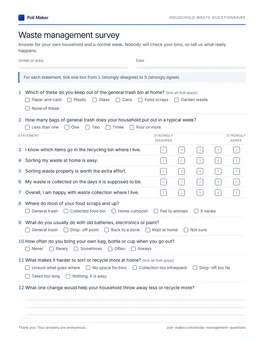
The household core with tick boxes on page one, then the collection, reuse, school and background modules. Print only the pages you need.
Download PDF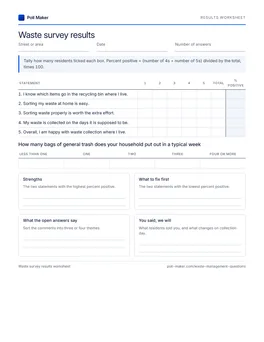
Results worksheet
Count the paper answers to the five rating statements, turn each count into a share of residents who agree, and circle the two problems to fix first.
Download PDFWaste questions that sound fine and tell you little
Each weak version gets an answer that sounds fine and tells you little. Our survey question guide covers the same fixes for other topics.
Do you recycle?
Which of these do you keep out of the general trash bin at home?
Nearly everyone says yes. A list of materials shows which ones are sorted and which are not.
Are you satisfied with waste collection and recycling services?
My waste is collected on the days it is supposed to be.
Overall, I am happy with waste collection where I live.
Two services in one question. Someone happy with trash pickup but not recycling has no honest answer.
How many kilograms of waste does your household produce each week?
How many bags of general trash does your household put out in a typical week?
Nobody weighs their rubbish, so the kilogram answers are guesses. Bags can be counted.
Don't you agree that plastic pollution is destroying the planet?
How important is it to you to cut down on single-use plastic?
The weak version tells people what to think. The better one lets them rate it themselves.
Waste survey questions, answered
For council officers, green teams, teachers and students.
What should a waste management survey ask?
Ask what people sort, how much they throw away, where food scraps and hazardous items go, what makes sorting hard, and how well collection works. Give every question answer options, then finish with one open question about the change people want.
How do you measure household waste in a survey?
Ask for the number of bags of general trash a household puts out in a typical week, and how many people live there. Both are easy to answer honestly, and bags per person can be compared before and after a campaign.
Can students use these questions for a research project?
Yes. Use the household core with the school module, get your teacher to approve it, and explain the purpose in one line before the first question. The questions are original, so cite this page in your method and describe how you chose who to ask.
Should a waste survey be anonymous?
Yes, for residents. People admit to putting batteries in the trash or burning rubbish only when nobody can trace the answer. Ask for a street or area if you need to compare places, never a house number.
How many questions should a recycling survey have?
Twelve covers the essentials and takes about four minutes. Add the collection module for a council survey or the school module for a class project; all 31 take around ten minutes.
Start counting before the next collection day
Open the household core in the builder, add the module your project needs, and share the link with residents or students today. Printed copies work for doorsteps and classrooms.