What residents need most: a 34-question community needs assessment
A community needs assessment survey asks residents which local problems hurt most, how well each one is served today, and what is already working. The core 12 below covers housing, jobs, health care, mental health, transport, childcare, safety and food in about five minutes, and every answer feeds a ranked list of needs.
- 34questions
- 12in the core
- 5 minfor the core
- 8need areas ranked
By Michael Hodge, BSc Psychology Updated September 2026
The 34 community needs assessment questions
The twelve core questions start selected. Add the household set for an anti-poverty program, the health set for a hospital or health department, and the civic set when residents will shape the plan. Each question shows its answers and what it tells you.
The core 1212 questions
One question on the biggest problems, nine statements on how well each need is met, and two open questions: what would make life better, and what is worth keeping. Together they rank the needs on their own.
-
Which of these are the biggest problems where you live?
Housing costsJobs and payHealth careMental healthGetting aroundChildcareSafetyFood costsNone of theseTick all that applyThe share of residents who tick each area is one half of the priority grid. The eight areas match the eight statements that follow.
-
People here can find a home they can afford.
Strongly disagree12345Strongly agree1 = Strongly disagree, 5 = Strongly agreeHousing cost, asked about the area rather than the resident, so owners and renters can both answer it.
-
People here can find work that pays enough to live on.
Strongly disagree12345Strongly agree1 = Strongly disagree, 5 = Strongly agreeSeparates "no jobs" from "jobs that do not pay", which call for different programs.
-
I can see a doctor or nurse when I need one.
Strongly disagree12345Strongly agree1 = Strongly disagree, 5 = Strongly agreeAccess to primary care in plain words. Read it with the barriers question in the health set to see what blocks it.
-
Help for mental health or addiction is easy to find here.
Strongly disagree12345Strongly agree1 = Strongly disagree, 5 = Strongly agreeMental health gaps rarely show up in service data because people who cannot find help leave no record.
-
I can get to work, shops and appointments easily.
Strongly disagree12345Strongly agree1 = Strongly disagree, 5 = Strongly agreeTransport asked as a result, not a mode, so residents without a car and rural residents both show up.
-
Families here can find childcare they can afford.
Strongly disagree12345Strongly agree1 = Strongly disagree, 5 = Strongly agreeChildcare limits work and training for parents, so a low score often explains the jobs score too.
-
I feel safe walking in my neighborhood after dark.
Strongly disagree12345Strongly agree1 = Strongly disagree, 5 = Strongly agreeThe standard way to ask about safety without asking residents to judge crime figures.
-
Healthy food I can afford is easy to buy near me.
Strongly disagree12345Strongly agree1 = Strongly disagree, 5 = Strongly agreeCovers both price and distance, the two halves of food access.
-
I know where to go for help with rent, food or bills.
Strongly disagree12345Strongly agree1 = Strongly disagree, 5 = Strongly agreeWhen services exist but this score is low, the need is outreach, not a new program.
-
What one change would make life better for people here?
Open answerNames needs the list above missed, in residents' own words. Sort the answers into themes and count them.
-
What is the best thing about this area, the thing worth protecting?
Open answerThe assets question. It shows what to build on: the places, groups and people a plan can start from.5
Your household's needs6 questions
For community action agencies, food banks and anti-poverty programs that need to know what households go without, not only what the area lacks. Each question keeps a way out for people who would rather not say.
-
In the past 12 months, has your household gone without any of these because of cost?
FoodRent or mortgageHeating or powerMedicinePhone or internetNone of thesePrefer not to sayTick all that applyHardship measured as things people went without, which is easier to answer honestly than an income figure.
-
How sure are you that you can stay in your current home for the next six months?
Very sureFairly sureNot sureI have no stable homePrefer not to sayPicks up households close to losing their home before they reach a shelter count.
-
Which of these has anyone in your household used in the past year?
Food pantryHelp with rent or billsJob trainingFree or low-cost clinicChildcare helpSenior servicesNone of theseTick all that applyShows which services already reach people, so gaps are judged against real use.
-
The last time you looked for help, how easy was it to get?
Very easyEasyHardVery hardI have not looked for helpThe experience of asking. A service that is hard to reach counts as missing for many people.
-
What got in the way when you looked for help?
Did not know where to goHours did not suit meToo far to travelForms were hardLanguageFelt judgedNothing got in the wayTick all that applyEach barrier has its own fix: outreach, evening hours, a mobile service, simpler forms, interpreters or staff training.
-
Does your home have internet good enough for forms and video calls?
YesOnly on a phoneNoMore services move online every year. A large "only on a phone" group means paper and in-person options still matter.
Health and care5 questions
For hospitals, clinics and health departments running a community health needs assessment. It adds health status, the main health worries and the barriers to care.
-
How would you rate your health overall these days?
ExcellentVery goodGoodFairPoorThe simplest overall health measure. Public health surveys ask a close version with the same five answers, so your results can sit beside theirs.
-
Which health issues worry you most in this community?
Long-term illnessMental healthDrug useAlcohol useDental healthHealth of older peopleHealth of childrenTick all that applyResidents' own ranking of health problems, to set beside the hospital and public health data you already hold.
-
Where do you usually go when you are sick or need health advice?
A regular doctor or clinicUrgent careHospital emergency roomA pharmacyNowhereMany emergency room or nowhere answers point to a gap in everyday primary care.
-
In the past year, what stopped you getting health care you needed?
CostNo insuranceLong waitTransportClinic hoursLanguageNothing stopped meTick all that applyTurns a low access score into a specific barrier the hospital or clinic can work on.
-
Where do you get most of your health information?
Doctor or nurseHealth departmentInternet searchSocial mediaFamily and friendsPicks the channel for health campaigns that follow the assessment.
Having a say4 questions
For councils, coalitions and planning groups that want residents involved in what happens next, not only surveyed once.
-
Local leaders listen to residents like me.
Strongly disagree12345Strongly agree1 = Strongly disagree, 5 = Strongly agreeTrust in local decision making. Where it is low, share results back before asking residents for anything else.
-
How do you usually hear about local services and events?
Social mediaText or emailWord of mouthLocal newsFlyers or postersChurch or schoolTick all that applyDecides where results and new services get announced, using the channels residents actually name.
-
What would make it easier for you to take part in local meetings?
Evening or weekend timesAn online optionChildcareLanguage supportA closer venueNothing, I take partTick all that applyRemoves the reasons working parents and older residents miss public meetings.
-
Would you help with a project on the top need this survey finds?
YesMaybeNoBuilds a volunteer list from the people who care most. Add an optional contact field only for those who say yes.
About you (optional)7 questions
Only what you need to compare areas and groups, and to check that the people who answered look like the people who live there.
-
Which neighborhood, town or ZIP code do you live in?
Open answerLets you report each area separately. Ask for an area, never a street address.
-
How long have you lived in this area?
Under 1 year1 to 4 years5 to 9 years10 years or moreNewcomers often name different needs from long-time residents, especially on housing.
-
What is your age group?
18 to 2425 to 4445 to 6465 or overPrefer not to sayChecks that younger and older residents are both represented before you trust the totals.
-
Who lives in your home?
Children under 18Adults 65 or overSomeone with a disabilityJust meNone of theseTick all that applySplits answers for families, older residents and disabled residents, the groups whose needs differ most.
-
Do you own or rent your home?
OwnRentLive with family or friendsOtherHousing answers mean different things to owners and renters, so compare them apart.
-
How well does your household income cover your basic needs?
ComfortablyJust aboutNot quiteNot at allPrefer not to sayA gentler stand-in for an income band. It shows whether low-income residents answered, which the community action standards require.4
-
Which language do you speak most at home?
Open answerTells you which languages the next survey and the services themselves need.
Rank the needs: how big a problem, how well served
A needs list is only useful once it is in order. The core gives you two numbers for each of the eight areas, and together they sort every need into one of four boxes.

The two numbers
From the first question, take the share of residents who ticked the area as one of the biggest problems. From its statement, take the share who agree the need is met. The idea comes from importance-performance analysis, where each item is plotted by how much it matters and how well it is delivered.2
The four boxes
- Act first: many call it a big problem and few say it is met.
- Protect: many care about it and most say it is met. Keep funding it.
- Watch: few call it a problem and few say it is met. Check it again next time.
- Covered: few call it a problem and most say it is met.
A worked example
These figures are invented for illustration and come from no real town. Split each axis at the middle of your own results rather than at a fixed line.
| Area | Big problem / met | Box |
|---|---|---|
| Housing costs | 61 / 18 | Act first |
| Mental health | 44 / 21 | Act first |
| Health care | 39 / 64 | Protect |
| Getting around | 12 / 30 | Watch |
| Safety | 9 / 77 | Covered |
Running a needs survey residents trust
The questions are the easy part. Who answers, and what happens after, decide whether the ranking holds up in front of a board or a funder.

Go where the least-heard residents already are
An online link alone reaches people who are already connected. Put paper copies at food pantries, clinic waiting rooms, libraries, bus stops and school pickup, and offer the survey in the languages spoken locally. The hospital rules for these assessments ask for input straight from low-income and underserved residents,3 as do the community action standards,4 and the about-you set shows whether you got it. For a small community, survey everyone; for a large one, make sure every neighborhood you plan to report on is represented.1

Ask what works, not only what is missing
A list of problems makes a community sound broken, and residents notice. A scoping review of 169 studies found that assessing a community's assets, its skills, places and groups, is an integral part of a good health needs assessment.5 The last core question asks residents what is worth protecting. Those answers often name the partners for the plan: the library that already runs job clubs, the church with a kitchen.

Report back, then run it again
Hold a meeting or post a one-page summary within weeks of closing the survey, with the ranked needs and what will happen next. The Community Tool Box steps end the same way: interpret the results as a group, plan and act, and repeat the survey from time to time to track change.1 A three-year cycle matches both the hospital rule3 and the community action standards,4 so one survey can serve both.
Holding a community meeting to talk through the results? Show the top-ranked needs as a live poll on the big screen so everyone votes on where to start. Setting up a meeting poll takes about a minute, and residents answer on their phones.
Chart how well each need is met
For each of the nine core statements, type the count of residents at every point of the scale. Agreeing means the need is met, so the shortest bars are the gaps. Print the chart for a board meeting, a coalition or the public summary.
- 1Count the paper and online answers to every statement; the bars give the proportion who chose agree or strongly agree.
- 2Take the two lowest statements and look up the same areas in the first question. A low score that many residents also call a big problem is a need to act on first.
- 3Split the chart by neighborhood before drawing conclusions. A county average can hide the town where nothing is met.
- 4Turn to the written answers last. The change residents ask for most often usually explains the lowest bar.
Community needs check
When a funder or regulator requires the assessment
Two of the most common reasons to run this survey come with rules about who must be heard. Build the sample around them from the start.
| Who | What the rule asks | Where the set helps |
|---|---|---|
| Nonprofit hospitals (US) | A community health needs assessment every three years, with input from a public health department and from medically underserved, low-income and minority residents. The report must be widely available.3 | Core plus the health set; paper copies in clinic waiting rooms; the about-you set to show who answered. |
| Community action agencies (CSBG) | An assessment and report within the past three years, using information collected directly from low-income people, both numbers and words, and input from key sectors.4 | Core plus the household set; the income-cover question; the open questions for the qualitative part. |
Partner input, from schools, faith groups, employers and public agencies, usually comes through short interviews or a separate partner survey. Keep this resident survey for residents so the two voices stay distinct in the report.
A paper version for pantries, clinics and doorsteps
Many of the residents a needs assessment most needs to hear from will never click a link. Print the questionnaire, leave a box for completed forms, and enter the answers with the report tool above.
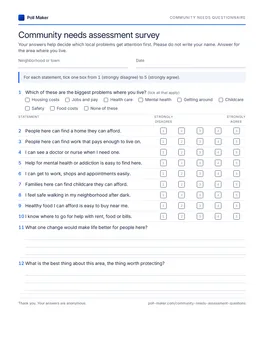
Community needs questionnaire
Sheet one is the resident core with a box beside every answer. Household, health, civic and background questions sit on the later sheets, so a hospital or an agency can skip what it does not need.
Download PDF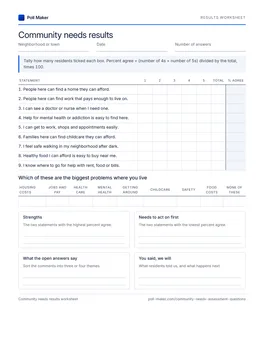
Results worksheet
Tally the nine statements from the paper forms and work out what proportion agreed with each one. A second row counts how many residents named each area as a big problem, the other half of the priority grid.
Download PDFThe short form for a food pantry line or a fair booth
When people have two minutes, not ten, these five still give you the top problems, whether residents know where help is, what households went without, and one idea and one strength in their own words.
- 01Which of these are the biggest problems where you live?
- 02I know where to go for help with rent, food or bills.
- 03In the past 12 months, has your household gone without any of these because of cost?
- 04What one change would make life better for people here?
- 05What is the best thing about this area, the thing worth protecting?
When a resident question points the wrong way
Most weak needs questions either ask for a wish list or put words in residents' mouths. The survey question guide covers these fixes for every question type.
What does our community need?
Which of these are the biggest problems where you live?
What one change would make life better for people here?
An open wish list is hard to count. A fixed list gives numbers to rank, and one open question catches what the list missed.
Would you like more affordable housing and better jobs?
People here can find a home they can afford.
People here can find work that pays enough to live on.
Everyone says yes to more of anything, and two topics share one answer. Two statements show which gap is wider.
Do you use the food bank because you cannot afford groceries?
In the past 12 months, has your household gone without any of these because of cost?
The weak version assumes the reason and names a service people may feel ashamed to use. The better one asks about going without, with a way to decline.
How would you rate social services in the county?
Which of these has anyone in your household used in the past year?
The last time you looked for help, how easy was it to get?
Most residents have never used most services, so their rating is a guess. Ask about use first, then about the experience.
Community needs assessment questions, answered
For staff at agencies, hospitals, councils and coalitions, and students writing a needs assessment for a course.
What questions should a community needs assessment survey include?
Ask which local problems are biggest, how well each need is met today, and what residents would change and keep. Add household hardship, health and civic questions when your program needs them, and a few background questions so you can compare areas and check who answered.
How is a community health needs assessment different?
It is the same idea focused on health and care. US nonprofit hospitals must run one every three years and hear from residents who are underserved, on low incomes or from minority groups.3 Pair the resident core with the health set.
How many residents should answer?
In a small community, try to reach everyone. In a larger one, aim for a sample that looks like the population, and make sure each neighborhood or group you want to report separately has enough answers to stand on its own.1 Compare the about-you answers with census figures to see who is missing.
Should the survey be anonymous?
Yes. Residents will not admit to going without food or fearing eviction if their name is attached. Ask for a neighborhood or ZIP code instead of an address, and keep any volunteer contact field optional and separate.
Get the survey to residents this month
Put the resident core into the builder today, bolt on the sets your program is funded for, and send the link out while paper copies go to pantries, clinics and libraries.