Parks and recreation survey questions that rank what residents want fixed
A parks and recreation survey asks residents how they use local parks and programs, what keeps them away and what to fix first. The 12-question core takes residents about five minutes. Families at the park get a playground version, and a master plan gets its own planning set.
- 38questions
- 12in the core
- 5 minto answer the core
- 5optional sets
By Michael Hodge, BSc Psychology Updated September 2026
All 38 parks and recreation survey questions
The 12 resident questions are already ticked. Bring in an entire set, or only the questions your department needs; each carries its answer choices and what park staff can do with the result. Send your selection online, print it for a mailing, or paste it into the survey tool your city already uses.
The resident core12 questions
Two questions on how the household uses parks, seven statements on upkeep, access, safety, programs and cost, then what keeps people away, what to fix first and one open question. Written so that people who never visit can answer too.
-
How often did your household use a local park or recreation center in the past 12 months?
Weekly or moreA few times a monthAbout monthlyA few times a yearNot at allSplit every other answer by this one. Nationally, people who live near a park visit about twice as often as people who do not.1
-
Which of these did your household use in the past 12 months?
Park or playgroundWalking or bike trailPark eventSports field or courtPool or splash padRec or senior centerClass, camp or leagueTick all that applyRead each rating only among the households that used that place. A family that never swims cannot rate the pool.
-
The park closest to my home is clean and well kept.
Strongly disagree12345Strongly agree1 = Strongly disagree, 5 = Strongly agreeUpkeep of the park people actually use, not the flagship one. Split it by neighborhood to see where the maintenance crew should go first.
-
I can easily walk to a park from my home.
Strongly disagree12345Strongly agree1 = Strongly disagree, 5 = Strongly agreeWalking access. Neighborhood parks are meant to serve people within about a mile, so low scores mark the gaps on your map.2
-
I feel safe spending time in our parks.
Strongly disagree12345Strongly agree1 = Strongly disagree, 5 = Strongly agreeWorry about safety at the park was the second most common obstacle in the national survey, after lack of time. A low score here goes to the top of the list.1
-
Park restrooms are open and clean when I need them.
Strongly disagree12345Strongly agree1 = Strongly disagree, 5 = Strongly agreeUsable restrooms decide how long families stay. The open answers usually say whether the problem is locked doors or cleaning.
-
Programs run at times that work for my household.
Strongly disagree12345Strongly agree1 = Strongly disagree, 5 = Strongly agreeTiming is a fix that needs no new building. When it scores low, the programs set asks which days and times suit people.
-
Program fees are fair for what my household gets.
Strongly disagree12345Strongly agree1 = Strongly disagree, 5 = Strongly agreeValue, from the households that pay. Cost or fees kept about one in five adults from using parks and recreation as much as they wanted.1
-
It is easy to find out what our parks offer.
Strongly disagree12345Strongly agree1 = Strongly disagree, 5 = Strongly agreeAwareness. When residents do not know what is on, a better program guide or park signs can raise use without a new facility.
-
What most keeps you from using our parks and programs more?
Not enough timeSafety worriesCost or feesToo far awayNot sure what is onNothingLack of time has topped this list in the national survey for nine years running, so look hardest at the answers you can change: safety, cost, distance and awareness.1
-
Which one should the parks department improve first?
Park upkeepTrails and pathsPlaygroundsSports facilitiesPrograms and classesOne pick forces a priority. Five options, so it also runs as a live poll at a council meeting or a park open house.
-
What one change would get your household using our parks more?
Open answerSort the answers into piles such as lighting, shade, restrooms or programs, and count each pile. The biggest pile often names a cheap fix.
At the park today (answered on site)7 questions
Answered by people at the park, often parents with children. Put these on a QR sign by the playground or a clipboard at the picnic shelter, and add the core if visitors have time.
-
Who is with you at the park today?
Just meChildren under 12TeenagersOther adultsA dogTick all that applyParents come for different things than people on their own. In a survey of park visitors, 59% of women and 42% of men had brought children.3
-
How did you get to the park today?
WalkedDroveBike or scooterBus or trainAnother wayPlans parking, bike racks and safe crossings. Nationally, more adults drive to parks than walk, with walking close behind.1
-
About how long are you staying today?
Under 30 minutes30 to 60 minutes1 to 2 hoursOver 2 hoursLonger visits need shade, restrooms and water. Read the amenity ratings for the long-stay group first.
-
The play equipment here is in good repair.
Strongly disagree12345Strongly agree1 = Strongly disagree, 5 = Strongly agreeParents check the swings before anything else. A low score sends an inspector out, not a follow-up survey.
-
There are enough shaded places to sit here.
Strongly disagree12345Strongly agree1 = Strongly disagree, 5 = Strongly agreeShade decides whether a family stays past lunchtime in summer. Read it next to the length-of-stay answer.
-
I could find a working drinking fountain here.
Strongly disagree12345Strongly agree1 = Strongly disagree, 5 = Strongly agreeA working drinking fountain was one of the park features linked to more people walking or biking to the park.3
-
What would make this park better for your family?
Open answerThe question parents answer at length. Ask it last, so the ratings get answered first.
Trails, access and getting there5 questions
For trail planners and anyone preparing an accessibility or lighting budget. Ask everyone, including people who rarely visit.
-
How long would it take you to walk to the nearest park?
Under 5 minutes5 to 10 minutes11 to 20 minutesOver 20 minutesNot sureMaps walking access by neighborhood. Nationally, three in four adults said they could walk to at least one park or recreation facility.1
-
Our trails connect the places I want to go.
Strongly disagree12345Strongly agree1 = Strongly disagree, 5 = Strongly agreeConnection, not length, is what turns a trail into a route to school, shops or work.
-
People with disabilities can get around our parks.
Strongly disagree12345Strongly agree1 = Strongly disagree, 5 = Strongly agreePaths, ramps, surfaces and accessible play equipment. The open answers name the exact place to fix.
-
Park lighting is good enough for evening visits.
Strongly disagree12345Strongly agree1 = Strongly disagree, 5 = Strongly agreeEvening use depends on lights along paths and courts. Compare it with the safety statement in the core.
-
Finding a parking space at our parks is easy.
Strongly disagree12345Strongly agree1 = Strongly disagree, 5 = Strongly agreeMost adults drive to a park at least some of the time, so a full lot turns people away. Read it among drivers.1
Programs, classes and camps6 questions
Email these to households on your registration list after a season, or add them to the community survey for households with children.
-
Which programs has your household joined in the past 12 months?
Youth sportsAdult sportsSwim lessonsSummer campFitness classesArts or natureSenior programsNoneTick all that applyFilters this set to the people who took part. Nationally, nearly two in three households had someone in a park and recreation program.1
-
Signing up for a program was quick and easy.
Strongly disagree12345Strongly agree1 = Strongly disagree, 5 = Strongly agreeRegistration is the first thing a new family touches. A clumsy form loses sign-ups before the first class.
-
Instructors and coaches were well prepared.
Strongly disagree12345Strongly agree1 = Strongly disagree, 5 = Strongly agreeQuality of delivery, asked about what people saw. Report it per program once a group is large enough.
-
When can your household most easily join a program?
Weekday daytimeAfter schoolWeekday eveningsWeekendsTick all that applyPairs with the timing statement in the core. Schedule new classes into the slots most households tick.
-
How would you like to hear about park news and programs?
EmailSocial mediaWebsiteProgram guidePark signsTick all that applySpend the outreach budget where residents will see it. Split the answers by age group.
-
What new program or class would your household sign up for?
Open answerDemand in residents' own words. Count repeated ideas before adding anything to next season's guide.
About your household (optional)4 questions
For comparing neighborhoods and life stages. Publish a neighborhood or age group only when enough households answered to keep everyone anonymous.
-
Which neighborhood or ZIP code do you live in?
Open answerThe key split for a parks survey: it shows which neighborhoods lack a walkable, well-kept park.
-
Are there children under 18 in your household?
YesNoHouseholds with children use playgrounds, pools and camps the most, so read those ratings among them.
-
What is your age?
18 to 3435 to 5455 to 6465 or olderOlder adults are easy to miss. In a national study of neighborhood parks, seniors were 4% of park users but 20% of the population.2
-
Does anyone in your household have a disability that affects park use?
YesNoPrefer not to sayLets you read the access statement among the households it matters to most.
Planning priorities (for a master plan or budget)4 questions
Three questions that feed a priority rating for new or better facilities, plus one on funding. The worked example further down turns them into a ranked list.
-
Which of these does your household have a need for?
Walking and bike trailsNeighborhood parksPlaygroundsIndoor fitness spacePools or splash padsSports fieldsOff-leash dog parkPicnic sheltersTick all that applyThe base of the rating: how many households need each kind of place at all.4
-
Which of those needs are only partly met, or not met at all, today?
Walking and bike trailsNeighborhood parksPlaygroundsIndoor fitness spacePools or splash padsSports fieldsOff-leash dog parkPicnic sheltersTick all that applyUnmet need. A facility many households need but few find good enough rises to the top.4
-
Which one of these matters most to your household?
Walking and bike trailsNeighborhood parksPlaygroundsIndoor fitness spacePools or splash padsSports fieldsOff-leash dog parkPicnic sheltersImportance. One pick per household makes people choose, so not everything comes out as important.4
-
How should adult recreation programs be paid for?
Mostly by taxesHalf taxes, half feesMostly by user feesNot sureShows councillors how residents want the cost split before fees are set. Ask it again for youth programs if you run both.
Pick the version that fits the job
One question bank, four ways to use it. Each version reaches different people, so choose by who you need to hear from.
| Version | Who answers, and how | Questions to use |
|---|---|---|
| Community survey | Random households, by mail or online link | Core 12 plus planning, access and household |
| At the park | Park visitors, by QR sign or clipboard | Playground five or the at-the-park set |
| After a program | Registered households, by email | Programs set plus timing and fee items |
| Council meeting or open house | Attendees, voting by phone | Which one to improve first |
Only the community survey hears from residents who never use the parks, so run it before a master plan, a bond measure or a new budget. The on-site and program versions are quick checks you can repeat every season.
How many households to ask
With 400 completed surveys from a random sample, a result is accurate to about 5 points either way. NRPA's national survey used 1,000 adults for a margin of about 3 points.1 If you want a result for each neighborhood, you need enough returns from each one, so mail more surveys to the areas that usually answer least.
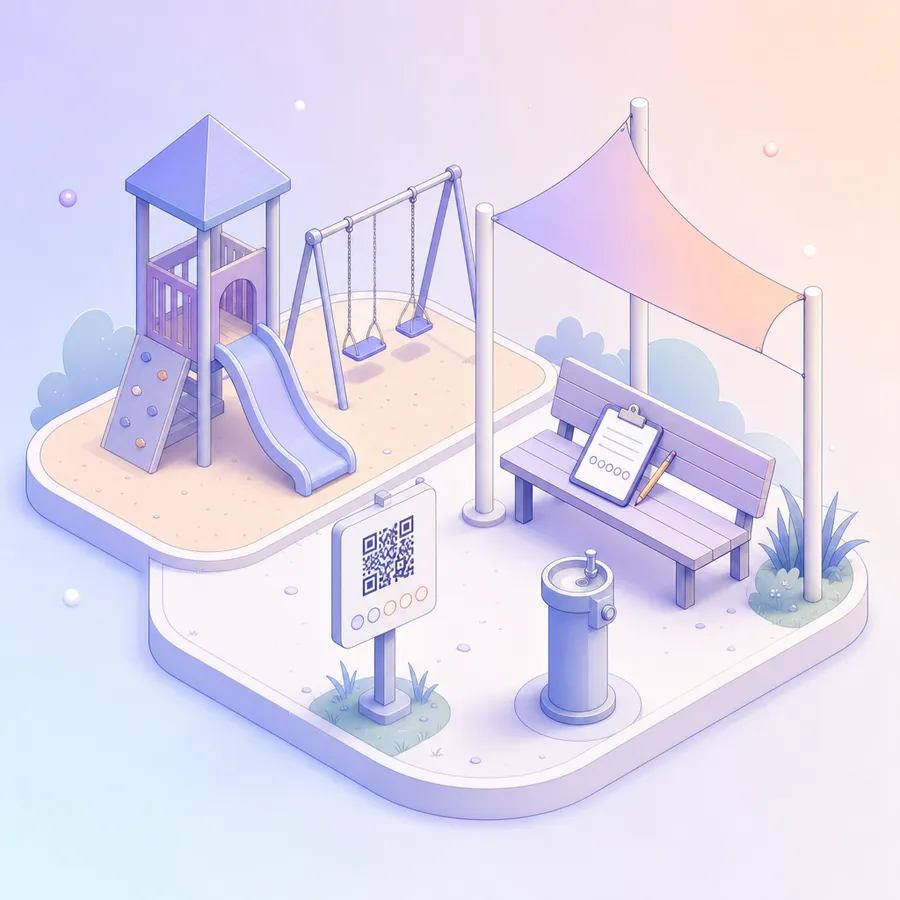
A QR sign by the swings: the playground five
Families at the park have a minute, not ten. Print these five on a sign by the playground or splash pad with a QR code, and parents can answer while the children play.
- 01The play equipment here is in good repair.
- 02There are enough shaded places to sit here.
- 03Park restrooms are open and clean when I need them.
- 04I feel safe spending time in our parks.
- 05What would make this park better for your family?
Lessons from cities that survey before they plan
Four habits drawn from national park research and from the surveys cities and counties run before they plan.
Hear from the residents who never come
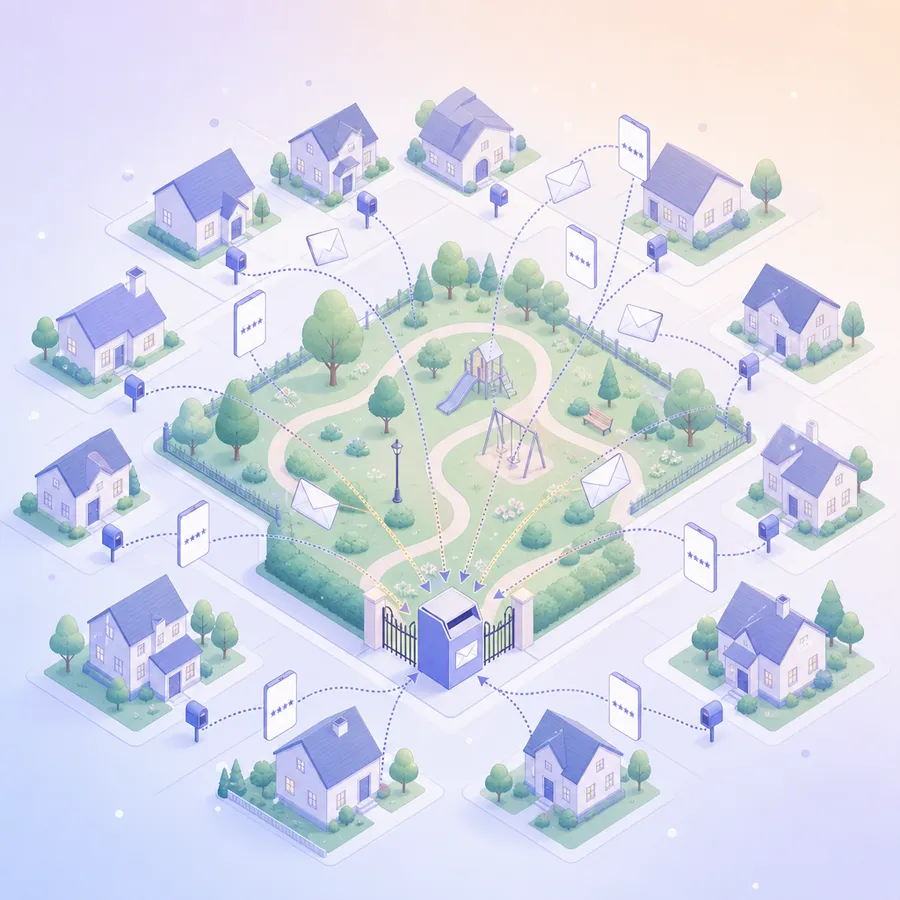
Hand a form out at the park and you only hear from people already using it. In a national study of 174 neighborhood parks, seniors were 4% of the people using the parks but 20% of the general population.2 Mail the community version to a random sample of addresses with an online link, and keep the non-users in: the barrier question is written for them. Nationally, lack of time heads the list of obstacles, with safety at the park and cost next.1
How US adults used local parks and recreation in the past year
Ask what people used before asking how good it was
Households use a park system in very different ways. In NRPA's 2025 national survey, 62% of adults had visited a park, playground or dog park in the past year, 47% a trail and 43% a special event, while about a quarter used a pool or a recreation center.1 The second core question records what each household used, so you read the pool rating among swimmers and the program ratings among families who signed up.
Meet families at the playground, at different hours
The best way to hear from families visiting a park is to ask while the children play: a QR sign at the playground with five questions, plus a volunteer with a clipboard at busy times. Spread those shifts across the week. The national study counted visitors at each park 12 times over two weekdays and a weekend, from 8 a.m. to 6 p.m., because visits at that many different times gave a reliable picture of a whole week.2 Copy that spread, and keep a pencil and a few stickers on the clipboard.
Put the results on a sign in the park
Post what you heard and the fix you chose on the city website, in the program guide and on a sign at each park. Signs do more than report back: in the national study, parks that used marketing such as banners and posters logged 63% more hours of moderate to vigorous activity a week.2 When residents spot a new bench or longer pool hours that came from their answers, they fill in the next survey too.
Need a fast answer to one question? Run a live poll at a council meeting or a park open house, and people vote on their phones in seconds. To reach a neighborhood group online, the page on posting a poll to Facebook, email or your website shows each step.
Which park service scores lowest
Got the returns in? For every core statement, key in the number of residents who chose each score. The panel lines the statements up so staff can spot the weakest service at a glance, ready to print for the council packet.
- 1Residents who picked 4 or 5 agree. The panel turns each statement's counts into a share while you type.
- 2Run it again for each neighborhood. A park system that scores well overall can still fail the blocks around one park.
- 3Set the lowest-rated statement beside the barrier question and the one-change answers; between them they usually name the fix.
- 4Publish the chart alongside this season's single biggest change, on the city website and on park signs.
Resident survey results
Turn the planning answers into a ranked build list
ETC Institute, a survey firm that works with park departments, ranks facilities with a Priority Investment Rating.4 The three planning questions collect everything the rating needs.
- Count the households that ticked each facility in the unmet-need question. Give the highest count a score of 100 and scale the others to it.
- Do the same with the question on which facility matters most. That gives the importance score. ETC asks each household for a top four; one pick keeps this version shorter, and the scaling works the same way.
- Add the two scores together. The total runs from 0 to 200.
| Facility | Unmet need + importance | Priority rating |
|---|---|---|
| Walking and bike trails | 100 + 100 | 200, high |
| Off-leash dog park | 75 + 30 | 105, high |
| Pools or splash pads | 50 + 50 | 100, high |
| Sports fields | 25 + 20 | 45, low |
In this example 400 households answered. 120 said their need for trails was only partly met or not met, the most for any facility, so trails score 100; 90 said the same about a dog park, which scales to 75. On importance, 150 households named trails as the facility that matters most and 45 named the dog park, so they score 100 and 30. The numbers are ours, for illustration.
ETC reads a total of 100 or more as a high priority, 50 to 99 as medium and under 50 as low.4 Here the dog park edges past the pools although fewer households named it as their first choice: most of the people who need one say the need is not being met.
Mail it, or bring a clipboard to the park
A paper form reaches households that never open a city email. Print the questionnaire for a mailing or a clipboard at the park, then count the returns on the worksheet. Sized for US letter, and fine on A4.
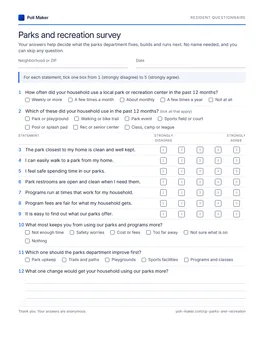
Resident questionnaire
Page one holds the 12 resident questions as tick boxes. The five optional sets run on after it, so a mailing can carry just the pages it needs.
Download PDF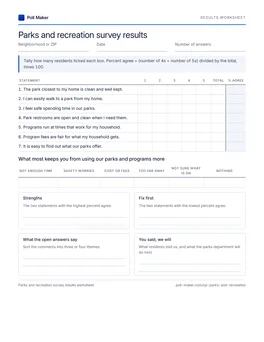
Results worksheet
Mark each returned form against the seven park statements and the barrier question, work out the share of residents behind each answer, then record the fix you will tackle first.
Download PDFParks survey questions worth rewording
Questions like these appear on many council surveys. Each rewrite below gives staff an answer they can act on. Examples for other topics are in the survey question collection.
How satisfied are you with our parks and facilities?
The park closest to my home is clean and well kept.
Park restrooms are open and clean when I need them.
"Parks and facilities" covers dozens of places. A resident who loves the trail and avoids the pool has no single honest answer.
How safe and well lit is our park?
I feel safe spending time in our parks.
Park lighting is good enough for evening visits.
Two questions in one. A park can feel safe at noon and still be badly lit at eight, and one answer cannot say which.
Would you support building new parks?
Which of these does your household have a need for?
Which of those needs are only partly met, or not met at all, today?
Almost everyone says yes to more parks. Needs and gaps tell you which facility to build first.
Do you use our parks? If not, why not?
How often did your household use a local park or recreation center in the past 12 months?
What most keeps you from using our parks and programs more?
A yes or no hides how often, and a blank "why not" box returns answers you cannot count. A list of common barriers gives you numbers.
What park and recreation staff ask
Short answers for parks departments, councils and friends-of-the-park groups.
What questions should be on a parks and recreation survey?
Start with how often the household uses parks and what they used. Then add short statements on upkeep, walking access, safety, restrooms, program times, fees and how easy it is to find out what is on. Finish with what keeps people away, what to improve first and one open question. Add the on-site, programs, planning or trails sets when you need them.
What is the best way to collect feedback from families visiting the park?
Ask at the park while the children play. Put five questions on a QR sign by the playground or splash pad, and send a volunteer with a clipboard at busy times on weekdays and weekends. Keep it to a minute or two, and close on one open question: what would make this park better for your family?
How many residents should you survey?
As many as a random sample lets you reach. With 400 completed surveys a result is accurate to about 5 points either way; with 1,000 it is about 3 points, the precision of NRPA's national survey.1 For results by neighborhood, you need enough returns from each one.
How often should a parks department survey residents?
Run the full community survey when you plan: before a master plan, a bond measure or a budget cycle. Use the short on-site and program versions every season, and keep the core statements word for word from year to year so results line up.
How do you count how many people use a park?
A survey tells you what residents think and how often they say they visit. To count who is actually there, researchers use systematic observation. The national study of neighborhood parks used a tool called SOPARC, scanning each area of a park at set times and recording who was there and how active they were.2 A count plus this survey shows both sides.
Before the budget hearing, hear from residents
Start the resident survey in the builder, then tack on whichever sets your staff want. Or print questionnaires for a mailing, plus the playground five for a sign by the swings.