Call center survey questions for the end of a call
Start with two facts from the caller: was the issue sorted, and how many calls did it take? Those two answers give you first call resolution. Six short statements cover the wait, the agent and the effort, and the survey closes with an overall rating and a question in the caller's own words.
- 38questions
- 12in the core set
- 3 minto answer the core
- 4in the keypad version
By Michael Hodge, BSc Psychology Updated September 2026
Each caller question and why it earns its place
Core questions arrive pre-selected. Bolt on a set for holds and transfers, agent coaching, unresolved calls or the follow-up a few days later, or tick individual rows. Beside every question sit the caller's answer choices and what a team leader learns from them.
The core 12, for every caller12 questions
The reason for the call, two resolution facts, six statements, an overall rating, one open question and permission to call back. On its own it gives you first call resolution, satisfaction and a list of callers to phone.
-
What was your call about?
BillingA fault or repairAn orderMy accountSomething elseThe answer every other result is split by. Resolution rates differ widely between call types, so one average for the whole line hides where the repeat calls come from.2
-
By the end of the call, was your issue sorted out?
Yes, all sortedPartlyNot yetHalf of first call resolution. On its own it is the resolution rate as the caller sees it, which can differ from what the agent logged.
-
Counting this one, how many times have you called us about this issue?
OnceTwiceThree timesFour or moreThe other half. A caller on their third try who says "all sorted" is resolved, just not on the first call.
-
I got through to a person quickly enough.
Strongly disagree12345Strongly agree1 = Strongly disagree, 5 = Strongly agreeThe wait, judged by the caller. Abandonment was one of only two call center measures linked to caller satisfaction in a study of operational metrics.1
-
I only had to explain my issue once.
Strongly disagree12345Strongly agree1 = Strongly disagree, 5 = Strongly agreeCatches transfers and lost notes in one line. A low score here usually points to routing, not to the agent who answered.
-
The agent understood what I needed.
Strongly disagree12345Strongly agree1 = Strongly disagree, 5 = Strongly agreeListening and product knowledge together, as the caller felt them. The agent set below splits them for coaching.
-
The agent explained the next steps clearly.
Strongly disagree12345Strongly agree1 = Strongly disagree, 5 = Strongly agreeMatters most when the issue is not fixed yet. Checking on an unresolved issue is one of the main reasons callers ring back.2
-
Sorting this out was easy for me.
Strongly disagree12345Strongly agree1 = Strongly disagree, 5 = Strongly agreeEffort in plain words. Read it beside question 3: two or more calls and a low score here is the pattern to fix first.
-
I trust that what was promised will happen.
Strongly disagree12345Strongly agree1 = Strongly disagree, 5 = Strongly agreeConfidence in the follow-through. Read it next to question 29 in the follow-up set, which checks whether the promise was kept.
-
Overall, how satisfied are you with this call?
Very satisfiedSatisfiedNeutralDissatisfiedVery dissatisfiedThe headline rating. The share of Satisfied and Very satisfied is your satisfaction score for the line; the tally sheet counts it for you.
-
What is one thing that would have made this call better?
Open answerOne change, in the caller's words. Sort the answers by call reason and they turn into a short list for each team.
-
May a team leader call you back about your answers?
YesNoPermission to close the loop. A callback to someone whose issue is not sorted can often finish the fix on that call.
Getting through: menu, hold and transfers4 questions
Useful when callers complain about hold times, menus or being passed along. These separate the queue from the conversation.
-
About how long did you wait before a person answered?
Under 2 min2 to 5 min6 to 10 min11 to 20 minOver 20 minThe wait as the caller remembers it. Compare it with your phone system's queue time for the same hour to see where memory and data part ways.
-
The phone menu sent me to the right place.
Strongly disagree12345Strongly agree1 = Strongly disagree, 5 = Strongly agreeTells you whether menu options match the words callers use for their problem.
-
How many times were you transferred on this call?
NoneOnceTwiceThree or moreEach transfer is a new chance to lose the thread. Pair it with question 5 to see whether notes travel with the call.
-
Were you offered a call back instead of holding?
Yes, I took itYes, but I heldNoI did not holdShows whether the callback option is offered, and whether callers who take it end up happier.
When it was not fixed first time5 questions
Show these to callers who answered "Partly" or "Not yet" on question 2, or who have called more than once. They tell you why the fix did not happen.
-
Before calling, where else did you try to get help?
Nowhere elseWebsite or appChat or emailA store or branchTick all that applyShows which self-service route sent people to the phone anyway.
-
Why was your issue not sorted on this call?
Needed another teamThe agent could notA rule stopped itA system was downNot sureSorts repeat calls by cause, so each one goes to coaching, to a process owner or to IT.
-
Were you told when the next step would happen?
Yes, with a dateYes, no dateNoA clear date is the cheapest way to stop a caller ringing back just to check.
-
What still needs to happen?
You will contact meI must call againI must send somethingNothing, it is doneTells you who holds the next move. "I must call again" is a repeat call you can see coming.
-
What would have fixed this on the first call?
Open answerCallers often name the missing piece exactly: a refund limit, a form, a team the agent could not reach.
The agent, for coaching6 questions
Six behaviours a coach can work on, each rated by the person on the other end of the line. Send them when a team is building its coaching plan.
-
The agent listened without rushing me.
Strongly disagree12345Strongly agree1 = Strongly disagree, 5 = Strongly agreeRushing shows up here before it shows up in handle time.
-
The agent knew how to fix my issue.
Strongly disagree12345Strongly agree1 = Strongly disagree, 5 = Strongly agreeKnowledge as the caller saw it. A low score across a whole team points to training or the knowledge base.
-
The agent used words I could follow.
Strongly disagree12345Strongly agree1 = Strongly disagree, 5 = Strongly agreeJargon check. Internal product names and codes are the usual cause.
-
The agent took ownership of my problem.
Strongly disagree12345Strongly agree1 = Strongly disagree, 5 = Strongly agreeWhether the caller felt someone was on their side, rather than being passed along.
-
Before ending, the agent checked I had what I needed.
Strongly disagree12345Strongly agree1 = Strongly disagree, 5 = Strongly agreeThe closing check. Agents who ask it catch the second issue before it becomes a second call.
-
The agent was polite from start to finish.
Strongly disagree12345Strongly agree1 = Strongly disagree, 5 = Strongly agreeCourtesy on its own line, so it never hides inside a question about skill.
A few days later, by email or text4 questions
A short second survey sent three to seven days after the call, to check whether the fix held. It turns "sorted on the call" into "stayed sorted".
-
Since your call, has the problem come back?
No, it stayed fixedYes, onceYes, more than onceIt was never fixedThe truest resolution check there is. Compare it with question 2 for the same callers.
-
Did what we promised on the call happen?
Yes, all of itSome of itNoStill waitingFollow-through by the teams behind the agent, which the caller cannot see from the call itself.
-
Have you had to contact us again about it?
NoYes, by phoneYes, another wayRepeat contact across every channel, not just the phone line.
-
How likely are you to recommend us to a friend or colleague?
0123456789100 = Not at all likely, 10 = Extremely likelyAsked a few days on, the recommend score reflects the whole experience rather than the last five minutes of the call.
About you (optional)2 questions
Two questions that help you compare groups of callers. Leave them out if your system already knows the answers.
-
How long have you been our customer?
Under a year1 to 3 yearsOver 3 yearsNot yet a customerNew customers call about different things and judge the line differently.
-
Were you calling for yourself or for a business?
For myselfFor a businessFor someone elseBusiness callers often need a different route and a different answer.
For your agents (agents answer, sent separately)5 questions
A five-question check for the people on the phones, sent on its own a few weeks into the program. It shows whether agents see the survey as fair and useful.
-
Caller survey scores reflect how I handle calls.
Strongly disagree12345Strongly agree1 = Strongly disagree, 5 = Strongly agreeIf agents disagree, they will not act on the scores. Find out which part feels unfair.
-
I see caller comments soon after the call.
Strongly disagree12345Strongly agree1 = Strongly disagree, 5 = Strongly agreeFeedback lands best while the agent still remembers the call.
-
Scores caused by policy are not held against me.
Strongly disagree12345Strongly agree1 = Strongly disagree, 5 = Strongly agreeTests whether coaching separates what the agent controls from what the rules decide.
-
Which call reason brings the most repeat calls?
BillingFaults and repairsOrdersAccount changesSomething elseThe agents' view of where repeat calls start. Set it beside what callers said on question 1.
-
What would help you fix more calls the first time?
Open answerAgents know which tool, rule or handoff costs them the fix. This is often the best idea in the whole survey.
First call resolution from questions 2 and 3
Customer-reported first call resolution needs just two answers from each caller. SQM Group builds its benchmark of inbound call centers the same way: two post-call survey questions, asked within one business day.2
The calculation
A call counts as first call resolution when the caller chose "Yes, all sorted" on question 2 and "Once" on question 3. Divide those callers by everyone who answered both questions. Callers who say "Yes, all sorted" after two or more calls are resolved, but not first time: count them separately, because they show what repeat calls cost you.
A worked example
Say 200 callers answered this month:
| What callers said | Callers | Share |
|---|---|---|
| All sorted, first call | 138 of 200 | 69% |
| All sorted, after a repeat call | 22 of 200 | 11% |
| Partly or not yet sorted | 40 of 200 | 20% |
| Resolution rate (first two rows) | 160 of 200 | 80% |
So this line sorts out 160 issues, but only 138 of them on the first call. The 40 callers still waiting are the ones to phone back. The 22 who needed a repeat call show, through their answers to the unresolved set, what went wrong the first time.
What counts as a good rate
SQM Group treats 70% to 79% as a good first call resolution rate and 80% or higher as world class; the average across the industries it benchmarked in 2024 was 69%.2 Call reasons differ so much that the more useful comparison is inside your own line: split the rate by question 1 and fix the lowest call type first.
Survey spiels agents can read at the end of a call
A spiel is the few lines an agent says to invite the caller to the survey. Keep it under fifteen seconds, say how long the survey takes, and offer it once the issue is handled or the next step is agreed.
On a line that plays a survey after the call
"Before you go, please stay on the line for four quick questions about this call. It takes under a minute, and your answers go to the team that runs this line."
When the survey goes out as a link
"In the next hour you will get a short survey by text about today's call. It takes about three minutes, and I would really value an honest answer."
A next-day callback interview
"Hello, this is [name] from [company]. You spoke to us yesterday about [reason]. Do you have three minutes for a few questions about that call? Your answers help us fix things faster."
Three rules that keep the scores honest
- Ask for an honest answer, never for a top score. A score the agent asked for tells you nothing.
- Say the real length, then keep to it. The keypad version is four questions; the core is twelve.
- Use the same words on every call, so a change in scores means a change in service, not in the invitation.
Running a caller survey that leads to fixes
Four habits that turn caller answers into fewer repeat calls, not just a number for the monthly report.

Ask within a day, while the call is fresh
SQM Group surveys callers within one business day of the call, and each center in its benchmark reaches at least 400 surveys before a rate is reported.2 A survey that lands the same day gets answers about that call, not about the company in general. Send the link by text within the hour for most calls. For calls that end with a promise, add the short follow-up set three to seven days later.
First call resolution by call type, 2024
Split every result by why people called
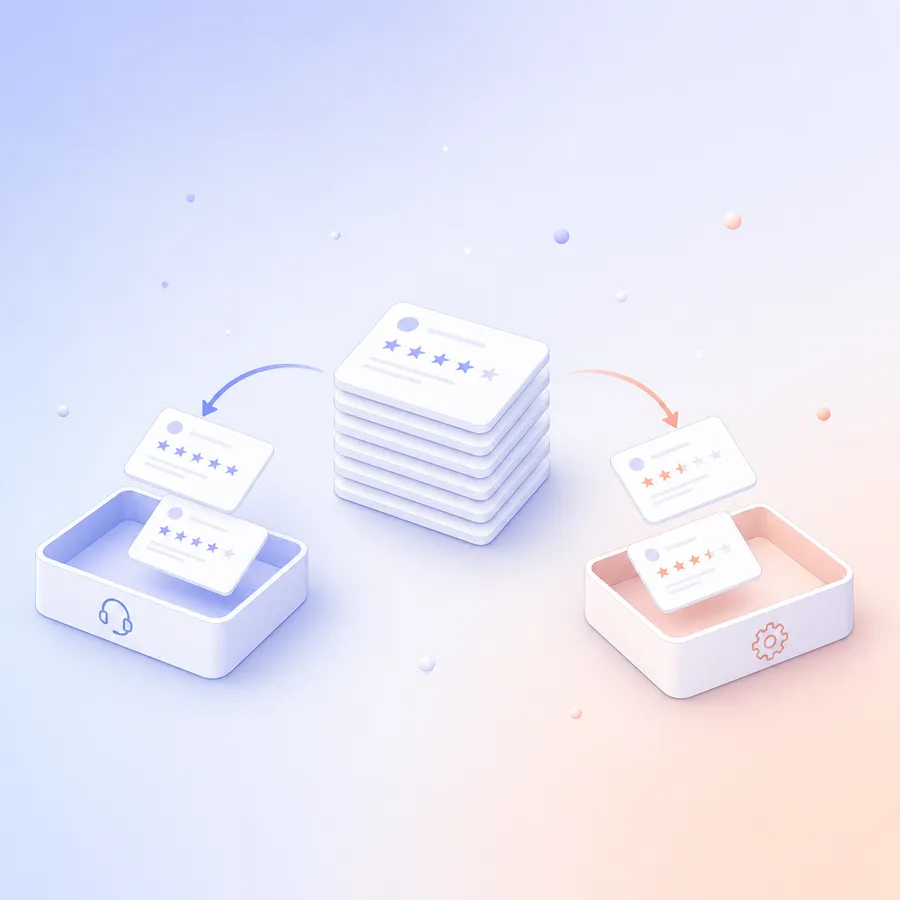
One number for the whole line hides the calls that need work. In SQM Group's 2024 benchmark, first call resolution ran from 73% for general inquiries down to 48% for complaints.2 Question 1 gives you the same split for your own line, so each fix goes to the call type that needs it.
Coach on what the agent controls
When SQM traced why calls were not resolved first time, 38% of causes sat with the agent, 13% with the customer and 49% with the organization's own policies and processes.2 Before a coaching session, read the answers to question 18: "The agent could not" goes to coaching, "A rule stopped it" goes to whoever owns the rule. The agent set gives coaches six specific behaviours to work on.
Phone back unhappy callers within a business day
SQM recommends acting on every dissatisfied or unresolved caller within one business day of the survey.3 Question 12 asks permission first. Send each "Partly" or "Not yet" on question 2, from a caller who said yes to a callback, to a team leader who can finish the fix, and log what they learn next to the survey answer.
Want your agents' view before changing anything? At the next team huddle, run a quick live poll asking which call reason brings the most repeat calls, and compare the vote with what callers said on question 1. The guide covers sharing a poll in Teams, Slack or by text.
The four-question keypad version
For a phone-line survey or a text message, where each answer is one key or one reply: resolution, number of calls, effort and the overall rating. Enough to track first call resolution and satisfaction week by week.
- 01By the end of the call, was your issue sorted out?
- 02Counting this one, how many times have you called us about this issue?
- 03Sorting this out was easy for me.
- 04Overall, how satisfied are you with this call?
A coaching report from the six core statements
Enter how many callers chose each point for the six statements in the core. The chart sorts what callers agree with from what they do not, and flags the pair of statements that need attention first. Bring the printout to the next team meeting.
- 1A statement's agreement share is its 4s plus 5s over all callers who rated it. Enter the counts in the panel and the arithmetic happens for you.
- 2Run it for the whole line first, then for each call reason, and only then for a single agent, once that agent has enough answers that one hard call cannot swing the result.
- 3Low scores on the wait or on explaining twice belong to planning and routing. Low scores on understanding or next steps belong to coaching.
- 4Read two or three caller comments aloud in the huddle, including one that shows what a great call sounds like.
Caller results
Print a callback interview sheet
When a team leader phones callers back the next day, the printed questionnaire is both the script and the answer sheet: read each question, tick the answer, move on. Either paper size works, US letter or A4.
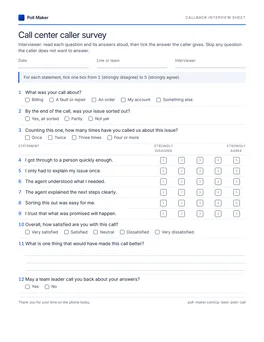
Callback interview sheet
Sheet one gives the interviewer every core question, plus spaces for the date, the line or team, and their own name. Longer callbacks continue onto the optional sets.
Download PDF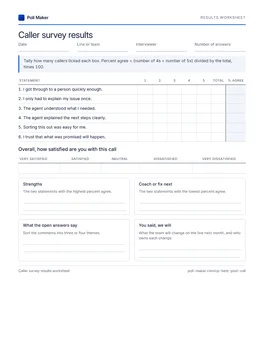
Weekly caller tally
Tally a week of callbacks with a pen, get the agreement share per statement and the satisfaction share, and write down the change to make next.
Download PDFCaller questions that need rewording
Four wordings that often go wrong on phone-line surveys, each with a clearer version. More examples by topic are in the survey questions hub.
Was the agent friendly and knowledgeable?
The agent understood what I needed.
The agent was polite from start to finish.
Two qualities in one question. A caller helped by a pleasant agent who got it wrong has no honest answer.
Was your issue resolved on the first call?
By the end of the call, was your issue sorted out?
Counting this one, how many times have you called us about this issue?
Callers do not think in terms of "first call resolution", and someone on their third call cannot answer it. Two plain facts give you the same rate.
How would you rate our excellent service today?
Overall, how satisfied are you with this call?
"Excellent" leads the answer, and "service" could mean the product, the bill or the call. Ask about the call.
Did the agent follow the call script?
Before ending, the agent checked I had what I needed.
Callers never see the script. Ask about something they heard, and leave script checks to your quality team.
What contact center managers ask
Short answers to the questions that come up before a caller survey goes live.
What is a good first call resolution rate?
SQM Group, which benchmarks more than 500 North American call centers a year, counts 70% to 79% as good and 80% or higher as world class.2 Track your own rate by call reason and aim to lift the lowest type first.
How many questions should a call center survey have?
Twelve for a link sent after the call, which takes about three minutes. Four for a keypad survey on the phone line or a text reply, where each answer is a single key or word.
What is a survey spiel in a call center?
The few lines an agent says at the end of a call to invite the caller to the survey. A good spiel says how long the survey takes and why it matters, and asks for an honest answer rather than a high score.
Should agents see their own caller survey results?
Yes, with the comments, and as soon after the call as you can manage. Show each agent their scores next to the team's, and take out answers the agent could not control before any coaching conversation.
Can I use these questions on a phone-line survey?
Yes. Each answer in the keypad version fits a single key. The builder version is an online survey, so text or email its link right after the call, or read the printed sheet to callers in a callback.
Ready to ask your callers?
Load the caller survey into the builder, choose the extra sets that fit your line, and have the link ready to text after tomorrow's calls.