Customer profile survey questions for building buyer personas
A customer profile survey asks your own customers who they are, what made them start looking, what they compared you with and where they go for advice. The 11-question profile core fills every field of a buyer persona; add a set for buying style, media habits, business buyers or food customers.
- 38questions
- 11in the profile core
- 4 minto answer the core
- 5optional sets
By Michael Hodge, BSc Psychology Updated September 2026
The profile core, then sets for buying style, media, B2B and food
The profile core starts ticked. Switch on a whole set for your kind of business, or pick individual questions one at a time. Under each question you will find the choices customers see and the persona field it fills, so the finished survey can go out as a link, on paper, or into another tool.
Profile core11 questions
One quick fact, then the buying story: the trigger, the alternative, what decided it, who else had a say, the budget, where they asked for advice and what nearly stopped them. Each question fills one field of a persona.
-
Which age group are you in?
Under 2525 to 3435 to 4445 to 5455 or olderThe first split most personas use. Wide bands are quick to answer and still show which generation you mostly serve.3
-
How did you first find out about us?
Online searchA friendSocial mediaAn adReview siteThe first touch for each persona. Read it next to the advice question to see where to spend on reaching more people like them.
-
What was happening that made you start looking for something like this?
Open answerThe trigger: a move, a new job, a problem that got worse. Personas built on triggers tell you when to reach people, not only who they are.
-
If you had not found us, what would you have done?
Another brandDone it myselfStayed as I wasNot sureYour real competition. "Stayed as I was" means your message has to sell the change before it sells you.
-
Which of these mattered most when you decided to buy?
PriceQualityServiceSpeedReviewsReferralTick all that applyThe two or three factors each group ticks most are the headline of its persona and the first line of your ads.
-
How often do you buy or use products like ours?
WeeklyMonthlyQuarterlyYearly or lessFirst timeSeparates regulars from one-off buyers, who usually need different offers and different reminders.
-
Who else has a say when you buy something like this?
Just meFamilyMy managerMy teamSomeone elseShows whether the person answering is the buyer or one voice among several. A persona with a co-decider needs material they can pass on.
-
About how much do you spend on products like ours in a year?
Under $50$50-199$200-499$500-1,999$2,000+Places each persona on a price ladder. Change the currency and bands to fit your market before you send it.4
-
Where do you look for advice before buying something like this?
SearchReviewsFriendsYouTubeSocial mediaTick all that applyWhere each persona does its research, which is where your content, reviews and partners need to be.
-
What almost stopped you from buying?
PriceMight not workHard to compareTimingNothingThe objection each persona carries. Answer it on the page where people decide, before they have to ask.
-
How would you describe what we do to a friend?
Open answerYour customers' own words for your product. Lift the phrases that repeat into headlines and search terms.
Media and content habits5 questions
For deciding where to reach each persona and in what format: video, articles, demos or a conversation.
-
Which of these do you use at least once a week?
InstagramTikTokYouTubeFacebookLinkedInPodcastsEmail newslettersTick all that applyA weekly timeframe filters out the apps people installed and forgot. Pick the two channels each persona actually opens.
-
How do you prefer to learn about a new product?
Short videosWritten articlesA live demoPodcastsTalking to someoneThe format question. It decides whether your next piece of content is a clip, a guide, a webinar or a sales call.
-
When do you usually have time to read or watch something about a purchase?
Early morningWork breaksEveningsWeekendsNo set timeTiming for emails, posts and ads, straight from the people you are trying to reach.
-
How often would you like to hear from a brand you buy from?
WeeklyEvery two weeksMonthlyOnly for real newsNeverSets the email rhythm per persona, so the keen ones hear more and the rest do not unsubscribe.
-
Which websites, creators or newsletters do you trust for advice in this area?
Open answerNames the partners, sponsors and guest spots worth paying for, in the customer's own words.
For business buyers5 questions
For software, agencies and suppliers who sell to organizations. Business customers answer these on top of the core.
-
What is your role in your organization?
Owner or founderManagerTeam memberBuyer or procurementConsultantSeparates the person who uses the product from the person who signs for it. Most business personas need both.
-
How many people work at your organization?
Just me2 to 1011 to 5051 to 250More than 250Company size predicts budget, buying process and which plan fits, so it is the first split for a business profile.
-
Which industry is your organization in?
Retail or hospitalityProfessional servicesTechnologyHealth or educationManufacturingSomething elseShows which industries you already win, so case studies and ads can speak their language. Swap in your own list.
-
What problem were you asked to solve when you started looking?
Open answerThe business trigger, often set by someone else. It is the sentence to open your sales page with.
-
How long did it take from first looking to buying?
Under a week1 to 4 weeks1 to 3 monthsOver 3 monthsStill decidingThe length of the buying cycle. Long cycles need follow-up content; short ones need a clear price and a fast start.
Food and drink customers5 questions
For food brands, cafes, bakeries and drink makers. Swap "food like ours" for your product, such as snacks, coffee or ready meals.
-
How often do you buy food like ours?
Every dayA few times a weekOnce a weekA few times a monthLess oftenPurchase frequency for a food product, which sets pack sizes, subscriptions and how often to run an offer.
-
Which of these describe how you eat?
VegetarianVeganGluten-freeLow sugarHigh proteinNo special dietTick all that applyDiet shapes whole personas in food. A large group on one diet can justify its own product line or menu section.
-
Where do you usually buy food like ours?
SupermarketConvenience storeOnline deliveryFarmers marketSpecialty shopTells a food brand which stockists to chase and a cafe how much of its trade could move to delivery.
-
What do you check on the pack before you buy?
PriceIngredientsNutrition labelWhere it is madeBrandNothingTick all that applyWhat each persona reads in the aisle. Put the most checked item where the eye lands first on your packaging.
-
Who do you usually buy food for?
Just meMe and a partnerA family with childrenHousematesWork or eventsThe household behind the purchase, which decides portion size, price per serving and the photo on the pack.
Buying style and values7 questions
Psychographic questions: how customers shop and what they care about. Add them when two customers with the same age and budget still buy in very different ways.
-
I research a purchase carefully before I buy.
Strongly disagree12345Strongly agree1 = Strongly disagree, 5 = Strongly agreePlanners want detail, comparisons and proof. Low agreement points to a persona that buys on trust or impulse.
-
I will pay more for something that lasts.
Strongly disagree12345Strongly agree1 = Strongly disagree, 5 = Strongly agreeSeparates value buyers from price buyers better than asking about price directly.
-
I like to try new products before my friends do.
Strongly disagree12345Strongly agree1 = Strongly disagree, 5 = Strongly agreeFinds your early adopters: the group to invite to a launch or a beta.
-
Once a brand works for me, I stick with it.
Strongly disagree12345Strongly agree1 = Strongly disagree, 5 = Strongly agreeLoyal personas reward a good first experience; switchers need a reason to stay every time.
-
I prefer brands whose values match mine.
Strongly disagree12345Strongly agree1 = Strongly disagree, 5 = Strongly agreeTells you whether causes, sourcing and ethics belong in your message for this group or only add noise.
-
I compare prices before anything else.
Strongly disagree12345Strongly agree1 = Strongly disagree, 5 = Strongly agreeThe price-first persona. If most customers agree, lead with the offer; if few do, lead with the outcome.
-
Which sounds most like you when you shop?
I plan and compareI buy what I trustI hunt for dealsI buy on impulseI ask others firstA one-question segment. Each answer is a ready-made persona name you can test against the rest of the profile.
About you (optional)5 questions
The household facts personas often include. Always leave a way to skip the money question.
-
How do you spend most of your working week?
Full timePart timeSelf-employedStudentRetiredWork situation says more about time and budget than a job title does, and it is quick to answer.
-
How many people live in your household?
123 to 45 or moreHousehold size changes how much people buy and who they buy for.
-
Which best describes where you live?
A big cityA suburbA small townA rural areaPlace type is often more useful than a postcode for delivery, store and event decisions.
-
Which band is your household income before tax?
Under $25,000$25,000 to $49,999$50,000 to $99,999$100,000 to $149,999$150,000 or morePrefer not to sayIncome in bands with a way out. Exact amounts are the most skipped question in most surveys; bands get answered.4
-
How do you describe your gender?
WomanManNon-binaryI use another termPrefer not to sayOnly ask when products or messages really differ by gender, and keep both the self-description and skip options.
From answers to a buyer persona
A persona is a short, true description of one group of customers. Each part of it comes from specific questions, so you can build one straight from your results.
| Persona field | Questions that fill it | What to write |
|---|---|---|
| Who they are | Age group, work situation, household | The most common answers in the group |
| The trigger | What made you start looking | The moment that sends them searching |
| The alternative | What you would have done instead | Who or what you really compete with |
| What decides it | What mattered most, buying style | The top two or three factors |
| Budget and pace | Yearly spend, how often they buy | A price band and a buying rhythm |
| Where to reach them | First found us, advice sources, media set | Two channels and one content format |
| The objection | What almost stopped you | The doubt your page must answer |
Find the groups first
Sort the answers by the trigger question or by the shopping-style question, then look at each pile on its own. A group becomes a persona when its members answer most of the core the same way. Two or three personas cover most small businesses; more than five usually means the groups are too thin to act on.
Then fill in one sentence per persona
[Age group] [work situation] who started looking when [trigger], would otherwise have [alternative], chose on [top two factors], spends [band] a year, asks [advice source] first and nearly walked away over [objection]. Paste the quotes from the last question underneath, and the persona speaks in your customers' words.
Getting a profile you can trust
A profile is only useful if the customers who answer are typical and their answers are true. These four decisions make the biggest difference.
Put the profile facts first
It is tempting to hide the personal questions at the end. In a profile survey the facts are the point, and there is evidence for asking them early: in an experiment with two versions of a large staff survey, putting the demographic questions at the beginning raised the response to those questions and did not change the answers to anything else.3 The core opens with the age question and saves household and money questions for the optional set.
Named the economy as the top issue, by question format
Build answer lists from real answers
The options you offer shape what people say. After the 2008 US election, Pew asked which issue mattered most: 58% chose the economy when it was on a list, but only 35% named it unprompted.1 Pew's advice is to run the question open first with a small group, then turn the most common answers into the list. Do that for the trigger and the alternative questions, and keep an open box for anything you missed.
Keep the core to about four minutes
Length costs you twice. In a web survey experiment that told people it would take 10, 20 or 30 minutes, fewer started and finished as the stated time grew, and questions near the end got faster, shorter and more uniform answers.2 Send the profile core on its own, or with one set. If you need more, send a second short survey a month later.
Ask about money in bands, with a way out
Income is the question people skip. A review in the Journal of Official Statistics puts typical nonresponse to income questions at 20 to 40%, against 1 to 4% for other survey questions, and reports that following up with income brackets cut missing answers by half or more.4 So every money question here uses bands, and the income question ends with "Prefer not to say".
Curious where your audience first hears about you, before a full survey? Put one question to your followers as a quick poll for customers and pin it to your profile or drop it into your next email. For QR codes, embeds and more, read how polls get shared.
Send with the order confirmation: five profile questions
Send these with the order confirmation or a welcome email, when the purchase is still fresh. They cover the first touch, the trigger, the deciding factors, the objection and the customer's own words for what you do.
- 01How did you first find out about us?
- 02What was happening that made you start looking for something like this?
- 03Which of these mattered most when you decided to buy?
- 04What almost stopped you from buying?
- 05How would you describe what we do to a friend?
Which sets to add for your kind of business
Every version starts with the profile core. Add one or two sets at most, because each one adds about a minute.
| Your business | Add these sets | When to send it |
|---|---|---|
| Shop or consumer brand | Buying style, media habits | With the order confirmation |
| Software or B2B service | Business buyers, media habits | After the first week of use |
| Food, drink or cafe | Food and drink, buying style | QR code on the pack or table |
| Starting out, no customers yet | Buying style, About you | To people who fit your target market |
A food brand that also wants taste feedback can pair the food set with the food tasting questions, and a brand checking whether people remember it can follow up with a brand recall survey. For launches, pricing and campaign research, browse the rest of our marketing survey questions.
A paper stack by the register
Paper suits a counter, a market stall, a trade show table or a focus group. Stack a few copies near the register and ask customers to drop them in a tray when done.
A short card for the register?
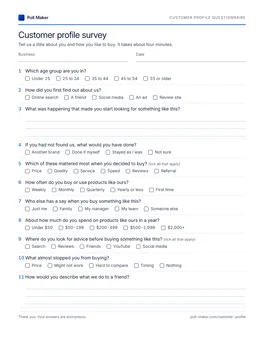
Customer profile questionnaire
Page one carries the profile core with tick boxes. The media, business buyer, food, buying style and household sets follow, so you can print only the sheets your version uses.
Download PDFUsing these as the respondent profile in a research questionnaire
In a thesis or class project, the respondent profile is the short first part of the questionnaire that describes who answered. These questions work for it with small changes.
Choose only what your research question needs
Take the facts you will actually compare groups on: usually age group, work situation and one buying question, such as how often people buy. Every extra profile question costs attention that your main questions need.
Keep the bands wide and add a skip option
Use the bands above rather than asking for exact ages or amounts, and add "Prefer not to say" to anything personal. Your adviser will also want a consent line at the top saying the survey is voluntary and anonymous.
Report the profile as a frequency table
Give each answer its count and percentage in one table per question, before any results. Readers use it to judge who your findings apply to, so say plainly if one group is much larger than the others.
Profile questions worth rewording
A weak profile question returns something you cannot put in a persona. Four common ones, fixed; for other question types, see the survey questions hub.
What is your income?
Which band is your household income before tax? (with "Prefer not to say")
An exact amount feels intrusive and is hard to recall, so many people skip it. A band is easier and still places each persona.
How did you hear about us and why did you buy?
How did you first find out about us?
Which of these mattered most when you decided to buy?
Two questions in one. The first touch and the deciding factor are different persona fields and need separate answers.
Are you a price-sensitive shopper?
I compare prices before anything else.
About how much do you spend on products like ours in a year?
Nobody likes the label. A plain statement and a spend band show price sensitivity without asking people to judge themselves.
What social media do you use?
Which of these do you use at least once a week?
Without a timeframe people tick every app they have. A weekly window shows the channels that actually reach them.
Customer profile surveys, answered
For owners, marketers and students putting one together.
What is customer profiling?
Customer profiling is describing the groups of people who buy from you: who they are, why they buy, how they decide and where they can be reached. A profile survey collects that directly from customers instead of guessing it from sales data.
What is the difference between a customer profile and a buyer persona?
A customer profile is the data: the answers and their spread. A buyer persona is a short description of one typical group, written from that data. This survey gives you the profile; the persona table above turns it into personas.
What questions should a customer profile survey include?
A few facts about the person, then the buying story: what made them start looking, what else they considered, what decided it, who else had a say, how much they spend, where they get advice and what nearly stopped them. The profile core covers each in eleven questions.
What are psychographic survey questions?
Questions about how people think and shop rather than who they are: whether they research carefully, pay for quality, try new things first, stay loyal or care about a brand's values. The buying style set asks them as agree statements plus one question that sorts customers into five shopping styles.
What should a consumer profile survey for a food business ask?
Start with the profile core, then add the food set: how often people buy food like yours, their diet, where they buy it, what they check on the pack and who they buy for. Those five answers shape pack sizes, stockists and the label.
Meet the customers behind your sales
Load the profile core into the builder, add the sets for your business, and send the link with your next order confirmation or print the questionnaire for the counter.