Questions for a food tasting survey, from one sample to a blind panel
A food tasting survey asks each taster about one sample at a time: how it looks, smells, tastes and feels, whether the flavor is too weak or too strong, and whether they would choose it again. Start with the 11 questions per sample, then add a set for comparing samples, a menu tasting, a new packaged food or a kids' taste test.
- 33questions
- 11per sample
- 3 minper sample
- 5optional sets
By Michael Hodge, BSc Psychology Updated September 2026
The 33 food tasting questions, sample by sample
We have ticked the per-sample set for you. Add the set that matches your tasting, or pick individual questions from anywhere below. Each one lists its answer choices and the reason to ask it, so you can open the survey on phones at the table, print cards, or paste the text into another tool.
For each sample11 questions
Eleven questions a taster answers with one sample in front of them: which sample it is, a rating for each of the five senses in the order they arrive, two just-right checks, the overall verdict, the choice, and one change they would make.
-
Which sample are you tasting?
Sample 314Sample 582Sample 947Sample 206Three-digit codes carry no hint of rank, the way A and B do. Put the same code on the cup and in this answer.
-
How good does this sample look?
Very poor12345Excellent1 = Very poor, 5 = ExcellentAsked before the first bite, because color and shape set expectations the flavor then has to meet.
-
How good does it smell before you taste it?
Very poor12345Excellent1 = Very poor, 5 = ExcellentAroma carries much of what people call flavor. A low score here often explains a low flavor score.
-
How would you rate the flavor of this sample?
Very poor12345Excellent1 = Very poor, 5 = ExcellentThe headline rating. Compare it across samples, never averaged together with the other senses.
-
How good is the texture as you chew?
Very poor12345Excellent1 = Very poor, 5 = ExcellentTexture is where a recipe change often fails: the flavor survives a swap and the bite does not.
-
How good is the taste it leaves after you swallow?
Very poor12345Excellent1 = Very poor, 5 = ExcellentThe aftertaste. Sweeteners, fats and bitter notes show up here and nowhere else.
-
The strength of the flavor is:
Much too weakToo weakJust rightToo strongMuch too strongA just-right question tells you which way to move the recipe, which a rating cannot. Read both ends, not the average.4
-
The sweetness is:
Much too lowToo lowJust rightToo highMuch too highSwap sweetness for the one thing your recipe change is about: salt, heat, sourness or crunch. Keep the five answers.4
-
All things considered, how do you feel about this sample?
Dislike extremelyDislike very muchDislike moderatelyDislike slightlyNeither like nor dislikeLike slightlyLike moderatelyLike very muchLike extremelyThe nine-point liking scale that food research has used since the 1950s, so your results sit next to published ones.5
-
If this were on the menu or on the shelf, would you choose it?
Definitely wouldProbably wouldNot sureProbably notDefinitely notLiking is not choosing. Count only "Definitely would" when you plan how much to make.
-
What one change would make it better?
Open answerOne change, not a list. Sort the answers into piles; the biggest pile is the next test.
Comparing the samples5 questions
Ask these once, after a taster has tried every sample. They work well as live votes at the tasting table.
-
Which sample did you like best?
Sample 314Sample 582Sample 947Sample 206No clear favoriteThe head-to-head winner. Keep "No clear favorite" so nobody is pushed into a guess.
-
Which sample would you least want to eat again?
Sample 314Sample 582Sample 947Sample 206None of themA sample can win on average and still put a group off. This finds the one to drop.
-
Could you taste a difference between the samples?
Yes, a big differenceYes, a small oneNo, they tasted the sameWhen you test a cheaper ingredient, "they tasted the same" is the answer you are hoping for.
-
Which sample had the texture you liked most?
Sample 314Sample 582Sample 947Sample 206No clear favoriteSeparates the texture winner from the flavor winner, which are often different samples.
-
What made your favorite stand out from the others?
Open answerThe reason behind the vote, in the taster's own words.
New packaged food (shoppers answer)5 questions
For a small food brand or a student product project. Shoppers answer these after tasting, before they see a price.
-
What would you expect to pay for one pack?
Under $2$2 to $3.99$4 to $5.99$6 to $7.99$8 or moreThe taster's own sense of value. Set the bands around the price you have in mind.
-
When would you most likely eat it?
BreakfastLunchDinnerAs a snackAt a partyTells you which shelf and which pack size to aim for.
-
Compared with the brand you buy now, this sample is:
Much betterA little betterAbout the sameA little worseMuch worse"About the same" rarely makes anyone switch. You need the top two answers.
-
What might stop you from buying it?
PriceTasteIngredientsNutritionPack sizeNothingTick all that applyThe barrier to fix before launch. "Nothing" is the answer to count.
-
How healthy do you think this food is?
Very healthyFairly healthyNeitherFairly unhealthyVery unhealthyShows whether the taste matches the health story you plan to tell on the pack.
Kids' taste test (children answer)4 questions
For a new lunch item, a classroom tasting or a snack for young customers. Read each question aloud for younger children; three answers are plenty.
-
Did you try it?
Yes, all of itYes, one biteNoCounts the brave. Children who did not try it should skip the rest.
-
What did you think of it?
I liked itIt was OKI did not like itThree answers a young child can choose between. Add faces to the paper version.
-
Would you eat it again at lunch?
YesMaybeNoThe decision the school or parent actually needs to make.
-
Which word fits it best?
CrunchySoftSweetSaltySpicyChildren describe food well when you give them the words. It shows what they noticed.
About you (optional)3 questions
Only when you want to split results by group. Ask about allergies before anyone tastes, never afterwards in the survey.
-
How old are you?
Under 1818 to 3435 to 5455 or olderSweetness and spice answers often split by age. Keep the bands wide.
-
How often do you eat this kind of food?
Most daysEvery weekEvery monthRarelyNeverRegular eaters are the people a recipe has to please. Read their answers first.
-
Do you follow any of these diets?
VegetarianVeganGluten-freeDairy-freeNone of theseTick all that applyExplains outliers: a vegan taster may mark down a dish for what it lacks.
Which answer scale to use for which question
Food research uses a handful of answer scales, each for one job. Mixing them up is the most common mistake on tasting forms.
| Scale | Use it for | In this set |
|---|---|---|
| Very poor to Excellent, five points | Scoring each sense, so you can see which one lets a sample down | Look, smell, flavor, texture, aftertaste |
| Nine-point liking scale | The overall verdict, comparable with published tests | All things considered |
| Just right, with two directions of wrong | Deciding which way to change the recipe | Flavor strength, sweetness, portion |
| Definitely would to definitely not | Choosing, ordering or buying | On the menu or on the shelf |
| Three simple answers | Children under about ten | Kids' taste test |
The nine-point liking scale was built in the 1950s to measure soldiers' food preferences,5 and food scientists still use it in much the same way.6 Its words matter more than its numbers: tasters choose "Like moderately", and you turn that into a 7 afterwards. Keep all nine answers in the builder, word for word.
Keeping a tasting fair: codes, order and palate cleansers
Most tasting results go wrong before anyone picks up a spoon. Four habits keep the answers about the food.
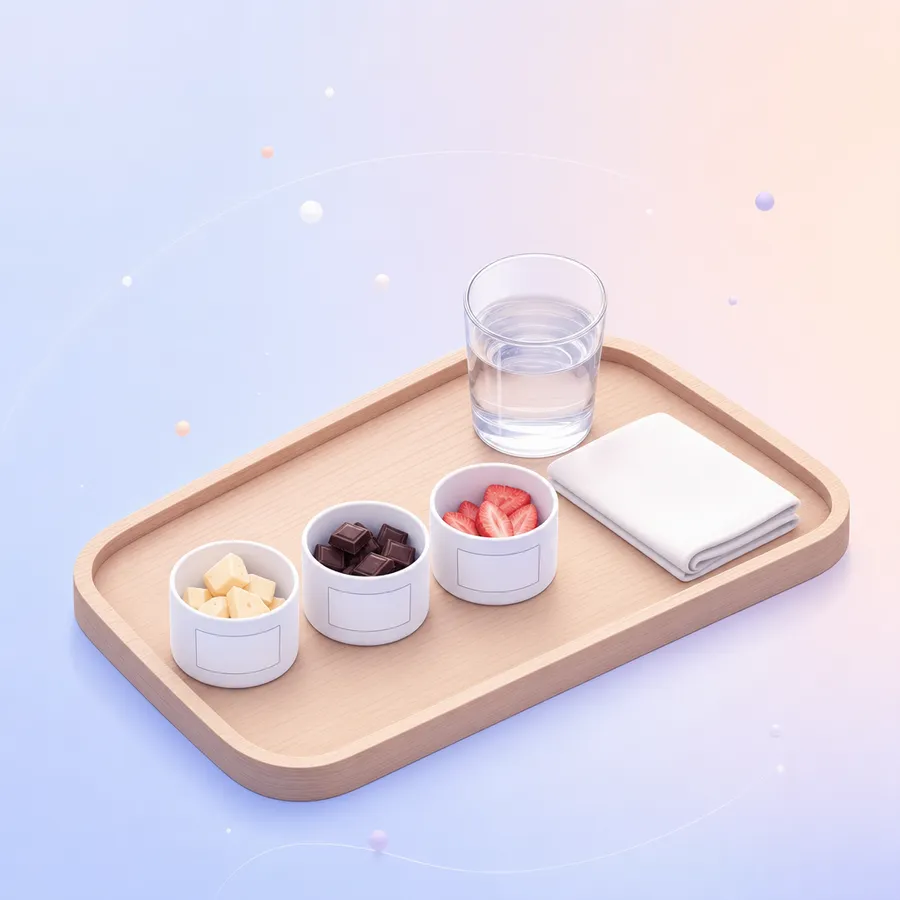
Hide the names, show a code
Serve every sample in the same cup with a three-digit code and nothing else: no brand, no pack, no "new recipe" sticker. Have someone other than the cook plate the samples and keep the key. Tasters then judge what is in the cup, and the survey's first question records which cup that was.
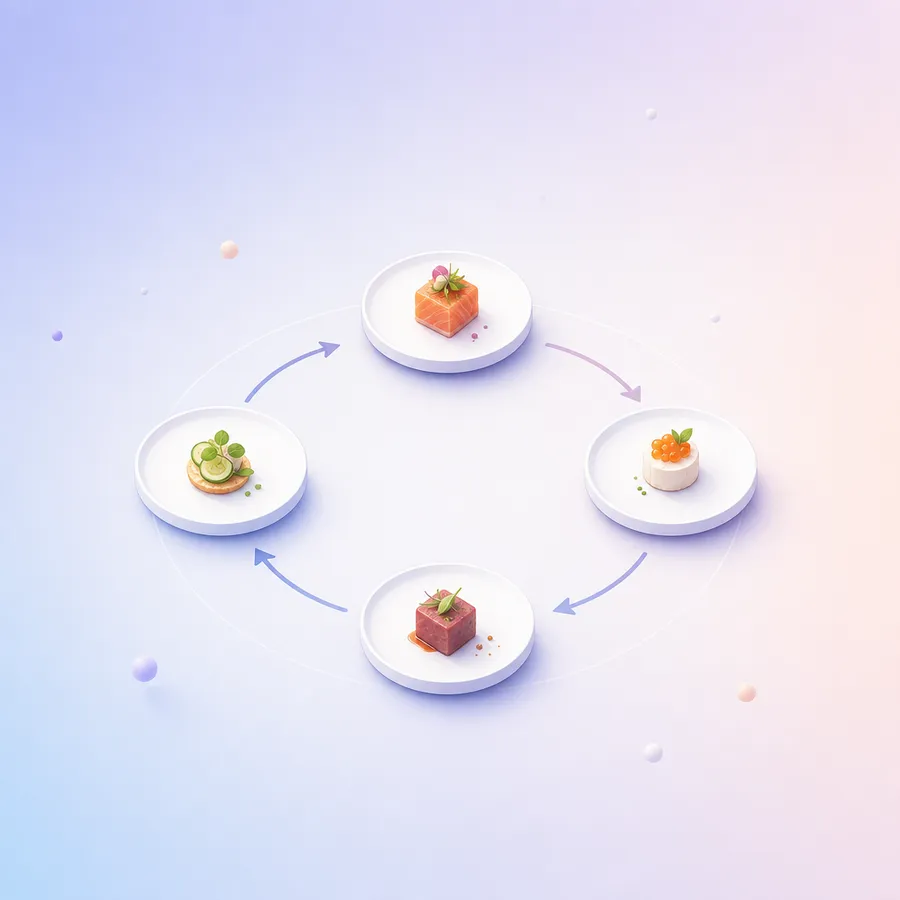
Change the serving order for each taster
Where a sample sits in the line-up changes its score, and each sample colors the one after it. Serve the samples in a different order for each taster so that every sample goes first equally often and follows every other sample. Sensory researchers publish ready-made serving plans for four to sixteen samples.2
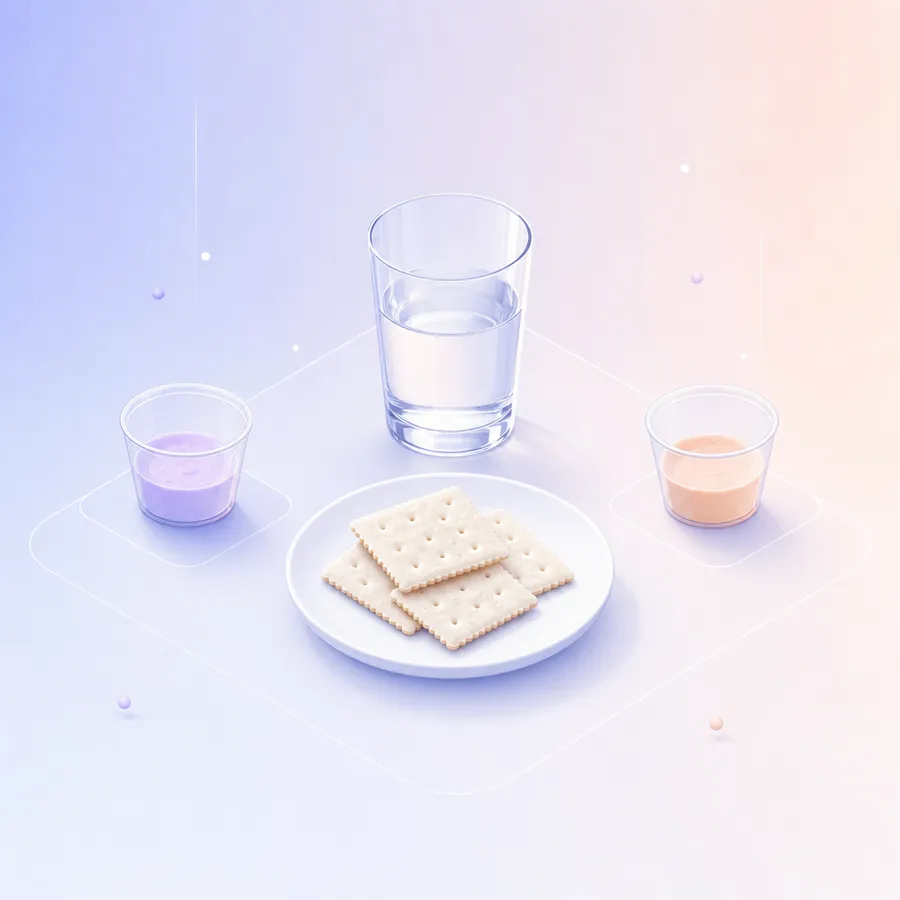
Water and a plain cracker between samples
Leftover taste changes the next rating. In a test of six common palate cleansers across seven kinds of food, from coffee to spicy chips, only plain table water crackers kept ratings steady for every food.3 Put crackers and water at every place and ask tasters to use both before each new code.

Ask enough people for the question you have
A dozen friends will spot a burnt batch or a missing ingredient. Telling two close recipes apart takes far more: a study of consumer tests across five countries put the number at 112 tasters to detect a difference of a tenth of the liking scale.1 For a quick check, look for big gaps and repeated comments; for a launch decision, recruit a full panel of people who eat this kind of food.
Running a tasting at a market, an office or a school fair? Put the favorite question on a screen and run a live vote on phones while people are still at the table. The comparison question is ready to go, and making a poll covers the other ways to share one.
Find the sense that lets a sample down
Type in how many tasters picked each rating for look, smell, flavor, texture and aftertaste, one sample at a time. The shortest bar is the part of the recipe to work on, and the printed page is ready for the kitchen.
- 1Fill in one report per sample code. Count how many tasters chose each answer from Very poor to Excellent for look, smell, flavor, texture and aftertaste.
- 2The chart shows the share rating each sense good or excellent. Compare senses within a sample first, then the same sense across samples.
- 3Read a low bar next to the just-right answers. A weak flavor bar with many "Too weak" answers has an obvious fix.
- 4Add two or three quotes from the open answers to the printout. Cooks act on words faster than on bars.
Sample results
Reading the just-right answers
A just-right question has one correct answer in the middle and a wrong answer on each side, so an average hides the story.
Look at the two ends separately
If a quarter of tasters say a sample is too sweet and another quarter say it is not sweet enough, the average lands on "Just right" and pleases nobody. Report the three groups side by side: too little, just right, too much.
Then check whether it costs you liking
Penalty analysis, also called mean drop analysis, compares the overall liking of tasters who found an attribute just right with those who did not.4 A big group on one side with a big drop in liking is the change to make first. A big group with almost no drop can wait.
A worked example with round numbers
| Sweetness answer | Tasters | Average liking (1 to 9) |
|---|---|---|
| Too low | 10 of 60 | 6.8 |
| Just right | 32 of 60 | 7.2 |
| Too high | 18 of 60 | 5.4 |
Here the sweet side is the problem: 18 tasters, and their liking sits 1.8 points below the just-right group. The not-sweet-enough group barely loses anything. Cut the sugar a little and taste again.
Five for a busy tasting table
At a market stall or a crowded open day, people give you about a minute per sample. These five cover flavor, texture, the verdict, the choice and one change.
- 01How would you rate the flavor of this sample?
- 02How good is the texture as you chew?
- 03All things considered, how do you feel about this sample?
- 04If this were on the menu or on the shelf, would you choose it?
- 05What one change would make it better?
Print the tasting questionnaire
Paper suits a tasting table: one sheet per sample, a pencil at each place and a box for finished sheets. Each file fits US letter and A4 sheets.
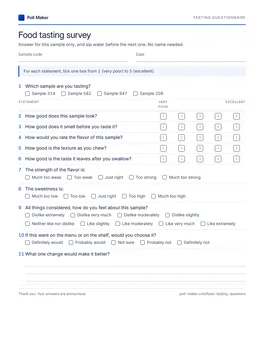
Tasting questionnaire
Page one holds the 11 per-sample questions as tick boxes. The comparison, menu, packaged food, kids and About you sets follow on the next pages.
Download PDF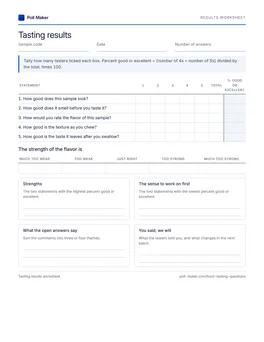
Tasting results worksheet
Tally the five sense ratings and the flavor strength answers by hand, work out the share rating each sense good or excellent, and circle the one to fix.
Download PDFTasting questions that need a rewrite
Every weak version below earns an answer nobody can act on. For other topics, our survey question library and writing tips apply these repairs too.
Did you like the food?
All things considered, how do you feel about this sample? (nine answers from Dislike extremely to Like extremely)
Yes or no hides the difference between "it was fine" and "I would queue for it". Nine steps show it.
How were the taste and texture?
How would you rate the flavor of this sample?
How good is the texture as you chew?
Two senses in one question. A taster who loved the flavor and hated the texture has no honest answer.
Was it too salty?
The saltiness is: Much too low, Too low, Just right, Too high, Much too high
The weak version plants the idea of too much salt and never asks about too little.
Which do you prefer: sweet, salty, savory or spicy?
Which sample did you like best?
A general taste question describes the person. After a tasting, ask about the samples they just ate.
Food tasting surveys: common questions
For cooks, caterers, food brands, teachers and students running a tasting.
What questions should a food tasting survey ask?
For each sample: a rating for how it looks, smells, tastes, feels in the mouth and finishes, a just-right question on flavor strength and one ingredient, an overall liking question and whether the taster would choose it. Close with one open question: the single change that would make it better.
Is it food testing or food tasting?
Tasting means people eat a sample and give their opinion, which is what this survey collects. Food testing usually means laboratory checks for safety, shelf life or nutrition. Both happen before a product launches, and they answer different questions.
What is it called when a consumer answers questions after tasting a new food product?
A consumer taste test, also called an acceptance or preference test. It is one kind of sensory evaluation: the part that asks ordinary eaters how much they like a product, rather than asking trained panelists to describe it.
How many people do you need for a taste test?
It depends on the difference you want to find. A small group will catch big problems. To tell two similar recipes apart with confidence, published guidance points to around 112 tasters.1
Can I use a Likert scale for food tasting?
Use a five-point rating from Very poor to Excellent for each sense and the nine-point liking scale for the overall verdict. Agree-disagree statements suit opinions; for food, a quality or liking scale asks about the thing a taster is actually judging.
How do I run a blind taste test?
Serve every sample in identical cups marked with three-digit codes, have someone other than the cook prepare them, change the serving order for each taster, and give water and plain crackers between samples. Reveal the recipes only after the forms are in.
Set the table for your tasting
Load the 11 questions for each sample into the builder, add the set for your tasting, and share the link on phones or print a sheet per sample.