Brand recall survey questions, from first mention to ad recall
A brand recall survey asks people who buy in your category which brands they can name from memory, then shows a list to see which they recognise. The 10-question core runs in that order and gives you top-of-mind, unaided and aided scores; add sets for a campaign, a brand lift test, your logo or an event.
- 36questions
- 10in the recall core
- 4 minto answer the core
- 3recall scores from one survey
By Michael Hodge, BSc Psychology Updated September 2026
36 brand recall questions, core first
The recall core starts ticked. Add a set for a campaign, a lift test, your brand assets or an event, or tick single questions as you go. Each row lists its choices and the reading a marketer takes from it. Share the result as a link, read it aloud at a stand, or move it into Google Forms.
The recall core10 questions
Keep this order. The two open questions come before any brand name appears, then the list, then what people saw and bought. Replace every word in square brackets with your category, your brand and up to three rivals.
-
When you think of [category], which brand comes to mind first?
Open answerTop-of-mind awareness: the brand people reach for with no help at all. Your score is the share who put your name here.4
-
What other [category] brands can you think of? Name as many as you can.
Open answerUnaided recall. Count your brand if it appears here or in the first answer; the list also shows which rivals people carry around.
-
Which of these [category] brands have you heard of before today?
[Your brand][Rival A][Rival B][Rival C][Made-up name]None of theseTick all that applyAided awareness, or recognition. The made-up name shows how many people tick names they cannot know, so every other score is read against it.6
-
How well do you know [Your brand]?
Never heard of itName onlyKnow a littleKnow it wellI use itBrand familiarity, one step past recognition. A big "name only" group means people know you exist but not what you sell.
-
Which of these brands have you seen or heard advertised in the past month?
[Your brand][Rival A][Rival B][Rival C][Made-up name]None of theseTick all that applyAided ad recall. On its own it is a snapshot; next to the same question asked before a campaign, it shows what the campaign added.
-
Where did you last see or hear something about [Your brand]?
Online videoSocial mediaTV or radioIn a storeSomeone I knowCredits the channel people actually remember, which is not always the one that got the most budget.
-
What do you remember about the latest advertising from [Your brand]?
Open answerChecks the memory is real. An answer that describes an actual ad counts as verified recall; "I think I saw something" does not.
-
Which of these brands have you bought in the past three months?
[Your brand][Rival A][Rival B][Rival C]None of theseTick all that applyTies memory to money. Plenty of recall with few purchases points to the message or the offer, not to reach.
-
If you were buying [category] today, which brand would you choose?
[Your brand][Rival A][Rival B][Rival C]Another brandPreference. People who name you first but would buy a rival show exactly where the story stops working.
-
How often do you buy [category]?
Every weekEvery monthA few times a yearOnce a year or lessNeverTells you who is in the market. Report recall for category buyers, and keep the "never" group apart.
After a campaign7 questions
Send these in the two weeks after a campaign ends, straight after the core. They separate people who remember the ad from people who remember the brand, which are not always the same people.
-
In the past two weeks, have you noticed any ads for [category]?
YesNoNot sureOpens the ad questions without naming a brand, so the next answer is still unprompted.
-
Which brand was that ad for?
Open answerUnaided ad recall with the brand attached. An ad people remember but credit to a rival has a branding problem you can fix in the edit.
-
Describe the ad you remember best. What happened in it?
Open answerSeparates viewers from guessers. Only count answers that match an ad that really ran.
-
Which of these lines have you seen or heard?
[Your slogan][Rival slogan][Made-up line]None of theseSlogan recognition, with a decoy line to measure guessing.
-
Which brand uses the line "[Your slogan]"?
[Your brand][Rival A][Rival B]Not sureThe link from line to brand, where many memorable slogans fall down. A catchy line credited to the leader is paid advertising for the leader.
-
About how many times do you think you saw it?
Once2 or 3 times4 or moreNot sureA rough frequency band. If recall keeps rising from one band to the next, more repeats are paying; if it flattens, change the creative.
-
After seeing the ad, did you do any of these?
Searched for itVisited the websiteTold someoneBought itNone of theseTick all that applyWhat the ad moved people to do, the step between remembering and buying.
Brand lift test5 questions
For comparing people your campaign reached with a matching group it did not reach. These cover the Brand Lift metrics the core does not ask already, in our own wording.
-
In the past two weeks, how often have you watched videos on YouTube?
Every dayA few times a weekAbout once a weekLess oftenNot at allSorts people into likely-reached and not-reached groups when you cannot target the survey yourself. Swap in the channel your campaign ran on.
-
Which of these brands do you link with [the idea in your ad]?
[Your brand][Rival A][Rival B][Rival C][Made-up name]None of theseTick all that applyAssociation: whether the ad planted the idea you paid for, not only the name.2
-
Which of these brands do you have a good opinion of?
[Your brand][Rival A][Rival B][Rival C]None of theseTick all that applyFavorability. Awareness that rises while this stays flat means people noticed you without warming to you.
-
Which of these would you consider the next time you buy [category]?
[Your brand][Rival A][Rival B][Rival C]None of theseTick all that applyConsideration, the shortlist a brand has to reach before anyone chooses it.
-
How likely are you to look up [Your brand] online in the next week?
Very unlikely12345Very likely1 = Very unlikely, 5 = Very likelyA survey stand-in for search lift. Google can measure real searches; your own test has to ask.
Logo, name and other brand assets7 questions
Show each asset with the brand name hidden: the logo, a block of your colour, a few seconds of your sound. Recognising the asset alone is the proof that it works for you.
-
Which brand does this logo belong to?
[Your brand][Rival A][Rival B]Not sureLogo recognition with the name covered. A low score means the logo leans on the name to be noticed.
-
Which brand do you link with this colour?
[Your brand][Rival A][Rival B]Not sureShows whether your colour belongs to you or to the category leader.
-
Which brand uses this sound or jingle?
[Your brand][Rival A][Rival B]Not sureSound works on radio, in videos watched with the sound on and in podcasts. This shows if yours is carrying the name.
-
What brand does this pack, shape or character remind you of?
Open answerUnprompted asset recall, the strongest sign an asset is yours alone.
-
How easy is it to say [Your brand] out loud?
Very difficult12345Very easy1 = Very difficult, 5 = Very easyA name that is awkward to say is a name people avoid passing on.
-
How easy would it be to spell [Your brand] in a search box?
Very difficult12345Very easy1 = Very difficult, 5 = Very easyA name people misspell sends their searches somewhere else.
-
Have you ever mixed up [Your brand] with another brand?
Yes, oftenOnce or twiceNeverNot sureConfusion with a rival. If many people say yes, the open answers usually name who.
Events and sponsorships (visitors answer)4 questions
For sponsors and exhibitors. Ask visitors on the way out or email them the next day, while the event is fresh.
-
Which companies do you remember sponsoring or exhibiting at [event]?
Open answerUnaided sponsor recall: the names that stuck without a prompt.
-
Which of these were sponsors of [event]?
[Your brand][Sponsor B][Non-sponsor rival][Made-up name]None of theseTick all that applyThe rival who did not sponsor is a control: people ticking it show how easily the category leader collects credit for your money.
-
Where at the event did you notice [Your brand]?
SignsStand or boothEvent appOn stageDid not noticeWhich placement did the work, so next year the budget follows it.
-
Did you visit the [Your brand] stand or talk to its staff?
YesNoNot sureSeparates recall earned by a visit from recall earned by signs alone.
About you (optional)3 questions
Three facts for cutting the results by age, household role and region. Merge small groups before reporting, so no one person's answers show.
-
Which age group are you in?
Under 2525 to 3435 to 4445 to 5455 or olderRecall often differs by age because people use different channels. Read each band against where you advertised.
-
Who does most of the buying of [category] in your home?
Mostly meWe share itSomeone elseThe main buyer and an occasional buyer can remember very different brand lists. Compare them before you report one number.
-
Which region do you live in?
[Region 1][Region 2][Region 3][Region 4]Somewhere elseRecall tends to follow where the money was spent. A region split shows which markets the campaign really reached.
How to score brand recall from the answers
Marketers track three classic awareness numbers: top-of-mind, spontaneous (unaided) and aided.4 The core produces all three, plus a check on how much of the result is guessing.
| Score | Where it comes from | How to work it out |
|---|---|---|
| Top-of-mind | Question 1 | People who named your brand first, divided by everyone who answered |
| Unaided recall | Questions 1 and 2 | People who named your brand in either answer, divided by everyone |
| Aided awareness | Question 3 | People who ticked your brand, divided by everyone |
| Guessing level | Question 3 | People who ticked the made-up name, divided by everyone |
| Verified ad recall | Question 7 | People who described an ad that really ran, divided by everyone |
A worked example with 200 answers
| Score | Count (of 200) | Result |
|---|---|---|
| Top-of-mind | 24 | 12 percent |
| Unaided recall | 58 | 29 percent |
| Aided awareness | 142 | 71 percent |
| Guessing level | 12 | 6 percent |
These are example numbers. Divide unaided by aided (58 of 142) and about four in ten people who know the name can also bring it up alone. That ratio is the one to watch between waves: a campaign that lifts aided awareness but not the ratio has made the name familiar without making it memorable. Work out the same scores for each rival from the same answers, because recall only means something next to the brands you compete with. Treat any brand scoring near the made-up name as unknown.
Coding the open answers
Before counting, write a short codebook: which spellings, nicknames and sub-brands count as your brand, and which descriptions ("the one with the green bird") are clear enough to count. Two people coding the same 30 answers and comparing notes will catch most disagreements. Keep the raw answers, so the next wave is coded the same way.
For pricing, launch and customer research, see the full list of marketing survey questions.
Getting recall numbers you can defend
Recall scores move with the way you ask. Four choices decide whether the numbers mean what they seem to.
Ask from memory before any name appears
Earlier questions set the context for the ones after them, which survey researchers call order effects.7 In a recall survey that effect is fatal: once people have seen a list of brands, they can no longer answer "which brands come to mind" honestly. So questions 1 and 2 come first, with no logo, email subject line or survey title that names your brand. Call it a survey about the category, not about you.
Aided awareness in one bakery study, including two brands that do not exist
Put a made-up brand in every list
Some people tick names they have never met, to be helpful or to get through the survey quicker. In one bakery study, two invented brands scored 9% and 12% aided awareness, level with several real regional rivals, and the client itself came in at 16% against the 6% to 9% the researchers expected.6 A made-up name in question 3 gives you that noise level for your own survey. Pick one that sounds plausible in your category and check that no real business uses it.
Ask people who buy the category, not your followers
Your email list and social followers already know you, so their recall tells you about loyalty, not reach. Recruit people who buy the category: a paid panel, an ad aimed at the category rather than your brand, or visitors at a trade event. Question 10 then lets you report recall for real buyers and set aside people who never buy.
Measure before and after, with the same words
A single recall score has nothing to compare with. Run the core before a campaign, again when it ends, and again a month later, with identical wording and the same kind of sample. Memory for advertising fades after exposure, and experiments on TV commercials found that recognition scores fall with time as well and pick up differences that unaided recall misses.5 Reporting both, as the core does, shows you the fade.
Want a fast read from your own audience before a full study? Swap in your brand name and post the channel question as a quick poll for followers. For story polls sized to four answers, see these Instagram poll question ideas.
YouTube Brand Lift study questions, and a lift test of your own
A YouTube Brand Lift study runs inside Google Ads. Knowing what it asks helps you read its report, and the same logic works with this survey when you are not advertising on Google.
What Google's Brand Lift asks
Google shows a short survey on YouTube before a video starts, to two groups: people who saw your ads and people who were eligible to see them but were held back.1 You pick up to 3 metrics from ad recall, awareness, association, consideration, favorability and purchase intent, or write one custom question, then enter your brand and up to 3 competitors. Every question carries an opt-out such as "None of the above", and a standard study completes within 3 to 14 days, with the minimum budget spent over a 10-day period.2 Google writes the wording for the standard metrics, so the questions below are our own versions of the same ideas.
| Brand Lift metric | Matching question here | Counts as positive |
|---|---|---|
| Ad recall | Question 5 | Ticks your brand |
| Awareness | Question 3 | Ticks your brand |
| Association | Question 19 | Ticks your brand |
| Favorability | Question 20 | Ticks your brand |
| Consideration | Question 21 | Ticks your brand |
| Purchase intent | Question 9 | Picks your brand |
Run the test yourself
Send the core and the brand lift set, at the same time, to people your campaign reached and to a matching group it did not: a region with no ads, a held-back slice of your email list, or people who say they did not use the channel. For each metric, work out the share of positive answers in each group. Google reports the gap three ways, and uses the same example for each: 20% positive in the held-back group and 40% in the group that saw the ads.3
| Lift figure | Sum | Google's example |
|---|---|---|
| Absolute lift | Exposed minus baseline | 40 minus 20 = 20 points |
| Relative lift | Absolute lift divided by baseline | 20 / 20 = 100 percent |
| Headroom lift | Absolute lift divided by (100 minus baseline) | 20 / 80 = 25 percent |
Relative lift flatters a small brand starting from a low base; headroom lift is the fairer read for a brand most people already know. Sample size decides how small a gap you can trust. Google expects to detect lift at about 2,000 responses per metric for a high-performing campaign, and 4,100 at the recommended minimum budget.3 With a few hundred answers per group, look for big gaps, keep the wording identical in both groups and test one campaign at a time.
The between-waves recall check
For a quick read between bigger waves: first mention, the unaided list, the aided list with its made-up name, ad recall and the proof question. It takes about two minutes and still gives all three recall scores.
- 01When you think of [category], which brand comes to mind first?
- 02What other [category] brands can you think of? Name as many as you can.
- 03Which of these [category] brands have you heard of before today?
- 04Which of these brands have you seen or heard advertised in the past month?
- 05What do you remember about the latest advertising from [Your brand]?
An interview sheet for store doors and trade stands
Recall works well face to face: at a store entrance, a trade show stand or the exit of a sponsored event. Read questions 1 and 2 aloud and write down the brands people name, then hand over the sheet for the rest, so nobody sees the brand list before answering from memory. Write your category and brand names into the brackets once, then photocopy that master.
Interviewing at a stand?
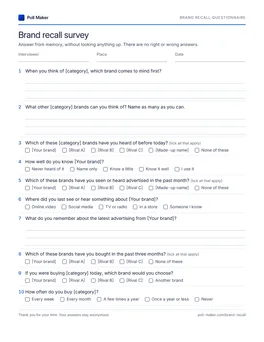
Brand recall questionnaire
Page one holds the recall core in interview order, with space for the interviewer and the place. Later pages carry the campaign, lift test, brand asset, event and about-you sets.
Download PDFRecall questions that give the answer away
Each weak version below leaks the answer or invites a polite yes. Our guide to survey question types covers the general fixes; these are the recall-specific ones.
Have you heard of [Your brand]?
When you think of [category], which brand comes to mind first?
Naming the brand first turns a memory question into a recognition question. Recall has to come before any name is on the screen.
Do you remember seeing our new ad?
Which of these brands have you seen or heard advertised in the past month?
Asking about one brand with only yes or no on offer invites a polite yes. A list with rivals, a made-up name and "None of these" gives people room to say no.
Which of these brands do you know: [Your brand], [Rival A], [Rival B]?
Which of these [category] brands have you heard of before today? (with a made-up name and "None of these")
Without a decoy or an exit, every tick looks like awareness. The extra options show how much is real.
How memorable is our logo, from 1 to 5?
Which brand does this logo belong to? (logo shown with the name hidden)
Rating memorability measures opinion. Matching the logo to a brand measures memory.
Brand recall, briefly: answers for marketers and students
Short answers for marketers planning a first wave, and for students writing a brand recall questionnaire.
What is brand recall?
Brand recall is being able to name a brand from memory when all you are given is the category or a need, such as "running shoes" or "somewhere to eat tonight". A survey measures it with an open question asked before any brand names are shown.
What is the difference between brand recall and brand recognition?
Recall is unprompted: people name the brand themselves. Recognition is prompted: they pick it from a list or identify its logo. Recognition is the easier task, so more people pass it. Experiments on TV ads found it is also the more sensitive measure, and that both fade after exposure.5 Measure both, recall first.
How do you calculate brand recall?
Divide the number of people who named your brand without help by the number who answered, and multiply by 100. For top-of-mind, count only the first brand each person named. The scoring table above covers aided awareness and the made-up-name check too.
What questions does a YouTube Brand Lift study ask?
One short question per metric, shown on YouTube before a video. The advertiser picks up to 3 metrics (ad recall, awareness, association, consideration, favorability, purchase intent or a custom question) and names their brand plus up to 3 competitors; Google writes the wording and always adds an opt-out such as "None of the above".2
How many responses does a brand lift study need?
Google expects to detect lift at about 2,000 responses per metric for a high-performing campaign and 4,100 at the recommended minimum budget.3 A smaller survey of your own can still show a large lift between two groups; keep both groups similar and the wording identical.
How often should you run a brand recall survey?
Before and after each major campaign, and on a steady rhythm in between, such as every quarter. Change nothing between waves: identical wording, identical order, one made-up name kept throughout and one kind of respondent, so any movement is real.
See who still remembers your brand
Open the recall core in the builder, fill in your category and rivals, and send it to category buyers, or take the printed version to your next event.