Willingness to pay survey questions to test a price before you set it
A willingness to pay survey describes your offer in a sentence or two, collects the price people expect and the most they would spend before any figure appears, then tests your own price with a yes or no and a check on how sure they are. The 9-question core does all of that in about three minutes.
- 33questions
- 9in the WTP core
- 3 minto answer the core
- 6optional sets
By Michael Hodge, BSc Psychology Updated September 2026
All 33 willingness to pay questions
The nine core questions are already selected. Switch on whole sets for plans, a four-price range, existing customers, business buyers or a public program, or pick questions one by one. Beneath each one you will find its answer choices and why that answer matters when you set a price.
The WTP core9 questions
Write one or two plain sentences about the offer into question 1 and your planned price into question 6. The two open price questions come before any number is shown, and the spending bands come after them.
-
Here is the idea: [describe the product in one or two sentences]. How useful would this be to you?
ExtremelyVerySomewhatNot veryNot at allEvery price below is read against this answer. Report the prices from the top two boxes on their own: they are the people you would actually sell to.
-
What do you use for this today?
A paid productA free toolDo it myselfPay someoneNothing yetNames the alternative each person prices you against. Someone on a free tool and someone already paying will not answer the price questions the same way.
-
What would you expect this to cost per month, in dollars?
Open answerExpectation, asked while the screen still shows no price, so no figure of yours can pull it up or down. For a brand-new product it gives you the range people have in mind.2
-
What is the most you would pay for this per month, in dollars?
Open answerThe direct ceiling. Read the median rather than the average, because a handful of very high answers pulls an average up.
-
About how much do you spend on this now, per month?
NothingUnder $10$10 to $49$50 to $199$200 or moreThe price already in their head. It sits after the open questions so its bands cannot steer them. Change the bands and currency to fit your market.
-
Would you buy it at [your price] a month?
YesNoNot sureThe one price test in the core. Keep "Not sure" in, as the NOAA panel advised for its vote questions, so undecided people are not forced to pick a side.4
-
How sure are you of that answer?
Definitely sureProbably sureI said not sureThe certainty follow-up. Count a buyer only when question 6 is yes and this is definitely sure; in a field test that count matched real purchases.3
-
How would you rather pay for a product like this?
One paymentMonthlyYearlyPer useSets the billing unit. If yearly wins, test a yearly price instead of twelve monthly ones.
-
What would stop you from buying it at that price?
Open answerThe objection behind a no. Sort the answers into price, trust, timing and missing features: only the first pile is fixed by charging less.
Prices and plans5 questions
For choosing between several prices, plans and extras. Replace the example prices with your own before sending.
-
Which is the highest of these monthly prices you would still pay?
$10$15$20$30None of theseA price ladder in one question. Anyone who picks $20 would also pay $15 and $10, so counting down from the top gives a demand curve (see the worked example).
-
Which plan would you pick?
Basic, $10Standard, $20Premium, $40None of theseShows what people choose when three plans sit side by side, the way your pricing page will show them.
-
Which of these extras would you pay more for?
Fast shippingSetup helpLive supportWarrantyNoneTick all that applySwap in your own extras. The ones few people tick belong inside a higher plan rather than on a price tag of their own.
-
Would you pay for a year up front to get two months free?
YesMaybeNoTests an annual discount before it goes on the pricing page.
-
How would a free trial change your decision?
Only after a trialA trial would helpNo differenceTells you whether a trial is the price of entry or a nice extra for this market.
Customers who already pay4 questions
For a price change. Existing customers answer these about what they pay today.
-
How would you rate the value for money you get from us?
Very poor12345Excellent1 = Very poor, 5 = ExcellentThe value for money question in its plainest form. Track it before and after any price change.
-
If the price went up by [amount], what would you do?
Keep payingMove to a cheaper planLook at other optionsCancelPut the real rise in the brackets. "Look at other options" is the answer to watch: those customers have not left yet.
-
What is the most you would pay each month before you would cancel?
Open answerThe point at which a current customer would leave: the number to stay under when you raise prices.
-
What would we need to add for a higher price to feel fair?
Open answerTurns a price rise into a plan: the features and service people would accept as the reason for it.
Business buyers4 questions
For products sold to organizations. The person answering may not be the person who pays, so these find the buyer and the budget.
-
Who signs off on buying something like this?
I doMy managerFinance or purchasingA committeeIf most answers are not "I do", the prices you collected come from people who recommend, not people who pay.
-
How much could you spend on this without asking anyone?
NothingUnder $100$100 to $499$500 to $1,999$2,000 or moreThe sign-off limit. A price just under it can be bought this week; a price over it waits for a meeting.
-
Which way of pricing would suit your team best?
Per userOne flat feeBy usageOne-off licenceThe unit you charge by often matters as much as the number. Pick the one buyers can predict.
-
Which budget would this come out of?
An existing budgetA project budgetA new budget lineNot sureA new budget line means a longer sale, whatever the price.
A public program (residents answer)4 questions
For a thesis or a council, utility or nonprofit study that prices a public service. Built on the referendum format the NOAA panel recommended: a budget reminder, a vote at a stated cost, then why.
-
If you paid more for this, what would you most likely spend less on?
Eating outSavingsOther billsNothingCould not pay moreA reminder of the household budget right before the vote, so the answer comes from real money rather than good intentions.4
-
How would you vote on [the program] at [$24] a year on your [bill]?
For itAgainst itWould not voteThe valuation question as a vote. Give different groups different amounts, keep the no-answer option, and the share voting for it at each amount traces the demand.4
-
Why would you vote that way?
Open answerSeparates "not worth it to me" from protest answers such as "someone else should pay", which are coded apart from real zero values.4
-
How much do you believe [the program] would work as described?
CompletelyMostlyPartlyNot at allA check on whether people accepted the description. Votes from people who did not believe it are read separately.
Four-price range (Van Westendorp)4 questions
Four typed-in prices from each person. Plotted together they give an acceptable range; send them as a block, in this order.
-
At what price would it seem so cheap you would doubt its quality?
Open answerThe floor. Prices below the point where most people start to doubt quality lose buyers instead of winning them.
-
At what price would it feel like a real bargain?
Open answerWhere the offer feels like good value. Plotted against the next question it marks the middle of the range.
-
At what price would it start to feel expensive but still possible?
Open answerThe point where price starts to weigh on the decision without ruling the product out.
-
At what price would it be too expensive to consider at all?
Open answerThe ceiling. Drop any row where this is lower than the bargain price before you plot.
About you (optional)3 questions
Three questions for splitting the prices by group. Keep the skip option on income.
-
Have you bought something like this in the past year?
YesNoNot sureLets you read prices from people who already buy in this category on their own.
-
What is your age?
18 to 2930 to 4445 to 5960 or olderOnly worth asking when your offer or your channels differ by age.
-
What is your yearly household income?
Under $35,000$35,000 to $74,999$75,000 to $149,999$150,000 or morePrefer not to sayIn the pharmacy field experiment, higher income went with more yes answers. If your prices show no rise with income at all, check that people understood the description.3
Which pricing question are you asking?
Each way of testing willingness to pay answers a different question. Find yours in the left column and send the questions beside it.
| Your question | What people answer | Questions here |
|---|---|---|
| What would people pay if I named no price? | An expected price and the most they would pay, typed in | 3 and 4 |
| Would they buy at the price I have in mind? | Yes or no at your price, then how sure they are | 6 and 7 |
| Which of a few prices earns the most? | The highest of four prices they would still pay | 10 |
| Will a price rise cost me customers? | Value for money, their reaction to a rise, their cancel point | 15 to 18 |
| What is a public service worth to residents? | A vote at a stated yearly cost, then the reason | 23 to 26 |
| What range of prices feels acceptable? | Four prices: too cheap, bargain, getting expensive, too expensive | 27 to 30 |
Where the survey hands over
When price is one feature among many, trade-off tasks (conjoint analysis) put a value on each feature, and they run in dedicated choice-design software. Once the survey has narrowed the range, a real-money check confirms it: take pre-orders or refundable deposits at your chosen price, or put the price on a live page and count sign-ups. For concept, brand and audience questions to run alongside a price test, browse the marketing survey questions.
Four ways to get prices people would really pay
Stated prices drift upward and lean toward whatever number people saw first. These four habits pull them back toward what buyers would actually spend.

Ask for their number before you show yours
Any price on screen becomes a starting point. In one study, 55 MBA students first said whether they would buy each of six products at a price equal to the last two digits of their social security number, then named the most they would pay. Students with above-median numbers named prices 57 to 107 percent higher, and for a cordless keyboard the top fifth offered $56 on average against $16 from the bottom fifth.2 So the core asks for the expected price and the most people would pay first, and the spending bands and your own price come after both.
Said yes to a diabetes program, all three prices
Count only the sure yeses
A yes on a survey costs nothing, so it runs high. When 267 people with diabetes, recruited at nine pharmacies, were offered a diabetes management program at $15, $40 or $80, some for real and some hypothetically, 45% of the hypothetical answers were yes against 26% of the real offers. A "cheap talk" paragraph asking people to answer as if they were paying left the yes rate at 45%. A follow-up asking whether they were probably or definitely sure worked: definitely sure yeses came to 24%, level with real purchases.3 Questions 6 and 7 are that pair.

Read every stated price as a ceiling
A meta-analysis of 77 studies that compared stated and real willingness to pay found stated amounts 21% too high on average.1 The gap was wider for specialty goods and pricier products, and wider for indirect methods than for simply asking. Its model put the overstatement for everyday goods at 9% for direct questions and 19% for indirect ones; for specialty goods it was 28% and 40%.1 Treat the median of question 4 as the top of your range, not the middle of it.
Show each person one price
A run of prices on one screen turns the survey into a comparison, and people start judging the prices against each other instead of against the product. To test two or three prices, make one copy of the survey per price, change the number in question 6, and send each link to a different part of your list. The ladder in question 10 is the planned exception: one choice among four prices, read as a demand curve.
Torn between monthly and yearly billing? Put it to your audience before you build the pricing page: turn the billing question into a live poll, share it, and see which way people lean within the hour. The poll-making walkthrough lists the places to post it.
From ladder answers to a price: a worked example
Question 10 asks each person for the highest of four prices they would still pay. Here is how 100 answers become a price. The numbers are an example; your own go in the same table.
| Monthly price | Would pay at least this | Revenue per 100 people |
|---|---|---|
| $30 | 12 | $360 |
| $20 | 12 + 18 = 30 | $600 |
| $15 | 30 + 20 = 50 | $750 |
| $10 | 50 + 15 = 65 | $650 |
Read it in three steps
- Add up from the top. The 18 people whose highest price was $20 would also pay $15 and $10, so each row includes everyone above it. The other 35 chose none of these.
- Multiply each price by the people who would pay it. Revenue peaks at $15 here, not at the $10 that the most people would pay.
- Take off your cost per customer. At $6 a month, $15 still wins: 50 x $9 = $450, against 30 x $14 = $420 at $20.
Then check the winner with a sure yes
Send the core with $15 in question 6 to a fresh group, and count only the people who answer yes and definitely sure. In a pharmacy field experiment, that count came out level with real purchases, while the plain hypothetical yes rate ran far above them.3 Plan on the smaller number.
First read on a new idea: the quick price check
For a first read on a new idea: the description and its usefulness question, the two open prices, then the yes or no at your price with its certainty follow-up.
- 01Here is the idea: [describe the product in one or two sentences]. How useful would this be to you?
- 02What would you expect this to cost per month, in dollars?
- 03What is the most you would pay for this per month, in dollars?
- 04Would you buy it at [your price] a month?
- 05How sure are you of that answer?
Four pricing questions that skew the answer, rewritten
Most bad pricing data starts with the wording. For every other question type, see our notes on writing clear survey questions.
Would you pay $49 a month for this?
What would you expect this to cost per month, in dollars?
Would you buy it at $49 a month?
As the opening question, your price becomes the anchor for every answer after it. Collect their number first, then test yours as a yes or no.
How much would you pay for our amazing new app?
Here is the idea: [plain description]. How useful would this be to you?
Praise in the question inflates the price. A plain description and a usefulness question give the price answers something real to rest on.
How much would you pay?
What is the most you would pay for this per month, in dollars?
With no unit or currency, one person answers per year, another per month and a third in euros, and the numbers cannot be added up.
Would you pay more for better quality?
Which of these extras would you pay more for?
Nearly everyone agrees to better quality in general. A list of concrete extras shows which ones earn a higher price.
Stalls, fairs and fieldwork: the paper sheet
Face to face, paper works: show the description, hand over the sheet and collect it before people walk on. Letter or A4, with room for handwritten prices.
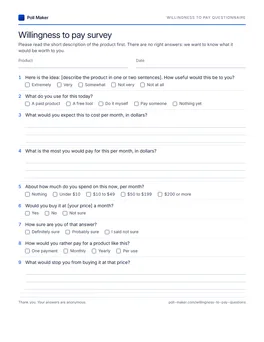
Willingness to pay questionnaire
The 9 core questions fill sheet one, with lines where people write their prices. The six optional sets run on from sheet two.
Download PDFWillingness to pay questions, answered
What people ask before they run their first pricing survey.
What is a WTP survey?
WTP stands for willingness to pay, the most a person would pay for a product or service. A WTP survey describes the offer, asks people what they would pay and tests one or more prices, so the price comes from buyers rather than from a guess.
How do you calculate willingness to pay from survey answers?
For typed-in prices, sort the answers to the most-you-would-pay question and take the median. For a price ladder, count how many people would pay at least each price and multiply by the price to see where revenue peaks, as in the worked example above. Then treat the result as a ceiling.
What is the difference between Van Westendorp and Gabor-Granger?
Van Westendorp asks each person for four prices of their own (too cheap, a bargain, getting expensive, too expensive) and gives a range. Gabor-Granger shows set prices and asks whether people would buy at each, which gives a demand curve. Here, the four-price range set is the first and the ladder in question 10 is a one-question take on the second.
How can you test willingness to pay without a survey?
Put a real price in front of real buyers: take pre-orders or refundable deposits, add the price to a landing page and count sign-ups, or show two prices to different visitors. The survey tells you which prices are worth testing that way.
Can I send this survey straight from this page?
Yes. Open the core in the free form builder, type your description into question 1 and your price into question 6, then share the link.
Find your price before you print it
Load the 9-question core into the builder, add a line about your offer and the price you have in mind, and send the link to people in your market today.