A spending habits questionnaire students answer and you can score
A spending habits questionnaire asks students where their money comes from, where it goes, and whether they plan, track and save it. This one starts with a 13-question core that takes about four minutes, then adds five optional parts for a thesis or a money lesson.
- 37questions
- 13in the core
- 4 minto answer the core
- Grade 9to college
By Michael Hodge, BSc Psychology Updated September 2026
The 37 spending habits questions
The core 13 starts ticked. Add whole parts to match your research questions, or pick questions one at a time. Every question comes with its answer options and the reason we included it.
The core 1313 questions
Where the money comes from and roughly how much, what it goes on, seven habit statements, how students pay, and what they do when money runs short. On its own it is a complete short questionnaire.
-
Where does most of your spending money come from?
Family allowancePaid workScholarship or grantStudent loanSelling or side gigsThe source shapes every other answer, and it is the grouping most spending studies compare first.
-
About how much money do you have to spend in a typical week?
Under $20$20 to $49$50 to $99$100 to $199$200 or moreBands are easier to answer honestly than an exact figure. Swap in your own currency, or a daily amount if students get a daily allowance.
-
Which of these do you spend money on in a typical week?
Food and snacksTransportSchool costsGoing outClothesGames and appsPhone and dataTick all that applyShows how widely spending spreads. The most-ticked areas are where the rest of your study should look closer.
-
I decide how much I can spend before the week starts.
Strongly disagree12345Strongly agree1 = Strongly disagree, 5 = Strongly agreePlanning ahead, the habit behind any budget, asked without the word "budget" that many students never use.
-
I know roughly how much I spent last week.
Strongly disagree12345Strongly agree1 = Strongly disagree, 5 = Strongly agreeTracking. A student who cannot agree here is spending without a picture of where the money went.
-
I save part of my money before I spend the rest.
Strongly disagree12345Strongly agree1 = Strongly disagree, 5 = Strongly agreeSaving first rather than saving whatever is left, which rarely adds up to much.
-
I stick to what I planned to buy when I shop.
Strongly disagree12345Strongly agree1 = Strongly disagree, 5 = Strongly agreeThe impulse question, worded so that agreeing is the good answer and every bar in the report reads the same way.
-
I compare prices before I buy anything costly.
Strongly disagree12345Strongly agree1 = Strongly disagree, 5 = Strongly agreePrice checking on bigger purchases, where it saves real money.
-
I can say no to plans with friends I cannot afford.
Strongly disagree12345Strongly agree1 = Strongly disagree, 5 = Strongly agreeFriends drive a lot of student spending. This asks whether the student stays in charge of it.1
-
My money usually lasts until my next allowance or pay.
Strongly disagree12345Strongly agree1 = Strongly disagree, 5 = Strongly agreeThe result of the six habits above. Read it next to the question on running out.
-
When your money runs out early, what do you usually do?
Borrow from familyBorrow from friendsUse my savingsGo withoutIt never runs outShows the safety net each student falls back on. Borrowing from friends is the answer to watch.
-
How do you pay for most things you buy?
CashDebit cardCredit cardE-wallet or phoneBuy now, pay laterPeople tend to spend more when no cash changes hands, so compare the habit statements across these groups.3
-
What is one thing you would like to change about how you spend money?
Open answerThe habit each student wants to fix, in their own words. Sort the answers into themes for your discussion.
Where the money goes5 questions
For papers that measure spending by area: food, school costs, transport, going out and phone. Each asks about a recent week or month that students can recall.
-
On a school day, how often do you buy food or drinks?
NeverRarelySometimesOftenAlwaysFood is the everyday spend, and the one students can cut most easily by bringing it from home.
-
Last month, how much did you spend on school costs such as supplies and printing?
NothingUnder $10$10 to $24$25 to $49$50 or moreThe educational spending area in most student studies, asked for one recent month so the total is easier to recall.
-
In a typical week, how much do you spend getting to and from school?
NothingUnder $5$5 to $14$15 to $29$30 or moreTransport is a fixed cost students cannot easily change. Set it apart before you judge anyone's habits.
-
How often do you spend money going out with friends?
NeverMonthly or less2 to 3 times a monthWeeklySeveral times a weekSocial spending, the area that most often pushes a week over plan.
-
In a typical month, how much do you spend on phone load, data or apps?
NothingUnder $5$5 to $14$15 to $29$30 or moreA recurring cost that grows quietly through subscriptions and in-app buys.
Saving habits5 questions
The saving half of a spending and saving study: how often, where the money sits, what it is for, and how hard it feels.
-
How often do you put money into savings?
Every dayEvery weekEvery monthNow and thenNeverRegular small amounts say more about the habit than one large deposit.
-
Where do you keep most of your savings?
Bank accountE-walletAt homeA family memberI have no savingsSavings kept at home are the easiest to dip into. Compare this with how long money lasts in the core.
-
What are you saving for?
School costsSomething I wantEmergenciesHelping my familyFuture plansNothing right nowTick all that applySeparates saving for a purchase from saving as a cushion, so you can compare the two groups.
-
I have savings I could use if something went wrong.
Strongly disagree12345Strongly agree1 = Strongly disagree, 5 = Strongly agreeAn emergency cushion: the saving that matters most when a cost arrives without warning.
-
Saving money feels easy for me.
Strongly disagree12345Strongly agree1 = Strongly disagree, 5 = Strongly agreeHow hard saving feels. Low scores alongside a high money band point to habits rather than income.
What pushes you to buy5 questions
For studies of buying triggers: friends, sales, social media and shopping online. The open question gives you quotes for the discussion.
-
How often do you buy something mainly because people around you have it?
NeverRarelySometimesOftenAlwaysPeer pressure, asked as something students do rather than something they believe.1
-
Which of these made you buy something in the past month?
A sale or discountA social media postAn influencerA friend's suggestionFree deliveryNone of theseTick all that applyNames the triggers. Useful when your study asks about advertising or social media.
-
How often do you shop online?
NeverMonthly or less2 to 3 times a monthWeeklySeveral times a weekOnline shopping removes the walk to the till. Compare it with the planned-buying statement in the core.
-
I wait a day before any unplanned purchase.
Strongly disagree12345Strongly agree1 = Strongly disagree, 5 = Strongly agreeA cooling-off habit that heads off regret buys, and a simple one to teach.
-
Think of something you bought and later regretted. What made you buy it?
Open answerRegret stories name the triggers students notice in themselves, and give your paper its quotes.
Budgets, cards and borrowing4 questions
For college students, who start to meet credit cards and pay-later plans. Leave it out for senior high respondents.
-
How do you keep track of what you spend?
Banking appBudget app or sheetNotebookIn my headI do not trackShows the tools students use. Read "In my head" and "I do not track" against the tracking statement in the core.
-
Do you have a credit card in your own name?
Yes, I pay it in fullYes, I carry a balanceNoCarrying a balance is where student spending turns into debt that charges interest.
-
Have you used buy now, pay later in the past year?
More than onceOnceNeverPay-later plans split a price into parts, which can make a purchase feel smaller than it is.
-
I know what it costs to borrow before I borrow.
Strongly disagree12345Strongly agree1 = Strongly disagree, 5 = Strongly agreeKnowing the interest and fees before signing is the basic credit skill.
About you (optional)5 questions
The respondent profile most papers report first. Ask only what you will compare, and keep "Prefer not to say" where it appears.
-
What year or grade are you in?
Grades 9 to 10Grades 11 to 12College year 1 or 2College year 3 or moreOtherStudies compare by year level. Edit the options to your school system, or to strands for senior high.
-
How old are you?
Under 1616 to 1718 to 2021 to 2425 or olderAge bands for the profile table. Keep them wide so small groups stay anonymous.
-
What is your gender?
FemaleMaleAnother genderPrefer not to sayA common comparison in spending studies. The last option means nobody is forced to answer.
-
Where do you live during term?
With familyDorm or boarding houseShared rentalOn my ownStudents living away from home pay for food and rent themselves, which changes most spending answers.
-
Do you work for pay during term?
NoUnder 10 hours a week10 to 19 hours20 hours or moreWorking students control more of their own money. Compare them with students on an allowance.
Match each research question to a part
Student studies of spending tend to share one outline: a profile of the respondents, their spending, and their saving. Pick the parts your statement of the problem asks for.
| Research question | Use these | Analyse with |
|---|---|---|
| What is the profile of the respondents? | About you, plus core 1 and 2 | Frequency and percent |
| What is the level of their spending habits? | The seven core statements | Weighted mean and mean range |
| Where does their money go? | Where the money goes | Frequency and percent |
| What is the level of their saving habits? | Saving habits | Weighted mean and percent |
| Do habits differ by gender, year or allowance? | About you against the core statements | t-test for two groups, ANOVA for three or more |
A study of 170 senior high school students in the Philippines used this three-part shape, then compared spending and saving by gender, age, strand, grade level and daily allowance.6
Open the form with one sentence on what the study is for, that no names are collected, and that students can skip it. Try it on five classmates first and reword anything two of them read differently.
Where the group stands on each money habit
Type in the number of 1s, 2s, 3s, 4s and 5s each habit statement received. Because agreement always marks the healthier habit, the weakest habit shows up as the shortest bar: start your findings, or your next money lesson, there.
- 1Take each statement's answer counts from the builder's results screen or your paper tally. The chart converts them to the share of students agreeing.
- 2Rank the statements against one another. The two lowest are the habits to discuss first in your findings.
- 3Split the answers by payment method or money source and chart each group, to test the differences your paper predicts.
- 4Pair the lowest bar with quotes from the open question about changing a habit. One quote per theme is plenty.
Student spending habits
Scoring the statements with mean ranges
Student papers usually report each statement as a weighted mean and give it a verbal description. Here is where the ranges come from, with a worked example.
| Mean range (5 points) | Description |
|---|---|
| 4.21 to 5.00 | Very high |
| 3.41 to 4.20 | High |
| 2.61 to 3.40 | Moderate |
| 1.81 to 2.60 | Low |
| 1.00 to 1.80 | Very low |
These are the ranges the senior high study above used.6 Each band is 0.80 wide: the distance from 1 to 5 is 4, split into five equal parts. On a four-point scale the bands are 0.75 wide: 1.00 to 1.75, 1.76 to 2.50, 2.51 to 3.25 and 3.26 to 4.00.
A worked example
Forty students rate "I know roughly how much I spent last week." Six choose 1, eight choose 2, ten choose 3, eleven choose 4 and five choose 5. Multiply each count by its score and add them up: 6 + 16 + 30 + 44 + 25 = 121. Divide by 40 and the weighted mean is 3.03, in the moderate band. Sixteen of the forty agree or strongly agree, which is the figure the report below charts.
No reverse scoring needed
Agreeing with any core statement means the healthier habit, so a higher mean always means a better habit. If you add a statement of your own where agreeing is the unhealthy answer, flip its scores (5 becomes 1, 4 becomes 2) before you average.
Getting honest numbers about money
Students answer money questions from memory, with one eye on what sounds sensible. Four choices in how you ask decide whether the numbers hold up.
What 15-year-olds did with money in the past year
Ask about saving and overspending together
Students do both. In the OECD's PISA 2022 assessment, 93% of 15-year-olds had saved money in the previous 12 months, yet 77% had bought something that cost more than they meant to spend, and 60% had bought something because their friends had it.1 A questionnaire that asks only about saving calls these students careful. The core puts planning, tracking, saving, impulse and friends side by side.

Ask about last week, not "usually"
Small purchases fade from memory fast. The US Consumer Expenditure Survey collects them with a diary kept for two consecutive one-week periods, and keeps recall questions for costs people can remember over three months or longer.2 So the questions here ask about a recent week or month for snacks, fares and load. For a deeper study, have students log every purchase for seven days and compare the log with their answers.

Find out how they pay
Payment method changes how much people spend. In studies with real purchases, Prelec and Simester found that willingness to pay rose when people were told to use a credit card instead of cash, in some cases doubling.3 Cards, e-wallets and pay-later apps all keep cash out of sight, so the core asks how students pay, and you can compare cash users with card users on every habit.

Use money bands and collect no names
Asked for an exact allowance, students round, guess or skip. Bands such as "$20 to $49" are quicker to answer and simpler to tabulate. Set them to your currency and to how students are paid: a daily allowance in senior high, a weekly or monthly amount in college. Keep the form nameless, and only show results for a group that is large enough to keep every member anonymous.
Teaching a money unit? Open the lesson with one question as a live class poll and put the results on the board before the discussion. The payment question works well. Sharing it by link or QR code is covered in our poll how-to.
A five-question money check-in
For a homeroom period or the first day of a money unit: how much students have, whether they plan and track it, whether friends steer it, and one habit they want to change.
- 01About how much money do you have to spend in a typical week?
- 02I decide how much I can spend before the week starts.
- 03I know roughly how much I spent last week.
- 04I can say no to plans with friends I cannot afford.
- 05What is one thing you would like to change about how you spend money?
Published money scales you can cite
Panels often want a validated instrument alongside a researcher-made one. These three sit well beside this questionnaire. Use their wording exactly as published and cite them; every question above is written by us.
CFPB Financial Well-Being Scale
Ten statements from the US Consumer Financial Protection Bureau about how secure and free a person feels with their money, scored from 0 to 100. There is also a five-item version, and the user guide says no permission is needed to use it.4 It measures well-being rather than habits, so it pairs with the core instead of replacing it.
Financial Management Behavior Scale
Dew and Xiao's scale asks how often, over the past six months, people carried out 15 money behaviours, from never to always, covering spending, cash management, saving and investing, credit and insurance.5 Several items assume bills, credit cards and retirement accounts, so it fits college students and adults better than senior high students.
PISA financial literacy results
The OECD's 2022 assessment asked 15-year-olds in 20 countries and economies about saving, overspending and the pull of friends.1 Its published results give your discussion chapter something to set your own findings against.
Hand out the questionnaire in a class period
Paper suits a class period or a campus table where phones stay in bags. Hand the forms out, give students about ten minutes, and collect them in a box so nobody can match a form to a face.
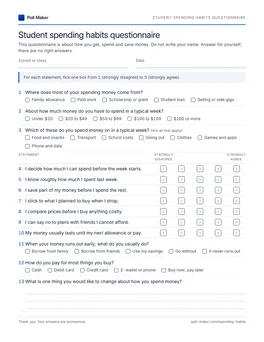
Student spending habits questionnaire
The core 13 with tick boxes first, then Where the money goes, Saving habits, What pushes you to buy, Budgets cards and borrowing, and About you.
Download PDF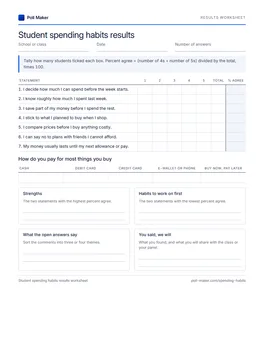
Tally and scoring sheet
Add up the paper answers to the seven core statements, work out what share agreed with each, and mark the habits to report first.
Download PDFMoney questions students struggle to answer
Weak questions give you numbers you cannot defend in front of a panel. Four common ones, fixed. Our survey questions handbook has the wider rules of wording.
How much is your allowance?
About how much money do you have to spend in a typical week?
An exact amount invites guesses and blanks. Bands are quicker, and "money to spend" counts wages and gifts as well as an allowance.
Do you spend and save wisely?
I save part of my money before I spend the rest.
I stick to what I planned to buy when I shop.
Two ideas in one, and "wisely" means something different to every student. Each better statement names one habit.
How much do you usually spend on food?
On a school day, how often do you buy food or drinks?
Small daily costs are hard to total from memory. How often, on a school day, is something a student can actually report.
Do you agree that impulse buying is bad?
I wait a day before any unplanned purchase.
The weak version tests an opinion nearly everyone shares. The better one asks what the student does.
Questions from student researchers
Short answers for thesis writers and the teachers who advise them.
Can I use these questions in my research paper?
Yes. Adapt them to your setting, pilot them with a few students, and describe the instrument in your method as researcher-made and adapted from this page. Run Cronbach's alpha on the seven core statements with your pilot answers to report reliability.
Should I use a four-point or a five-point scale?
Five points gives students a neutral middle, which suits habits that really are "sometimes". Four points makes everyone lean one way. Both work with mean ranges, and the scoring section gives the bands for each. Use one scale for the whole instrument.
How many respondents do I need?
It depends on your population and on how many groups you compare, so settle it with your adviser. Whatever the total, make every group you compare, such as Grade 11 and Grade 12, large enough to report without anyone being identifiable, and say in your method how respondents were chosen.
What is the difference between spending habits and financial literacy?
Spending habits are what students do with money: plan, track, save and buy. Financial literacy is what they know, such as how interest works, and is measured with questions that have right answers. Many papers measure both and test whether they are related.
How do I change the amounts for my currency?
Edit the answer bands in the builder. Keep five bands, put the typical amount for your students in the middle band, and use the period they are paid in: per day for a daily allowance, per week or month otherwise.
Send it to your respondents today
Load the core 13, add the parts your research questions call for, then send the link to respondents or run off paper copies for a class period.