Clothing survey questions to ask shoppers in store and online
The questions that matter most in a clothing survey are about fit, price and returns, because that is where shoppers get let down. Start with the 12-question shopper core, then add a set for store visits, online orders, a new design or fast fashion habits.
- 37questions
- 12in the shopper core
- 4 minto answer the core
- 5optional sets
By Michael Hodge, BSc Psychology Updated September 2026
Shopper core first, then the set for your shop
The shopper core is ticked. Add the set for your situation, or tick single questions from any of them. Every question shows its answer options and what the answers tell you, ready to share as a link, print for a counter, or copy into another form.
Shopper core12 questions
Twelve questions any clothes buyer can answer: how often and where they shop, what decides a purchase, five statements on size, fit, value, wear and returns, what they spend, and why the last item went back.
-
How often do you buy new clothes for yourself?
Every weekA few times a monthAbout once a monthEvery few monthsOnce or twice a yearSorts heavy buyers from occasional ones, so you can read every other answer by group.
-
Where did you buy most of your clothes in the past year?
Online storesChain stores in a mallSmall boutiquesDepartment storesSecond-hand or thriftShows which channel your shoppers already trust, and where a new brand would have to compete.
-
What matters most when you choose a piece of clothing? Pick up to three.
PriceFitFabric and qualityStyleComfortBrand nameHow it was madeTick all that applyA limit of three forces a choice. The top three answers are what your product pages and window displays should lead with.
-
I can usually find clothes in my size where I shop.
Strongly disagree12345Strongly agree1 = Strongly disagree, 5 = Strongly agreeMissing sizes lose the sale before fit even comes up. A low score is a stock and size-range problem.
-
Clothes I buy usually fit the way I expected.
Strongly disagree12345Strongly agree1 = Strongly disagree, 5 = Strongly agreeFit is the top reason clothes go back, so this is the statement to watch most closely.1
-
The clothes I buy are worth what I paid for them.
Strongly disagree12345Strongly agree1 = Strongly disagree, 5 = Strongly agreeValue, not price. Shoppers who pay little can still feel short-changed, and the reverse.
-
Clothes I buy keep their shape and colour after washing.
Strongly disagree12345Strongly agree1 = Strongly disagree, 5 = Strongly agreeQuality as a shopper sees it at home. Low agreement predicts complaints and no repeat purchase.
-
Returning or exchanging clothes that do not work out is easy.
Strongly disagree12345Strongly agree1 = Strongly disagree, 5 = Strongly agreeAn easy return is part of the purchase. A low score here makes shoppers hesitate at the checkout.
-
About how much do you spend on clothes in a typical month?
Under $25$25 to $50$51 to $100$101 to $200Over $200Places your shoppers on a price ladder. Change the currency and bands to fit your market before you send it.
-
The last time you returned clothes, what was the main reason?
Did not fitDid not like itOrdered two sizesNot as picturedNo returnsSeparates fit problems from style and photo problems. Each has a different fix.1
-
Where do you get ideas for what to wear?
Friends and familyInstagram or TikTokStore windows and displaysBrand emails or websitesMagazines or blogsI do not look for ideasTick all that applyTells a brand where its next customers are looking, and a store whether its displays still do their job.
-
What one thing would make buying clothes easier for you?
Open answerOne change, in the shopper's own words. Sort the answers into piles; the biggest pile is your next project.
After a store visit7 questions
For shops and boutiques. Put these on a QR code at the till or a card in the bag, so customers answer while the visit is fresh.
-
What brought you into the store today?
Something specificJust browsingBuying a giftA return or exchangeWalking pastRead every other store answer against the reason for the visit. Browsers and gift buyers need different help.
-
Did you find what you came in for?
YesPartlyNoI was only browsingThe simplest measure of a lost sale. Follow up the "No" answers with the reason question below.
-
If you left without buying something you wanted, what stopped you?
Not in my sizeToo expensiveDid not like the stylesThe queue was too longI bought what I wantedNames the fix: stock, price, range or staffing at busy times.
-
It was easy to find my way around the store.
Strongly disagree12345Strongly agree1 = Strongly disagree, 5 = Strongly agreeLayout and signage. Low scores often come from new customers who do not know where the sizes are.
-
Staff helped when I wanted help and gave me space when I did not.
Strongly disagree12345Strongly agree1 = Strongly disagree, 5 = Strongly agreeGood service in a clothing store is timing. This asks about both halves in one idea: being there without hovering.
-
I could get a fitting room quickly, and it was clean.
Strongly disagree12345Strongly agree1 = Strongly disagree, 5 = Strongly agreeShoppers who try things on are the ones about to buy. A slow or messy fitting room loses them at the last step.
-
How likely are you to recommend this store to a friend?
0123456789100 = Not at all likely, 10 = Extremely likelyA number to track visit after visit. Ask it last, so it sums up everything above it.
After an online order5 questions
For online shops. Send these a few days after delivery, once the customer has tried the clothes on.
-
When you are unsure of your size online, what do you usually do?
Check the size chartRead fit reviewsOrder two sizesPick my usual sizeSkip buying itShows how much ordering two sizes is costing you. Better fit information cuts that habit and the returns it causes.3
-
How did the clothes in your last order fit?
Too smallA little smallJust rightA little bigToo bigTells you which way a size runs. If most answers fall on one side, fix the size chart, not the customer.
-
The size chart helped me choose the right size.
Strongly disagree12345Strongly agree1 = Strongly disagree, 5 = Strongly agreeWhether your size information works for real bodies. Read it with the fit question above.
-
The product photos showed how the clothes really look.
Strongly disagree12345Strongly agree1 = Strongly disagree, 5 = Strongly agree"Not as pictured" is a common return reason. This finds it before the returns pile up.1
-
What would help you choose the right size online?
Garment measurementsThe model's height and sizeFit reviews from buyersA size finder quizPhotos on different body typesTick all that applyLets customers choose the next fix for your product pages.
Testing a new design5 questions
For a brand planning a collection or a single T-shirt. Show a photo or sketch of each design with the options, then ask these.
-
Which of these designs would you be most likely to buy?
Design ADesign BDesign CNone of theseThe head-to-head. Attach a picture to each option in the builder, and keep "None of these" so nobody is forced to pick.
-
What would you expect to pay for the design you chose?
Under $20$20 to $39$40 to $59$60 to $89$90 or moreAsk before you show a price, so the answer is the shopper's own sense of value, not an anchor you gave them.
-
Which fit would you choose for this piece?
SlimRegularRelaxedOversizedTells you which fit to cut the most of, and whether you need two fits at launch.
-
If it went on sale next month at that price, would you buy it?
DefinitelyProbablyNot sureProbably notDefinitely notPurchase intent. Count only "Definitely" when you estimate the first order; "Probably" answers over-promise.
-
What would you change about this design?
Open answerCollects the fixes before production, when they are cheap. Look for the same comment from several people.
Clothing habits and fast fashion6 questions
For sustainability projects, class research and brands that sell on durability. These ask what people do with clothes, not how green they feel.
-
About how many times do you wear a typical piece of clothing before you stop wearing it?
Under 5 times5 to 1011 to 3031 to 50More than 50Wears per garment is the measure the textiles research uses, so your results sit next to it.2
-
How often do you buy clothes second-hand?
NeverRarelySometimesOftenAlwaysA behaviour, not an opinion. Compare it with how often people buy new in the core.
-
How often do you buy clothes you had not planned to buy?
NeverRarelySometimesOftenAlwaysImpulse buying drives fast fashion. Read it next to spend and wears per garment.
-
How often do you mend clothes instead of replacing them?
NeverRarelySometimesOftenAlwaysRepair is the habit that keeps clothes in use longest, and the rarest one in most groups.
-
What do you do with clothes you no longer wear?
Give to charitySell them onlinePass to friends or familyTake to textile recyclingThrow them awayKeep themTick all that applyShows where clothes end up after use. A big "Throw them away" share makes a case for a take-back or swap day.
-
I would pay more for clothes that last twice as long.
Strongly disagree12345Strongly agree1 = Strongly disagree, 5 = Strongly agreeTests the durability promise directly. Pair it with the spend band to see who says yes.
About you (optional)2 questions
Only when you want to compare groups. Split results only by groups big enough to hide any single shopper.
-
How old are you?
Under 1818 to 2425 to 3435 to 5455 or olderFit, channel and spend answers often split by age. Keep the bands wide.
-
Which section do you usually shop in?
Women'sMen'sBothMostly for my childrenAsks about the clothes, not the person. Size and fit answers only make sense within a section.
Pick the set for your store, brand or project
Every version starts with the shopper core. Add one set, two at most, and the survey stays short enough to finish.
| You are | Add this set | Send it |
|---|---|---|
| A clothing store or boutique | After a store visit | QR code at the till or in the bag |
| An online clothing shop | After an online order | Email a few days after delivery |
| Starting a clothing brand | Testing a new design | To your followers and people who fit your customer |
| A student or researcher | Clothing habits and fast fashion | Classmates, family and a class poll |
Starting a brand from zero? Before you test designs, find out who you are selling to with the customer profile questions, and how that group splits its money with the spending habits questionnaire. More survey sets for launches and pricing are on the marketing survey questions page.
Four habits that change what ends up on the rail
Clothing surveys go wrong in the same few ways: asked too late, about the wrong thing, or with questions nobody can answer honestly. Four habits fix most of it.
Why online fashion shoppers sent clothes back
Put fit at the centre
When 8,393 customers of an online fashion retailer were asked why they returned clothes, 87.1% said the item did not fit, well ahead of not liking it (45.9%). Another 41.6% had ordered several sizes on purpose to choose at home.1 So the core covers sizes in stock, fit against expectation and the reason for the last return. In the field experiment by Gallino and Moreno, giving shoppers better fit information cut returns and multi-size orders.3
Ask after the try-on, not after the payment
A shopper who has just paid knows about the checkout and nothing about the fit. For online orders, send the survey a few days after delivery, when the clothes have been tried on and maybe washed. For a store, ask at the till about the visit, and save the fit questions for a follow-up message a week later.
Count wears instead of asking about values
Ask people whether they care about sustainable fashion and nearly everyone says yes. Ask how many times they wear a piece before it goes and you get a number you can compare. The Ellen MacArthur Foundation reports that the average number of times a garment is worn has fallen by 36% worldwide over 15 years.2 The fast fashion set asks about wears, second-hand buying, mending and disposal in the same concrete way.
Show the design before you name a price
For a new line, attach a photo to each design option, ask which one people would buy, and only then ask what they would expect to pay. Showing your price first anchors every answer. Treat "definitely would buy" as your real demand; the "probably" crowd shrinks on launch day.
Want a quick answer from your followers before a full survey? Post one question as a live poll for your customers and share the link in your story or newsletter. The channel question works well for that, and how to make a poll shows the other ways to share it.
Size, fit, value, wear and returns on one chart
Fill in the answer counts for the five core statements on size, fit, value, wear and returns. Agreeing is always the good answer, so the shortest bar is the weak spot: the thing a store should fix, or the gap a new brand can win on.
- 1Count the answers from 1 to 5 for each statement. The chart shows the share of shoppers who agree or strongly agree.
- 2Look at fit and returns together. Low scores on both mean returns are costing you customers, not only postage.
- 3Split the chart by where people shop, using the channel question. Online buyers and boutique regulars often rate fit very differently.
- 4Save the open answers for the end, and pull out two or three quotes that explain the lowest bar. Put them on the printed report.
Shopper core results
A one-minute survey for the receipt QR code
Keep a survey on a receipt QR code to about a minute. These five cover the lost sale, sizes on the rail, service and the number to track, plus one open answer.
- 01Did you find what you came in for?
- 02I can usually find clothes in my size where I shop.
- 03Staff helped when I wanted help and gave me space when I did not.
- 04How likely are you to recommend this store to a friend?
- 05What one thing would make buying clothes easier for you?
Fast fashion as a class project: a shorter set
Clothing and fast fashion are popular topics for school surveys, and a short set of ten works well for a class assignment.
Choose your ten
Take the first three questions of the shopper core, the five statements on size, fit, value, wear and returns, and two questions from the fast fashion set: times worn and what people do with old clothes. That gives you habits, opinions and one number to compare with published research.
Ask enough people
Aim for at least 30 answers so the percentages settle down, and ask more than one group, such as classmates and parents, so you have two sets of answers to compare. Say in one line at the start that the survey is for a school project, is anonymous and is optional.
Compare two groups
A result means more side by side. Compare students with adults, or people who buy second-hand with people who never do. The age question in the About you set makes that split for you.
Show one chart and one finding
Put the times-worn answers in a bar chart and write one sentence about what they show. The shopper core report further up this page charts the five statements for you to print.
Forms for a pop-up stall, market table or classroom
Paper works at a pop-up stall, a trunk show, a market table or in a classroom. Leave a stack by the till with a pen and a box for finished forms.
Clothing shopper questionnaire
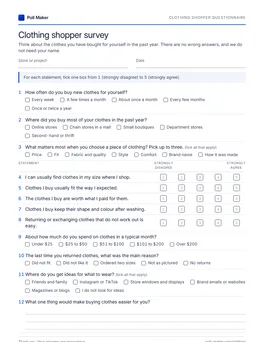
The shopper core with tick boxes first, followed by the store, online, new design, fast fashion and About you sets. Print the pages you need.
Download PDF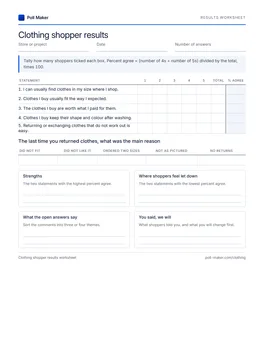
Results worksheet
Tally the five core statements and the return reasons by hand, turn each into a percentage agreeing, and mark the weak spot to fix first.
Download PDFWeak clothing questions and what to ask instead
Each weak version gets a polite answer that tells you very little. More pairs for other topics are in our survey question writing guide.
Do you like our clothes?
The clothes I buy are worth what I paid for them.
Clothes I buy keep their shape and colour after washing.
Liking is vague and polite. Value and wear are the two things a shopper actually judges, and each points to a fix.
How was the fit and quality of your order?
How did the clothes in your last order fit?
The product photos showed how the clothes really look.
Two questions in one. A customer happy with the fabric but not the size has no honest answer.
Would you buy sustainable clothing?
About how many times do you wear a typical piece of clothing before you stop wearing it?
Nearly every respondent says yes to the weak version. Wears per garment shows what people actually do.
Would you pay $45 for this T-shirt?
What would you expect to pay for the design you chose?
Naming a price anchors the answer. Let shoppers name their own band first, then test your price.
What shop owners and students ask about clothing surveys
For store owners, brand founders and students.
What questions should a clothing store survey ask?
Ask whether the customer found what they came for, whether their size was on the rail, how the staff and fitting rooms were, and how likely they are to recommend the store. The store visit set covers all of it in seven questions.
How do I survey people before starting a clothing brand?
Start with the shopper core to learn how your target customers buy, then show them your designs with the new design set. Ask which design they would buy, what they would expect to pay, and whether they would buy it next month.
How many questions should a clothing survey have?
Twelve to fifteen for most surveys: the core plus a few questions from one set. A receipt survey should stop at five. All 37 take about ten minutes, which suits a class project or a paid panel.
What are good fast fashion survey questions?
Questions about behaviour: how many times people wear a piece, how often they buy second-hand or on impulse, whether they mend clothes, and what they do with clothes they no longer wear. The fast fashion set asks all of these.
When should I send a survey after an online clothing order?
A few days after delivery, once the customer has tried the clothes on. Sooner, and they can only tell you about the delivery; much later, and they have forgotten the details.
Start with the shopper core and one set
Load the shopper core into the builder, tick the set for your store, shop, brand or class, and share the link or print the forms.