VALS survey, free online: your closest two of the 8 types
An independent VALS-style survey with an instant result and a plain-English guide to every type. The official survey went offline in 2024.
- 22statements
- 3 minto your closest two
- 8types explained
- Freeno sign-up or email
By Michael Hodge, BSc Psychology Updated September 2026
Your closest two types, and what they say about you
Answer the 22 statements in the profile card above and your full profile opens here: your closest and second-closest of the eight types, where you sit on the two dimensions, and how a marketer would reach you, ready to copy or print for an assignment. It is an independent VALS-style estimate built from our own statements. Poll Maker has no link to, and no endorsement from, SRI International or Strategic Business Insights.
The interactive self-check needs JavaScript. Score yourself by hand with the key below; it gives the same result. The statements are in the question list and on the printable questionnaire.
How your result is worked out
Nothing is hidden: the same rule scores the self-check, the paper questionnaire and any class survey you run from this page.
- Score every answer from 1 to 5, where Strongly disagree is 1, Neutral is 3 and Strongly agree is 5. Statement 22 (familiar brands and places) counts the other way round: use 6 minus your answer.
- Average each block. Ideals is statements 1 to 5, Achievement 6 to 10, Self-expression 11 to 15 and Resources 16 to 22.
- Innovators: Resources at 4.0 or higher, and all three motivation averages at 3.5 or higher.
- Survivors: Resources at 2.5 or lower, and no motivation average reaching 3.5.
- Everyone else: your highest motivation average is your main motivation, and Resources of 3.5 or more puts you on the higher row. Ideals gives Thinkers above the line and Believers below it, Achievement gives Achievers or Strivers, and Self-expression gives Experiencers or Makers.
- Second closest: when Resources is within 0.3 of 3.5, take the same motivation on the other row; otherwise take your next-highest motivation on the same row. Innovators take the higher-row type of their strongest motivation, and Survivors the lower-row one.
- If your two highest motivation averages are within 0.1 of each other, you sit between those two types on your row.
Worked example: Ideals 4.2, Achievement 3.6, Self-expression 2.8, Resources 4.0. Not Innovators, because Self-expression is under 3.5. Ideals is the main motivation and Resources is above the line, so the closest profile is Thinkers. Resources sits 0.5 from the line, so the second closest is the next motivation on the same row: Achievers.
The eight VALS types in plain English
VALS was created at SRI International in 1978, and the current eight-type system launched in 1989.1 Strategic Business Insights (SBI) owned and ran it until SBI closed in 2024.3, 8 VALS is a trademark of its owner. The descriptions below are our own words.
Two things place every type: what drives you, and what you have to act on it
The framework sorts adults on two dimensions.2 The first is primary motivation: ideals (guided by knowledge and principles), achievement (guided by success other people can see) or self-expression (guided by activity, variety and risk). The second is resources: income and education, but also energy, self-confidence, curiosity, novelty seeking and leadership. Resources decide how fully someone can act on a motivation, which is why each motivation splits into a higher and a lower type.
| Primary motivation | Higher resources | Lower resources |
|---|---|---|
| All three, with the highest resources | Innovators | |
| Ideals | Thinkers | Believers |
| Achievement | Achievers | Strivers |
| Self-expression | Experiencers | Makers |
| None dominant, with the lowest resources | Survivors | |
All eight at a glance
| Type | What they are like, and how a marketer reaches them |
|---|---|
| Innovators All three, highest resources | Innovators are confident, curious people with the most resources. They draw on all three motivations at once and are often first to adopt new ideas and technology. Reach them: Lead with what is genuinely new and well made. Early access, launch events, expert reviews and design detail reach this profile; generic discounts do not. |
| Thinkers Ideals motivation, higher resources | Thinkers are well-resourced planners guided by ideals. They research before they buy and favor proven, practical, long-lasting products. Reach them: Give the facts: specifications, independent test results, warranties and clear comparisons. Calm, reasoned messages in trusted publications land better than hype. |
| Believers Ideals motivation, lower resources | Believers are guided by ideals and have fewer resources. They hold to tradition, community and clear rules, and stay with brands they know and trust. Reach them: Speak to family, community and consistency. Familiar brands, local media, word of mouth and messages that show a product fits their values work best. |
| Achievers Achievement motivation, higher resources | Achievers are busy, goal-focused people with ample resources. Career and family sit at the center of their lives, and they like purchases that signal success. Reach them: Show how a product saves time and signals success. Premium positioning, respected brands, convenience and messages about getting ahead reach this profile. |
| Strivers Achievement motivation, lower resources | Strivers are driven by achievement and have fewer resources. They are keen to get ahead, enjoy fun and style, and like things that look successful. Reach them: Offer the look of success at an accessible price: affordable versions of aspirational brands, easy payment options, social media and creator content. |
| Experiencers Self-expression motivation, higher resources | Experiencers are energetic, social people with ample resources who are driven by self-expression. They chase new experiences and pick up fresh trends quickly. Reach them: Make it exciting and new: limited releases, events, travel, sport and entertainment tie-ins, and fast-moving social video. |
| Makers Self-expression motivation, lower resources | Makers express themselves through hands-on work. They are practical and self-reliant, and put their energy into the outdoors, family and home. Reach them: Show practical value and how things work: durable tools, DIY guides, how-to video and plain, no-nonsense claims. |
| Survivors None dominant, lowest resources | Survivors have the fewest resources and no single dominant motivation. They favor routine, familiar places and trusted brands, and spend carefully. Reach them: Stress value, reliability and familiarity: known brands, clear prices, discounts and loyalty rewards, through local stores and everyday media. |
Doing this for a class?
Most VALS assignments ask the same three things. Answer each one from your self-check result, and keep the facts and the name changes below for the quiz.
The three questions teachers set
| The assignment asks | What to write |
|---|---|
| What are your primary and secondary types? | Your closest and second-closest profiles, noting they come from an independent VALS-style self-check because the official survey is no longer offered. |
| How does the description fit you? Agree or disagree, and why. | Quote one line that fits and one that does not, for both types, then name the statement that pushed your score that way. |
| How could marketers use VALS? | Pick one product you buy and say how a brand would change its message, price or channel to reach your profile. |
A worked answer
"My closest profile is Thinkers, and Achievers is second. The research part fits: I read reviews and compare the facts before any big purchase, and I gave that statement a 5. The part about favoring proven products fits less, because I also gave a 4 to being among the first to try new products, and I bought my phone in its launch week. The Achievers description fits my goal setting but not the status part: I would not pay more for a brand just because it signals success. A laptop brand could reach me with independent test results and a long warranty, placed on review sites rather than in a celebrity advert."
Key facts for the test
- Eight types, placed on two dimensions: primary motivation (ideals, achievement or self-expression) and resources.2
- Resources cover energy, self-confidence, curiosity, novelty seeking and leadership as well as income and education.2
- SRI International launched the first VALS in 1978, based on the work of consumer futurist Arnold Mitchell. The current system launched in 1989; textbooks often call it VALS2.1, 4
- VALS began as short for Values and Lifestyles. Since 1990 it has been a name, not an acronym.3
- Strategic Business Insights, an SRI spin-off, owned and ran VALS until it ceased operations in May 2024.1, 8
- The eight types describe US adults. SBI built separate systems for other countries, such as UK VALS (1995, six groups).12, 13
Old names you will still see in slides
Course materials often mix three generations of names, which is where lists of "nine VALS types" and "Self-Actualizers" come from.9, 10, 11
| You may see | Where it comes from | Current name |
|---|---|---|
| Actualizers | The 1989 system, renamed between 2002 and 2003 | Innovators |
| Fulfilleds | The 1989 system, renamed between 2002 and 2003 | Thinkers |
| Strugglers | The 1989 system, renamed between 2002 and 2003 | Survivors |
| Believers, Achievers, Strivers, Experiencers, Makers | The 1989 system | Unchanged |
| Nine lifestyles: Survivors, Sustainers, Belongers, Emulators, Achievers, I-Am-Me, Experiential, Societally Conscious, Integrateds | The original 1978 VALS, in four groups | Replaced by the eight types in 1989 |
| Self-Actualizers | Never a VALS type. SRI described its top 1978 group, the Integrateds, as self-actualizing | No match: a list with it mixes the two systems |
Can you still take the official VALS survey?
Not any more. The official questionnaire has not been offered to the public since early 2024, and its owner, Strategic Business Insights, ceased operations that May.7, 8 You can still read the official descriptions and take our independent self-check above.
| When | What happened |
|---|---|
| Until late 2023 | SBI's free online survey asked 35 agree-or-disagree statements on a four-point scale plus a few background questions, and reported a primary and a secondary type.5, 6 |
| February 2024 | The survey page said the questionnaire was no longer provided publicly.7 |
| May 2024 | SBI ceased operations. Its closure notice points readers to the Internet Archive for its former website.8 |
| 26 September 2026 | We checked again: SBI's web address no longer resolves, so survey links in older course materials lead nowhere. |
The official type descriptions are still readable in the Internet Archive's copy of SBI's US framework and VALS types page, and SRI International keeps a short history of the VALS program.
Our self-check uses the same two public ideas but is not the official classifier. SBI's questionnaire combined attitude statements with demographics and its scoring was proprietary, so an official type and our closest profile can differ, most often for someone near the line between two types.5, 14, 17
Putting the eight types to work in a plan or a class study
VALS was sold for product development, positioning and communications. Here is how to use the types in a marketing plan or a class study, where critics say the framework falls short, and which version a textbook means.

One product, a different pitch for each type
Segmenting only pays off when it changes what you say. Take one product, an electric bike: show Thinkers the range test and the warranty, Achievers the time it saves on a busy commute, Experiencers the launch ride and Makers the repair guide. Pick one or two target types first, then build the product story around their motivation. SBI's own list of uses ran from new-product development to positioning and communications.4 The table of all eight gives a starting pitch for each type.

Running it on a class or a customer sample
Send the 22 statements as a survey or print them with the key, and add the write-up set so everyone reports their closest profile. A class describes that class, not a market, so call the spread indicative. In a sample, cut resources at the group's median rather than at 3.5, so the higher and lower rows split the people you actually asked. Keep the background set: in a study of over 45,000 people, demographics predicted some choices better and personality others, and the authors recommend using both.15 To profile real customers rather than textbook types, start from the customer profile survey or browse more marketing survey questions.
Where critics say VALS falls short
It was built for the United States: SBI itself said the survey was written for people whose first language is American English.6 It relies on self-report, so it captures how people see themselves. Its scoring was proprietary, and researchers comparing it with the public-domain List of Values counted that openness among the alternative's advantages.14 And any typology is a snapshot: SRI rebuilt VALS in 1989 around psychological traits, which its team found more stable than social trends and shared values.1
The versions you will meet in textbooks
The original VALS (1978) had nine lifestyles in four groups.9 The system launched in 1989, often called VALS2, has the eight types on this page, and three of them were renamed between 2002 and 2003.10, 11 SBI also built separate systems for other countries, because attitudes and buying connect differently across cultures: UK VALS, developed in 1995, has six core groups.12, 13
Opening a class on segmentation? Warm the room up with a live poll on the weekend question: the spread of answers previews the eight types before anyone opens the self-check. Our poll-making guide shows how to share the link and watch the votes come in.
All 33 questions: the self-check plus three optional sets
The 22 core statements are the self-check above, in the same order. Open them as a survey to run on a class or a customer sample, and add a set when you need product, write-up or background questions. Each one shows its answer scale and what it tells you.
The 22 lifestyle statements22 questions
Five statements for each of the three motivations and seven for resources, in the same order as the self-check and the paper key. On their own they give every respondent a closest and a second-closest profile.
-
When I choose what to buy, I check that it fits my values before I look at price or popularity.
Strongly disagree12345Strongly agree1 = Strongly disagree, 5 = Strongly agreeIdeals. Agreeing means principles decide a purchase before price or popularity do.
-
I would rather keep one well-made item for years than upgrade each time a new model comes out.
Strongly disagree12345Strongly agree1 = Strongly disagree, 5 = Strongly agreeIdeals. Agreeing points to buying for durability and function rather than for the newest model.
-
Before a big purchase, I read independent reviews and compare the facts.
Strongly disagree12345Strongly agree1 = Strongly disagree, 5 = Strongly agreeIdeals. Agreeing shows knowledge-led buying: research and facts come before the decision.
-
My everyday decisions follow a few firm principles that I rarely bend.
Strongly disagree12345Strongly agree1 = Strongly disagree, 5 = Strongly agreeIdeals. Agreeing means a personal code guides everyday choices, the heart of this motivation.
-
Duty to my family and community shapes how I spend my time and money.
Strongly disagree12345Strongly agree1 = Strongly disagree, 5 = Strongly agreeIdeals. Agreeing shows duty and tradition steering how time and money get spent.
-
I want the things I own to show how far I have come.
Strongly disagree12345Strongly agree1 = Strongly disagree, 5 = Strongly agreeAchievement. Agreeing means possessions work as signals of progress.
-
Reaching my career or income goals is a big part of how I judge my progress.
Strongly disagree12345Strongly agree1 = Strongly disagree, 5 = Strongly agreeAchievement. Agreeing means success is judged by career and income goals.
-
I notice which brands successful people around me choose.
Strongly disagree12345Strongly agree1 = Strongly disagree, 5 = Strongly agreeAchievement. Agreeing shows an eye on a valued peer group when choosing brands.
-
Each year I pick clear targets and check my progress against them.
Strongly disagree12345Strongly agree1 = Strongly disagree, 5 = Strongly agreeAchievement. Agreeing points to a plan-and-measure, goal-driven style.
-
I will pay more for a brand that signals success and quality.
Strongly disagree12345Strongly agree1 = Strongly disagree, 5 = Strongly agreeAchievement. Agreeing shows a willingness to pay for brands that look successful.
-
I spend on experiences, such as trips, concerts or sports, before I spend on things.
Strongly disagree12345Strongly agree1 = Strongly disagree, 5 = Strongly agreeSelf-expression. Agreeing puts doing things ahead of owning things.
-
Most of my free time goes to sport, going out or being with friends.
Strongly disagree12345Strongly agree1 = Strongly disagree, 5 = Strongly agreeSelf-expression. Agreeing points to active, social free time.
-
I enjoy DIY jobs such as repairs, gardening or building around the home.
Strongly disagree12345Strongly agree1 = Strongly disagree, 5 = Strongly agreeSelf-expression. Agreeing shows practical, hands-on ways of expressing yourself.
-
I choose what I buy to express who I am, not to impress anyone.
Strongly disagree12345Strongly agree1 = Strongly disagree, 5 = Strongly agreeSelf-expression. Agreeing means buying to show who you are rather than to impress.
-
Spontaneous plans usually beat carefully scheduled ones for me.
Strongly disagree12345Strongly agree1 = Strongly disagree, 5 = Strongly agreeSelf-expression. Agreeing shows a taste for variety and risk over routine.
-
I am usually among the first people I know to try a new product, app or service.
Strongly disagree12345Strongly agree1 = Strongly disagree, 5 = Strongly agreeResources. Agreeing marks an early adopter, one of the traits that raise this score.
-
I trust my own judgment on major purchases without needing a second opinion.
Strongly disagree12345Strongly agree1 = Strongly disagree, 5 = Strongly agreeResources. Agreeing shows self-confidence in big decisions.
-
Friends often ask me which product or service to choose.
Strongly disagree12345Strongly agree1 = Strongly disagree, 5 = Strongly agreeResources. Agreeing marks opinion leadership: other people treat you as a guide.
-
I have the energy to take on new projects on top of my usual routine.
Strongly disagree12345Strongly agree1 = Strongly disagree, 5 = Strongly agreeResources. Agreeing shows spare energy for new projects.
-
I have the time and money to act on what interests me.
Strongly disagree12345Strongly agree1 = Strongly disagree, 5 = Strongly agreeResources. Agreeing shows the means to act on interests, asked without an income question.
-
Science and new inventions are topics I follow closely.
Strongly disagree12345Strongly agree1 = Strongly disagree, 5 = Strongly agreeResources. Agreeing shows curiosity and a habit of seeking out information.
-
I prefer brands and places that are familiar to me.
Strongly disagree12345Strongly agree1 = Strongly disagree, 5 = Strongly agreeResources, scored in reverse. Agreeing points to low novelty seeking, which lowers the resources score.
Link the profiles to a product3 questions
For a marketing project: add these to see whether each profile shops the way its description predicts. Swap the phone for your own product in the builder.
-
When you choose a new phone, what matters most to you?
That it lasts and does the job wellThe newest featuresWhat the brand says about meThat it fits my style and interestsThe lowest priceEach option leans toward a different motivation, and lifestyle shapes buying through what people value in a product.16
-
Where do you usually first hear about something you end up buying?
Reviews and comparison sitesFriends or familySocial media or creatorsAdverts on TV, radio or streamingSeeing it in a storeShows which channel reaches each profile, the practical point of segmenting a market.
-
Which weekend sounds most like you?
A quiet one with family or close friendsGetting ahead on work or a side projectOut trying something new or activeFixing, making or growing something at homeKeeping it simple and spending littleA light warm-up that maps loosely onto the types and works as a live poll to open a class discussion.
For the class write-up4 questions
The three questions most VALS assignments set, ready to collect from a whole class in one survey, plus the profile each student got.
-
Which profile did the self-check give as your closest?
InnovatorsThinkersBelieversAchieversStriversExperiencersMakersSurvivorsTally this across the class to see how the room spreads over the eight types. The worksheet has a row for it.
-
Which parts of your closest profile describe you well? Give an example.
Open answerThe "how does it describe you" part of the assignment, grounded in a real purchase.
-
What does not fit you, and which statement do you think placed you there?
Open answerThe agree-or-disagree part. Pointing to one statement turns an opinion into an argument.
-
How could a marketer use your profile to sell you something you like?
Open answerThe application question, answered from your own buying rather than from the textbook.
About the respondent4 questions
Only when you compare groups. Lifestyle answers explain more next to a few basics, and none of these asks about income.
-
What is your age group?
Under 1818 to 2425 to 3435 to 4950 to 6465 or overResources shift with life stage, so age helps explain where people land.
-
What do you do most days?
StudyWork full timeWork part timeLook after home or familyRetiredSomething elseSeparates students from working adults, the first split most class samples need.
-
Where do you live?
A large cityA suburbA small townA rural areaWhat is on offer nearby shapes buying, so place matters when you compare profiles.
-
After essentials, how much of your budget is usually free?
NoneA littleSomePlentyA gentle stand-in for income that most people will answer, useful beside the resources score.
Print the questionnaire and scoring key for a class
No devices needed. Hand out the questionnaire, let everyone score themselves with the key printed at the top, then tally the class on the worksheet to see how the room spreads across the eight types.
Allow ten minutes, scoring included.
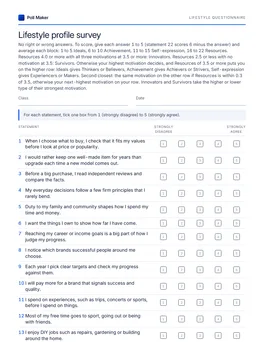
Lifestyle questionnaire
The full scoring key sits at the top, then the 22 statements, each with five boxes to tick. The optional product, write-up and background questions follow.
Download PDF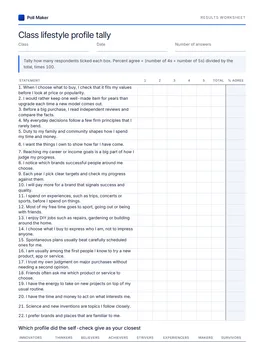
Class tally worksheet
Count how the class answered each statement, then tally how many landed closest to each of the eight types on the second sheet.
Download PDFThree weak lifestyle statements, and stronger ones
Writing your own psychographic questions for a project? These fixes apply to any lifestyle statement. The survey question guide covers more question types.
Do you like shopping and going out?
Most of my free time goes to sport, going out or being with friends.
Two activities in one question, and "like" measures a mood. The better version asks where free time actually goes.
Are you a successful person?
Reaching my career or income goals is a big part of how I judge my progress.
Almost nobody answers no to being successful. Asking what someone uses to judge progress separates the motivations.
How much money do you earn?
I have the time and money to act on what interests me.
Income questions get skipped or rounded. Resources in this framework means room to act, so ask about that.
VALS questions, answered in a line or two
Short answers to what students and marketers search for most.
What is my VALS type?
Take the free self-check on this page: 22 original statements give your closest and second-closest of the eight types, the primary and secondary type most assignments ask for. Official VALS types came only from SBI's own questionnaire, which has not been offered publicly since early 2024.7
What are the VALS segments?
Eight: Innovators, Thinkers, Believers, Achievers, Strivers, Experiencers, Makers and Survivors.2 Six pair a motivation (ideals, achievement or self-expression) with higher or lower resources; Innovators sit above with all three motivations and Survivors below with none dominant. See all eight in one table.
What does VALS stand for?
Values and Lifestyles, originally. The owner dropped the long form in 1990 and kept VALS as a name, so today it is not an acronym.3
What is the VALS framework?
A consumer segmentation system created at SRI International that groups US adults into eight types by primary motivation and resources, so marketers can see why people buy, not only who they are.1, 2
How does the VALS survey work?
The official version asked 35 agree-or-disagree statements on a four-point scale plus a few background questions, then reported a primary and a secondary type.5, 6 Our self-check works the same way in outline: 22 original statements on a five-point scale, averaged into three motivation scores and one resources score. The scoring key shows every step.
Who developed the VALS survey?
SRI International launched the first VALS in 1978, based on the work of consumer futurist Arnold Mitchell.4 A team from SRI, Stanford University and the University of California, Berkeley built the current system, launched in 1989.1 Strategic Business Insights, an SRI spin-off, ran it until it closed in 2024.8
Run the 22 statements with your class or customers
Open the self-check as an online survey for phones and laptops, or print the questionnaire and its scoring key before the next lesson.