Student needs assessment: 38 questions a school counselor can plan from
An educational needs assessment asks students where school is and is not working for them, in learning, planning ahead and wellbeing, so counselors and school teams can plan support around real needs. Start with the core 12, then bolt on whichever set matches what you are planning.
- 38questions
- 12in the core set
- 5 minto answer the core
- 3counseling domains
By Michael Hodge, BSc Psychology Updated September 2026
All 38 student needs assessment questions
Tick marks start on the core 12. Add a set for track choice, careers, support or college, or pick single items. Every item shows the options students pick from plus the reason a counselor asks it, ready for the builder, a printout or your own form.
Core 12: what students need this year12 questions
Eight statements across learning, future plans and personal support, a help list, how students want that help, and two open questions. Used alone, the twelve make a complete start-of-year needs survey.
-
I know what it takes to pass each of my classes.
Strongly disagree12345Strongly agree1 = Strongly disagree, 5 = Strongly agreeThe academic baseline. Low agreement in one grade usually points to unclear course expectations there.1
-
When I fall behind, I know where to get extra help.
Strongly disagree12345Strongly agree1 = Strongly disagree, 5 = Strongly agreeSeparates students who struggle from students who struggle and do not know that tutoring or office hours exist.
-
I have a plan for after high school.
Strongly disagree12345Strongly agree1 = Strongly disagree, 5 = Strongly agreeThe career domain in one line. Read it by grade: a low score in grade 11 matters more than in grade 7.1
-
I know which courses I need for the future I want.
Strongly disagree12345Strongly agree1 = Strongly disagree, 5 = Strongly agreeLinks course choice to plans. A gap here is the cue for a course-selection lesson before registration opens.
-
I have an adult at school I can go to with a problem.
Strongly disagree12345Strongly agree1 = Strongly disagree, 5 = Strongly agreeWhether support feels reachable. Students who disagree are the ones a counselor rarely sees without a survey.
-
I have ways to handle stress when school gets busy.
Strongly disagree12345Strongly agree1 = Strongly disagree, 5 = Strongly agreeThe social and emotional domain. Low agreement across grades is a class lesson; low in one group is a small group.1
-
I have at least one friend at school I can count on.
Strongly disagree12345Strongly agree1 = Strongly disagree, 5 = Strongly agreePeer connection. A small share disagreeing still names students worth a quiet follow-up plan.
-
Life outside school leaves me time for schoolwork.
Strongly disagree12345Strongly agree1 = Strongly disagree, 5 = Strongly agreeJobs, caring for family and long commutes show up here, and none of them is fixed by a study skills lesson.
-
What would you like more help with this year?
Study skillsA hard classCourse choicesCareersStressFriendshipsHome lifeTick all that applyThe count you plan from. Each option maps to a lesson, a group or a conversation, as the next section shows.
-
If you wanted help, how would you like to get it?
One to oneSmall groupClass lessonOnlineNo help neededTells you the format students will actually turn up for, before you book rooms and times.
-
What would make this school year go better for you?
Open answerAn open read on needs the list missed. Sort the answers into themes and compare them with the lowest bars.
-
What do you need that our school does not offer yet?
Open answerPoints past current services to what is missing, which is where new groups and programs come from.
Learning and grades5 questions
Add these when the core shows an academic gap, or when the school improvement plan targets grades and attendance.
-
I keep track of my assignments and due dates.
Strongly disagree12345Strongly agree1 = Strongly disagree, 5 = Strongly agreeOrganisation is one of the most teachable academic needs, and a quick win for a class lesson.
-
I know how to prepare for a big test.
Strongly disagree12345Strongly agree1 = Strongly disagree, 5 = Strongly agreeSeparates effort from method: students who study hard with poor methods need a different kind of help.
-
Which class is hardest for you this year?
MathScienceEnglishSocial studiesA languageNoneShows where tutoring or peer help would be used, subject by subject.
-
About how many school days did you miss last month?
None1 or 23 to 5More than 5Attendance as students report it. Compare with the attendance record before you act on it.
-
What gets in the way of homework?
No quiet placeNo deviceA jobFamily carePractice or clubsNothingTick all that applyBarriers the school can sometimes remove: a homework room, a loaned device or a later deadline.
College, career and next steps5 questions
For grades 9 to 12, or any grade where the core plan question scores low. Swap the options for the routes your students really take.
-
I know which jobs fit my interests.
Strongly disagree12345Strongly agree1 = Strongly disagree, 5 = Strongly agreeThe starting point for career lessons. Low agreement means an interest inventory is worth the class time.
-
I know how to apply to college, training or jobs.
Strongly disagree12345Strongly agree1 = Strongly disagree, 5 = Strongly agreeKnowing where you want to go is not the same as knowing the steps. This asks about the steps.
-
I know the ways to pay for college or training.
Strongly disagree12345Strongly agree1 = Strongly disagree, 5 = Strongly agreeFinancial aid knowledge. Pair a low score with a family evening on aid forms.
-
What do you plan to do first after high school?
Four-year collegeTwo-year collegeTrade trainingWorkMilitaryNot sure yetThe mix of plans in a grade decides which visits, speakers and application workshops to book.
-
Which of these would help you plan?
Career quizJob shadowingCampus visitAid forms helpCounselor meetingResume helpTick all that applyA ranked wish list for the career calendar, straight from the students it is for.
Choosing a track or courses (grades 8 and 10)5 questions
For the year before students pick a track, strand or pathway. It shows how settled the choice is and what is shaping it, and it gives a thesis on curriculum specialization a ready set of items.
-
Which path are you leaning toward next year?
University prepTechnical or vocationalArts and designSportsNot sure yetEdit the options to your own tracks or strands. The "not sure" share is the group to see first.
-
How sure are you about that choice?
Very sureFairly sureUnsureNo idea yetCertainty matters as much as the choice. Unsure students gain most from a taster day or a talk with older students.
-
What is shaping your choice most?
My interestsMy gradesMy familyMy friendsFuture jobsCostTick all that applyShows whether choices follow interest and ability or follow friends, which changes what the guidance lesson covers.
-
I know enough about each option to choose well.
Strongly disagree12345Strongly agree1 = Strongly disagree, 5 = Strongly agreeThe information need behind the choice. A low score calls for a track fair or a one-page comparison.
-
What do you still want to find out before you choose?
Open answerThe questions to answer at the information session, in the students' own words.
Stress, friends and support4 questions
Add these when the core stress, adult or friend statements come out low and you need to know where to start.
-
How often does schoolwork make you feel stressed?
NeverRarelySometimesOftenAlwaysHow widespread school stress is. "Often" and "Always" together size the audience for a coping lesson.
-
After something upsets me, I can settle and refocus.
Strongly disagree12345Strongly agree1 = Strongly disagree, 5 = Strongly agreeA coping skill a lesson can teach, asked as something students can judge about themselves.
-
I know how to tell an adult about bullying safely.
Strongly disagree12345Strongly agree1 = Strongly disagree, 5 = Strongly agreeWhether reporting routes are known. Pair it with the school safety survey if the answers worry you.
-
Who would you go to first with a personal problem?
A friendFamilyA teacherThe counselorNo one yetWhere help-seeking starts. A large "a friend" share makes a case for peer support training.
College and university students4 questions
For a college or university version. The core still works with "after high school" changed to "after graduation"; these add the campus needs that decide whether students stay.
-
I know where to get academic advising on campus.
Strongly disagree12345Strongly agree1 = Strongly disagree, 5 = Strongly agreeAdvising is the service students most often find too late. Low agreement in first-years is the cue for outreach.
-
This term, how often did money worries get in the way of study?
NeverRarelySometimesOftenAlwaysBasic needs, asked gently. A sizable "often" share justifies emergency aid or a food pantry.
-
Which campus services would you use if they were easier to reach?
TutoringWriting helpCounselingCareer officeDisability officeFood pantryTick all that applyServices that exist but are not reached. Better hours or location can meet the need without new spending.
-
How many hours a week do you work for pay?
None1 to 1011 to 2021 to 30Over 30Work hours explain a lot of unmet needs. Read the other answers split by this one.
About you (optional)3 questions
Ask only what you will analyse. Grade lets you plan by year group; the language question shows whether English learners have different needs.
-
What grade are you in?
Grade 6 to 8Grade 9 to 10Grade 11 to 12CollegePrefer not to sayThe first split to make. Most needs differ more by grade than by anything else you can ask.2
-
Are you learning English as a new language?
YesNoPrefer not to sayOne of the groups ASCA suggests checking for equity gaps.2
-
How long have you been at this school?
First year here1 to 2 years3 years or moreNew students often have needs, such as knowing where to go for help, that settled students no longer notice.
From answers to support: lesson, group or one to one
Question 9, the help list, tells you how many students want each kind of help. How widely a need is spread decides how you meet it.

ASCA's guidance for counselors is that areas of need "apparent across race, gender and SES status" can be covered "in school counseling core curriculum lessons", while specific needs belong "in small groups or individual interventions".2
- Spread across every grade and group: a schoolwide need. Plan a core lesson for every advisory or homeroom.
- Clustered in one grade or group: a shared, specific need. Offer a small group that meets for a few weeks.
- A handful of students, or an open answer that worries you: an individual need. Follow up one to one.
A worked example
Say 240 ninth and tenth graders answer. 96 tick Stress, spread evenly over both grades: that is two in five students, enough for a lesson on handling deadlines in every advisory group. 30 tick Course choices, and 26 of them are in grade 10: that is a small group before course selection opens. Two open answers mention trouble at home. Those students need a conversation, so hand out a separate, named "I would like to talk" slip next to the anonymous survey.
See which needs to plan for first
Type in the number of students at each point on the eight core statements. Agreeing with any of them means that need is covered, so the shortest bars mark where students need the most support.
- 1Gather counts for each statement, from the survey dashboard or the hand tally. The report treats every 4 and 5 as a need that is met.
- 2Read the two shortest bars next to the help list. When both point at the same area, that is the first lesson or group to plan.
- 3Split the counts by grade before deciding. A need that sits in one grade calls for a small group, not a schoolwide lesson.
- 4Give students and staff a short summary: what students said, and the lessons and groups you are adding because of it.
Student needs results
Getting the timing and the groups right
Three habits turn one class period of answers into a counseling calendar that fits your students.
Students per school counselor, United States
Hear from every student in one period
No counseling team can talk to every student in the first weeks of term. ASCA recommends 250 students per school counselor, and the national average in 2023-24 was 376, down from 385 the year before.3 A needs survey in advisory or homeroom hears from all of them in about five minutes, including the students who would never knock on the office door.

Split the results by group
ASCA describes the needs assessment as a survey that "offers a data-informed direction for a comprehensive school counseling program," and suggests asking about "grade level, gender, ethnicity, free and reduced lunch status, gifted status or English language learner status" to find barriers that sit with one group.2 Add only the groups your school tracks, and leave out any breakdown where a student could be recognised.

Run it early, then again in spring
Send it in the first month, so the answers set the lesson calendar and the small groups while there is still a whole year to use them. Repeat the core 12 in spring. The second round shows which needs shrank after your lessons and which ones call for a new approach.
Want a quick read in homeroom first? Project the help-format question as a live poll students answer on phones. Students can join by link or QR code, as our poll making walkthrough explains.
Validating the questionnaire for a thesis
Student researchers are usually asked to show that a questionnaire is valid and reliable before it goes out. Three checks cover what most advisers expect.

Content validity: three or more experts
Give each item to teachers, counselors or subject experts and ask them to rate its relevance from 1 (not relevant) to 4 (highly relevant). The item content validity index (I-CVI) is the share of experts who chose 3 or 4. Polit, Beck and Owen conclude that items with an I-CVI of .78 or higher, rated by three or more experts, show good content validity.5
Worked example: six experts rate "I know enough about each option to choose well." Five give it a 3 or 4, so its I-CVI is 5 divided by 6, or .83. Keep it. Another item gets 3 or 4 from four of the six experts, which is .67. Rewrite that one and ask again.
Reliability: alpha for each domain
After the pilot, compute Cronbach's alpha separately for each group of agree statements (learning, future plans, support), not for the whole questionnaire. Tavakol and Dennick explain that alpha "should be calculated for each of the concepts" when a test measures more than one, and that reported acceptable values range from 0.70 to 0.95.6
Pilot: watch where students hesitate
Ask a small group from the same grade to answer, then talk through any item they paused on or read twice. Fix the wording before you compute anything, because one confusing item drags down every statistic it is part of.
A homeroom or advisory version on paper
Some students answer more openly with a pencil than with a school login. Both files fit a letter or A4 sheet.
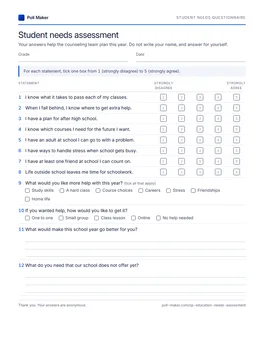
Student needs questionnaire
The first sheet carries the twelve starter questions under a grade line. The learning, career, track, support and college sets follow, so print only the pages your survey uses.
Download PDF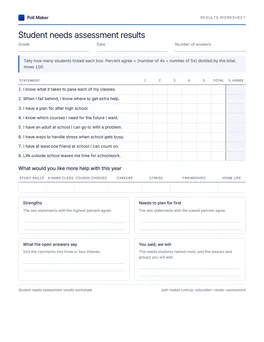
Results worksheet
Tally the eight core statements and the help list with a pencil, turn each into a percent met, and note the needs to plan for first.
Download PDFA five-question check-in for advisory
Only have a few minutes of homeroom? These five cover academic help, course planning, a trusted adult, the help list and one open question.
- 01When I fall behind, I know where to get extra help.
- 02I know which courses I need for the future I want.
- 03I have an adult at school I can go to with a problem.
- 04What would you like more help with this year?
- 05What would make this school year go better for you?
Where the student survey fits in a school needs assessment
Washington's OSPI describes a comprehensive needs assessment as examining data to address "the gap between the current state of a school or a district and the desired state".4 Student answers are one source among several.
| Source | What it shows | Where to get it |
|---|---|---|
| Student survey | Needs students name for themselves | The core 12 and sets on this page |
| Grades and attendance | Where results fall short | Your school data system |
| Teacher survey | Training and support staff need | The professional development survey |
| Staff and parent views | How the school runs and talks to families | The school improvement survey |
The toolkit asks teams to involve students at the secondary level and to make the extra effort "to hear from students who are most disenfranchised by their school experiences".4 In practice that means giving class time for the survey, bringing paper copies for students who rarely log in, and offering a translated version. The last phase narrows everything the data shows to three to five priority statements, so the student results should be summarised as a short ranked list, not a stack of charts.
Planning support for a group outside school, such as adult learners or a workforce? The general needs assessment survey is written for that.
Fixing the questions students misread
Four patterns that turn up on school needs surveys. Wording rules for every question type are collected on the survey questions hub for when you write your own.
Do you need help from the counselor? (Yes / No)
What would you like more help with this year? (tick list)
A yes or no tells you how many, not what. The tick list gives you a count for every kind of help you could offer.
Are you stressed about grades and college?
How often does schoolwork make you feel stressed?
I know the ways to pay for college or training.
Two worries in one question. A student stressed about one and not the other cannot answer honestly.
How would you rate our counseling program?
When I fall behind, I know where to get extra help.
Rating the program is an evaluation. A needs question asks about the student's situation, so the answer shows the gap.
Which college do you plan to attend?
What do you plan to do first after high school?
The first version assumes college. Listing trade training, work and military lets every student answer.
Student needs assessment: questions counselors ask
Short answers for counselors, school teams and student researchers.
What is a student needs assessment?
A short survey in which students say where they need support, usually across learning, future plans and personal or social needs. Counselors use the results to decide which class lessons, small groups and individual follow-ups to plan for the year.
What should a school counselor needs assessment include?
Statements from all three ASCA domains (academic, career, social and emotional), a list of help topics students can tick, how they would like help delivered, one or two open questions and a grade question. Every one of these is in the core 12.
Should a student needs assessment be anonymous?
Yes, for the survey itself. Students name real problems only when they cannot be identified. Offer a separate, named slip for anyone who wants to talk to a counselor, and keep it apart from the answers.
How is this different from a comprehensive needs assessment?
A comprehensive needs assessment is the whole school or district process: achievement, attendance, staff and family data as well as student views. A student needs survey is one input to it, and usually the only one that shows needs from the student's side.
How do I validate a needs assessment questionnaire for my thesis?
Ask three or more experts to rate each item for relevance and keep items with an I-CVI of .78 or higher, pilot it with a few students like your sample, then give Cronbach's alpha domain by domain. The validation section above has a worked example.
Plan the year from what your students say
Load the twelve starter questions into the builder so students can answer on any phone or laptop, or bring a printed stack to your next advisory period.