A study habits survey students score in three areas
A study habits questionnaire asks students how they plan their time, which methods they use to revise and what breaks their focus. This one starts with a core 12 that students can score themselves in three areas, then adds modules on test preparation, notes and study space.
- 27questions
- 12in the scored core
- 6 minto answer the core
- 3areas to score
By Michael Hodge, BSc Psychology Updated September 2026
Planning, methods, focus and more: 27 questions
The scored core starts ticked. Each question lists the answer choices and what the answer reveals. Add a module, drop what you do not need, then share your pick as a web survey, put it on paper, or copy the wording into another tool.
The scored core12 questions
Nine habit statements rated from Never to Always, three in each area you can score, then two questions on study time and revision method and one open question. Students answer about the last few weeks.
-
I plan which days and times I will study.
Never12345Always1 = Never, 5 = AlwaysPlanning area. In a survey of 324 undergraduates, the next deadline drove most studying, and most of all for lower performers.4
-
I spread revision for a test over several days.
Never12345Always1 = Never, 5 = AlwaysPlanning area. Spacing study out is one of the two techniques a major review rated most useful.1
-
I hand in homework by the time it is due.
Never12345Always1 = Never, 5 = AlwaysPlanning area. A plain record of follow-through that students can answer accurately.
-
I test myself without looking at my notes.
Never12345Always1 = Never, 5 = AlwaysMethods area. Practice testing is the other technique rated most useful, and one of the least used.1
-
I explain what I learned in my own words.
Never12345Always1 = Never, 5 = AlwaysMethods area. Self-explanation, out loud or on paper, shows whether the idea is understood or only familiar.
-
Within a day of a lesson, I go over my notes and add what I missed.
Never12345Always1 = Never, 5 = AlwaysMethods area. Catching what was missed while the lesson is fresh saves hours before a test.
-
My phone is out of reach while I study.
Never12345Always1 = Never, 5 = AlwaysFocus area. Time lost to distraction predicted lower exam scores in a study of 424 biology students.2
-
When I am stuck, I ask a teacher or classmate.
Never12345Always1 = Never, 5 = AlwaysFocus area. Getting unstuck quickly keeps a session moving instead of ending it.
-
I get a full night of sleep before a test.
Never12345Always1 = Never, 5 = AlwaysFocus area. In a survey of 324 undergraduates, lower performers were more likely to study late at night.4
-
Outside class, how long do you study on a typical weekday?
NoneUnder 30 min30 to 60 min1 to 2 hoursOver 2 hoursTime on task, to read next to the habit scores. More hours with weak methods is still a weak result.
-
When you revise for a test, what takes up most of your time?
Reading notes againHighlighting or copyingFlashcards or self-quizzingPractice questionsExplaining it to someoneThe single most telling answer on the page. The first two are the common, low-yield choices; the last three make students recall.3
-
What gets in the way of studying the way you would like to?
Open answerStudents name the real obstacle, such as a job, a shared room or not knowing where to start. It tells you which fix fits.
Test preparation5 questions
Add these in the weeks before exams, or when the core shows students revise by reading their notes again.
-
I find out what a test will cover before I revise.
Never12345Always1 = Never, 5 = AlwaysRevision without a target spreads effort thin. A low score is fixed by one clear topic list.
-
I work through practice questions or past papers.
Never12345Always1 = Never, 5 = AlwaysAnother form of practice testing, and the closest rehearsal of the real thing.1
-
I mix different topics in one revision session.
Never12345Always1 = Never, 5 = AlwaysInterleaving. Rated moderately useful: it trains students to pick the right method, not just repeat one.1
-
I stay calm enough in tests to show what I know.
Never12345Always1 = Never, 5 = AlwaysWorry about exams works against grades, so a low score here needs a conversation, not a study tip.5
-
When a test comes back, I check what I got wrong.
Never12345Always1 = Never, 5 = AlwaysShows whether a marked test becomes the start of the next round of study or the end of this one.
Study space and distractions4 questions
For students who study at home, in shared rooms or on the move, and whenever the phone statement scores low.
-
Where do you do most of your studying?
My own roomA shared room at homeSchool or college libraryElsewhere at schoolSomewhere elseTells you whether a quiet library slot or study hall would help more students than advice would.
-
About how much of your study time is lost to distractions?
Almost noneAbout a tenthAbout a quarterAbout halfMore than halfDistraction as a share of time. College students in one study put their own figure at about a fifth.2
-
What distracts you most while you study?
Phone notificationsSocial mediaGames or videosNoise or people nearbyFeeling tiredMy own thoughtsTick all that applyNames the distraction so the fix fits it. Notifications and noise call for different changes.
-
Do you usually study alone or with others?
Always aloneMostly aloneAbout half and halfMostly with othersGroup study helps when members quiz each other and hurts when it turns social. Read it next to the methods area.
Reading and notes4 questions
For courses with heavy reading, or when students say they read the chapter and remember little of it.
-
I take notes in class in my own words.
Never12345Always1 = Never, 5 = AlwaysCopying word for word keeps the pen busy and the mind idle. Own-words notes show processing.
-
Before reading a chapter, I look over the headings.
Never12345Always1 = Never, 5 = AlwaysA two-minute preview gives the reading a frame, so details have somewhere to land.
-
I turn headings into questions and answer them.
Never12345Always1 = Never, 5 = AlwaysTurns passive reading into recall. Students who never do this usually reread instead.
-
I draw diagrams or tables to link ideas together.
Never12345Always1 = Never, 5 = AlwaysShows whether students connect ideas across a topic or learn each fact on its own.
About you (optional)2 questions
Only for comparing groups or for a research project. Keep each group big enough that no single student can be identified.
-
Which stage of school are you in?
Middle schoolHigh schoolCollege or universityAdult classesPrefer not to sayHabits change a lot between school and college, so compare stages rather than pooling them.
-
What were most of your grades last term?
Mostly AMostly A and BMostly B and CMostly C or belowPrefer not to sayLets a research project set habits next to grades. Swap in your own grading bands in the builder.5
A scored copy for each student, a tally for you
Paper suits a homeroom period or a study skills lesson. Students keep their own scored copy, and you keep the tally. Both files print on letter and A4.
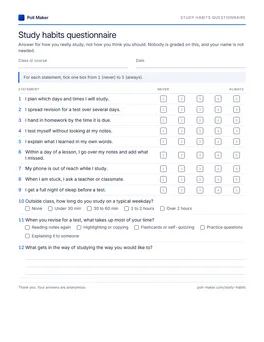
Study habits questionnaire
The scored core with Never to Always boxes on page one, followed by the test preparation, study space, notes and background modules.
Download PDF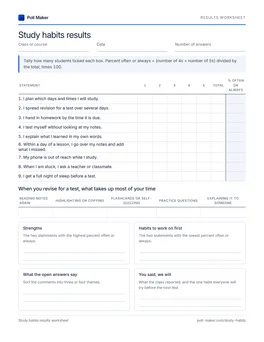
Class tally worksheet
Tally the boxes for every statement, turn them into the share of students answering Often or Always, and circle the habits to work on first.
Download PDFScore your study habits in three areas
Students can score the core on their own paper in two minutes. Count Never as 1, Rarely 2, Sometimes 3, Often 4 and Always 5, then add the three statements in each area.
| Area | Statements | If this is your lowest area |
|---|---|---|
| Planning your time | Plan study days, spread revision, hand in on time | Put three short study slots in your calendar for the next test instead of one long night. |
| How you study | Test yourself, explain in your own words, fill gaps in notes | Swap one rereading session for flashcards or a blank page where you write down all you remember. |
| Focus and support | Phone away, ask when stuck, sleep before tests | Put the phone in another room for one session and see how much further you get. |
Each area scores from 3 to 15. Compare your three areas with each other, not with a friend: the lowest one is where a small change pays off first.
A worked example
Take an example tenth grader who scores Planning 12, How you study 6 and Focus 10, and ticks "Reading notes again" for the revision method. The plan writes itself: keep the schedule, and spend the first half of each study slot answering questions from memory before opening the notes. After the next test, the student answers the core again to see whether the methods score moved.
Teachers can add up the same scores for a whole class with the results worksheet PDF, or ask the time management questions when Planning is the weak area for most students.
Getting answers that describe how students really study
Students overrate the habits they know they should have. These four choices keep the answers close to what actually happens at the desk.
Study methods 424 biology students used for an exam
Ask about each method on its own
A single "how well do you study" rating hides the mix. When one biology course asked about each method separately, almost every student read their notes, three in four quizzed themselves, and only one in six rewrote notes word for word.2 The same study found that students who used more active methods, and gave them a bigger share of their time, scored higher on exams. So testing, explaining and filling gaps each get their own statement in the core.

Watch the revision method answer
Rereading feels productive because the page looks familiar. In one survey of 177 college students, 84% listed rereading as a strategy and 55% called it their number one, while 11% said they practised recalling the material.3 A review of ten techniques rated rereading and highlighting low and practice testing high.1 If most of a class picks the first two options on the revision question, teach one swap: close the notes and write down everything you remember first.

Count distraction as lost time
Asking "do you get distracted?" gets a shrug. Asking what share of study time goes to distractions gets a number students can act on. In the biology course above, students put it at about 20% on average, and those who reported more distraction scored lower on exams even with study time held equal.2 The phone statement in the core and the distraction module turn that into something a student can change tonight.

Time it around a real test
Habits are easiest to recall right after they were used. Give the questionnaire in the days after a big test, while students remember how they prepared, and again after the next one to see whether the change they chose stuck. Keep it ungraded, and let students keep their scored copies.
Curious how your class revises? Put the revision method question up as a live poll and let students vote from their phones. Seeing the split on screen starts a study skills lesson better than any slide. The step-by-step poll guide shows the ways to share it.
When homeroom only has a few minutes
No time for the full core? These five catch the habits that matter most: a plan, self-testing, the phone, the revision method and the obstacle in the student's own words.
- 01I plan which days and times I will study.
- 02I test myself without looking at my notes.
- 03My phone is out of reach while I study.
- 04When you revise for a test, what takes up most of your time?
- 05What gets in the way of studying the way you would like to?
Using the questionnaire in a research project
Many students search for a study habits questionnaire for a thesis or class project, often to compare habits with grades. The set works for that with four adjustments.
Get consent and keep it anonymous
Explain the purpose on the first screen, say that every question can be skipped, and collect no names. Students under 18 usually need school approval and a note home.
Sample whole sections
Ask every student in the classes you pick rather than posting an open link. Volunteers tend to be the most organised students, which flatters the results.
Add the grades question and report area scores
Switch on the About you module, then report the mean of each area score by grade band. A large meta-analysis of 344 samples found study habit and skill measures rival admission test scores and previous grades as predictors of college grades.5 The academic performance questionnaire adds workload and support questions if your project needs them.
Cite a published scale where you need one
If your supervisor asks for a validated instrument, the learning strategies section of the MSLQ has 50 items rated on a seven-point scale, and its manual is free to read on ERIC.6 The questions here are original, shorter and written for school as well as college.
Study habit questions that get vague answers, fixed
Most weak questions on this topic ask students to judge themselves. The fixes ask about behaviour instead. For fixes that work on any topic, see the survey question guide.
Do you have good study habits?
I test myself without looking at my notes.
I spread revision for a test over several days.
Everyone knows the right answer to a yes or no about good habits. Specific behaviours rated by frequency show what a student really does.
How many hours do you study, and do you take breaks?
Outside class, how long do you study on a typical weekday?
Two questions in one. Ask about time on its own, and leave breaks out unless you will act on the answer.
Do you get distracted when studying? (Yes / No)
About how much of your study time is lost to distractions?
Almost every student says yes. A share of time separates the student who glances at a message from the one who loses the evening.
Don't you agree that cramming the night before is a bad idea?
I spread revision for a test over several days.
Leading wording pushes students toward the answer you want. A neutral statement about their own week gets an honest spread.
Study habits questionnaire FAQ
Quick answers for teachers, advisors and student researchers.
What questions should a study habits questionnaire include?
Cover planning (when students study and whether they space it out), methods (self-testing, explaining, reviewing notes), focus (phones, sleep, asking for help), study time and one open question on obstacles. The core 12 on this page does exactly that.
Which study habits make the biggest difference?
Testing yourself and spreading study over several sessions have the strongest evidence behind them. A review of ten common techniques rated both high and rated rereading and highlighting low.1
How do students score the questionnaire?
Give each answer from Never to Always a score of 1 to 5 and add the three statements in each area: planning, methods, and focus and support. Each area runs from 3 to 15, and the lowest one is the place to start.
Is this a study habits test with right and wrong answers?
No. It is a self-report questionnaire, so it works best when students answer honestly and nothing rides on the result. Use the scores to choose one habit to change, not to rank students.
Can I use it for high school and college students?
Yes. The statements work for students from middle school through university. For younger students, read the statements aloud and use three answers: never, sometimes, always.
Find out how your students study
Send the scored core as an online survey today, or download the questionnaire and hand it out after the next test.