Feedback questions teachers answer at the end of a PD session, and six weeks later
The best PD feedback asks whether a session will change what happens in class tomorrow, not whether the coffee was hot. Give teachers the core 12 before they leave the room, then send a short follow-up six weeks later to see what they actually used.
- 38questions
- 12for the end of a session
- 4 minto answer the core
- 6 weeksto the classroom check
By Michael Hodge, BSc Psychology Updated September 2026
All 38 PD feedback questions
Every item shows the choices a teacher will see and why we kept it. You start with the core 12 selected, and each set you tick joins the builder hand-off, the printable view and the Copy text.
End of session: the core 1212 questions
Nine statements built on the features of PD that change teaching, one readiness question, then two open prompts. Between them they show whether this session fit, whether teachers practised, and what each person plans to try first.
-
The session matched the subjects and grades I teach.
Strongly disagree12345Strongly agree1 = Strongly disagree, 5 = Strongly agreeContent focus is the first feature of PD that changes practice. A low score means the session stayed generic, however polished it was.2
-
I saw a clear model of the strategy in action.
Strongly disagree12345Strongly agree1 = Strongly disagree, 5 = Strongly agreeA video, a sample lesson or real student work gives teachers a clear picture of good practice that a description alone cannot.2
-
I got to try the strategy during the session.
Strongly disagree12345Strongly agree1 = Strongly disagree, 5 = Strongly agreeActive learning, the difference between a lecture about a strategy and a rehearsal of it.2
-
I planned with colleagues how we will use it.
Strongly disagree12345Strongly agree1 = Strongly disagree, 5 = Strongly agreeLearning alongside colleagues from the same school, grade or subject is one of the structural features linked to teacher learning.7
-
The ideas built on my own teaching experience.
Strongly disagree12345Strongly agree1 = Strongly disagree, 5 = Strongly agreeAdults learn by connecting new ideas to experience. A low score from veterans often means the session started from zero.6
-
The facilitator understood classrooms like mine.
Strongly disagree12345Strongly agree1 = Strongly disagree, 5 = Strongly agreeCredibility. Advice lands better from someone who clearly knows students like yours.
-
I know exactly what I will try in class next.
Strongly disagree12345Strongly agree1 = Strongly disagree, 5 = Strongly agreeA usefulness rating. Ratings like this track later use on the job better than ratings of enjoyment.5
-
This session was worth the time it took.
Strongly disagree12345Strongly agree1 = Strongly disagree, 5 = Strongly agreeThe plain value check. Read it beside the pacing and content questions to see whether length or substance is the problem.
-
I know who will support me when I try this.
Strongly disagree12345Strongly agree1 = Strongly disagree, 5 = Strongly agreePD that ends at the door rarely changes practice. A low score says to name a coach or a follow-up date before people leave.2
-
How ready are you to use this with students?
Ready nowReady with supportNeed more practiceNot for my roleSplits the room into who can start Monday, who needs a coach and who needs another session. The worksheet counts each group.
-
What will you try first, and with which class?
Open answerTurns intention into a plan with a time and a place. These answers become the list for the six-week follow-up.
-
What would make the next session more useful?
Open answerOne request per person. Group the answers and the two biggest piles are the agenda changes for next time.
Delivery and pacing6 questions
Add these for a full PD day or a session with several presenters, when you need to know how it ran as well as whether it helped.
-
The pace of the session was:
Too slowA bit slowAbout rightA bit fastToo fastShows which way to adjust. A room split between both ends usually means mixed experience levels, not a bad presenter.
-
For the time we had, the amount of content was:
Too littleAbout rightToo muchCramming is easy to see from the front of the room and hard for teachers to say out loud. This puts a number on it.
-
Which parts helped you learn most?
ModelingPracticePlanning timeDiscussionStudent workHandoutsTick all that applyTells you what to keep when the agenda is cut. The parts nobody ticks can go first.
-
The facilitator adjusted when the group got lost.
Strongly disagree12345Strongly agree1 = Strongly disagree, 5 = Strongly agreeResponsive facilitation. A low score often explains a low readiness count.
-
The slides and handouts will still help next month.
Strongly disagree12345Strongly agree1 = Strongly disagree, 5 = Strongly agreeMaterials teachers keep and reuse carry the session into the classroom.
-
The room and schedule made it easy to focus.
Strongly disagree12345Strongly agree1 = Strongly disagree, 5 = Strongly agreeHeat, noise, late starts and no breaks. Logistics can sink good content, and they are the cheapest fix.
Online and self-paced sessions5 questions
For webinars, recorded courses and PD run through an online platform or teacher community.
-
The platform and links worked the whole time.
Strongly disagree12345Strongly agree1 = Strongly disagree, 5 = Strongly agreeSeparates a technology problem from a content problem before anyone rewrites the session.
-
I talked with other teachers, not just watched.
Strongly disagree12345Strongly agree1 = Strongly disagree, 5 = Strongly agreeOnline PD drifts into a broadcast. This checks whether breakout rooms or discussion threads did their job.
-
I can go back to the recording and materials.
Strongly disagree12345Strongly agree1 = Strongly disagree, 5 = Strongly agreeSelf-paced learners return to the material when they plan. If they cannot find it, the session ends at logout.
-
Where else do you learn from other teachers online?
Social media groupsOnline forumsDistrict platformPodcastsNowhere yetTick all that applyShows which online teacher communities your staff already use, so follow-up material goes where they are.
-
How would you rather take a session like this?
In personLive onlineSelf-paced onlineA mixFormat preference for the next round. Compare it with the barriers question in the planning set.
Six weeks later: back in the classroom7 questions
Send these to the same group four to eight weeks after the session. They ask what changed in class, which no end-of-session form can tell you.
-
Since the session, how often have you used the strategy?
Not yetOnce or twiceAbout weeklyMost daysThe headline number for any PD program: how many teachers are using it, and how often.1
-
I can see a difference in my students' work.
Strongly disagree12345Strongly agree1 = Strongly disagree, 5 = Strongly agreeA first read on student outcomes. Follow it up with the work itself, not the rating alone.1
-
Someone has watched me try it and given feedback.
Strongly disagree12345Strongly agree1 = Strongly disagree, 5 = Strongly agreeCoaching has solid causal evidence behind it. A low score means nobody has seen the strategy in a real lesson yet.4
-
I have had time to plan lessons that use it.
Strongly disagree12345Strongly agree1 = Strongly disagree, 5 = Strongly agreePlanning time is the condition schools most often forget. Without it, even keen teachers stall.
-
School leaders expect us to use it and back us up.
Strongly disagree12345Strongly agree1 = Strongly disagree, 5 = Strongly agreeOrganization support, one of the five levels of PD evaluation. Mixed messages from leaders stop a new practice fast.1
-
What has made it harder to use?
TimeMaterialsClass sizeUnclear stepsNo follow-upNothing so farTick all that applyNames the fix. Time and materials go to leaders; unclear steps go back to the facilitator.
-
What have you noticed in student work since you started?
Open answerConcrete examples to bring to the next PLC or staff meeting, and the start of an evidence file for the program.
Planning next year's professional learning5 questions
Use this set in spring, or tack it onto any session form, while you draft the PD calendar for next year.
-
Which topics would help you most next year?
AI toolsBehaviorSpecial educationReadingMathAssessmentSELTick all that applyIncludes the areas US teachers flag most often as high needs, from AI to behavior. Edit it to match your school plan before sending.3
-
Which formats help you learn best?
WorkshopsCoachingPLC timePeer visitsOnline coursesConferencesTick all that applyGives staff a say in how they learn, which adult learners expect.6
-
When should professional learning happen?
Before schoolAfter schoolRelease daysSummerPlanning periodsScheduling decides attendance. Read it next to the barriers question.
-
What gets in the way of professional learning for you?
No timeSchedule clashesNo incentivesCostNo coverTick all that applyIncludes the barriers US teachers report most often. The one your staff tick most is the one to plan around.3
-
What one skill do you most want to build next year?
Open answerEach teacher names a goal of their own. It makes a good opener for a coaching conversation.
About you (optional)3 questions
For comparing roles, experience levels or grade bands. Skip any breakdown so small that a colleague could guess who answered.
-
What is your role?
Classroom teacherSpecialistParaprofessionalCoach or leaderOther staffThe same session can land very differently for a classroom teacher and a paraprofessional.
-
How many years have you worked in education?
0 to 23 to 56 to 1011 to 2021 or moreNew teachers and veterans need different next steps. Compare readiness by experience.3
-
Which grades do you work with?
Pre-K to 23 to 56 to 89 to 12Several levelsShows whether a session fit one grade band and missed the rest.
Which level of PD evaluation each question covers
Thomas Guskey sorts PD evaluation into five levels, in this order, from how participants reacted to what changed for students.1 An end-of-session form can only reach the first two or three. This table shows where each question on this page sits, and when to ask it.
| Level | What it asks | Ask it with |
|---|---|---|
| Reactions | Was the time well spent, and did it make sense? | Questions 1 to 8 and 13 to 18, on the day |
| Learning | Did teachers gain the knowledge and skill? | 3, 7 and 10, plus a short practice task |
| Support | Did the school make it easy to use? | 9 on the day; 27 and 28 later |
| Use | Are teachers using it, and using it well? | 24, 26 and 29, plus a classroom visit |
| Students | What changed for students? | 25 and 30, plus real student work |
Guskey is blunt about level 4: that information "cannot be gathered at the end of a professional development session."1 Teachers need weeks to fit a new practice to their own classes, so book the six-week follow-up when you plan the session. Survey answers at levels 4 and 5 are self-reports; pair them with walkthrough notes and samples of student work before you judge a program. Staff and student surveys on other school topics sit in our education survey questions list.
A stack on every table before the closing activity
Put a stack of forms on each table before the closing activity and collect them in a tray at the door. Print one per teacher on standard office paper, letter or A4.
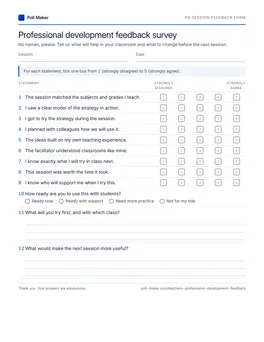
PD session feedback form
The first sheet is the core 12, laid out for a pen. The delivery, online, six-week and planning sets come after it, ready to keep or cut.
Download PDF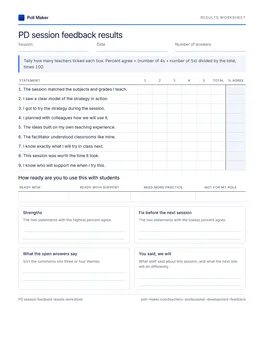
Results worksheet
Tally the nine statements by hand, turn each into percent agree, count the readiness groups, and write down what changes next time.
Download PDFKeeping PD feedback out of the drawer
PD feedback only pays off when someone acts on it. These four practices keep the forms out of a drawer and in the next agenda.

Collect it before the closing activity
Guskey names end-of-session questionnaires as the tool for level 1, the reactions of participants.1 Timing matters more than wording: once the final slide is up, people start packing. Hand out the form, or show a QR code that opens the core 12, before the last activity and allow five minutes. Paper for people without a phone, a link for everyone else.
Barriers US teachers named to professional learning
Plan around what keeps teachers away
In the OECD's 2024 teacher survey, US teachers named lack of time as the biggest barrier to professional learning (67%), then clashes with their work schedule (59%) and a lack of incentives (54%).3 Only half (50%) said the PD they took in the past year had a positive impact on their teaching.3 The planning set asks your own staff the same things, so next year's calendar fits the time they actually have.
Book the six-week follow-up on the day
Effective PD rarely happens in one sitting. In a review of 35 studies with positive results, 31 described PD sustained over time, and the most common model was an intensive workshop, then classroom practice, then more sessions or coaching.2 Send the six-week set four to eight weeks after the session, when teachers have tried the strategy with real classes. The answers to question 11 tell you what to ask each person about.
Use the answers to plan coaching
Coaching has strong causal evidence behind it. A meta-analysis of 60 studies with causal designs found average effects of 0.49 standard deviations on teachers' instruction and 0.18 on student achievement.4 Question 10 on the day and question 26 six weeks later show who wants that support. A teacher who picked "Ready with support" and still has no one watching a lesson is the first person to call.
Before the forms go round, project the readiness question as a live poll: teachers vote from their phones and the whole room sees the split in seconds. It works just as well with students, using these classroom poll questions, and our steps for running a poll cover links, QR codes and results.
Build a one-page report from the forms
Enter the tallies for the nine statements, from paper forms or the online results. The panel ranks them from strongest to weakest, shows how divided the staff are on each, and marks the two to fix before the next session.
- 1Anything rated 4 or 5 counts as agreement. The panel turns those answers into a percentage of all teachers who rated that statement.
- 2Look at the model, the practice and the planning statements together. If all three are low, the session was mostly talk, and the fix is to build in rehearsal time.
- 3Check the readiness counts next. Everyone who picked "Ready with support" goes on the coaching list for the six-week follow-up.
- 4Open the next session by telling staff one change that came from their feedback. People answer the next form more carefully when they see the last one used.
PD session results
Agenda overran? A shorter exit form
Agenda overran and people are packing up? These five cover fit, practice, a clear next step and readiness, and still leave space for one request.
- 01The session matched the subjects and grades I teach.
- 02I got to try the strategy during the session.
- 03I know exactly what I will try in class next.
- 04How ready are you to use this with students?
- 05What would make the next session more useful?
Adult learning principles, turned into survey questions
Malcolm Knowles described how adults learn differently from children.6 Each of his assumptions suggests a question to put to teachers after a PD session. Researchers and PD designers can use this table to show that a feedback form rests on adult learning theory.
| Adult learners... | So ask | Question here |
|---|---|---|
| Draw on their experience | Did it build on what they already do? | 5 |
| Want to apply learning right away | Do they know what to try next? | 7 and 11 |
| Learn when a new role or problem calls for it | Did it fit the grades and subjects they teach? | 1 |
| Direct their own learning | What do they want to learn, and how? | 31, 32 and 35 |
| Are driven by internal motives | Was it worth their time? | 8 |
| Need to know why they are learning | Did they see the strategy work? | 2 |
The same fact sheet notes that adults learn by doing, so tasks beat memorized content. Question 3, on trying the strategy during the session, checks exactly that.6
Rating the session, not the snacks
Three questions found on many PD evaluation forms, with sharper versions. Questions about usefulness predict later use on the job better than questions about enjoyment.5 For question types and wording tips beyond PD, see our survey questions hub.
Did you enjoy today's session?
I know exactly what I will try in class next.
Enjoyment rates the snacks and the presenter's jokes. The better version asks whether the session gave teachers something to do.
Was the presenter knowledgeable and engaging?
The facilitator understood classrooms like mine.
I got to try the strategy during the session.
Two ideas in one question, and knowledge is hard for the audience to judge. Ask about fit and practice, which teachers can answer from experience.
Will you use what you learned today?
What will you try first, and with which class?
Six weeks later: Since the session, how often have you used the strategy?
A yes or no question invites a polite yes. A named plan on the day, checked against real use later, shows what happened.
PD feedback: what coordinators ask
Quick answers for PD leads, coaches and principals planning their next survey.
What questions should a professional development feedback survey include?
Ask whether the session fit teachers' subjects and grades, whether they saw a model and practised, whether they know what to try next, and who will support them. Add a readiness question and two open questions: what they will try first and what would improve the next session. The core 12 above asks all of this in about four minutes.
When should you send a PD feedback survey?
Twice. The core 12 goes out before the session closes, when every participant is still seated. Send the six-week set four to eight weeks later, once teachers have had time to use the strategy with their classes.1
Should PD feedback surveys be anonymous?
Yes, for the end-of-session form. An anonymous form makes it easier to be candid about a session a colleague ran. For the six-week follow-up, an optional name lets a coach offer help, so say plainly how names will be used.
How do you measure the impact of professional development?
Go beyond the end-of-session form. Guskey's five levels run from reactions and learning to school support, use of new skills and student outcomes.1 The six-week set covers use and support; add classroom visits and student work for the last two levels.
Can I use these questions for after-school or extended day staff?
Yes. Swap "class" for "program" or "group" where it appears and drop the grades question. The delivery, online and planning sets work for after-school, extended day and support staff training as written.
Put the form on the closing slide
Have the core 12 open on the closing slide as a link, with paper forms on every table for anyone who prefers a pen.