Student engagement questionnaire with behavioral, emotional, cognitive and agentic scores
Measure how involved students are in what they do, feel, think and say at school. The core 12 gives each of the four engagement indicators two statements, and students finish it in about five minutes.
- 33questions
- 4engagement indicators
- 5 minfor the core 12
- Grade 6to college
By Michael Hodge, BSc Psychology Updated September 2026
The engagement item bank, sorted by indicator
Beside each engagement item you will find its scale or choices plus a note on what a low result means. The core 12 starts selected; switch modules on or off to fit your school, then launch your set online, print copies for homeroom, or move the wording to a tool you already use.
The core 1212 questions
Two statements for each indicator (doing, feeling, thinking, speaking up), a question on boredom, a tick list on what holds attention, and a pair of open prompts. Use it across a school, or put one class name at the top.
-
I join in during lessons without being asked.
Strongly disagree12345Strongly agree1 = Strongly disagree, 5 = Strongly agreeBehavioral: participation a student chooses, not the kind a teacher calls for.
-
I finish my work even when it feels dull.
Strongly disagree12345Strongly agree1 = Strongly disagree, 5 = Strongly agreeBehavioral: effort that holds up when the task is not exciting.
-
Most of my classes hold my interest.
Strongly disagree12345Strongly agree1 = Strongly disagree, 5 = Strongly agreeEmotional: interest across the day. A low score here with a high one on effort means students comply without caring.
-
I look forward to school on most days.
Strongly disagree12345Strongly agree1 = Strongly disagree, 5 = Strongly agreeEmotional: how school feels before the first bell. It tends to fall first when something outside lessons goes wrong.
-
I try another way when a topic is hard to follow.
Strongly disagree12345Strongly agree1 = Strongly disagree, 5 = Strongly agreeCognitive: whether students work at understanding or wait for the answer.
-
I link new ideas to things I already know.
Strongly disagree12345Strongly agree1 = Strongly disagree, 5 = Strongly agreeCognitive: the habit that turns a lesson into something that sticks.
-
I tell my teachers what helps me learn.
Strongly disagree12345Strongly agree1 = Strongly disagree, 5 = Strongly agreeAgentic: students shaping the lesson they get. It predicted grades over and above the other three indicators.2
-
I ask questions when I do not understand.
Strongly disagree12345Strongly agree1 = Strongly disagree, 5 = Strongly agreeAgentic: the most visible way a student steers their own learning. Low scores often mean asking feels risky.
-
In how many of your classes are you bored most days?
NoneOne or twoAbout halfMost of themAll of themCounts classes instead of asking for a feeling. In one national high school survey, about half of students said they were bored every day.3
-
Which of these hold your attention in a lesson?
DebatesGroup projectsHands-on tasksChoice of topicReal examplesCreative workTick all that applyTells you which formats to use more. High school students have rated discussion and group projects among the best ways to learn.3
-
Think of a lesson this year that grabbed you. What was going on?
Open answerStudents describe the conditions that work for them, in their own words.
-
What would make you want to take a bigger part in school?
Open answerOne request per student. Sort the answers into piles and the biggest pile is your first change.
One lesson: the exit check5 questions
Five quick questions for the last two minutes of a single lesson. Use them to compare two lessons, not to grade a teacher.
-
How hard was today's lesson?
Too easyA bit easyAbout rightA bit hardToo hardLessons pitched too easy or too hard both lose students. Read the spread, not the middle.
-
Time went fast during this lesson.
Strongly disagree12345Strongly agree1 = Strongly disagree, 5 = Strongly agreeA plain way to ask about deep concentration without using the word.
-
Today's lesson taught me something I will use.
Strongly disagree12345Strongly agree1 = Strongly disagree, 5 = Strongly agreeWhether the lesson felt worth the time. TNTP asked about worth next to engagement in every lesson it surveyed.4
-
Which word fits how you felt for most of the lesson?
CuriousFocusedJust okayBoredLostSeparates bored (too little challenge) from lost (too much), which call for opposite fixes.
-
What would have made today's lesson better?
Open answerOne idea from each student while the lesson is still fresh.
Belonging and relationships5 questions
Add these when the emotional scores come back low and you want to know whether people, not lessons, are the reason.
-
Most students here are kind to one another.
Strongly disagree12345Strongly agree1 = Strongly disagree, 5 = Strongly agreePeer climate. Students who dread the hallway rarely engage in the classroom.
-
My teachers ask about my goals and interests.
Strongly disagree12345Strongly agree1 = Strongly disagree, 5 = Strongly agreeClassrooms where teachers often talked with students about interests and goals saw clearly higher engagement.4
-
I have classmates I can count on when things go wrong.
Strongly disagree12345Strongly agree1 = Strongly disagree, 5 = Strongly agreeSupport from friends, which keeps students coming through a hard term.
-
I feel at home at this school.
Strongly disagree12345Strongly agree1 = Strongly disagree, 5 = Strongly agreeBelonging to the place as a whole, the heart of emotional engagement.1
-
Is there an adult at school you could go to with a problem?
Yes, more than oneYes, oneNot sureNoEvery "No" is a student to connect with an adult this month.
Beyond the classroom3 questions
Clubs, teams and events are part of behavioral engagement too. Add these for a whole-school survey.
-
How many school clubs, teams or activities are you in?
NoneOneTwoThree or moreA simple count to compare year groups. Students with none are the ones to invite.1
-
How often do you go to school events outside class time?
NeverA few times a yearAbout once a monthEvery weekShows who treats school as more than lessons.
-
What stops you joining more school activities?
TimingTransportWork or familyCostNothing appealsNot knowing anyoneTick all that applyNames the barrier, so the fix fits it: a late bus is a different problem from a club nobody wants.
College and university6 questions
For courses and campuses. The questions move from lessons to courses, instructors and study time.
-
My courses push me to think harder than I expected.
Strongly disagree12345Strongly agree1 = Strongly disagree, 5 = Strongly agreeAcademic challenge, one of the four themes NSSE reports for colleges.6
-
This term, how often have you talked with an instructor outside class?
NeverOnce or twiceA few timesOftenContact with faculty beyond lectures, which many students never have.
-
I study with classmates before tests or deadlines.
Strongly disagree12345Strongly agree1 = Strongly disagree, 5 = Strongly agreeLearning with peers. A low score in a first-year course is a cue to set up study groups.
-
People on campus would notice if I stopped showing up.
Strongly disagree12345Strongly agree1 = Strongly disagree, 5 = Strongly agreeBelonging at college, asked in a way that makes isolation easy to admit.
-
In a typical week, how many hours do you spend preparing for class?
0 to 56 to 1011 to 1516 to 20Over 20Time on task outside class, to read next to the challenge score.
-
What would help you get more out of your courses this year?
Open answerStudents name the support or change that would matter most to them.
About you (optional)2 questions
Only for comparing groups across a school. Report a group only when enough students are in it that nobody can be singled out.
-
Which stage of school are you in?
Middle schoolHigh school, grades 9 to 10High school, grades 11 to 12College or universityPrefer not to sayEngagement usually falls with age, so compare each stage with itself over time.4
-
How many school days did you miss last month?
None1 or 23 to 5More than 5Not sureAttendance is the most visible behavioral indicator. Read it next to the core scores.1
The four indicators, and how to score them
Researchers describe engagement as behavioral, emotional and cognitive,1 and newer work adds agentic engagement: students putting something into the lesson themselves.2 Every rating in the core 12 belongs to one of the four.
| Indicator (core items) | What it covers | Read it with |
|---|---|---|
| Behavioral (1, 2) | Taking part, effort, sticking with work | Attendance, work handed in |
| Emotional (3, 4) | Interest, looking forward to school, belonging | The belonging module |
| Cognitive (5, 6) | Working to understand, linking ideas | Quality of written work |
| Agentic (7, 8) | Asking, suggesting, telling teachers what helps | Questions asked in class |
Score each indicator in three steps
- Give each answer a number: Strongly disagree is 1, Strongly agree is 5.
- Average the two statements for each indicator across everyone who answered.
- For a 0 to 100 score, subtract 1 from the average and multiply by 25. NSSE puts its college indicators on a similar fixed scale, 0 to 60, so groups and years line up.6
A worked example: one grade 8 class
| Indicator | Statement averages | Indicator average | Score out of 100 |
|---|---|---|---|
| Behavioral | 3.9 and 3.7 | 3.8 | 70 |
| Emotional | 3.0 and 2.6 | 2.8 | 45 |
| Cognitive | 3.3 and 3.1 | 3.2 | 55 |
| Agentic | 2.9 and 2.3 | 2.6 | 40 |
This class does the work but rarely speaks up or feels much for it. TNTP calls this pattern out directly: students can be on task and still not be engaged in their thinking or feelings.4 Here the plan starts with agentic engagement: build in time for questions, and ask students how they would like to show what they learned.
No time in homeroom? One statement per indicator
Only have a few minutes in homeroom? One statement for each indicator plus one open question gives you a first reading of all four.
- 01I join in during lessons without being asked.
- 02Most of my classes hold my interest.
- 03I try another way when a topic is hard to follow.
- 04I ask questions when I do not understand.
- 05What would make you want to take a bigger part in school?
Making the results change something in class
Engagement moves with the lesson, the age group and the adults in the room. Three habits keep the results useful.
Share of class time students rated engaging
Compare a grade with itself, not with younger students
Engagement drops as students get older. In TNTP's study, students called their lessons engaging 55% of the time overall and 42% of the time in high school.4 A high school scoring below a middle school is normal. The useful comparison is the same grade this spring against last fall.

Check single lessons as well as the term
A term survey tells you where students are; the exit check tells you which lessons move them. The same students reported more engagement on days with stronger teaching than on days with weaker teaching.4 Run the five exit questions after two different kinds of lesson and set the results side by side.

Follow up with conversations, not just charts
Relationships carry engagement. Where teachers often talked with students about their interests and goals, engagement ran 34% higher, and students who believed their teacher expected them to learn a lot were twice as likely to find class engaging.4 When the agentic or emotional score is lowest, plan short one-to-one check-ins before changing the curriculum.
For a first reading in homeroom, launch the boredom question as a live poll. Answers stay anonymous, the bars fill in as students vote, and the discussion that follows often says more than the numbers. First poll? The steps for making a poll take a minute to read.
Chart your engagement profile
Enter the answer counts for the eight core statements, one number per point on the scale. The chart shows each statement as a bar; read the bars in pairs and the weakest indicator is plain to see. Bring the printout to a staff meeting, or walk students through it.
- 1A statement's percent agree is its 4s and 5s divided by every answer it got. The builder works it out for you.
- 2Pair the statements by indicator: 1 and 2 are behavioral, 3 and 4 emotional, 5 and 6 cognitive, 7 and 8 agentic.
- 3Pick the lowest indicator, then read the boredom counts and the open answers for the reason behind it.
- 4Share one finding and one change with students, and run the core again in eight to ten weeks.
Engagement profile
Using this questionnaire in a thesis or research project
Education students often need an engagement questionnaire with named indicators for a methods chapter. This set is built to be written up.

Choose the level before you collect
Decide whether you are measuring engagement in school as a whole or in one class, and keep the wording consistent. A federal review of 14 student self-report instruments found 9 worded for school in general and 5 for a single class.1 The core 12 is written for school; add the class name to every statement for a class-level study.
Describe the indicators in your methods
Cite the three-part model of Fredricks, Blumenfeld and Paris, summarized in the review above,1 and Reeve and Tseng for agentic engagement.2 Report each indicator separately, with its mean and the number who answered. Adding the belonging module strengthens the emotional indicator.
Ask whole classes, with permission
Volunteers skew keen, so sample whole classes or year groups. Anyone under 18 will usually need the school's sign-off and a letter to parents. Tell every student up front that answers are anonymous and any item can be left blank.
When your adviser asks for a validated scale
The Student Engagement Instrument has 35 items for grades 6 to 12 and is free for research and non-profit use.5 College studies often lean on NSSE, which needs permission from Indiana University.6 Reeve and Tseng print their four short scales in their paper.2 Because this set is original wording, you can adapt it freely, build the online version in the free form builder, and find related sets among the education survey questions.
For students who never open a survey link
A paper round in homeroom reaches the students who never open a survey link. Both PDFs print on letter or A4.
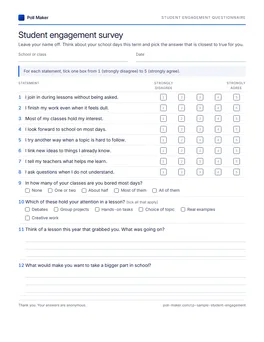
Student engagement questionnaire
Page one fits all twelve core items, answered with a pencil. The five optional sets start on page two.
Download PDF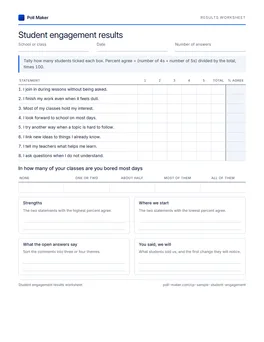
Indicator scoring worksheet
Tally each statement, turn the counts into percent agree, and circle the weakest indicator to start with.
Download PDFWhere engagement items go wrong, and how to fix them
Most weak engagement questions ask students to judge themselves or the school in one word. Our guide to writing clear questions works through these traps on any subject.
Are you an engaged student?
I join in during lessons without being asked.
Students do not share a meaning for "engaged". A behavior they can picture gets an honest answer.
Do you enjoy your classes and find them useful?
Most of my classes hold my interest.
Today's lesson taught me something I will use.
Two questions joined by "and". A student who enjoys class but sees no use for it has no true answer.
How often do you participate in class? (Rarely, Sometimes, Often)
In how many of your classes are you bored most days?
Words like "sometimes" mean different amounts to different students. Counting classes gives everyone the same ruler.
Wouldn't more group work make class better?
Which of these hold your attention in a lesson? (tick all that apply)
The weak version leads to yes. A tick list lets group work compete with other formats.
What teachers and researchers ask about engagement surveys
Short answers for teachers, school leaders and student researchers.
What are the indicators of student engagement?
Four are widely used: behavioral (taking part, effort, attendance), emotional (interest and belonging), cognitive (working to understand) and agentic (asking questions and shaping the lesson).12 The core 12 gives each indicator two statements.
How do you measure student engagement?
Researchers use three sources: student self-reports, teacher ratings of students, and observation.1 A student questionnaire is the only one that captures how students feel and think, so pair it with attendance and work records for the behavior side.
What is the difference between engagement and motivation?
Motivation is the reason a student has for doing the work. Engagement is what shows up in class: effort, interest, thinking and speaking up. To ask about reasons, use the student motivation survey.
How often should a school run an engagement survey?
Twice a year works for the core 12: early in the fall and again in spring. Use the five-question exit check whenever you try a new kind of lesson.
How involved are your students, really?
Launch the twelve core questions for your next homeroom, or hand round printed copies and collect them before the bell.