Senior exit survey questions for high school seniors before they graduate
A senior exit survey asks graduating seniors where they are headed and how well four years of high school got them there. The core 12 takes seniors about six minutes in May; add sets on classes, planning, school life, a July check-in or a face-to-face exit interview when you need them.
- 36questions
- 12in the core set
- 6 minfor the core
- 6optional sets
By Michael Hodge, BSc Psychology Updated September 2026
The whole exit survey, from fall plans to the July check-in
Tick marks begin on the core 12. Add the sets your team needs, or single questions, then open the survey in the builder, print it for a senior homeroom, or copy the wording. Under each question sit the choices seniors see and the reason a counselor would ask it.
The core 1212 questions
Where each senior is going, seven statements about how school prepared them, the steps they have finished, and two open questions. On its own it gives the school a full exit reading.
-
What will you mainly be doing this fall?
Four-year collegeTwo-year or community collegeTrade school or apprenticeshipFull-time jobMilitaryGap year or undecidedThe headline number every exit report opens with. Six real paths, so seniors who are not going to college still see their plan.1
-
I have a clear plan for the first year after graduation.
Strongly disagree12345Strongly agree1 = Strongly disagree, 5 = Strongly agreeA plan named in c1 is not always a plan a senior feels sure of. Low scores here mark students to check on before June.
-
My classes prepared me for what I plan to do next.
Strongly disagree12345Strongly agree1 = Strongly disagree, 5 = Strongly agreeReadiness in the senior's own terms, whether the next step is a lecture hall, a job site or basic training.
-
A counselor helped me plan for after high school.
Strongly disagree12345Strongly agree1 = Strongly disagree, 5 = Strongly agreeShows how far counseling reached this class. Read it next to the counselor meetings question.
-
I knew which credits and tests I needed to graduate.
Strongly disagree12345Strongly agree1 = Strongly disagree, 5 = Strongly agreeGraduation requirements that surprise seniors in spring point to a communication gap in grades 9 to 11.
-
At least one adult at this school knew me well.
Strongly disagree12345Strongly agree1 = Strongly disagree, 5 = Strongly agreeThe connection question. Seniors who disagree often went four years without anyone checking on them.
-
Over four years, this school felt like my school.
Strongly disagree12345Strongly agree1 = Strongly disagree, 5 = Strongly agreeBelonging looked back on from the end, when seniors have nothing left to lose by answering honestly.
-
I would recommend this high school to a younger student.
Strongly disagree12345Strongly agree1 = Strongly disagree, 5 = Strongly agreeOne overall verdict. Compare it by plan: a gap between college-bound seniors and the rest is worth chasing.
-
Which of these steps for your plan have you finished?
AppliedAccepted or hiredFAFSA filedDeposit paidOrientation bookedNone yetTick all that applyTells you who still has paperwork left in June. Those seniors are the ones whose plans are most likely to slip over the summer.2
-
How many times did you meet a counselor about your plans this year?
NeverOnce2 or 3 times4 or more timesA count, not an opinion. Split it by plan to see which seniors counseling reached and which it missed.
-
Which teacher or staff member made the biggest difference for you, and how?
Open answerNames what worked in the words of a student. Pass the answers on to the staff they name.4
-
What is one thing this school should do differently for next year's seniors?
Open answerOne change, from people who just finished. Sort the answers into three or four themes and act on the biggest.
Classes and skills5 questions
For department heads and curriculum teams who want to know which parts of four years of classes seniors think will carry them.
-
I can write a clear essay or report on my own.
Strongly disagree12345Strongly agree1 = Strongly disagree, 5 = Strongly agreeThe skill colleges and employers mention first. A low score for a whole class is a curriculum signal, not a student one.
-
My math classes covered the math my next step will need.
Strongly disagree12345Strongly agree1 = Strongly disagree, 5 = Strongly agreeRelevance of math to the actual plan, which matters as much for an electrician as for an engineering major.
-
I got into the advanced or career classes I wanted.
Strongly disagree12345Strongly agree1 = Strongly disagree, 5 = Strongly agreeAccess, not grades. Split by the About you set to see whether some groups were shut out.
-
I can keep up with work when nobody reminds me.
Strongly disagree12345Strongly agree1 = Strongly disagree, 5 = Strongly agreeIndependence is the gap seniors meet first after high school, in class or on the job.
-
Which skills do you wish school had taught you more of?
Money and budgetingWritingMathStudy skillsResumes and job interviewsForms such as the FAFSA or a leaseTick all that applyA wish list you can rank. The top two are candidates for an advisory lesson next year.
College, career and paying for it5 questions
For counselors and the college and career center. These show when planning started, where advice came from and whether cost was clear.
-
When did you start planning seriously for after high school?
Grade 9 or earlierGrade 10Grade 11Grade 12I have not started yetIf most seniors started in grade 12, the planning lessons belong earlier.
-
Where did you get the most useful advice about your plans?
A school counselorA teacher or coachMy familyFriendsOnlineShows who seniors actually listen to, so you know which adults to brief next year.
-
Staff helped with my applications when I asked.
Strongly disagree12345Strongly agree1 = Strongly disagree, 5 = Strongly agreeHands-on help with the paperwork, the part seniors most often say they did alone.
-
I know how I will pay for my next step.
Strongly disagree12345Strongly agree1 = Strongly disagree, 5 = Strongly agreeCost is where plans come apart. Seniors who disagree need a financial aid conversation before they leave.2
-
I tried out a career in a job shadow or internship.
Strongly disagree12345Strongly agree1 = Strongly disagree, 5 = Strongly agreeWhether work-based learning reached this class, and whether the plan in c1 rests on any first-hand experience.
Four years at this school4 questions
For principals and site councils. Seniors are the only students who have seen every grade of your school.
-
How many years were you on a school team, club or arts group?
None1 year2 or 3 yearsAll 4 yearsInvolvement over the whole of high school. Seniors with none are the ones activity fairs never reached.
-
Students of every background were treated fairly.
Strongly disagree12345Strongly agree1 = Strongly disagree, 5 = Strongly agreeFairness judged over four years, not one term. Read the open answers for where it slipped.
-
When I was struggling, I knew where to go at school.
Strongly disagree12345Strongly agree1 = Strongly disagree, 5 = Strongly agreeWhether support was findable. Pair it with c6 to see if help depended on knowing the right adult.
-
The school kept seniors well informed about deadlines and senior events.
Strongly disagree12345Strongly agree1 = Strongly disagree, 5 = Strongly agreeSenior year runs on dates. A low score is a quick fix for next year's class sponsor.
Summer check-in (send in July)3 questions
The same graduates answer these by text or email in July, a few weeks before fall starts. They catch plans that are slipping while a counselor can still help.
-
Are you still starting the plan you had at graduation?
Yes, the same planYes, but at a different school or programNo, my plans changedNot sure yetThe one question that finds summer melt. Anyone not on "the same plan" gets a call.2
-
Which of these do you still need to do before fall?
Finish financial aidPay a fee or depositSign up for orientation or placement testsSort out housing or transportNothing, I am readyTick all that applyTurns a worry into a task list a counselor can work through in one call.
-
What would help you most before your first day?
Open answerGraduates tell you what the June checklist missed.
Exit interview prompts5 questions
For a face-to-face senior exit interview with a counselor or a panel. The senior answers aloud, or writes answers first and brings them along.
-
Walk us through your plan for the first year after graduation.
Open answerOpens the interview with something every senior can talk about.3
-
Which experience in high school shaped that plan the most?
Open answerLinks the plan to something that happened, which is what a panel listens for.
-
Tell us about a setback in high school and what you did next.
Open answerShows how the senior handles difficulty, told as a story rather than a claim.
-
What will you need to learn or find in your first months to stay on track?
Open answerAsks the senior to name their own next risk, which makes the follow-up easy.
-
What would you tell a student starting grade 9 here next fall?
Open answerAdvice worth passing to next year's freshmen, and a warm way to close.
About you (optional)2 questions
Only to compare groups. Report no group small enough for a single senior to be recognised.
-
How long have you attended this high school?
All four yearsThree yearsTwo years or lessSeniors who arrived late judge a shorter slice of the school. Read their answers apart.
-
Will you be the first in your family to go to college?
YesNoI am not going to collegeNot sureFirst-generation seniors often plan with less help at home, so their counseling answers matter most.
Giving the exit survey in the last weeks of senior year
Seniors are busy, distracted and nearly gone. These four decisions make their answers worth reading.
Where 2024 US high school graduates were in October 2024
Give every path its own answer
College is the biggest path, but not the only one. Of 3.2 million 2024 graduates, 62.8 percent were in college that October, two in three of them at four-year schools, and 66.4 percent of those not in college were working or looking for work.1 An exit survey that only asks "Which college?" leaves over a third of the class with nothing to tick. The plans question gives trade school, work, the military and a gap year their own options.

Book class time in May
Issaquah's high schools run their senior exit survey each spring, between May and June.5 Aim for the last three or four weeks, before final exams and senior events empty the building. Give ten minutes in a senior homeroom or English class, with the link on the board or paper copies on the desks, and collect before the bell.

Pass the thank-yous on
The difference-maker question produces the best reading of the whole survey. The University of Iowa asks graduating seniors to name faculty or staff who made a positive difference and acknowledges them each spring.4 Do the same: send each named teacher, coach or custodian the comments about them, without the senior's name. Staff start asking when the survey goes out next year.

Ask about the plan before the school
Seniors answer questions about their own future carefully and questions about the school quickly. Opening with the plan and how ready they feel gets real attention on the part that matters most, then the school questions follow while they are still focused. Keep the core anonymous so seniors can be frank about counseling and classes.
At a senior class meeting, show the counselor meetings question as a live poll seniors answer on their phones, and see the spread a week ahead of the survey. For more quick questions to run in class, see our poll questions for students.
Read the plans question against the national picture
The first number anyone asks for is where the class is going. Here is one way to set it beside the national figures, using made-up counts from a class of 250.
| Plan this fall | Example class of 250 | US 2024 graduates, October |
|---|---|---|
| Four-year college | 98 (39%) | 42.1% |
| Two-year or community college | 61 (24%) | 20.7% |
| Trade school, work, military or gap year | 91 (36%) | 37.2% not in college |
The national column comes from the Bureau of Labor Statistics, which counts where recent graduates actually are in October.1 Your column is what seniors intend in May, so expect it to run a little ahead of reality.
Three checks before you publish the numbers
- Split the plan by the counselor meetings question. If seniors headed straight to work met a counselor far less often than college-bound seniors, counseling time went to one group.
- Look at "Gap year or undecided" on its own. A small group with a clear gap-year plan is fine. A large group still deciding in May needs a meeting before graduation.
- Compare with last year's class, not with the nation. The national figure gives context. The trend inside your own school is what a counseling plan can change.
Build the class report from the seven statements
Type the number of seniors who picked each point for each of the seven agree statements. The chart lines them up so the strongest and weakest parts of four years are plain to see. Print it for the counseling team or the school board.
- 1Take one statement at a time: seniors who picked 4 or 5, divided by the number who rated it. The report does the arithmetic.
- 2Start with the counselor help and graduation credits statements. Both are things the school controls directly, so a low score leads straight to a change.
- 3Then compare the clear plan statement across the plans question. Seniors still deciding in May usually score it lowest, and they are the group to follow up.
- 4Tell next year's seniors at their first class meeting what this class said and what the school changed. It shows them the exit survey gets read.
Graduating class results
The July check-in that catches slipping plans
A plan in May is not a seat in September. Some seniors with a college place never arrive, and the summer is when it happens.

Researchers call it summer melt. In national survey data and records from a large urban district, between 8 and 40 percent of college-intending, low-income graduates did not enroll in the fall.2 The causes are ordinary: an unfinished aid form, a fee nobody expected, an orientation date missed.
The exit survey sets up the fix. The steps question in the core shows who still has paperwork outstanding on the day they leave. The Summer check-in set goes to the same graduates in July and asks two things: is the plan still on, and what is left to do. Anyone who answers "my plans changed" or ticks an unfinished step gets a call or a text from a counselor that week.
Keep the May survey anonymous. Collect permission to check in, with a phone number or email, on a separate short form, so the survey answers stay nameless.
Graduation week version: five questions, two minutes
Graduation week leaves no time for 12? Ask the plan, whether it feels clear, whether classes prepared them, the steps done and one change. Seniors finish in two minutes.
- 01What will you mainly be doing this fall?
- 02I have a clear plan for the first year after graduation.
- 03My classes prepared me for what I plan to do next.
- 04Which of these steps for your plan have you finished?
- 05What is one thing this school should do differently for next year's seniors?
Exit survey or exit interview?
Schools use the same name for two different things. Pick the one that fits your job, or run both.
| Senior exit survey | Senior exit interview | |
|---|---|---|
| Who learns | The school, from the whole class | The senior, by reflecting aloud |
| Names | Anonymous | Named, often scored pass or fail |
| Time | About six minutes online or on paper | About 20 minutes with a panel |
| Questions | The core 12 plus any set | The Exit interview prompts set |
In Tumwater, Washington, the exit interview is a local graduation requirement: a 20-minute reflective conversation in which each senior gives a short presentation and then answers questions from a panel of a teacher and a community member.3 The five interview prompts above follow that shape. Seniors can write their answers first, which calms nerves and gives the panel something to read.
One homeroom period, every senior, no logins
Paper suits a senior homeroom: every senior answers at once, nobody needs a login, and the sheets go straight into a box at the door. Use the worksheet to add up the results by hand.
Running the short version in homeroom?
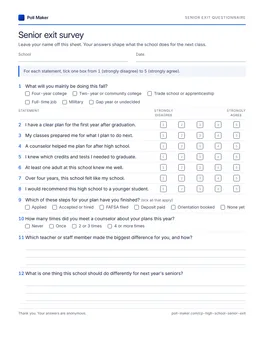
Senior exit questionnaire
Sheet one carries the twelve core questions with tick boxes. Later pages hold classes, planning, school life, the July check-in, interview prompts and About you.
Download PDF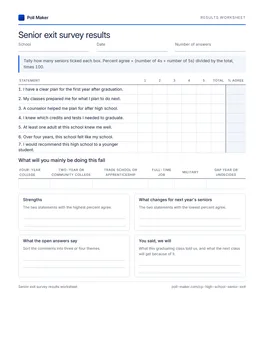
Results worksheet
Count the plans question and the seven statements, work out the share for each, and note the changes for next year's seniors.
Download PDFExit questions to reword before May
Senior surveys often repeat these four wording habits. Here is what to ask instead. Our survey writing guide applies the same repairs to every question type.
Which college will you attend in the fall?
What will you mainly be doing this fall?
The weak version leaves out every senior headed to work, the military or a trade.
How satisfied were you with the counseling department?
A counselor helped me plan for after high school.
How many times did you meet a counselor about your plans this year?
Satisfaction with a department is vague. Help with a plan and a count of meetings tell you what happened.
Did your high school prepare you for college and career?
My classes prepared me for what I plan to do next.
College and career in one question asks about two things, and many seniors only have one of them in view.
Please rate your overall high school experience.
I would recommend this high school to a younger student.
What is one thing this school should do differently for next year's seniors?
A single rating gives a number and no direction. The better pair adds the reason.
Senior exit survey questions answered
For counselors, principals and career center staff planning this year's survey.
What is a senior exit survey?
A short survey graduating seniors take in their last weeks of high school. It records where each senior is headed and asks how well school prepared them, so counselors and principals can plan for the next class.
What questions should a senior exit survey ask?
Ask the plan for the fall, how clear it feels, whether classes and counseling helped, which steps are done, and what the school should change. The twelve core questions here cover that in about six minutes.
When should seniors take the exit survey?
In May, three or four weeks before graduation, in class time. Later than that, seniors are at exams, rehearsals and senior events, and response drops. Send the July check-in set after graduation.
What is a senior exit interview?
A face-to-face conversation, often a graduation requirement, where a senior presents their plan and answers questions from a counselor or a panel. The Exit interview prompts set gives five questions for it.
Should a senior exit survey be anonymous?
Yes for the survey itself. Some schools make it a checkout step, such as before final transcripts are sent; if so, record who finished it on a separate list rather than in the answers.
Send the exit survey before graduation
Seniors leave in weeks. Send the builder link to every senior homeroom this month, or run a paper round from the printable questionnaire, collected before graduation rehearsal.