School improvement survey questions teachers and parents can answer
A school improvement survey asks the people who work in a school how it really runs: leadership, teaching, behavior, time and ties with families. Staff answer the core 12 in about six minutes, and a separate seven-question set gives parents their say.
- 38questions
- 12in the staff core
- 6 minto answer the core
- 7for parents
By Michael Hodge, BSc Psychology Updated September 2026
Leadership, teaching, behavior and families: the question bank
The staff core 12 starts ticked. Add a whole set in one click, or build your own mix. Beside every question sit the answers people choose from and a line on why it earns its place. For families, untick the core and build the parent set as its own survey.
Staff core 1212 questions
Eight statements that cover leadership, staff learning, behavior, teaching, families and time, then a vote on where to start, a question about next year and two open questions. Sent alone, they give the improvement team everything it needs for a first plan.
-
School leaders have a clear plan for improving this school.
Strongly disagree12345Strongly agree1 = Strongly disagree, 5 = Strongly agreeDirection. If staff cannot see the plan, nothing else in the survey can be read as progress against it.
-
When leaders here say something will change, it does.
Strongly disagree12345Strongly agree1 = Strongly disagree, 5 = Strongly agreeFollow-through, the root of trust. Staff judge a new plan by what happened to the last one.
-
I often pick up useful ideas from colleagues here.
Strongly disagree12345Strongly agree1 = Strongly disagree, 5 = Strongly agreeShows whether staff learn from each other or work behind closed doors.
-
The training I get here makes me better at my job.
Strongly disagree12345Strongly agree1 = Strongly disagree, 5 = Strongly agreeProfessional learning judged by its effect, not by the hours spent in sessions.
-
Rules for student behavior are applied the same way across the school.
Strongly disagree12345Strongly agree1 = Strongly disagree, 5 = Strongly agreeConsistency is what staff notice first. A low score points to hallways, lunch and cover lessons.
-
Teachers here agree on what good teaching looks like.
Strongly disagree12345Strongly agree1 = Strongly disagree, 5 = Strongly agreeA shared approach means students meet the same routines and standards in every room.
-
Families are treated as real partners in their children's learning.
Strongly disagree12345Strongly agree1 = Strongly disagree, 5 = Strongly agreeAsks how the school treats families, which staff can change, rather than how involved families are.
-
My workload leaves me enough time to do my job well.
Strongly disagree12345Strongly agree1 = Strongly disagree, 5 = Strongly agreeWorkload asked through its effect on the work, so the answer points at time rather than goodwill.
-
Which area should be our top priority next year?
Student behaviorTeaching and learningStaff workloadCommunicationWorking with familiesStaff vote on where to start. Run it live at a staff meeting; the worksheet tallies it too.
-
Do you expect to be working at this school next year?
Yes, definitelyProbablyNot sure yetProbably notDefinitely notIntent to stay. Read it beside the two leadership statements, since working conditions predict who plans to leave.3
-
What does this school do well that we should protect?
Open answerKeeps the plan from cutting what already works. Staff name specific routines and people.
-
What one change would make the biggest difference here?
Open answerOne change per person. Sorted into piles, the answers show which priority has real support.
Leadership and decisions5 questions
Add these when the two leadership statements come back low, or in the first year of a new principal.
-
Staff views are sought before big decisions.
Strongly disagree12345Strongly agree1 = Strongly disagree, 5 = Strongly agreeVoice. People rarely carry out plans they had no part in, so a low score here often explains weak follow-through.
-
I know how this year's goals affect my work.
Strongly disagree12345Strongly agree1 = Strongly disagree, 5 = Strongly agreeShows whether the plan has reached classrooms and offices or stayed in the leadership team.
-
Leaders are often seen around the building.
Strongly disagree12345Strongly agree1 = Strongly disagree, 5 = Strongly agreeVisibility, asked as something staff can observe rather than a judgement of character.
-
Feedback from leaders helps me improve.
Strongly disagree12345Strongly agree1 = Strongly disagree, 5 = Strongly agreeSeparates feedback that changes practice from feedback that only completes an evaluation.
-
Good work by staff gets noticed here.
Strongly disagree12345Strongly agree1 = Strongly disagree, 5 = Strongly agreeRecognition costs almost nothing, so a low score here is one of the quickest wins in any plan.
Teaching and student support4 questions
For the classroom side of the plan: expectations, extra help, additional needs and calm shared spaces.
-
We expect every student to do challenging work.
Strongly disagree12345Strongly agree1 = Strongly disagree, 5 = Strongly agreeAcademic expectations. Rises in this area went with both lower turnover and higher achievement in New York.2
-
Students who fall behind get extra help quickly.
Strongly disagree12345Strongly agree1 = Strongly disagree, 5 = Strongly agreeAsks about speed, since help that arrives a term late rarely closes a gap.
-
Students with additional needs are well supported.
Strongly disagree12345Strongly agree1 = Strongly disagree, 5 = Strongly agreeSpecial education and language support, rated by the people who see the gaps each day.
-
Hallways, lunch and other shared spaces are calm.
Strongly disagree12345Strongly agree1 = Strongly disagree, 5 = Strongly agreeOrder outside the classroom, where rules are hardest to apply the same way.
Workload and staying4 questions
Add this set when the workload statement or the question about next year comes back worrying. It names the tasks to cut.
-
Which tasks take the most time away from your main job?
PaperworkMeetingsEmailsCovering classesBehavior incidentsSupervision dutiesTick all that applyNames what to cut. A tick list turns a vague complaint about time into two or three fixable tasks.
-
In a typical week, how many hours do you work, counting evenings and weekends?
Under 4040 to 4445 to 4950 to 5960 or moreTurns the workload statement into hours. Track the spread across the year, not only the average.
-
Would you recommend working here to a friend?
YesProbablyNot sureProbably notNoA plain loyalty check. Set it beside the next-year question to find staff who are staying but unhappy.
-
If you did leave, what would be the main reason?
WorkloadPayLeadershipBehaviorPersonal reasonsShows which reasons sit inside the school's control. Workload, leadership and behavior all belong in the plan.
Parents and carers answer7 questions
A separate short survey for families: untick the staff core and send these seven on their own. The first five use the topics and answers of the national parent survey, so you can compare.
-
How satisfied are you with this school overall?
Very satisfiedSomewhat satisfiedSomewhat dissatisfiedVery dissatisfiedThe headline family number. Compare the share who are very satisfied with the national figure.4
-
How satisfied are you with your child's teachers this year?
Very satisfiedSomewhat satisfiedSomewhat dissatisfiedVery dissatisfiedSeparates how families feel about the teachers from how they feel about the school.
-
How satisfied are you with the school's academic standards?
Very satisfiedSomewhat satisfiedSomewhat dissatisfiedVery dissatisfiedTells you whether families think the work is demanding enough.
-
How satisfied are you with order and discipline at the school?
Very satisfiedSomewhat satisfiedSomewhat dissatisfiedVery dissatisfiedThe family view of the behavior statement staff answer in the core.
-
How satisfied are you with how staff work with parents?
Very satisfiedSomewhat satisfiedSomewhat dissatisfiedVery dissatisfiedPairs with the staff statement about families as partners, so you see both sides.
-
How would you like to hear from the school?
EmailText messageSchool appPaper note homePhone callSends news where families actually read it. Once a year is enough for this one.
-
What is one thing that would make this a better school for your child?
Open answerThe family version of the one-change question. Translate it along with the rest.
About you (staff, optional)2 questions
Only for comparing groups of staff. In a small school, skip this set, because a role plus years of service can identify a person.
-
What is your role?
TeacherAide or assistantCounselor or specialistOffice or support staffSchool leaderShows whether teachers and support staff experience the school differently.
-
How long have you worked at this school?
Under 1 year1 to 3 years4 to 10 yearsOver 10 yearsNewer staff often see gaps that long-serving staff have stopped noticing.
Mid-year check-in4 questions
Send these in January alongside the core 12, so staff can say whether the fall plan is showing up in their week.
-
Staff input has led to changes I can see.
Strongly disagree12345Strongly agree1 = Strongly disagree, 5 = Strongly agreeThe report-back test. If it is low, share what has changed before you ask for more answers.
-
This year's changes have made my job easier.
Strongly disagree12345Strongly agree1 = Strongly disagree, 5 = Strongly agreeSeparates changes staff noticed from changes that actually helped.
-
Compared with the start of the year, your workload now is:
Much lighterA little lighterAbout the sameA little heavierMuch heavierA direct before-and-after for any plan goal about time.
-
What should we stop doing for the rest of this year?
Open answerA stop list frees time for the plan, and staff tend to be specific about what to drop.
The five supports behind the staff core
Bryk and colleagues tracked Chicago elementary schools over 15 years and found five organizational supports that set improving schools apart from stagnant ones.1 The core asks about all five, plus the time staff have to do the work.
| Support | Core questions | Add when it scores low |
|---|---|---|
| Leadership that drives change | 1 and 2 | The leadership set, questions 13 to 17 |
| Professional capacity | 3 and 4 | Question 16 on feedback, then ask which training staff want |
| Student-centered climate | 5 | Questions 18 to 21 on expectations, extra help, additional needs and calm spaces |
| Instructional guidance | 6 | Question 18, then compare lesson routines across rooms |
| Family and community ties | 7 | The parent set, questions 26 to 32 |
| Time to do the work | 8 | The workload set, questions 22 to 25 |
The payoff for covering all five is large. Schools strong on most of the supports were 10 times as likely to improve as schools weak on most of them, and a weakness in any one support, left in place for years, tended to stall the rest.1
A staff survey that leads somewhere
Four habits decide whether a staff survey shapes the plan or ends up as a slide nobody opens again.
Chicago elementary schools that improved substantially in reading
Ask how the school runs, not only how staff feel
Morale matters, but the conditions behind it are what predict improvement. In the Chicago study, 43% of schools strong on school leadership improved substantially in reading, against 11% of schools weak on it. The gaps were as wide for the other supports: 47% against 9% for staff work orientation, and 45% against 10% for curriculum alignment.1 That is why eight of the core statements ask about leadership, colleagues, training, behavior, teaching, families and time.

Report back before you ask again
Share the results at a staff meeting within a few weeks, name the two things that will change, and say when staff will see them. Trust carries the whole effort: without it, Bryk's team found schools found it "nearly impossible to strengthen parent-community ties, build professional capacity, and enable a student-centered learning climate."1 The mid-year check-in then asks staff directly whether they have seen changes.
Read the next-year question beside leadership
Question 10 is an early warning that costs nothing to ask. In a statewide survey of North Carolina teachers, working conditions were "highly predictive" of plans to leave a school, and leadership stood out as the most important condition.3 In New York City middle schools, gains in leadership, expectations, relationships among teachers and safety each went with lower teacher turnover.2 Compare the leadership answers of staff who chose "probably not" with everyone else, as long as both groups hold at least five people.

Meet families where they already are
Most families come into school at some point in the year. In 2022-23, 83% of US K-12 students had a parent at a general school or PTO meeting, and 72% had one at a parent-teacher conference.4 Put paper copies and a QR code on the welcome table at conferences, text the link the same evening, and translate it into every home language your school serves.
One question works well in the middle of a staff meeting. Put the priority vote on the big screen with a quick poll for staff meetings, then use the result to open the talk about the full survey. The poll how-to covers one vote per person and sharing a link in Teams or by email.
See the whole staff picture on one chart
For statements 1 to 8, key in the number of staff who picked each point. Every statement gets a bar, the two lowest are tagged Focus and the strongest Strength, and the page prints for the improvement team.
- 1Copy the counts from your survey results, or from the paper tally. Agree counts every 4 and 5.
- 2Look first at the two statements tagged Focus, then at the priority vote. Where the chart and the vote agree, the goals choose themselves.
- 3Read the answers to the one-change question next. They usually explain what sits behind a low score.
- 4Keep this chart. In the spring, enter the new counts and compare the two printouts at the planning meeting.
Staff survey results
Worked example: from staff answers to two plan goals
Picture a staff of 40 answering the core in October. This is how their numbers turn into next year's goals.
| Core statement | Agree (4 or 5) | Reading |
|---|---|---|
| 1. A clear plan for improving | 31 of 40 | Strong |
| 2. Leaders follow through | 22 of 40 | Middle |
| 3. Useful ideas from colleagues | 33 of 40 | Strong |
| 4. Training makes me better | 20 of 40 | Middle |
| 5. Behavior rules applied the same way | 14 of 40 | Lowest |
| 6. Shared idea of good teaching | 26 of 40 | Middle |
| 7. Families as real partners | 29 of 40 | Strong |
| 8. Workload leaves enough time | 16 of 40 | Second lowest |
The priority vote in question 9 agrees: 15 staff chose student behavior and 11 chose staff workload. So the plan gets two goals, each tied to its own statement. Agreement that behavior rules are applied the same way rises from 14 to at least 24 by the spring survey. Agreement that workload leaves enough time rises from 16 to 24, by cutting the two tasks staff ticked most often in question 22.
In January, send the mid-year check-in. If few staff agree with question 35, they have not yet seen the plan at work, so show them what changed before the spring round.
Ten minutes on the staff meeting agenda
Ten minutes on a meeting agenda covers these: follow-through, behavior, workload, plans for next year and one change. Run them between full surveys to see whether the plan is landing.
- 01When leaders here say something will change, it does.
- 02Rules for student behavior are applied the same way across the school.
- 03My workload leaves me enough time to do my job well.
- 04Do you expect to be working at this school next year?
- 05What one change would make the biggest difference here?
How your families compare with parents nationwide
Questions 26 to 30 ask about the same five things as the federal Parent and Family Involvement survey, with the same four answers, so you can set your school beside the national picture for 2022-23.4
| Parent question | Very satisfied, US | How to read yours |
|---|---|---|
| 26. The school overall | 63% | Your headline family figure |
| 27. Your child's teachers | 62% | Read with question 26 |
| 28. Academic standards | 60% | Set beside staff question 18 |
| 29. Order and discipline | 55% | Set beside staff question 5 |
| 30. How staff work with parents | 55% | Set beside staff question 7 |
To compare, count only the Very satisfied answers to each question, then divide that count by the number of parents who answered it. The national figures count the top answer alone, so Somewhat satisfied stays out. The question where your families sit furthest below the national line is where the family side of the plan starts.
For the staff room and the conference welcome table
Give staff the paper version as a staff meeting winds down, with a closed box for finished sheets, or stack parent copies on the welcome table at conferences. The PDFs work on US letter or A4.
Surveying parents only? and stack them on the welcome table.
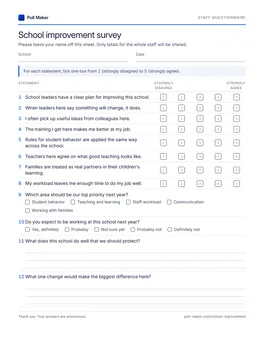
Staff and parent questionnaire
Sheet one carries the staff core 12 as tick-box statements, with lines for the two open answers. The leadership, teaching and workload sets come next, then the parent set on a sheet of its own, with the mid-year check-in at the end.
Download PDF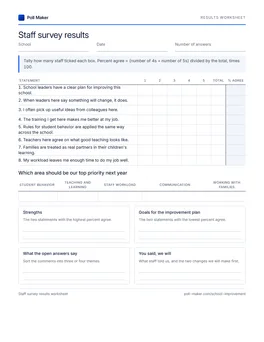
Results worksheet
A pencil tally for statements 1 to 8 and the priority vote, a percent-agree figure per statement, and space for the two goals your plan will chase.
Download PDFA survey calendar for the school year
Three staff rounds and one family round give you a baseline, a mid-course check and proof of progress.
| When | Who answers | What it feeds |
|---|---|---|
| Weeks 4 to 6 of the fall term | All staff: the core 12 plus one set | This year's goals and the baseline |
| Fall parent conferences | Families: the parent set | The family side of the plan |
| January | Staff: the core 12 and the mid-year check-in | A mid-course correction |
| April or May | All staff: the core 12 again | Progress on each goal and a draft of next year's plan |
Students see the same school from their seats. Pair the spring round with a student survey from the education survey questions, such as climate, safety or the end of the year, and the plan draws on every group in the building.
Staff survey questions to rewrite before you send
Four questions that school surveys often carry, and what to ask instead. More topics, each with answer options, sit in the survey question library.
Are you happy working at this school?
My workload leaves me enough time to do my job well.
Happiness bundles pay, colleagues, the commute and the week someone just had. A statement about workload points at something the school can change.
Does leadership communicate well and support staff?
School leaders have a clear plan for improving this school.
When leaders here say something will change, it does.
Two vague questions in one. The pair asks about the plan and about follow-through, and a low score on either tells you which to fix.
How would you rate parent involvement at our school?
Families are treated as real partners in their children's learning.
Rating involvement puts the problem on families. Asking how the school treats them gives staff something to act on.
Any other comments?
What does this school do well that we should protect?
An open box with no question gets little back. A real question gets specific routines, people and programs worth keeping.
What school leaders ask about staff surveys
Short answers for improvement teams planning their first round.
What questions should a school improvement survey ask?
Ask staff about leadership, learning from colleagues, training, behavior, a shared approach to teaching, families and workload, plus where to start and whether they plan to stay. The core 12 covers each of these in about six minutes. Ask families a separate, shorter set.
Should a staff survey be anonymous?
Yes. Drop the name field, let someone outside the leadership team collect the paper copies, and only report a group when it has five or more people in it. In a small school, drop the role and years questions so nobody can be identified.
How often should schools survey staff?
Three times a year works well: a full survey in the fall, a short check-in in January, and the core again in spring to measure progress. Each round earns its answers when staff can see what the last one changed.
How do we get more parents to answer?
Go to where families already are. Hand out paper copies at conferences and school events, send the link by text as well as email, translate it, and keep it to the seven parent questions. Then tell families what changed because of their answers.
Can students answer these questions?
These are written for the adults who work at the school or send their children there. Students need their own wording: the student engagement survey and the school safety survey ask them about the same school from their side of the desk.
Start your school improvement survey
Open the staff core 12 in the builder and send the link before your next staff meeting, or print copies and set out a sealed box in the staff room.