Needs assessment questionnaire: 38 questions for members, clients and staff
A needs assessment survey asks the members, clients or staff an organisation or program serves where their situation falls short of what it should be, then ranks those gaps so you fix the biggest first. The core 12 works for any of those groups, adult learners included, and three optional sets cover training, client intake and CME.
- 38questions
- 12in the core set
- 5 minto answer the core
- 3sets by who answers
By Michael Hodge, BSc Psychology Updated September 2026
Which needs assessment are you running?
The questions depend on who has the need. Find your situation, then send the sets listed in the last column.
| Your situation | Who answers | What to send |
|---|---|---|
| Planning or reviewing the support you offer a group | Members, clients or staff | Core 12, plus About you |
| Deciding which training to offer | Staff or learners | Core 12 and the skills gaps set |
| Scoping one client's or a customer base's needs | Clients or customers | Client set, with core 1, 9 and 10 |
| Planning CME or CPD for the year | Clinicians | CME set and the skills gaps set |
| A town, county or neighbourhood | Residents | The community needs assessment |
| A school or district | Students, parents, staff | The educational needs assessment |
| Checking a program that has already run | Participants | The program evaluation questions |
A need is a gap, not a wish
Borich built his needs assessment model on "a discrepancy analysis that identifies the two polar positions of what is and what should be".4 Every set on this page follows that rule. The core statements ask whether a need is met today, the skills set rates importance against current skill, and the client set asks what people came for against what they got.
All 38 needs assessment questions
The core 12 starts out ticked. Tick the skills, client or CME set as well for your kind of assessment, or pick single questions. Every item lists its options plus a line on what the reply says about the need, ready for the builder, the printer or another tool.
Core 12: what people need from you12 questions
Anyone your organisation supports can answer these. One overall fit rating, six statements on the usual gaps (information, skills, access, cost, knowing where to turn, fit), a wish list, barriers, urgency and two open questions.
-
Overall, how well does the support we offer meet your needs today?
Not at allA littlePartlyMostlyFullyYour headline figure. Repeat it at every assessment; the rest of the core explains why it moves.
-
I can get the information I need when I need it.
Strongly disagree12345Strongly agree1 = Strongly disagree, 5 = Strongly agreeAn information gap. It is often the cheapest need to close: a page, a leaflet or a clearer inbox.
-
I have the skills to do what I am trying to do.
Strongly disagree12345Strongly agree1 = Strongly disagree, 5 = Strongly agreeA skills gap. When this scores lowest, add the skills set to find out which skills.
-
Support is available at times and places that suit me.
Strongly disagree12345Strongly agree1 = Strongly disagree, 5 = Strongly agreeAn access gap. The need may already be met on paper and still be out of reach in practice.
-
Cost does not stop me getting the help I need.
Strongly disagree12345Strongly agree1 = Strongly disagree, 5 = Strongly agreeSeparates people who need a different service from people who need the same one at a lower price.
-
I know where to turn when a problem comes up.
Strongly disagree12345Strongly agree1 = Strongly disagree, 5 = Strongly agreeAn awareness gap. A low score here can mean the help exists and nobody has heard of it.
-
The help on offer fits my situation.
Strongly disagree12345Strongly agree1 = Strongly disagree, 5 = Strongly agreeFit. Services built for an average case miss people with less common needs, and this is where they say so.
-
Which of these would help you in the next year?
InformationSkills or trainingPractical helpEasier accessLower costSomeone to talk toTick all that applyA wish list you can count. Replace the six options with the kinds of support you could realistically offer.
-
What gets in the way of getting the help you need?
CostTimeTravelNot knowing where to goWaiting timesNothing doesTick all that applyBarriers. Removing the top one often helps more people than launching anything new.
-
How urgent is your most pressing need?
It can waitWithin a yearWithin a monthThis weekUrgency breaks ties between two gaps of the same size. A cluster of "this week" answers needs a reply now, not a plan.
-
What is the one thing that would make the biggest difference for you right now?
Open answerOne thing, in their words. Sort the answers into themes; the largest theme usually matches the lowest bar.
-
What do you need that nobody around you offers yet?
Open answerLooks past your own services to gaps in the whole system, which is where new programs come from.
Skills gaps: importance and current skill (staff or learners answer)10 questions
For training needs analysis. Each skill is rated twice, once for how much it matters and once for how good the person is at it today. Swap the four sample skills for the ones your roles depend on.
-
How important is handling complaints in your role?
Not at all important12345Extremely important1 = Not at all important, 5 = Extremely importantThe "should be" half of the first pair. The weighted gap score below uses both halves.3
-
How important is planning your work in your role?
Not at all important12345Extremely important1 = Not at all important, 5 = Extremely importantImportance sets the weight, so a small gap in a vital skill can outrank a large gap in a minor one.5
-
How important is your main software in your role?
Not at all important12345Extremely important1 = Not at all important, 5 = Extremely importantTools change faster than roles, so this pair tends to move between assessments.
-
How important is writing clear reports in your role?
Not at all important12345Extremely important1 = Not at all important, 5 = Extremely importantUseful as a check: if everyone rates it low, drop it from next year's list.
-
How good are you at handling complaints today?
Very poor12345Excellent1 = Very poor, 5 = ExcellentThe "what is" half. The gap is importance minus this rating, person by person.3
-
How good are you at planning your work today?
Very poor12345Excellent1 = Very poor, 5 = ExcellentSelf-ratings run generous, which is why the score ranks skills against each other rather than grading people.
-
How good are you with your main software today?
Very poor12345Excellent1 = Very poor, 5 = ExcellentA low rating with high importance is the classic case for a short, practical session.
-
How good are you at writing clear reports today?
Very poor12345Excellent1 = Very poor, 5 = ExcellentCompletes the fourth pair, so every sample skill gets a weighted gap score.
-
How would you most like to learn a new work skill?
Short workshopOnline courseCoachingFrom a colleagueVideo or readingTells you the format, once the gap score has told you the topic.
-
Which task takes you longer than it should?
Open answerAsks about the work, not about courses. The answers point at the gap behind the request.
Client and customer needs (clients answer)7 questions
For a first conversation or intake form, or a needs analysis across your customer base. These ask what people came for and what they would do without you.
-
What problem were you hoping we could solve when you first contacted us?
Open answerThe need in the client's own words, before your service shaped how they describe it.
-
How long have you had this need?
Under a month1 to 6 months6 to 12 monthsOver a yearLong-standing needs often mean earlier help did not work. Read it next to the open answer about what they tried.
-
What matters most to you when choosing a provider?
PriceSpeedQualityBeing listened toLocationReputationTick all that applyWhat people weigh when they choose. Build the offer around the top two.
-
What would you do if we were not here?
Use another providerDo it myselfAsk family or friendsGo withoutNot sureThe strength of the need. "Go without" answers mark the clients who depend on you most.
-
We understand what you are trying to achieve.
Strongly disagree12345Strongly agree1 = Strongly disagree, 5 = Strongly agreeWhether the client feels heard. A low score means the intake conversation needs work.
-
How easy was it to find a service like ours?
Very difficult12345Very easy1 = Very difficult, 5 = Very easyHard-to-find help is an access gap that better referral links or search listings can close.
-
What have you already tried, and what did not work?
Open answerSaves you from offering the thing that already failed, and shows what the need really is.
Continuing medical education (clinicians answer)6 questions
For CME and CPD planners. Accredited continuing education has to start from the practice gaps of your own learners, and these questions collect them in the clinicians' words.
-
Which topics do you want more education on this year?
New guidelinesPrescribing safetyChronic disease careMental healthTalking with patientsPractice systemsTick all that applyA topic list to plan the year around. Edit the options to your specialty.
-
Describe a recent case where you were unsure of the best next step.
Open answerA practice gap in one story: the difference between what was done and what current knowledge makes possible.6
-
How confident are you applying the latest guidelines in your field?
Not at all confident12345Extremely confident1 = Not at all confident, 5 = Extremely confidentA quick read on competence, one of the three kinds of educational need alongside knowledge and performance.6
-
Which format fits your schedule best?
Live conferenceOnline moduleCase discussionJournal clubGrand roundsAttendance follows format. Plan the topic list around it.
-
What stops you changing practice after a course?
Time with patientsSystem or EHR limitsCostPatient preferencesTeam buy-inNothingTick all that applySome gaps are not educational. System and team barriers need a different fix than another course.
-
What is your profession?
PhysicianNurse or NPPharmacistPhysician assistantOtherLets you plan for each profession on an interprofessional program.
About you (optional)3 questions
Add these to compare members with clients, or newcomers with long-time users. Publish a breakdown only for groups of a size where no individual can be recognised.
-
How are you connected to our organisation?
MemberClient or customerStaffVolunteerOtherDifferent groups need different things. Split the core results by this before you rank anything.
-
How long have you used our support?
Under 6 months6 to 24 months2 to 5 yearsOver 5 yearsNot yetNewcomers and long-time users see different gaps. "Not yet" answers show the people you are missing.
-
What is your age group?
Under 2525 to 4445 to 6465 or olderPrefer not to sayChecks whether a need is spread evenly or sits with one age group.
Rank skills by a weighted gap score
The skills set gives you two ratings per skill. The Borich model turns them into one number, so the list of training needs comes out in priority order.3
The three steps
- For each person and each skill, subtract their skill rating from their importance rating. That is the gap.
- Multiply each gap by the average importance everyone gave that skill.
- Average those weighted gaps across everyone who answered. That average is the mean weighted discrepancy score.
A 2025 study that ranked the training needs of extension staff sets out the same three steps.5 Because step 2 uses the same multiplier for everyone, you can also get the score from two averages: average importance times (average importance minus average skill).
A worked example
| Skill | Importance / skill (averages) | Weighted gap |
|---|---|---|
| Handling complaints | 4.6 / 2.9 | 1.7 x 4.6 = 7.8 |
| Planning your work | 4.2 / 3.4 | 0.8 x 4.2 = 3.4 |
| Writing clear reports | 3.1 / 2.6 | 0.5 x 3.1 = 1.6 |
| Main software | 3.8 / 3.7 | 0.1 x 3.8 = 0.4 |
These averages are invented purely to demonstrate the arithmetic. Report writing has the lowest skill rating of the four, yet it ranks third, because people rate it as less important to their jobs. Complaints training comes first. A score below zero means people rate their skill above its importance, so that skill needs no training this year.
McKim and Saucier describe the same method with "what is" and "what should be" ratings in place of skill and importance,4 so the arithmetic works for any pair of ratings you collect.
Getting honest answers from members and clients
Three habits separate a needs survey that shapes next year's plan from one that confirms what the loudest voices already said.

Write down the gap before you write a question
The CDC puts it plainly: "A needs assessment identifies gaps in knowledge or skills within the workforce, and helps you determine if training is necessary."2 Before you draft anything, name the result you want and where people are today. Then keep only questions that measure one side of that gap or the reasons for it.

Ask everyone you can, and check the answers against records
The Community Tool Box describes the survey as "a way of asking group or community members what they see as the most important needs of that group or community."1 In a small group, it says, you can ask every single person; larger groups need a sample. The CDC lists the other ways to confirm a gap: "existing data review, interviews, surveys, or focus groups".2 Waiting lists, complaint logs and attendance records test what the survey says.

Rank the needs, then say which ones you will meet
A list of twenty needs helps nobody. Order them by the size of the gap and by urgency: the report below shows the lowest core statement, the gap score orders skills, and the urgency question breaks ties. Then publish the top three and what you will do about each. People who see their answers turn into a plan answer the next round.
Want a quick read at a members' meeting before the full survey goes out? Turn the urgency question into a live poll from the homepage, then show the result on screen. How to make a poll walks through sending it out by link, QR code or embed.
Find the biggest unmet need in the core
Enter the count at each point for all six core statements. Each one describes a need being met, which puts your first gap at the bottom of the chart.
- 1Count responses at every point on each statement, whether they came in online or on paper. The report adds the 4s to the 5s and shows that as the share whose need is met.
- 2Read the two lowest statements together. Low on information and knowing where to turn points to outreach; low on cost or access points to how the help is delivered.
- 3Check the urgency answers for the people who disagreed. A small group with a need this week comes before a large group that can wait.
- 4Match the open answers to the lowest bars, then write down the three needs you will meet and by when.
Needs assessment results
A five-question needs check
Running it at the door of an event or at the end of a meeting? These five cover overall fit, whether the help suits people, what blocks them, how urgent it is and the one thing to add.
- 01Overall, how well does the support we offer meet your needs today?
- 02The help on offer fits my situation.
- 03What gets in the way of getting the help you need?
- 04How urgent is your most pressing need?
- 05What is the one thing that would make the biggest difference for you right now?
Print the needs assessment for a meeting or front desk
Paper reaches people who never open an email survey: a reception desk, a members' meeting, a clinic waiting room. Each PDF fits a US letter or A4 sheet.
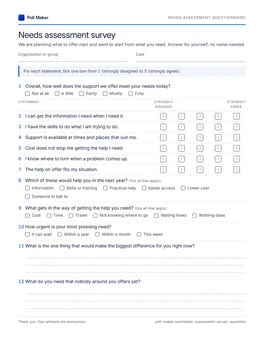
Needs assessment questionnaire
The core 12 fills page one, with a line for your organisation. Pages two onward hold the skills, client, CME and About you sets, so leave out any page your assessment skips.
Download PDF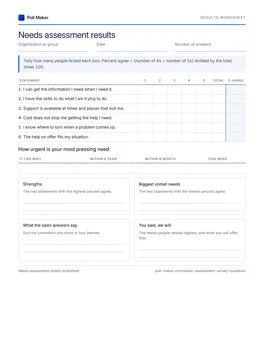
Results worksheet
Tally urgency and the six core statements with a pencil, find what share say each need is met, and list the needs you will act on first.
Download PDFWordings that hide the real gap, rewritten
These four turn up on real needs surveys and each one skews the result. More examples of each question type live on the survey questions hub.
What training do you need?
Which task takes you longer than it should?
People name courses they have heard of, not the gap behind them. Asking about the work finds the gap.
Would you use an evening service if we started one?
Support is available at times and places that suit me.
Saying yes to a hypothetical costs nothing. The better version measures the access gap you would be closing.
How important is complaint handling, and how good are you at it?
How important is handling complaints in your role?
How good are you at handling complaints today?
Two ratings in one question. Split them and you can compute the gap for each person.
Don't you agree our town needs more youth programs?
Which of these would help you in the next year?
A leading question gets the answer it suggests. A neutral list lets people rank their own needs.
Needs assessment surveys: common questions
For program managers, trainers, CME planners and anyone deciding what to offer next.
What is a needs assessment survey?
A survey that asks the people you serve where their situation falls short of where it should be. The answers show which gaps are biggest, so you decide what to offer, change or stop before you spend money on it.
What questions should a needs assessment include?
Five kinds: how well needs are met today, what people would add, what gets in their way, how urgent it is, and one or two open questions. All five appear in the core 12. Add paired importance and skill ratings when the job is training.
How do you analyze needs assessment results?
Find the percentage agreeing with each core statement and begin with the lowest. For skills, use the weighted gap score above. Then group the open answers by theme and check them against urgency and the About you groups.
What is the difference between a needs assessment and a program evaluation?
A needs assessment comes first and asks what people need. An evaluation comes after a program has run and asks whether it worked. Use the program evaluation questions for the second job.
How many people should answer?
In a small group, ask everyone. In a large one, survey a sample that includes every kind of person you serve, and make sure the groups you plan to compare each get enough answers.
Send the core 12 to your members this week
Send the core 12 from the builder with the set for your job ticked, or bring printed copies to your next members' meeting.