35 questions to ask students about how social media affects school, sleep and mood
Written for students in middle school, high school or college, these 35 questions measure how social media shapes their studying, sleep, mood and friendships. The core 10 asks what students do on their phones and when, then how they think it affects their grades and mood. Five modules go deeper for a research paper or a whole-school survey.
- 35questions
- 10core questions
- 4 minto answer the core
- 5optional modules
By Michael Hodge, BSc Psychology Updated September 2026
All 35 student questions, with answer choices
The core 10 is ticked for you. Switch on the modules your project needs, untick anything you will not use, then run it online, print a paper version or copy the text into your research instrument.
The core 1010 questions
Two questions on how much and which apps, five statements on habits and feelings, two on the effect students notice, and one open question. Enough on its own for a class project.
-
On a typical school day, how much time do you spend on social media?
NoneLess than 1 hour1 to 3 hours3 to 5 hours5 hours or moreThe bands match a UK study of 11,872 teenagers, so your results line up with published figures.5
-
Which of these apps do you use at least once a week?
YouTubeTikTokInstagramSnapchatFacebookWhatsAppRedditXDiscordAnother appTick all that applyThe first six follow how widely US teens use them, so the apps most students name come first.2
-
I can study for half an hour without checking social media.
Strongly disagree12345Strongly agree1 = Strongly disagree, 5 = Strongly agreeStudying with social media open is the habit most closely tied to lower grades in a meta-analysis of 59 samples.3
-
Social media helps me with schoolwork, like class chats or study videos.
Strongly disagree12345Strongly agree1 = Strongly disagree, 5 = Strongly agreeThe school side of social media. In the same meta-analysis it went with slightly better grades.3
-
I put social media away well before I go to sleep.
Strongly disagree12345Strongly agree1 = Strongly disagree, 5 = Strongly agreeHeavy users fall asleep later on school nights. This shows whether the phone comes to bed.5
-
I usually feel good about myself after time on social media.
Strongly disagree12345Strongly agree1 = Strongly disagree, 5 = Strongly agreeSelf-image asked as a feeling students notice, not a label they have to accept.
-
Social media helps me feel closer to my friends.
Strongly disagree12345Strongly agree1 = Strongly disagree, 5 = Strongly agreeThe upside most teens report. Without it a survey only counts harms.1
-
Overall, how does social media affect your grades?
Hurts a lotHurts a littleNo real effectHelps a littleHelps a lotThe student's own verdict on the question your research asks. Compare it with the habits above.
-
Overall, how does social media affect your mood?
Hurts a lotHurts a littleNo real effectHelps a littleHelps a lotKeeps wellbeing separate from schoolwork. Many students feel a cost in one area and a gain in the other.
-
What is the biggest way social media affects your school life, good or bad?
Open answerStudents name effects your list missed. Sort the answers into themes before you write up the numbers.
Study and grades7 questions
For a paper on academic performance. Pair the grade question with the habits in the core to test your hypothesis.
-
How would you describe your grades last term?
ExcellentGoodAverageBelow averagePrefer not to sayA self-reported grade band you can compare against every habit question without asking for school records.
-
Where is your phone while you do homework?
In my handBeside me, sound onBeside me, on silentIn another roomI do not have a phoneA concrete answer students can give accurately, and a habit they can change tomorrow.
-
How often do notifications interrupt your homework?
NeverRarelySometimesOftenAlwaysSeparates interruptions the phone starts from checking the student starts.
-
How often is your work late because time went on social media?
NeverRarelySometimesOftenAlwaysA cost with a date on it, which students report more honestly than lost focus.
-
Videos or posts online help me understand my subjects.
Strongly disagree12345Strongly agree1 = Strongly disagree, 5 = Strongly agreeShows whether the learning side of social media reaches most students or only a few.
-
How often do you check social media during lessons or lectures?
NeverRarelySometimesOftenAlwaysChecking in class and checking at home need different fixes: a phone rule for one, a study routine for the other.
-
Which of these do you use social media for in your schoolwork?
Class or group chatsAsking classmates about homeworkSharing notes or study filesRevision or explainer videosPlanning group projectsI do not use it for schoolTick all that applyNames the school uses behind the schoolwork statement in the core, so a class chat and a revision channel are counted apart.
School-night sleep4 questions
Ask about nights before school, when late scrolling costs the most.
-
On a school night, what time do you usually fall asleep?
Before 10 pm10 to 11 pm11 pm to midnightAfter midnightFalling asleep late is the sleep problem most strongly linked with heavy social media use.5
-
When do you last check social media before sleep?
Over an hour before30 to 60 minutes beforeUnder 30 minutes beforeI fall asleep using itTells you whether the phone is part of the bedtime routine or put away well before it.
-
How often do you check your phone if you wake in the night?
NeverRarelySometimesOftenAlwaysNight-time checking breaks sleep that the bedtime question will not show.
-
I feel rested in morning classes.
Strongly disagree12345Strongly agree1 = Strongly disagree, 5 = Strongly agreeThe school side of sleep, in words any student can judge.
Friends, mood and self-image6 questions
For counselors and wellbeing research. Keep it anonymous and point students to support in the closing message.
-
How often do you compare your life with what others post?
NeverRarelySometimesOftenAlwaysRead it next to the feel-good statement in the core: together they show whether comparison sits behind a low mood.
-
How often do posts make you feel left out?
NeverRarelySometimesOftenAlwaysSeeing plans you were not part of. A friendship cost that grades questions miss.
-
In the last month, how often did someone post or send hurtful things about you?
NeverOnceTwo or three timesEvery weekAlmost every dayOnline bullying, asked about what happened rather than the word "bullying", which students define differently.
-
Social media gives me a place to share what I make or care about.
Strongly disagree12345Strongly agree1 = Strongly disagree, 5 = Strongly agreeThe creative side. Most teens say social media gives them a place for it.1
-
How often do you feel you have to show only the best side of your life online?
NeverRarelySometimesOftenAlwaysThe other half of comparison: the first question asks what students see, this one what they feel they must show.
-
If something on social media upset you, who would you talk to?
A friendA parent or family memberA teacher or counselorSomeone onlineNobodyNothing has upset meTick all that applyTells counselors whether students would come to them, keep it among friends, or tell nobody at all.
Screen time and self-control5 questions
Add this module when you want hours you can trust and a picture of what students already try.
-
Open your phone's screen time report. How many hours did social media apps take yesterday?
Open answerA logged figure beats a guess: self-reported hours rarely match what the phone records.4
-
How often do you stay on social media longer than you planned?
NeverRarelySometimesOftenAlwaysLosing track of time, the everyday sign that use is running ahead of intention.
-
Have you tried to cut down your social media time?
Yes, and it workedYes, but it did not lastNo, but I would like toNo, I am happy with itShows how many students want to change and how many already found something that works.
-
What usually makes you open a social media app?
A notificationA message from a friendBoredomHabit, without thinkingPutting off homeworkLooking something upThe trigger points to the fix: notifications can be switched off, while boredom and putting off work need a plan.
-
What helps you stay off social media when you need to focus?
Notifications offApp time limitsPhone in another roomDeleting an app for a whileStudying with friendsNothing yetTick all that applyCollects the strategies that already work in your school, ready to share back with students.
About you (optional)3 questions
For comparing groups in a research paper. Report a group only when it is large enough that nobody stands out.
-
Which stage of education are you in now?
Middle school or junior highHigh school or senior highCollege, first or second yearCollege, third year or laterPrefer not to saySocial media habits change a lot between early teens and college, so compare levels separately.
-
How old are you?
12 or younger13 to 1516 to 1819 to 2223 or olderAge bands let you compare early teens, older teens and college students in one survey.
-
What is your gender?
Girl or womanBoy or manAnother genderPrefer not to sayGirls and boys often report different effects, so a gender split is one of the first comparisons researchers make.1
Published scales that measure social media use
Writing a research paper? Your adviser may ask which instrument you used. Here is how this questionnaire sits next to the published measures, and what each one is for.
| Instrument | What it measures | Format |
|---|---|---|
| This questionnaire | Habits (when, where, what for) and the effects students feel on grades, sleep and mood. | 35 original questions; a core 10 plus five modules. Free to use and edit. |
| Social Media Disorder Scale (van den Eijnden, Lemmens and Valkenburg, 2016) | Addiction-like use: preoccupation, withdrawal, escape, conflict and five more signs. | Nine yes or no items about the past year; six or more yes answers marks problematic use. Validated with 222,532 adolescents in 44 countries.6 |
| Bergen Social Media Addiction Scale (Andreassen and colleagues, 2016) | The core signs of addiction applied to social media. | Six items, one for each core sign of addiction.6 |
| Phone screen time logs | Actual minutes per app, recorded by the phone. | Students read the figure from their settings. Much closer to real use than a guess.4 |
Studying effects on school life? Use the questions on this page. Studying addiction? Use one of the two scales as published, cite the original paper, and add the study and sleep modules from here as your outcome measures. For device time beyond social apps, the screen time questionnaire covers gaming, streaming and devices in the bedroom.
Measuring the impact, not just the hours
Four choices make the difference between a survey that confirms what everyone expected and one that finds something new.

Ask what students do on it, and when
Hours alone tell you little. A meta-analysis of 59 samples and 29,337 students found that general social media use had only a small link with grades. Checking it while studying had a stronger negative link, and using it for school work went with slightly better grades.3 That is why the core asks about studying, schoolwork and bedtime separately.
US teens who say social media hurts each part of their life
Give sleep and focus their own questions
Students feel the effects in some places far more than others. In Pew's 2024 survey, 45% of teens said social media hurts their sleep and 40% their productivity, while 74% said it makes them feel more connected to friends.1 A single "is social media good or bad" question would blur all of that into one number.

Let the phone count the hours
People are poor judges of their own screen time. A review of 106 comparisons found self-reported use matched phone logs only moderately and was rarely accurate.4 If students have phones in class, ask them to open their screen time report and type in yesterday's figure. It takes a minute and turns your weakest number into your strongest.

Ask about school nights
In a study of 11,872 UK teenagers, those on social media five or more hours a day had roughly twice the odds of falling asleep late on school nights, compared with average users.5 Asking about "nights before school" pins students to the nights that matter for the next day's lessons.
Starting a class discussion on phones? Project a single question as a quick class poll and let students vote anonymously before you share the full survey. The results appear live, which makes a good opening for a lesson on digital habits. Making a poll takes a minute.
See where your students stand
Type in how many students picked each point on the five core statements. Each one is worded so that agreeing is the healthy answer, so the report marks the weakest area as your focus and the strongest as a strength. Print it for your paper's results chapter or a staff meeting.
- 1Count the answers for each statement. The report turns them into percent agree, meaning a 4 or a 5, out of all who answered.
- 2Look at the study and bedtime statements first. They connect most directly to grades and sleep.
- 3Set the schoolwork and closer-to-friends statements beside them. They show what social media gives students, not only what it costs.
- 4Compare the habit results with the grade and mood verdicts. A group that scrolls in bed and reports poor grades is your headline finding.
Social media habits
Matching the questions to your research question
Four research questions this questionnaire answers well. Pick yours, then report the comparison in the right-hand column.
| Your research question | Questions to compare | What to report |
|---|---|---|
| Does social media affect students' academic performance? | Grades last term (study module) against the half-hour study statement, and against hours per day. | A cross-table of grade band by agreement with the study statement. To go further on marks and homework, add the academic performance questionnaire. |
| Does late-night use affect sleep? | Putting social media away before sleep, and the last check, against the time students fall asleep. | The share falling asleep after midnight in each group. |
| How does social media affect students' mood and self-image? | The feel-good statement and the comparison question against the mood verdict. | Percent agree and the spread of comparison answers, split by gender and school level. |
| Which platforms do students use, and for what? | The app list against schoolwork use and hours. | A bar chart of weekly app use, then which apps heavy users name most. |
Before you collect anything, get approval from your teacher or school, tell students the survey is anonymous and voluntary, and ask parents too when students are under 18. Survey whole sections or classes rather than friends who volunteer, and give the number of students who answered next to every percentage.
Download the questionnaire for paper surveys
Paper works well when phones stay in bags during class. Hand it out, give students ten minutes, and collect the sheets in a closed box. Each file prints on letter or A4.
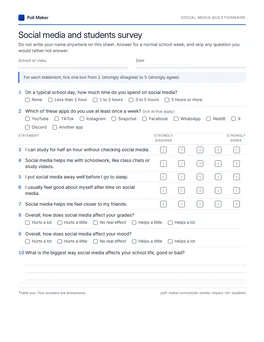
Social media questionnaire
Page one holds the core 10 as tick-box questions, followed by every optional module. Ready to attach to a research paper as your instrument.
Download PDF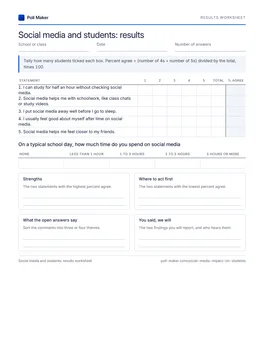
Results tally sheet
Count the paper answers for each habit statement, turn them into percentages and note your first findings.
Download PDFFour common questions that skew the results
Student questionnaires on social media repeat the same mistakes. Here is each one fixed. For the general rules on any topic, see how to write survey questions.
Don't you think you spend too much time on social media?
On a typical school day, how much time do you spend on social media?
The first version tells students the right answer. The second lets heavy and light users answer truthfully.
Does social media affect your studies? (Yes / No)
I can study for half an hour without checking social media. (Strongly disagree to Strongly agree)
Almost everyone says yes to the first. A specific habit on a five-point scale gives you a spread you can analyse.
Is social media good or bad for you?
Overall, how does social media affect your grades?
Overall, how does social media affect your mood?
Students often feel it helps one part of life and hurts another. One question hides both.
How often do you use Facebook and Instagram?
Which of these apps do you use at least once a week? (tick all)
Two apps in one question, and not the ones most students use. A tick list covers every platform at once.
Social media and students: common questions
Quick answers for student researchers, teachers and counselors.
How does social media affect students' academic performance?
It depends on how students use it. Research across 59 samples found that using social media while studying goes with lower grades, while using it for schoolwork goes with slightly higher grades. Overall use on its own had only a small link.3 Ask about habits, not just hours, to see which pattern your students follow.
How much time do students spend on social media?
It varies widely. In a UK study of 13 to 15 year olds, about a third used it less than an hour a day and about one in five used it five hours or more.5 Your own students may differ, which is why the first core question uses the same bands, so you can compare.
What are good research questions about social media and students?
Keep each one to a single relationship you can measure: "Is checking social media while studying related to grades?", "Do students who scroll in bed fall asleep later?" or "Which apps do heavy users rely on most?" The table above shows which questions to compare for each.
Is this questionnaire valid and reliable?
It is a set of original questions built from published research, not a validated scale. For a thesis, run it with a few classmates first to check the wording, and report internal consistency for the habit statements. If you need a validated addiction measure, add one of the published scales above.
Can I translate it for students in another language?
Yes. Open it in the survey builder and replace each question and answer with your translation. Keep the answer scales in the same order so your results stay comparable with English-language studies.
Start collecting answers this week
Send your class or research sample a link to the core 10 today. Prefer paper? Print the PDF for tomorrow.