Measure AI use, trust and adoption with these survey questions
The best AI survey questions ask what people actually did with AI last week: which tools, for which tasks, how long, and whether it saved them time. Start with the 12-question core, then add the set for your staff, your students or a research project.
- 34questions
- 12in the core set
- 4 minto answer the core
- 4optional sets
By Michael Hodge, BSc Psychology Updated September 2026
The full bank: 34 AI survey questions with answer options
The core 12 is ticked. Add a whole set for your workplace, school or study, or pick single questions. Each one lists its answer options and a line on what the answers reveal, so you can send it online, print it or paste it into another tool.
Core 12: how you use AI12 questions
Twelve questions anyone can answer, at work, in class or at home: how often and how long, which tools and tasks, five statements on time saved, checking, rules, skill and openness, one feeling question and two open answers.
-
In the past seven days, on how many days did you use an AI tool such as ChatGPT, Gemini or Copilot?
None1 day2 or 3 days4 or 5 days6 or 7 daysA count of days in one real week separates daily users from people who tried it once. It is how national adoption surveys ask.1
-
Which AI tools have you used in the past month?
ChatGPTGeminiCopilotClaudeAI inside another appNoneTick all that applyShows which tools people already rely on, so training and approved tools can start from those.
-
What did you use AI for in the past week?
WritingSummarisingFinding factsNew ideasCodingData analysisAdminTick all that applyTasks are where AI pays off. The list follows the tasks workers rank as most helpful, so your results can sit next to published figures.1
-
On a day you use AI, how long do you actively use it?
Under 15 minutes15 to 60 minutesMore than an hourI have not used itDepth of use. Two people who both "use AI" can differ by an hour a day.1
-
AI tools save me time on tasks I do often.
Strongly disagree12345Strongly agree1 = Strongly disagree, 5 = Strongly agreeThe payoff question. Read it next to the task list to see which jobs AI speeds up for this group.
-
I check what an AI tool tells me before I rely on it.
Strongly disagree12345Strongly agree1 = Strongly disagree, 5 = Strongly agreeGood habits with AI start here. High agreement means people use it with judgement, not blind trust.
-
I know what I may and may not use AI for.
Strongly disagree12345Strongly agree1 = Strongly disagree, 5 = Strongly agreeClear rules are the cheapest fix there is. A low score means people are guessing, and some stop using AI to stay safe.3
-
My prompts get a useful answer within two tries.
Strongly disagree12345Strongly agree1 = Strongly disagree, 5 = Strongly agreeA plain test of skill. Low agreement is where a short training session pays back fastest.
-
I am comfortable saying when I have used AI.
Strongly disagree12345Strongly agree1 = Strongly disagree, 5 = Strongly agreeOpenness. When people hide their AI use, good ideas stay with one person instead of spreading.
-
Overall, do you feel more excited or more worried about AI tools?
Mostly excitedMore excitedBoth equallyMore worriedMostly worriedOne balanced question on mood. It gives both sides equal room, so the answer is not pushed either way.
-
Describe one task where AI has helped you the most.
Open answerReal examples to share. The best answers become the tips you pass on to everyone else.
-
What would help you get more out of AI tools?
Open answerPeople name what they need in their own words: a tool, a rule, time to learn or an example. Sort the answers into piles.
AI adoption at work (employees answer)7 questions
For managers and HR teams measuring AI adoption. Staff answer the core about their own use, then these seven about the workplace.
-
When you use AI for work, whose tools do you mostly use?
Tools my employer providesMy own personal accountsA mix of bothI do not use AI for workShows how much AI use happens on personal accounts, where company data may be going.
-
My employer provides the AI tools I need for my job.
Strongly disagree12345Strongly agree1 = Strongly disagree, 5 = Strongly agreeRead with the question above. Low agreement plus high personal use means people want tools they are not given.
-
My manager encourages me to try AI in my work.
Strongly disagree12345Strongly agree1 = Strongly disagree, 5 = Strongly agreeShows whether people feel free to experiment. Read it next to the days-of-use answers for each team.
-
Have you had any training on using AI for your job?
Yes, formal trainingYes, tips from colleaguesNo, but I would like someNo, and I do not need itSeparates people who want training from people who are fine without it, so you train the right group.3
-
About how much time does AI save you in a typical work week?
NoneUnder 1 hour1 to 3 hours4 to 6 hoursMore than 6 hoursTime saved is the number leaders ask for. Bands are easier to answer honestly than an exact figure.1
-
What stops you from using AI more at work?
Not sure it is allowedNo approved toolNot enough trainingWorried about accuracyWorried about data privacyIt does not fit my tasksNothing stops meTick all that applyThe blockers list. Employer restrictions and a need for training often hold workers back, and both are fixable.3
-
Which part of your job would you most like AI to help with?
Open answerPoints to the next use case to pilot, straight from the people who do the work.
AI at school or college (students answer)6 questions
For teachers, schools and colleges. Students answer the core about their own use, then these six about AI in their courses.
-
My teachers make it clear when AI is allowed on an assignment.
Strongly disagree12345Strongly agree1 = Strongly disagree, 5 = Strongly agreeThe student version of the rules question. Unclear rules are the source of most AI worries in class.
-
How do you mostly use AI for your studies?
To explain hard topicsTo check my writingTo make practice questionsTo research a topicI do not use it for schoolShows whether AI is working as a tutor or doing the work. Each answer calls for a different class rule.
-
Using AI helps me understand my coursework better.
Strongly disagree12345Strongly agree1 = Strongly disagree, 5 = Strongly agreeLearning, not grades. High agreement means students use AI to learn and not only to finish.
-
How confident are you at spotting a wrong AI answer?
Not at all confident12345Extremely confident1 = Not at all confident, 5 = Extremely confidentSubject knowledge is what catches AI mistakes. Low confidence is a teaching moment, not a discipline issue.
-
Should courses teach students how to use AI well?
Yes, in every courseYes, in some coursesNot sureNoTells a school whether students want AI skills taught, and where.
-
If you could change one rule about AI at your school, what would it be?
Open answerStudents often suggest workable rules. The most common answer is a good place to start the next policy talk.
Views on AI and society (anyone answers)6 questions
For public surveys, newsrooms, community groups and class research. These ask what people know and think about AI beyond their own use.
-
How much have you heard or read about AI in the past month?
A lotA fair amountA littleNothing at allAwareness. Compare it with the tools question to see who hears about AI without using it.
-
How confident are you at spotting AI-made content?
Not at all confident12345Extremely confident1 = Not at all confident, 5 = Extremely confidentA key media-literacy measure. It shows who might be fooled by fake images or text.
-
Where do you think AI will do the most good in the next five years?
Health careEducationScience and researchCustomer serviceTransportThe hopes question. It shows which uses people are ready to welcome.
-
Which concern about AI matters most to you?
Job lossesWrong answersData privacyFake images and videoLess human contactOne pick forces a priority, so you learn which concern to address first.
-
Should content made with AI be labelled?
AlwaysOnly in news and adsNot neededNot sureA clear yes or no on disclosure that newsrooms, brands and schools can act on.
-
Who should set the main rules for how AI is used?
GovernmentsAI companiesIndependent expertsEach workplace or schoolNot sureA popular class-debate question with fixed options you can chart.
About you (optional)3 questions
Add these to split results by role, age or gender. Keep every reported group large, so no single answer can be traced back.
-
Which best describes you?
Employed full timeEmployed part timeStudentSelf-employedNot working right nowLets one public survey report workers and students side by side.
-
How old are you?
Under 1818 to 2425 to 3435 to 5455 or olderYounger people often adopt new tools first. Wide bands keep answers anonymous.3
-
What is your gender?
WomanManAnother identityPrefer not to sayUse of AI at work can differ by gender, so this split shows whether training is reaching everyone.3
Which AI questionnaire to send
Every version starts with the core 12. Add one set and the survey still takes under ten minutes.
| Your goal | Add this set | Who answers |
|---|---|---|
| Measure AI adoption in a team or company | AI adoption at work | All staff, every quarter |
| Set AI rules for a class or college | AI at school or college | Students, early in term |
| A thesis or class research project | Views on AI and About you | Classmates, family, a wider sample |
| Gauge AI awareness in a community | Views on AI and society | Readers, members or residents |
Researching why people accept a new tool, not only how they use it? The technology acceptance model questionnaire measures perceived usefulness and ease of use. For AI in lessons alongside laptops and apps, see the technology in education questions. Other research question sets are collected under marketing survey questions.
Four design choices behind usable AI answers
AI moves fast and people describe it in different words, so small design choices decide whether your results are useful. Four choices make the difference.

Say what you mean by AI first
Some people know the app names better than the term. The national study behind the core opened its AI questions with a one-line definition and named ChatGPT, Gemini and Midjourney as examples.1 The printed questionnaire here does the same in its first line, and the core question on days of use names three tools so nobody has to guess.

Ask about last week, not ever
"Have you used AI?" gets a yes from someone who tried it once in 2023. Asking how many days in the past seven, and for how long, shows real habits. Measured this way, work use of generative AI spread as fast as the personal computer did, and overall use faster than both PCs and the internet.1 Repeat the same question each quarter and you can chart your own adoption curve.
Work tasks where people found generative AI most helpful
List tasks, then ask which helped most
A task list turns "I use AI" into a map of where it pays off. Workers in the national study ranked writing first (39.5%), then admin tasks (25.6%) and summarising or translating (22.7%).1 The task question in the core uses the same kinds of tasks, so your chart can sit next to theirs.

Find the blockers, then remove them
The gains are real. In a study of 5,172 customer support agents, an AI assistant raised issues resolved per hour by 15% on average, and the least experienced agents gained the most.2 Danish workers saw the same potential, but many were held back by employer restrictions and a felt need for training.3 The rules statement, the training question and the blockers list in the work set find exactly those gaps.
Want a quick show of hands in a meeting or class first? Ask the feelings question as a live poll on AI and share the results on screen in seconds. New to polls? Read how to make a poll for every sharing option.
See where people need AI support
Type in how many people picked each number on the five core statements: time saved, checking answers, knowing the rules, prompt skill and openness. Agreeing is the good answer on every one, so the shortest bar is where to help first.
- 1For each statement, note how many people picked 1, 2, 3, 4 and 5. The chart turns the 4s and 5s into a percent.
- 2If the rules statement is the shortest bar, write a one-page AI policy before you buy anything. It costs nothing and people can act on it the next day.
- 3If prompt skill is lowest, run a 30-minute session built on the best examples from the open question about tasks.
- 4Repeat the survey after a change and compare the same five bars. Share both charts with the group that answered.
Core statement results
Before a lesson or team meeting, ask these five
Need a quick read before a team meeting or a lesson? These five cover how often people use AI, what for, whether it saves time, whether the rules are clear and what would help next.
- 01In the past seven days, on how many days did you use an AI tool such as ChatGPT, Gemini or Copilot?
- 02What did you use AI for in the past week?
- 03AI tools save me time on tasks I do often.
- 04I know what I may and may not use AI for.
- 05What would help you get more out of AI tools?
Turning these questions into a student research project
AI ranks among the favourite topics for student surveys. Here is how to turn these questions into a project that holds up.
Pick one research question
For example: do students who use AI every day feel more confident spotting wrong answers? Then choose the questions that answer it. For that example: days used last week, the checking statement, the confidence question from the school set, and age.
Compare your results with a national benchmark
The core asks about use the same way a large US study did: days used in the past week, tasks, and minutes per day. In that study, 39.6% of adults aged 18 to 64 had used generative AI, at work or outside it.1 Put your group next to that figure in your discussion.
Need a validated attitude scale?
When a supervisor wants a published measure, cite the General Attitudes towards Artificial Intelligence Scale. It has 20 statements, 12 positive and 8 negative, each on a five-point agreement scale.4 Take its items from the original paper and credit the authors. Every question above is written in our own words, and none is taken from that scale.
Sample, consent and a pilot
Collect 30 or more responses in each group you plan to compare. Start with one sentence explaining that it is a student project, that answers are anonymous and that taking part is optional. Then test it on five friends to catch confusing wording.
The AI questionnaire on paper, for workshops and classes
For a workshop, a staff meeting or a class, paper gets answers from everyone in the room at once. Both PDFs fit US letter and A4 paper.
Handing it out in a workshop? Keep the one-line definition of AI tools at the top of the first sheet.
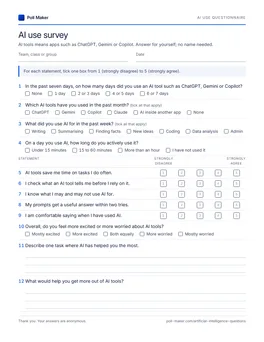
AI use questionnaire
A one-line definition of AI tools, then the core 12 with tick boxes, then the work, school, views and About you sets. Skip the sets you do not need when you print.
Download PDF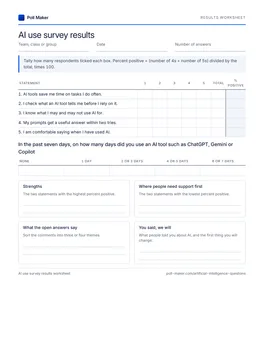
Results worksheet
Count the paper answers for the days-of-use question and each core statement, turn them into a percent agreeing, and circle the first area that needs support.
Download PDFLeading AI questions and plainer ways to ask them
These four mistakes show up in most AI questionnaires. The survey question writing guide has more before-and-after examples.
Do you use AI?
In the past seven days, on how many days did you use an AI tool such as ChatGPT, Gemini or Copilot?
Yes or no mixes daily users with people who tried it once. A count of days in one week shows the habit.
Is AI good or bad?
Overall, do you feel more excited or more worried about AI tools? (Mostly excited to Mostly worried)
A two-way choice forces a side. A balanced five-point version lets people say they feel both.
How much has AI improved your productivity and job satisfaction?
About how much time does AI save you in a typical work week?
AI tools save me time on tasks I do often.
Two questions in one, and "improved" assumes the answer. Ask about time saved in plain bands.
Do you agree that AI will take our jobs?
Which concern about AI matters most to you?
The weak version plants the worry. A list of concerns lets people choose the one they really hold.
AI surveys at work and in class: your questions
For managers, teachers and student researchers.
What are good survey questions about artificial intelligence?
Questions about real behaviour: how many days people used AI last week, which tools, for which tasks, and how much time it saves. Add a few agree statements on rules, skill and checking answers, and one balanced question on how people feel about AI.
How do you measure AI adoption in a company?
Send the core 12 and the AI adoption at work set to all staff, then repeat it every quarter. Track three numbers: the share using AI on at least one day a week, the time saved per week, and agreement that the rules are clear.
How many questions should an AI survey have?
Twelve to twenty works well, which means the core and one extra set. A five-question pulse works for a meeting. All 34 suit a research project where people have ten minutes.
What AI questions can I ask students?
Ask how often and how they use AI for studying, whether teachers make the rules clear, whether AI helps them understand the work, and how confident they are at spotting a wrong answer. The school set covers all of these.
Should an AI survey at work be anonymous?
Yes. People who use personal AI accounts or feel unsure of the rules will only say so when they cannot be identified. Collect answers without names and report groups only when they are large.
Find out how your group really uses AI
Put the core 12 in front of your team, class or sample today: pick one extra set in the builder, then send the link by email or chat, or hand out printed copies.