Library survey questions for school and college students
A student library survey asks how often students use the library, whether they find what their classes need, how the hours and study space work for them and whether staff feel easy to approach. Twelve core questions handle that in about four minutes.
- 37questions
- 12in the core
- 4 minto answer the core
- Grade 2to graduate school
By Michael Hodge, BSc Psychology Updated September 2026
Choose from the full library question set
Your survey begins with the core 12 selected. Tick more lines, or entire sets, for reading, study space, research help, the catalog or the youngest grades. Every row spells out the choices on offer and what a librarian learns from the answers.
The core 1212 questions
Use and purpose first, then eight statements about things a library can actually change, a single forced choice and a free-text question. The same twelve suit a middle school, a high school or a university library.
-
In the last month, how often did you use the library, in person or online?
Not at allOnce or twiceAbout once a weekA few times a weekMost daysSplits regular users from rare ones. Read every later answer by this one, because the two groups want different things from the library.
-
What did you use the library for this term?
Quiet studyGroup workBorrowing booksComputers or printingHelp from staffReading for funTick all that applyShows which jobs the library already does. A job almost nobody ticks may be one students do not know is on offer.
-
I can find the materials I need for my classes.
Strongly disagree12345Strongly agree1 = Strongly disagree, 5 = Strongly agreeThe collection question. When it scores low, the catalog set tells you whether the item is missing or just hard to locate.
-
The library is open when I need it.
Strongly disagree12345Strongly agree1 = Strongly disagree, 5 = Strongly agreeOpening hours judged by the people who use them. Set it beside the time-of-day question before anyone rewrites the timetable.
-
I can find a quiet spot when I need to focus.
Strongly disagree12345Strongly agree1 = Strongly disagree, 5 = Strongly agreeQuiet space for working alone was the lowest-rated item in one university library's 2023 LibQUAL+ survey.2
-
There is room in the library for group work.
Strongly disagree12345Strongly agree1 = Strongly disagree, 5 = Strongly agreeGroup tables and quiet desks compete for the same floor. Asking about each on its own shows which one is short.
-
Library staff are easy to approach for help.
Strongly disagree12345Strongly agree1 = Strongly disagree, 5 = Strongly agreeMany students feel lost in a library and keep it to themselves. This shows whether the desk looks like a safe place to ask.1
-
I can search the library catalog on my own.
Strongly disagree12345Strongly agree1 = Strongly disagree, 5 = Strongly agreeSelf-service skill. A low score is a teaching job for the next class visit rather than a gap on the shelves.
-
The library's technology works when I need it.
Strongly disagree12345Strongly agree1 = Strongly disagree, 5 = Strongly agreeComputers, wifi and printers in one line. In the Ohio school library study, 92.4% of students said library computers helped their schoolwork.3
-
Using the library helps me do better in class.
Strongly disagree12345Strongly agree1 = Strongly disagree, 5 = Strongly agreeThe outcome statement. First-year college students who used the library earned higher first-term grades than those who did not.4
-
Which ONE change would make the library most useful to you?
Longer hoursMore quiet spaceMore group spaceMore books and e-booksMore research helpForces a choice. Ratings say everything matters; one pick per student shows what to fund first.
-
What would make you use the library more often?
Open answerReaches the students who rarely come in. They name the barrier that the ratings cannot show.
Books and reading for fun6 questions
For school librarians building the fiction and graphic novel shelves, and for anyone asked for a reading preferences survey.
-
How often do you read for fun, outside schoolwork?
Most daysEvery weekEvery monthRarelyNeverThe reading habit behind the borrowing figures. Compare grade levels: high school students in the Ohio study ranked leisure reading low, and the lead researcher put it down to crowded timetables.3
-
Which kinds of books do you enjoy most?
FantasyMysteryGraphic novelsNonfictionFunny booksPoetryTick all that applyA buying list from the readers themselves. Order more of what is ticked most, and check the shelves for what is thin.
-
Which formats do you read?
Print booksE-booksAudiobooksMagazinesComics or mangaTick all that applyTells you whether the next dollar goes on print or on e-book and audiobook licences.
-
The library has books I want to read for fun.
Strongly disagree12345Strongly agree1 = Strongly disagree, 5 = Strongly agreeKept apart from the class-materials statement, because students can rate the study collection high and the fun shelf low.
-
I can get popular books without a long wait.
Strongly disagree12345Strongly agree1 = Strongly disagree, 5 = Strongly agreeAccess rather than stock. A title with a long hold list scores low here even though the library owns it.
-
What book or series should the library add next?
Open answerTitles by name. Buy a few of them and say so: students notice when their pick turns up.
Study space and hours4 questions
For planning the floor and the timetable. Run it before you move furniture or change closing times.
-
When do you most want to use the library?
Before classesLunch or free periodsAfter classesEveningsWeekendsShows when demand peaks. Put it next to the opening hours before adding staff time.
-
On most days, the library sounds:
Too quietAbout rightA bit loudToo loudSays which way to move. Noise came up in about 11% of the comments in one university library survey.2
-
I can find a seat at busy times, like exam weeks.
Strongly disagree12345Strongly agree1 = Strongly disagree, 5 = Strongly agreeSeats at the peak, not on a slow afternoon. Exam season is when a free desk matters most.
-
It is comfortable to spend a few hours here.
Strongly disagree12345Strongly agree1 = Strongly disagree, 5 = Strongly agreeLight, temperature, chairs and outlets add up to one feeling. The open answers say which of them to fix.
Research help and library lessons5 questions
For high school and college libraries that teach research skills. Send it after a round of library lessons or when a research unit wraps up.
-
Where do you usually start research for an assignment?
A search engineAn AI chatbotThe library websiteA database from classA librarianShows where students begin. If few start at the library, put library links where they already search, such as course pages.
-
When did you last ask library staff for help?
This monthEarlier this termBefore this termNeverPairs with the approachability statement. Students who never ask may not know what help exists.
-
I can tell if a source is good enough to cite.
Strongly disagree12345Strongly agree1 = Strongly disagree, 5 = Strongly agreeJudging sources, the skill most library lessons teach. Compare classes that had a lesson with classes that did not.
-
I can find articles in the library databases.
Strongly disagree12345Strongly agree1 = Strongly disagree, 5 = Strongly agreeDatabases hold most of what the library pays for. A low score means subscriptions students cannot get value from yet.
-
A library lesson helped me with a real assignment.
Strongly disagree12345Strongly agree1 = Strongly disagree, 5 = Strongly agreeUse, not attendance. Asked how the library had helped, Ohio students most often described library lessons.3
Online catalog and e-books4 questions
For the library website, the catalog and remote access: also the set to use for a class project on a library management system.
-
The catalog shows clearly if a book is on the shelf.
Strongly disagree12345Strongly agree1 = Strongly disagree, 5 = Strongly agreeChecks the catalog's busiest job. Students who walk to an empty shelf stop trusting the search.
-
I can open e-books and databases from home.
Strongly disagree12345Strongly agree1 = Strongly disagree, 5 = Strongly agreeRemote access for late-night study. A low score points you to the sign-in step first.
-
Renewing or reserving a book online is easy.
Strongly disagree12345Strongly agree1 = Strongly disagree, 5 = Strongly agreeThe self-service tasks that save a trip to the desk.
-
What goes wrong when you use the library website or app?
Open answerBug reports in students' own words. Pass them straight to whoever runs the library system.
About you (optional)2 questions
Useful for splitting results by level of study. Drop any group from the report if it is so small that one student could be recognised.
-
Which best describes you?
Grade 8 or belowGrades 9 to 12College, years 1 to 2College, year 3 or laterGraduate studentNeeded only when one survey covers several levels, such as a district or a campus with a graduate school.
-
Do you have a quiet place to study at home?
Yes, alwaysSometimesNoStudents with no quiet place at home lean on the library most. Read their quiet-space and hours scores on their own.
Younger students (grades 2 to 5 answer, read aloud)4 questions
For elementary library time. A teacher or librarian reads every question to the class, and each child circles one of three answers.
-
Do you like visiting the library?
YesSometimesNoThe simplest signal of how library time feels. Ask it again at the end of the year.
-
Can you find books you want to read?
YesSometimesNoYoung readers give up quickly when shelves are hard to browse. A lot of "no" points to labels and displays.
-
Do you know who to ask for help finding a book?
YesSometimesNoChecks that children know help exists, the habit older students need too.
-
Is the library a calm place to read?
YesSometimesNoNoise and bustle, asked in words a seven-year-old can answer.
What makes students answer a library survey honestly
What library research says about asking students, and where the core 12 puts it to work.

Make it easy to admit being lost
Libraries can feel intimidating, and students rarely say so to a librarian. Constance Mellon collected two years of search journals and essays from students in beginning college writing classes, and 75 to 85 percent of students in each class described their first response to the library in terms of fear or anxiety.1 They felt lost because of the building's size, not knowing where things were, and not knowing how to begin or what to do next. Many believed everyone else already knew how, and that asking a question would give them away. Anonymous statements such as "Library staff are easy to approach for help" and "I can search the library catalog on my own" let students report that quietly.
Ask about quiet space and group space separately
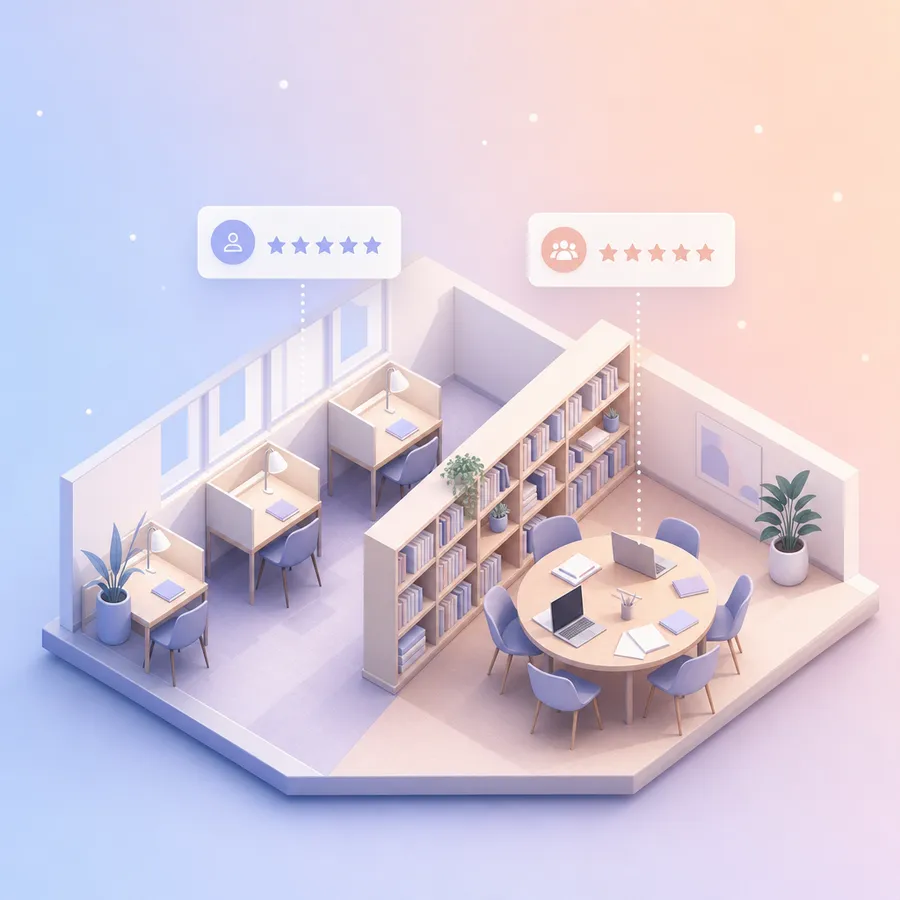
Give library users a comment box and they write about the building. In Western University's 2023 LibQUAL+ survey, where two thirds of respondents were undergraduates, 68 percent of comments were about library spaces and a quarter about study space alone, and quiet space for individual work was the lowest-rated item on the whole survey.2 One "study space" rating would blur two needs that compete for the same floor, so the core asks about a quiet spot and room for group work in separate statements, and the space set adds noise and seating at busy times.
Ohio students who found the school library most or quite helpful
Ask what the library helped them do
Outcome questions are where a library shows its worth. In the Ohio study of 13,123 students in grades 3 to 12, 88.5 percent said the school library helped them get better grades on projects and assignments, and the help students described most often was a library lesson.3 Across more than 34 statewide studies, strong school library programs go with higher test scores,5 and at the University of Minnesota, first-year students who used the library earned higher first-semester grades and stayed on into spring at higher rates.4 The last core statement and the research set ask your own students. Keep the full five-point scale so a "no" can show up: reviewers of the Ohio study noted its scale had no "did not help" answer.7
Survey mid-term, where students already are
Pick a week in the middle of a term, once students have used the library for real work and before exams fill every seat. Display the QR code at checkout and on the library home page, hand out paper in class visits, and send the link through the school or course system. Western also showed each person only part of its question list, the LibQUAL+ Lite approach, to keep the survey short.2 The same idea works here: everyone gets the core 12, and each extra set goes only to the students it fits.
Torn between later hours and more group tables? Put the one-change question on the library home page as a quick student poll and let the votes settle it by Friday. First time running one? The poll making guide has the steps.
From low scores to changes the library can make
Every core statement maps to something a librarian controls. When one scores low, check the linked question before deciding what to do.
| When this scores low | Check next | A change to try |
|---|---|---|
| Finding materials for classes (question 3) | The online catalog set: is the item missing, or just hard to find? | Buy or borrow the titles students name, and demo catalog search in class visits |
| Opening hours (question 4) | The time-of-day question in the study space set | Trial a later close in the weeks before exams, then ask again |
| A quiet spot (question 5) | How the library sounds on most days, in the same set | Mark one zone silent and move group tables away from it |
| Staff easy to approach (question 7) | When students last asked staff for help, in the research help set | Put someone out on the floor at busy times, and add a chat link |
| Searching the catalog alone (question 8) | Where students start research, in the research help set | A five-minute search demo at the start of every class visit |
| The most-voted change (question 11) | The open answers, question 12 | Fund it first, and tell students it came from their votes |
Run the same core 12 again a term after the change. A statement that climbs is the clearest proof a library can show its principal or dean.
Chart the eight library statements
Type the counts for each point of the scale, from paper or from the online results. Each bar shows how many students agree with a statement, and the shortest one is where the library starts.
- 1A 4 or a 5 counts as agreeing. As you type, the panel divides those by everyone who rated the statement.
- 2Make a second chart from the students who used the library once or twice, or not at all, last month. Their lowest bars show what keeps them away.
- 3Read the lowest statement beside the one-change votes and the answers about what would bring students in more often.
- 4Share the chart where students will see it, on a sign at the entrance, the library web page or a slide in the next class visit, together with the change you picked.
Library results
A QR code on the checkout desk, and five questions behind it
Tape a QR code to the checkout desk or pin the link to the library home page and ask just five: how often students come, whether they find class materials, whether the hours fit, whether staff are approachable and which single change they would pick.
- 01In the last month, how often did you use the library, in person or online?
- 02I can find the materials I need for my classes.
- 03The library is open when I need it.
- 04Library staff are easy to approach for help.
- 05Which ONE change would make the library most useful to you?
Forms to bring on class visits
Take a stack to each class visit and collect them at the door, so students who never come in on their own still get a say. The layout suits whatever paper the school copier holds.
Visiting one class only? for that group.
Student library questionnaire
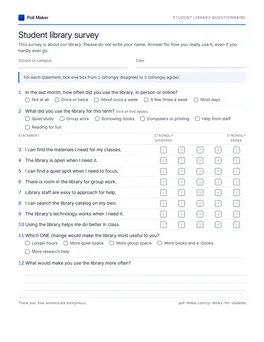
Students tick their way through the first twelve questions on page one and write one short answer. The six extra sets come after it, one heading each, and the read-aloud set for grades 2 to 5 gets a sheet of its own.
Download PDF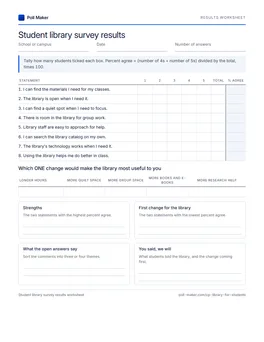
Results worksheet
Tally the eight statements and the one-change votes by hand, turn every tally into a percent agreeing, then note the first change at the bottom.
Download PDFA library use study for a class project or thesis
Students researching how classmates use the library can take this set as it stands. Here is how the questions answer common research questions, and how to collect the answers fairly.
| What you want to know | Which questions | Analysis |
|---|---|---|
| How often do students use the library, and for what? | Questions 1 and 2, with level of study from the About you set | Share choosing each answer, by level of study |
| How satisfied are students with library services? | Questions 3 to 10 | Percent agreeing with each statement, highest to lowest |
| Do frequent users find the library more helpful? | Questions 1 and 10 | A cross-tab of visits against agreement |
| How well does the online library system serve students? | The online catalog and e-books set | Percent agreeing, plus themes from the open answers |
A consent line for the opening screen
"This survey is part of a class project on library use. Taking part is voluntary and anonymous, and you can skip any question or stop whenever you like. Nothing is shared except totals for the whole group."
Who to ask
Get the go-ahead from the librarian and your teacher first. Then hand the survey out in classrooms or share the link in class group chats, not only inside the library: students sitting in the library already use it, and the ones who stay away are half the story. Spread it across year levels and note how many students you asked as well as how many answered.
For the methods chapter, research types and study designs explains what makes a study valid. For surveys on other school topics, browse the education survey questions collection.
Library questions students struggle to answer, rewritten
Four questions that look reasonable on a library survey but produce results no librarian can use. Browse survey question examples for fixes on other subjects.
How satisfied are you with the library?
I can find the materials I need for my classes.
The library is open when I need it.
One satisfaction score cannot tell a librarian whether to buy books, change the hours or move the tables.
Is the library quiet and comfortable?
I can find a quiet spot when I need to focus.
It is comfortable to spend a few hours here.
It asks two things at once. Someone who finds the room cosy but noisy cannot answer honestly.
Do you use the library databases? (Yes / No)
I can find articles in the library databases.
A yes or no counts users. The statement shows whether students can actually get to the articles.
Our friendly staff are always ready to help. Do you agree?
Library staff are easy to approach for help.
The leading version hands students the answer before they give it. Neutral wording lets the unhappy ones say so.
What librarians ask before surveying students
Short answers for school librarians, college library teams and students running their own library study.
What questions should a library survey for students include?
Start with how often students use the library and what for. Then ask whether they find materials for class, whether the hours suit them, whether there is a quiet spot and room for group work, whether staff are easy to approach and whether they can search alone. End with one change and one open question, and add the reading, research or catalog set when you need detail.
How many questions should a student library survey have?
About twenty at most. The American Association of Law Libraries' model student survey advises staying near twenty questions to avoid survey fatigue.6 The core 12 plus one extra set stays under that.
How do I get more students to answer a library survey?
Ask in several places at once. Western University's library promoted its 2023 survey by email, posters, website banners, social media and campus newsletters, offered a prize draw that included a private study room, and kept entry emails apart from the answers. It drew 2,762 responses, its largest LibQUAL+ turnout yet.2 Class visits add the students who seldom come in.
Can elementary students answer a library survey?
Yes. Use the younger students set, which an adult reads to the class while each child circles an answer. It fits inside one library period. From grade 6 up, use the core 12.
When should a school or college library survey students?
In the middle of a term, after students have used the library for real assignments and before exam crowds fill every seat. Run it at the same point each year so the results line up.
Hear from students before next term
Pick your sets, send them to the builder and post the link on the library home page, or run off paper copies before the next class visit.