A student motivation survey about one class at a time
Find out what makes your students try, and what stops them. The core 12 covers interest, value, confidence, choice and belonging in about six minutes. Add modules on the reasons behind the effort, goals and classroom climate.
- 29questions
- 12in the core check
- 6 minfor the core
- Grade 6to college
By Michael Hodge, BSc Psychology Updated September 2026
Five minutes at the end of a lesson
Got five minutes at the end of a lesson? These cover interest, value and confidence, name what gets in the way, and ask for one thing that would help.
- 01The topics we cover in this class interest me.
- 02I can see how what we learn here will be useful to me.
- 03If I put in the effort, I can do well in this class.
- 04What gets in the way of your motivation most often?
- 05What is one thing that would make you try harder in this class?
Interest, value, confidence and belonging, then goals and climate
Each question shows the choices students pick from and what the answer tells you. The core 12 starts ticked. Switch on a module or untick what you can skip, then send your set to students as a link, print it for class, or copy the wording.
Motivation core12 questions
Eight statements, one for each part of motivation a teacher can influence, then a tick list on what drives effort, one question on what blocks it, and two open questions. Ask it about one class.
-
The topics we cover in this class interest me.
Strongly disagree12345Strongly agree1 = Strongly disagree, 5 = Strongly agreeInterest, the inside kind of motivation. A large meta-analysis linked it to student success and well-being.2
-
I can see how what we learn here will be useful to me.
Strongly disagree12345Strongly agree1 = Strongly disagree, 5 = Strongly agreeValue. Often the quickest score to raise: a short relevance task lifted interest and grades in a field experiment.3
-
If I put in the effort, I can do well in this class.
Strongly disagree12345Strongly agree1 = Strongly disagree, 5 = Strongly agreeConfidence. Students who doubt effort will pay off stop trying early, so this score often explains a low persistence score.
-
I get some say in how I do my work in this class.
Strongly disagree12345Strongly agree1 = Strongly disagree, 5 = Strongly agreeChoice. Teachers who support autonomy see more curiosity and more appetite for a challenge.1
-
My teacher cares whether I learn, not just whether I finish.
Strongly disagree12345Strongly agree1 = Strongly disagree, 5 = Strongly agreeConnection with the teacher. Students who feel cared for take school values on as their own.1
-
I feel like I belong in this class.
Strongly disagree12345Strongly agree1 = Strongly disagree, 5 = Strongly agreeBelonging with classmates. A student who feels like an outsider rarely speaks up, however interested they are.
-
When the work gets hard, I keep going.
Strongly disagree12345Strongly agree1 = Strongly disagree, 5 = Strongly agreePersistence, where motivation shows. Read it next to interest and confidence to see which one is holding it back.
-
I have a goal of my own for this class.
Strongly disagree12345Strongly agree1 = Strongly disagree, 5 = Strongly agreeDirection. A goal of their own gives students a reason to work that does not depend on the next test.
-
What makes you want to try your hardest in this class?
Learning something interestingA good gradeMy future plansMy familyMy friendsTeacher praiseBeating my last resultTick all that applyShows the mix of inside and outside reasons in the room. A class that ticks only grades and praise needs reasons of its own.
-
What gets in the way of your motivation most often?
The work is too hardThe work is too easyNot seeing the pointFalling behindDistractions or tirednessNames the main blocker so the fix fits it. Too hard and too easy call for opposite changes.
-
Think of a lesson or project that made you want to work hard. What made it different?
Open answerStudents describe the conditions that work for them, such as a real audience, a choice or a challenge they could meet.
-
What is one thing that would make you try harder in this class?
Open answerOne request per student. Sort the answers into piles and the two biggest become the plan.
Why I do the work6 questions
Six reasons, from pressure to real interest. Add them when you want to know what kind of motivation is in the room, not only how much.
-
I do my schoolwork because I like finding things out.
Strongly disagree12345Strongly agree1 = Strongly disagree, 5 = Strongly agreeDoing the work for its own sake. The strongest reason to grow.2
-
I do my schoolwork because it matters for my future.
Strongly disagree12345Strongly agree1 = Strongly disagree, 5 = Strongly agreePersonal value. Across 344 samples it was often the reason most closely tied to effort and staying in school.2
-
I do my schoolwork so I will not feel guilty.
Strongly disagree12345Strongly agree1 = Strongly disagree, 5 = Strongly agreePressure from inside. It drives effort and also brings worry, so read it next to the blockers question.2
-
I do my schoolwork mainly to stay out of trouble.
Strongly disagree12345Strongly agree1 = Strongly disagree, 5 = Strongly agreePressure from outside. In the same meta-analysis it did not go with better grades or persistence, so a high score is a cue to add other reasons.2
-
I do my schoolwork mostly for grades or rewards.
Strongly disagree12345Strongly agree1 = Strongly disagree, 5 = Strongly agreeRewards. Grades matter; this shows how much of the effort in the room depends on them.
-
Honestly, I do not see the point of my schoolwork.
Strongly disagree12345Strongly agree1 = Strongly disagree, 5 = Strongly agreeNo reason at all. Even a few agrees are worth a quiet one-to-one conversation.
Goals and study habits5 questions
For advisory time, study skills lessons or coaching, where the next step is a plan the student makes.
-
I set a goal before I start a test or a big assignment.
Never12345Always1 = Never, 5 = AlwaysShows whether goal setting is a habit or a one-off. Low scores are easy to coach.
-
I plan when I will do my homework and revision.
Never12345Always1 = Never, 5 = AlwaysPlanning turns good intentions into study time. Pair it with the time question below.
-
After a poor mark, I work out what to change.
Never12345Always1 = Never, 5 = AlwaysHow a student treats a setback: as information or as a verdict.
-
How long do you study on a typical school night?
NoneUnder 30 min30 to 60 min1 to 2 hoursOver 2 hoursA plain measure of time on task, to read against the effort and goal answers.
-
What is one goal you want to reach by the end of this term?
Open answerGives you each student's own target to check in on at the midpoint.
Classroom climate4 questions
Add these when the core comes back low on teacher care or belonging and you want to see why.
-
In this class, mistakes are treated as part of learning.
Strongly disagree12345Strongly agree1 = Strongly disagree, 5 = Strongly agreeWhether it is safe to try something hard and get it wrong, which is where learning happens.
-
I can ask a question in class without feeling embarrassed.
Strongly disagree12345Strongly agree1 = Strongly disagree, 5 = Strongly agreeA low score means questions go unasked and confusion builds quietly.
-
My teacher notices when I have worked hard.
Strongly disagree12345Strongly agree1 = Strongly disagree, 5 = Strongly agreeRecognition for effort, not only for results. Students who feel seen keep trying.
-
Our teacher explains why the work we do matters.
Strongly disagree12345Strongly agree1 = Strongly disagree, 5 = Strongly agreeA clear reason for a task helps students take it on as their own, even when it is dull.1
About you (optional)2 questions
Use these only when one survey spans several classes, and report a group only once it is big enough that no one stands out.
-
Which stage of school are you in?
Middle schoolHigh school, first two yearsHigh school, last two yearsCollege or universityPrefer not to sayLets you compare age groups when the survey runs across a whole school.
-
Which subject are you answering about?
English or language artsMathScienceSocial studies or historyAnother subjectMotivation changes from subject to subject, so this keeps the answers apart.
What a low score tells you to try
Work out percent agree for each core statement, then start with the lowest. Every statement maps to one thing you can change in your own classroom.
| Low score on | What to try |
|---|---|
| Interest. The topic feels like content to get through. | Open the next unit with a puzzle, a mystery or a real case, and hold back the notes until students are curious. |
| Value. Students cannot see what the topic is for. | Ask students to write a few sentences on how the topic connects to their own lives. In high school science classes, a task like this raised interest and grades for students who expected to do poorly.3 |
| Confidence. Effort does not seem to pay off. | Break big tasks into steps students can finish, and show them the progress they have made. |
| Choice. The work feels done to them, not by them. | Offer two or three ways to show what they learned, or let students pick the topic of one assignment.1 |
| Teacher care and belonging. Some students feel unseen or on the outside. | Learn every name in the first week, give each student a role in group work, and add the classroom climate module next time. |
| Persistence and goals. Students stall when work gets hard. | Have each student set one goal for the unit and check it halfway. The study habits questionnaire shows how they plan and revise. |
Read the drivers and blockers questions next. If most students pick "Not seeing the point", start with value; if "The work is too hard" leads, start with confidence.
Build a motivation profile for your class
Enter how many students chose each point for the core statements. The chart lines up interest, value, confidence, choice, belonging, persistence and goals, so the weakest area stands out. Print it for a department meeting or a parent evening.
- 1Percent agree is the share of students picking 4 or 5 on a statement, out of everyone who answered it. The chart works it out as you type.
- 2Look for the lowest one or two statements. Those are the areas to work on, and the table above suggests where to start.
- 3Check the drivers, the blockers and the open answers against the low scores. They usually say why in the students' own words.
- 4Tell the class what came out and what you will try first, then run the core again later in the term.
Class motivation profile
Real classes, no names: what gets students to open up
Students tell you what drives them when the questions are about a real class and the answers cannot come back to them.

Ask about one class at a time
Motivation is not a fixed trait a student carries from room to room. The same student can be keen in art and switched off in algebra, and research on motivation finds people more self-motivated in some settings and subjects than in others.1 Name the class at the top of the survey and run it separately for each group you teach.

Survey early, then again after a change
By week three or four students know the class well enough to answer, and most of the term is still ahead. Pick one change from the results, give it four to six weeks, then run the core again. The second round shows whether the change worked, and students see that their answers led somewhere.

Make it safe to say "I do not see the point"
The most useful answers are the ones students hesitate to give: that they only work for the grade, or not at all. Send an anonymous link with no name field, have a colleague or a student collect paper copies, and share results only for whole classes.
Want a quick read before the full survey? Put the blockers question on the board as a live class poll. Students vote from their phones, everyone sees the result at once, and the conversation starts itself. First time? Here is how to make a poll in five steps.
From labelling students to asking about the class
Most motivation surveys ask students to label themselves. These four fixes ask about the class instead. For the same fixes on other topics, see the survey question writing guide.
Are you a motivated student?
When the work gets hard, I keep going.
A label invites a polite yes. A statement about one moment in class gets an honest spread of answers.
Do grades and praise from your teacher motivate you?
What makes you want to try your hardest in this class? (tick all that apply)
Two reasons in one question. A tick list lets students name each reason separately and shows the mix.
Don't you think learning is important?
I can see how what we learn here will be useful to me.
Leading: there is only one acceptable answer. A statement about this class and its use leaves room to disagree.
How motivated are you, from 1 to 10?
The topics we cover in this class interest me.
If I put in the effort, I can do well in this class.
One overall number cannot tell you what to change. Separate statements for interest and confidence point to different fixes.
Research use: making a thesis survey hold up
Students and trainee teachers use this questionnaire for research too. Four things make the results hold up.

Ask permission first
Surveys of students under 18 usually need the school's approval and a note to parents. Tell respondents what the survey is for, that it is anonymous and that they can skip any question.
Survey whole classes, not volunteers
The keenest students volunteer first, which pushes motivation scores up. Pick classes, then ask everyone in them.
Report area scores
Give percent agree for each core statement and compare groups (stage of school, subject) only when each group is large enough to stay anonymous. Studying grades as well? Pair it with the academic performance questionnaire to set results next to motivation.
Need a published scale?
The motivation section of the Motivated Strategies for Learning Questionnaire (MSLQ) has 31 items on a seven-point scale, written for college courses, and its manual is free on ERIC.4 The questions on this page are original and shorter, which suits a class survey in school.
Ten quiet minutes and sheets collected face down
Handing out paper? Give students ten quiet minutes early in the lesson and collect the sheets face down. Each PDF fits letter and A4 paper.
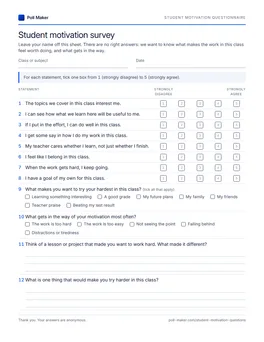
Student motivation questionnaire
The 12 core questions on the first page, with tick boxes and space to write. The reasons, goals, climate and background modules follow.
Download PDF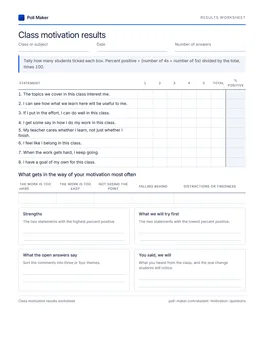
Class results worksheet
Tally the paper answers, turn each statement into percent agree, and mark the lowest area to work on first.
Download PDFWhat teachers ask before running a motivation survey
Short answers for teachers, counselors and student researchers.
How do you measure student motivation?
Ask students to rate short statements about the parts of motivation you can influence: interest, value, confidence, choice and belonging. Use a five-point agree scale, work out percent agree for each, and start with the lowest area. Watch persistence on hard tasks as well.
What are the types of motivation in students?
Intrinsic motivation is doing the work because it is interesting. Extrinsic motivation is doing it for something else, and it ranges from outside pressure, through guilt, to personal value.1 The "Why I do the work" module asks about each one.
Can students use this as a motivation test on themselves?
Yes. A student can answer the core and look at which statements they agree with least. That is where to start: setting one goal, or asking the teacher how a topic will be used. It works best talked through with a teacher or counselor.
How often should I run a motivation survey?
Twice a term suits most classes: once early on, and again four to six weeks after you change something. In between, a single poll question keeps the conversation going.
What age is this questionnaire for?
The wording suits students from middle school to college. For younger children, read each statement aloud and use three answers: yes, sometimes, no.
Ask your class what keeps them going
Send the motivation core to your class as a link, or hand out the paper questionnaire in tomorrow's lesson.