A time management questionnaire students score themselves
These questions show where a student's week really goes: how far ahead they plan, what comes first, when big assignments start and whether the load feels under control. The core 14 takes about six minutes and scores itself in four areas.
- 32questions
- 4scored areas
- 6 minfor the core 14
- Grade 7through college
By Michael Hodge, BSc Psychology Updated September 2026
The 32 questions, grouped by what they measure
The core 14 is ticked for you. Every question shows its answer choices and a line on what a low or high score means. Add the modules that fit your students, then share your pick through one link, print a class set, or paste the wording elsewhere.
The core 1414 questions
Twelve statements in four areas of three: planning ahead, priorities, getting started, and control and balance. Then one question on when big work begins and one open question. Together they make a complete questionnaire.
-
I know what is due for every class this week.
Strongly disagree12345Strongly agree1 = Strongly disagree, 5 = Strongly agreePlanning ahead. The basic map of the week; a student who disagrees is managing by surprise.
-
I keep all my due dates written in one place.
Strongly disagree12345Strongly agree1 = Strongly disagree, 5 = Strongly agreePlanning ahead. One calendar or planner beats three half-used ones. Low scores often explain missed work.
-
I set aside time for big assignments days in advance.
Strongly disagree12345Strongly agree1 = Strongly disagree, 5 = Strongly agreePlanning ahead. Shows whether large tasks get a slot on the calendar or only a deadline.
-
When everything is due at once, I know what to do first.
Strongly disagree12345Strongly agree1 = Strongly disagree, 5 = Strongly agreePriorities. Tells you whether a busy week turns into a plan or into panic.
-
I break big projects into smaller steps with dates.
Strongly disagree12345Strongly agree1 = Strongly disagree, 5 = Strongly agreePriorities. Students who skip this step usually meet a large project for the first time the week it is due.
-
I save my most alert hours for my hardest work.
Strongly disagree12345Strongly agree1 = Strongly disagree, 5 = Strongly agreePriorities. Whether demanding work gets fresh attention or the tired end of the evening.
-
I start assignments well before the night they are due.
Strongly disagree12345Strongly agree1 = Strongly disagree, 5 = Strongly agreeGetting started. The clearest single sign of how a student handles deadlines.
-
Once I sit down to work, I get going quickly.
Strongly disagree12345Strongly agree1 = Strongly disagree, 5 = Strongly agreeGetting started. Separates students who plan well but stall at the desk from those who never plan.
-
My time estimates for schoolwork are about right.
Strongly disagree12345Strongly agree1 = Strongly disagree, 5 = Strongly agreeGetting started. Most people underestimate how long their own tasks take, so a low score here is common and fixable.3
-
I feel in control of how I spend my time.
Strongly disagree12345Strongly agree1 = Strongly disagree, 5 = Strongly agreeControl and balance. The overall feeling that the week belongs to the student. Read it next to the workload module.
-
Most school nights I still get enough sleep.
Strongly disagree12345Strongly agree1 = Strongly disagree, 5 = Strongly agreeControl and balance. Sleep is usually the first thing a crowded week takes away.
-
I can turn down plans when I have work to finish.
Strongly disagree12345Strongly agree1 = Strongly disagree, 5 = Strongly agreeControl and balance. Friends, family and jobs all ask for time; this shows whether study time survives.
-
How far ahead do you usually start a big assignment?
On the due dateThe night before2 or 3 days beforeA week beforeOver a week beforeThe one answer that turns into a plan. If most of a group picks the first two, build checkpoints into the next assignment.
-
What most often eats up time you meant to spend on schoolwork?
Open answerStudents name the real thief, such as a job, a long commute, a phone or looking after siblings. It decides which fix will work.
Where the week goes5 questions
Add these when you want the hours behind the feelings. They feed the 168-hour check further down this page.
-
Outside class, how many hours a week do you spend on homework and study?
Under 33 to 67 to 1011 to 15Over 15Study time per week, to set against the course load. Very high numbers with low scores point to methods, not effort.
-
How many hours a week do you work at a paid job?
None1 to 1011 to 2021 to 30Over 30Paid work is the biggest fixed demand many students carry. Read it next to the sleep and control statements.
-
How many hours a week go to sports, clubs or other activities?
None1 to 56 to 1011 to 15Over 15Activities are good for students, and they also fill evenings. This shows how many hours are already spoken for.
-
On a school night, when do you usually fall asleep?
Before 10 pm10 to 11 pm11 pm to midnightMidnight to 1 amAfter 1 amA concrete time is easier to answer honestly than "do you sleep enough", and it shows where late work lands.
-
Which of these take up a big part of your week?
Homework and studyA paid jobSports or clubsFamily dutiesPhone, games or videosGetting to and from schoolTick all that applyLets students name several demands at once, so you see the combination, not just the largest one.
Planning tools3 questions
For advisers choosing what to teach: which tools students already use, and whether they actually look at them.
-
What do you use to keep track of deadlines?
A paper plannerA phone or online calendarThe school learning platformA to-do list appSticky notesNothing, I remember themTick all that applyTells you which tool to build on. Teaching a new app to students who love paper rarely sticks.
-
When do you plan out your week?
At the start of each weekA little each dayOnly when a deadline is closeI do not plan itWeekly planning is the habit most study skills courses teach first. This shows how many students already have it.
-
I look at my calendar or planner every school day.
Strongly disagree12345Strongly agree1 = Strongly disagree, 5 = Strongly agreeA planner that is never opened is a diary of good intentions. This separates owning one from using one.
Starting and staying focused5 questions
Add these when the Getting started area scores lowest, to find out why work gets put off.
-
When you put off an assignment, what is usually the reason?
It feels too bigI do not know where to startIt seems boringI work better under pressureOther things feel more urgentI am too tiredTick all that applyEach reason has a different fix: a first small step, a clearer brief, a reason to care or an earlier bedtime.
-
I can study for half an hour without checking my phone.
Strongly disagree12345Strongly agree1 = Strongly disagree, 5 = Strongly agreeA plain test of focus. Students who cannot yet do this get more from short timed sessions than from long ones.
-
When a plan falls apart, I get back on track the next day.
Strongly disagree12345Strongly agree1 = Strongly disagree, 5 = Strongly agreeEvery plan slips. What matters is whether one lost evening becomes a lost week.
-
How often do you finish work in a rush just before it is due?
NeverRarelySometimesOftenAlwaysLast-minute finishing, asked as a frequency. Read it next to the start-date question in the core.4
-
Compared with your plan, how long did your last big assignment take?
Much less timeA little lessAbout what I plannedA little moreMuch more timeThe gap between plan and reality. Students who see it start planning with their real track record.3
Workload and stress3 questions
For checking whether the problem is the student's planning or simply too much to do.
-
My workload this term feels manageable.
Strongly disagree12345Strongly agree1 = Strongly disagree, 5 = Strongly agreeIf a whole class disagrees, the fix is the assignment calendar, not a lesson on planning.
-
I have time each week for things I enjoy.
Strongly disagree12345Strongly agree1 = Strongly disagree, 5 = Strongly agreeTime management should protect rest as well as work. Low scores here often come with low sleep scores.2
-
In the past month, how often did deadlines keep you up late?
NeverOnce2 or 3 timesMost weeksMost nightsA concrete marker of overload students can count. Useful to compare before and after a busy exam season.
About you (optional)2 questions
Switch these on when a project needs to split results by year or grade band. Show results for a band only when it holds enough students to stay anonymous.
-
Which stage of education are you in?
Middle schoolHigh schoolFirst year of collegeLater years of collegePrefer not to sayFirst-year college students manage far more unstructured time than school students, so compare stages separately.
-
Which best describes your grades so far this year?
Mostly AMostly A and BMostly B and CMostly C or lowerPrefer not to sayFor projects that set time management next to grades. Change the bands to match your own grading system.1
Self-scoring: four areas, three statements each
Each statement earns 1 point for Strongly disagree up to 5 for Strongly agree, so the three statements in an area add up to a score from 3 to 15.
| Area | Statements | Lowest area? Try this |
|---|---|---|
| Planning ahead | 1 to 3: what is due, one list of dates, time set aside | Copy every due date for the next month into one calendar tonight. |
| Priorities | 4 to 6: what comes first, smaller steps, alert hours | Each evening, circle the task that would hurt most if it slipped, and do it first. |
| Getting started | 7 to 9: starting early, getting going, good estimates | Spend 20 minutes on each new assignment on the day it is set, even if it is only an outline. |
| Control and balance | 10 to 12: in control, sleep, turning down plans | Pick one commitment to shrink until the next big deadline has passed. |
Reading the scores
Set a student's four totals side by side and look for the gap; a classmate's totals tell them nothing. As a rule of thumb, 12 to 15 is a strength to keep, 8 to 11 works in some weeks and not others, and 3 to 7 is the place to start.
A worked example
Picture a first-year college student who scores Planning ahead 13, Priorities 10, Getting started 6 and Control and balance 9, and who usually starts big assignments the night before. Planning is not the problem: every deadline is in the calendar. The start date is. So the plan is 20 minutes on each assignment the day it is set, and a second go at the core after the next deadline to see whether Getting started has climbed.
A PDF to hand out in advisory or seminar
Paper works well in an advisory period or a first-year seminar. Each student scores and keeps their own sheet, and the adviser collects a copy for the group count. Letter and A4 printers both handle them.
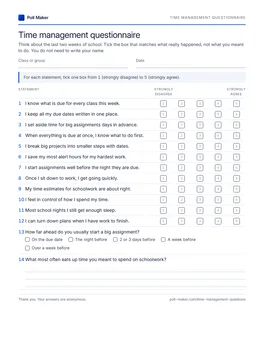
Time management questionnaire
Page one holds the core 14 ready for a pencil. The week, tools, focus, workload and background modules follow.
Download PDF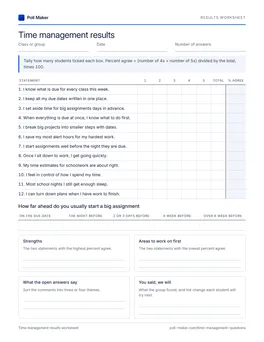
Group results worksheet
Tally each statement, work out the share who agree, and pick the two areas the group will work on before the next deadline.
Download PDFSee where the whole group stands
Enter the number of students behind every answer. The chart ranks the statements from most to least agreement and marks the weakest as the focus. Print it for an advisory session or a staff meeting.
- 1The share who agree is Agree plus Strongly agree, divided by all the students who responded. The panel works it out for every statement as you type.
- 2Sort the twelve core statements into their four areas. When most statements in one area sit low, it is a group habit to teach, not one student's problem.
- 3Read the start-date question beside the Getting started area. If most of the group begins the night before, set an early checkpoint on the next big assignment.
- 4Show students the chart and the one change you will make together, such as a draft due a week early, then run the core again after that deadline.
Group time management results
Running it so the answers change something
Students know what good time management is supposed to look like, so a careless survey collects the ideal week. These four choices keep it about the real one.

Send it in week three, then after midterms
By the third week of a term the deadlines are real but nothing is lost yet, so a student can still move a start date or drop a commitment. Run the same core again after the first round of tests and compare the four area scores. The change between the two is the result worth reporting.

Ask how long the last assignment took
People plan the next job as if nothing will go wrong. Buehler and colleagues found that predictions of when a task would be finished were too optimistic for schoolwork and everyday tasks alike, and that the bias disappeared when people tied their forecast to how long similar jobs had taken before.3 So one core statement checks whether estimates hold up, and the focus module asks how the last big assignment compared with the plan.

Follow it with one scheduled change
The payoff comes from what students do next. In a randomised study of 96 students, those given a short time management training spread their work on an important assignment evenly across the weeks, while the untrained group piled it up just before the deadline.4 Ask each student to pick their lowest area, choose one change from the scoring table and put it in their calendar that same day.

Collect hours, not impressions
Asking "do you have enough time?" gets a sigh. Hours at a job, at practice and on homework give a total a student can check against the 168 hours in a week. The Where the week goes module collects them, and the check below shows how to add them up.
Want a quick read on a whole class first? Put the start-date question on screen as a live classroom poll and let students answer from their phones. Seeing the spread starts a conversation about deadlines that no lecture can. Sharing a poll with a class walks through posting it in Teams, by link or on a class website.
Does the week add up? The 168-hour check
Answers from the Where the week goes module turn into a simple sum. Add them to sleep and class time and a student sees at once whether their plans fit inside one week.
| Part of the week | Example hours | Where the number comes from |
|---|---|---|
| Sleep, 8 hours a night | 56 | Bedtime question |
| Classes and travel | 35 | The student's timetable |
| Homework and study | 12 | Study hours question |
| Paid job | 15 | Job hours question |
| Sports and clubs | 8 | Activities question |
| Meals, chores, getting ready | 21 | The student's own estimate |
| Total | 147 | 21 hours left of 168 |
This example student has 21 free hours a week for friends, family, phones and rest: about three a day. That is a workable week. When a student's total comes close to 168, the answer is choosing what to shrink, and the sum makes that choice easy to talk about. It also explains most low scores on Control and balance in one line.
Short on class time? Ask these five
Running short on homeroom time? These five still cover each scored area, and they end with the start-date question that shows how close to the deadline work really begins.
- 01I know what is due for every class this week.
- 02When everything is due at once, I know what to do first.
- 03I start assignments well before the night they are due.
- 04I feel in control of how I spend my time.
- 05How far ahead do you usually start a big assignment?
Time management and grades: a research project plan
Linking time management to grades is one of the most popular student research topics. The questionnaire is ready for it once four choices are made.
Know what earlier studies found
In a classic study, 90 college students filled in a time management questionnaire, and their grade point averages were collected four years later. Two parts of the questionnaire predicted those grades, and together they explained more of the difference between students than their SAT scores did.1 A 2021 meta-analysis pooled 158 studies, 76 of them in schools and colleges, and found time management moderately related to academic achievement and a little more strongly to wellbeing.2 So measure both: the Workload and stress module covers the wellbeing side.
Choose whole class sections
Ask everyone in the sections you pick instead of posting an open link, which mostly reaches students who already plan well. Put the purpose and a skip option on the first screen, collect no names, and get school approval for anyone under 18.
Report area scores by grade band
Tick the two background questions at the end of the bank. Report the average of each of the four area scores for each grade band, plus how the start-date answers spread across bands. If the design calls for more detail on marks and course load, borrow items from the academic performance questionnaire.
Name a published scale if your adviser asks for one
The Time Management Questionnaire by Britton and Tesser began as 35 items and was cut to 18 in three parts: short-range planning (7 items), time attitudes (6) and long-range planning (5).5 Trueman and Hartley tested it with students in the UK and describe its scoring in a paper you can read free on ERIC. Every item on this page uses fresh wording and suits school students as well as undergraduates.
Time management questions that get vague answers, fixed
A weak time management question invites students to give themselves a grade. Each fix asks about something they did this week. The advice on picking survey questions applies the same rules to any topic.
Are you good at managing your time?
When everything is due at once, I know what to do first.
I start assignments well before the night they are due.
A self-rating mostly measures confidence. Statements about specific behaviour show which habit is missing.
How do you feel about your time management and stress levels?
I feel in control of how I spend my time.
My workload this term feels manageable.
Two topics in one question. A student who feels in control but overloaded cannot answer it honestly.
Do you procrastinate? (Yes / No)
How far ahead do you usually start a big assignment?
Nearly everyone answers yes. Days before the deadline gives a spread you can plan around.
Why don't you plan your week?
When do you plan out your week?
The weak version assumes failure and makes students defensive. The better one lets "I do not plan it" be an ordinary answer.
Time management questionnaire FAQ
Short answers for teachers, advisers and students running their own project.
What should a time management questionnaire for students ask?
Four things: how far ahead students plan, how they decide what comes first, when they start big work and whether the load feels under control. Add the hours spent on jobs, activities and homework so the answers can be checked against a real week.
How do you score a time management questionnaire?
Give each answer 1 to 5 points, from Strongly disagree to Strongly agree. Add up statements 1 to 3 for Planning ahead, 4 to 6 for Priorities, 7 to 9 for Getting started and 10 to 12 for Control and balance. A student with 7 or less in an area has found their first habit to work on.
Are there right answers to these time management questions?
No. Every question asks what a student actually does, so the honest answer is the useful one. The scoring table then turns each low area into a concrete next step.
What is the Time Management Questionnaire (TMQ)?
A published scale from Britton and Tesser (1991) for college students. Its 18-item version has three parts: short-range planning, time attitudes and long-range planning.5 Everything in the question bank here is original wording, not TMQ items.
Can students use it as a self-assessment?
Yes. A student can print the questionnaire, circle their answers and total each area with the scoring table in a couple of minutes. The lowest area and its suggested change make a ready-made goal for the next two weeks.
Get the group ready for the next deadline
Send the core 14 as a link students fill in from any phone today, or print the PDF and hand it out at your next advisory period.