Survey questions for small business owners on sales, costs and cash
Ask owners where sales are heading, which costs hurt, how much cash cover they have and what help they would use. The core 12 is a five-minute check-up; the six topic sets go deeper on money, customers, staff, technology and local support.
- 37questions
- 12in the owner check-up
- 5 minto answer the core
- 6topic sets
By Michael Hodge, BSc Psychology Updated September 2026
Breakfast meeting version: the owner pulse
For a breakfast meeting, a one-page mailer or a quick text survey: sales direction, the money problems of the past year, next year's priority, whether owners know where to get advice, and the change that would help most.
- 01Compared with 12 months ago, your revenue is:
- 02Which money problems did the business face in the past 12 months?
- 03Your top priority for the next 12 months is to:
- 04I know where to go for advice when a problem comes up.
- 05What one change would make the biggest difference to your business next year?
All 37 questions for business owners
The check-up comes pre-selected. Pick further sets by the job in hand: money for lenders and advisers, customers for market research, staff for workforce planning, local support for chambers and councils. Every row lists the choices an owner sees and what a given answer means for you.
The owner check-up12 questions
Where sales and staffing are heading, the challenges of the past year, the one priority for next year, five statements about cash, finance, rules, advice and location, and one open question.
-
Compared with 12 months ago, your revenue is:
Much higherHigherAbout the sameLowerMuch lowerThe direction of trade. Read it next to the next question: a firm that is down but expects a recovery needs different help from one that expects to keep falling.1
-
Over the next 12 months, you expect revenue to go:
Up a lotUp a littleFlatDown a littleDown a lotOwner confidence in one answer. A group that reports steady sales but expects a fall is telling you to act now.1
-
Over the coming year, what are your staffing plans?
Hire moreStay the sameReduce staffNot sureHiring plans show where local jobs are about to come from, and which firms will want help finding people.
-
Which of these were real problems for the business in the past 12 months?
Finding customersStaffingSupply chainTechnologyRegulationsNoneTick all that applyOperational problems, in the categories of the national survey, so your share can sit beside the national share.1
-
Which money problems did the business face in the past 12 months?
Rising costsRunning costsCash flowWeak salesTariffsDebtCreditNoneTick all that applyThe financial side. The option ticked most often is the first workshop, loan product or advice session to offer.1
-
Your top priority for the next 12 months is to:
Grow salesCut costsCash flowHire or trainNew equipmentHold steadyOne priority per owner, so you can see what the group will spend its time on, not a list where everything matters.
-
We could cover three months of costs from cash.
Strongly disagree12345Strongly agree1 = Strongly disagree, 5 = Strongly agreeA simple test of how much of a shock the business can take. Low agreement means a slow month turns into a crisis.
-
I can get finance when I need it, at a cost I can manage.
Strongly disagree12345Strongly agree1 = Strongly disagree, 5 = Strongly agreeAccess and price in one owner-sized statement. Read the finance set for where the gap sits.
-
Permits and local rules are simple to deal with here.
Strongly disagree12345Strongly agree1 = Strongly disagree, 5 = Strongly agreeRed tape as owners feel it. A council can often fix a low score without spending money.
-
I know where to go for advice when a problem comes up.
Strongly disagree12345Strongly agree1 = Strongly disagree, 5 = Strongly agreeShows whether local support is known about, which is a different problem from whether it is any good.
-
This is a good place to run a business like mine.
Strongly disagree12345Strongly agree1 = Strongly disagree, 5 = Strongly agreeThe location verdict. Break it down by sector: a street can suit cafes and fail retailers at the same time.
-
What one change would make the biggest difference to your business next year?
Open answerOne change, in the owner's words. The answers usually fall into three or four groups you can act on.
Money and financial management7 questions
For lenders, advisers and anyone asking what small firms put first when they manage money: how the books are kept, how the business was funded and how it coped with costs.
-
How often do you look at your profit and cash position?
WeeklyMonthlyEvery quarterOnce a yearRarelyAn owner who checks monthly sees a cash gap coming. Rarely is the answer an adviser most wants to find.
-
How do you keep the books?
Accounting softwareSpreadsheetsA bookkeeper or accountantPaper recordsNothing formalTick all that applyTells a lender or adviser what records the owner could show tomorrow, and who to talk to about them.
-
In the past 12 months, did you apply for any business finance?
Yes, and got the full amountYes, and got part of itYes, and got noneDid not applyThe outcome of asking, which the national survey reports for every applicant. Compare the three Yes answers with its figures.1
-
If you did not apply, why not?
Had enough fundingDid not want debtExpected a noCost too highToo much paperworkTick all that applySeparates firms that need nothing from firms that gave up before asking, which a lender can do something about.
-
When costs rose, what did the business do?
Used personal fundsRaised pricesUsed cash reservesCut other costsTook on debtReduced hours or staffPaid a bill lateNothing neededTick all that applyShows where the pressure went. Personal funds and late bills are the early signs of strain.1
-
How confident are you in your cash forecast for the next three months?
Not at all confident12345Extremely confident1 = Not at all confident, 5 = Extremely confidentLow confidence is the clearest request for cash-flow help, even from owners who never tick it on a list.
-
Which money topic would you most like help with?
Cash flow planningPricingTaxGetting financeCutting costsBookkeepingTurns the finance answers into the first session to put on the calendar.
Customers and sales4 questions
For market research on small firms: where their customers are, how new ones find them and how much selling happens online.
-
Where are most of your customers based?
This town or cityElsewhere in the regionAcross the countryOutside the countryLocal firms and firms that sell far away need different support, and different parking and delivery rules.
-
How do most new customers find you?
Word of mouthSocial mediaSearch and our websiteWalking pastOnline marketplacesDirectories or adsTick all that applyShows which channels owners rely on, and where marketing training would reach the most people.
-
About how much of your sales come from online orders?
NoneUnder 10%10 to 25%26 to 50%Over halfA quick measure of how far the group sells online, and who might want help to start.
-
Who do you lose customers to, and why?
Open answerOwners know their competition better than any report. The answers show whether the pull is price, range, convenience or a bigger town.
Staff and hiring3 questions
For owners who employ people. Workforce boards and colleges use these to plan training and recruitment help.
-
How easy has it been to fill open roles in the past year?
Very difficult12345Very easy1 = Very difficult, 5 = Very easyHiring difficulty in one rating. Read it by sector; trades and hospitality often score very differently.1
-
What makes hiring hard for you?
Too few applicantsMissing skillsWage expectationsTransport or locationHousing costsNot hiringTick all that applySeparates problems a training course can fix from ones only housing or transport policy can.
-
Which training would help your team most?
Customer serviceDigital skillsTrade or technicalManaging peopleHealth and safetyNone neededTick all that applyGives a college or workforce board a list of courses owners would actually send people to.
Technology and AI3 questions
Where small firms stand on new tools, and what stands in the way. The first question uses the stages the national survey reports.
-
Does the business use AI tools today?
Yes, part of how we workYes, trying them outPlan to within 12 monthsNo plansThe stage of adoption, comparable with the national share of firms that use AI or plan to.1
-
What do you use AI for, or plan to?
Writing and marketingEveryday adminPlanning and analysisCustomer questionsBookkeepingNot using itTick all that applyThe jobs owners hand to AI first, which is where a short practical session helps most.1
-
What holds you back most from using more technology?
CostTime to learn itFinding the right toolWorries about accuracySlow internetNothingPoints to money, training, advice or broadband, four very different fixes.
Local support (for chambers and councils)4 questions
For a chamber, business district or council asking owners on its own patch. Add the last question when you want to hear it in their words.
-
Which local improvements would help your business most?
ParkingMore eventsCleaner streetsSafetyBetter broadbandSigns and wayfindingTick all that applyA ranked list of spending priorities from the people who open the shutters every morning.
-
Which kinds of support would you use in the next year?
One-to-one adviceMarketing helpShort workshopsGrantsNetworking eventsHelp with permitsTick all that applyAsks what owners would use, not what they like the sound of, so programmes are sized to real demand.
-
How would you like us to keep in touch?
EmailText messagePrinted newsletterA visitSocial mediaThe channel that reaches owners decides whether the next survey and the next event get noticed at all.
-
What should local leaders understand about running a business here?
Open answerThe quote that ends up in the council report. Read these aloud at the results meeting.
About the business (optional)4 questions
Four splits that make every other answer easier to read. Report a split only when it holds enough firms that none can be recognised.
-
How many people work in the business, including you?
Just me2 to 45 to 910 to 4950 or moreThe national figures cover firms with employees, so filter out the just-me answers before you compare.1
-
How long has the business been trading?
Under 2 years2 to 5 years6 to 10 yearsOver 10 yearsNew firms and long-standing ones face different problems. Read cash and finance answers by this split.
-
Which sector fits the business best?
RetailFood and hospitalityProfessional servicesTrades and constructionHealth and personal careManufacturingOtherThe split most results turn on. Rising costs hit hospitality and retail hardest in the national figures.1
-
Is the business your main source of income?
YesNo, one of severalNot yetSide businesses answer the growth and cash questions differently from full-time owners.
Compare your owners with the national figures
Five of the questions here borrow the answer categories of the Federal Reserve's Small Business Credit Survey, which asked 6,525 employer firms in late 2025.1 Put your shares next to theirs and the differences point to what your area needs.
| Question here | National figure, employer firms | What a gap means |
|---|---|---|
| Money problems (core 5) | Rising costs 73%, operating costs 54%, uneven cash flow 50%1 | Higher cash-flow share: run a cash planning clinic |
| Real problems (core 4) | Reaching customers 57%, hiring or keeping staff 46%1 | Higher customer share: marketing help before loans |
| Applied for finance (money 3) | Of applicants: full amount 42%, part 36%, none 22%1 | More got none: talk to local lenders |
| When costs rose (money 5) | Personal funds 54%, raised prices 48%1 | More late bills: owners are close to the edge |
| AI tools (tech 1) | Use AI 46%, plan to 15%1 | Far fewer users: a hands-on session |
A worked example
A town business group gets answers from 40 owners with staff. On the money question, 30 tick rising costs, which is 75% and close to the national 73%.1 But 27 tick uneven cash flow: 68%, well above the national 50%. The group books a cash-flow clinic with a local accountant for the spring, and asks the same question next year to see whether the share falls.
Compare like with like. The national survey covers firms with 1 to 499 employees, so leave out the owners who answer Just me to the size question before you set the two side by side.1 Treat a gap of a few points as noise and a gap of fifteen as a finding.
Making yours the survey owners finish
Owners are busy, wary of paperwork and asked for their opinion constantly. Four habits make yours the survey they finish.
Money problems small employer firms faced in the past 12 months
Ask about the problems they face this year
Owners answer when the list reads like their week. In the national survey, 73% of small employer firms named rising costs of goods, services or wages as a money problem, half named uneven cash flow, and 57% struggled to reach customers or grow sales.1 The two tick lists in the check-up use those categories, so owners recognise their own problems and you can compare the results.

Take it to the door
A link in a newsletter reaches the owners who already come to your events. For a small downtown, Wisconsin Extension advises trying to reach every business and aiming at a full response, with volunteer block captains handing out and collecting the forms.2 Carry printed copies and a QR code for the online version, and collect paper answers a few days later.

Keep the core to one sitting
Expect fewer answers from businesses than from individuals. Across 490 published studies, surveys of organisations averaged a 35.7% response rate against 52.7% for surveys of individuals.3 The check-up takes about five minutes at a counter. Send the longer sets only to the owners they fit: finance to borrowers, staff to employers.

Repeat it every year with the same words
One survey is a snapshot; the second one shows whether anything you did made a difference. Wisconsin Extension suggests surveying owners every year, or at least every other year, and keeping the wording fixed so each year's answers line up with the last.2 Save your version in the builder and send it again next autumn.
At a chamber breakfast or a business forum, ask one question out loud and show the answers on the screen. The sales outlook question works well as a live poll for the room, and our poll set-up guide shows how to put the results on a projector.
Chart what owners agree with
Type in how many owners gave each answer to the five check-up statements. The report shows where the local business climate is strong and which statement needs attention first, ready to print for your board.
- 1Tally every statement. Each bar shows the part of all answering owners who picked one of the two agreeing options.
- 2Read the cash cover and finance statements together. Two short bars there make finance the first job.
- 3Check the advice statement against the support you already offer. A short bar there usually means owners have not heard of it, so publicise it before you build anything new.
- 4Within a month, send owners the chart and name the single step you will take on the shortest bar.
Owner check-up statements
Run a named form and an anonymous one
Owners want help with their own business, and they want their figures kept private. Two short forms give them both.
The University of Wisconsin Extension, whose downtown market analysis toolbox includes a business owner survey, suggests exactly this: an open survey where owners give their name so someone can follow up with help, and a separate anonymous survey for sales, rent, wages and other figures, reported only as totals.2
| Form | Sets to use | Why |
|---|---|---|
| Named | Local support, Staff and hiring, Customers and sales, plus contact details | Someone calls back about the advice or training the owner asked for |
| Anonymous | The owner check-up, Money and financial management, About the business | Cash cover, finance refusals and late bills are too personal to sign |
Build them as two surveys in Poll Maker and send both links in one message. Owners who only want to help with the data can skip the first; owners who want a visit fill in both.
For door-to-door visits: the paper form
Owners often answer faster on paper at the counter than through a link they mean to open later. Print them on whatever paper the office printer holds, letter or A4.
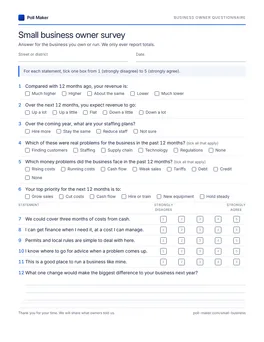
Business owner questionnaire
The owner check-up on page one, with a street or district line at the top, then every topic set after it.
Download PDF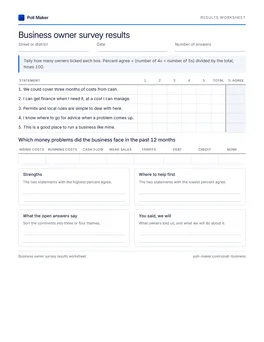
Owner results tally
Count the money problems owners ticked, tally the five statements, and pick where to help first on one sheet.
Download PDFOwner questions that need rewording
Four questions that turn up on local business surveys, each with a version owners can answer quickly and you can count. More on wording is in the survey question guide.
How is business going?
Compared with 12 months ago, your revenue is: much higher ... much lower
A mood question gets a polite answer. A fixed time frame and five choices give you a direction you can compare year on year.
What are your biggest challenges, and how can we help?
Which money problems did the business face in the past 12 months?
Which kinds of support would you use in the next year?
Two questions in one, both open. Tick lists give you counts; the open question at the end catches the rest.
What was your total revenue last year? $______
Compared with 12 months ago, your revenue is: much higher ... much lower (and exact figures only on the anonymous form)
Exact figures on a named form make owners stop. Direction is enough for most decisions.
Would you support the new parking plan that will help local businesses?
Which local improvements would help your business most?
The first version tells owners the answer you want. The better one lets parking compete with everything else.
Surveying business owners: common questions
For chambers, councils, lenders and students planning a survey of small business owners.
What questions should you ask small business owners?
Start with the direction of sales now and next year, hiring plans, the operational and money problems of the past year, the top priority for next year, and whether they have cash cover, finance and advice. End on a single open question: which change would help most. That is the owner check-up above.
How do you get business owners to respond?
Keep the core short, tell owners how their answers will be used, and deliver it in person where you can. On a downtown street, Wisconsin Extension suggests hand delivery by volunteer block captains as the way to reach every owner.2
Should a survey of business owners be anonymous?
For figures and finance, yes. For requests for help, no, because someone has to follow up. Run a named form for support and an anonymous one for money questions, and report both only as totals.2
How many owners do you need to survey?
In a small downtown, ask every business. Across a larger area, aim for enough owners in each sector to compare sectors: Wisconsin Extension's worked example uses 20 owners in each of 10 sectors.2
Can students use these to interview a business owner?
Yes. For a class interview, use the core and read the open questions aloud, then ask the owner to say more about each money problem they ticked. The About the business set gives you the background for the write-up.
Check in with local owners this month
Load the owner check-up into the builder, pick the topic sets your group wants, then send owners the link or carry printed copies along the high street.