Internal communication survey questions for every employee, desk or not
A good internal communication survey asks two things: does news reach people in time and make sense, and do their views travel back up? The core 12 covers both in about four minutes, and six optional sets go deeper on channels, managers, leaders, speaking up and staff away from a desk.
- 36questions
- 12in the core set
- 4 minto answer the core
- 6optional sets
By Michael Hodge, BSc Psychology Updated September 2026
36 internal communication survey questions to choose from
Your survey starts with the core 12 selected. Pick extra items singly or take a full set. Under each wording you get the answer choices staff will see and a line on reading a low score.
The core 1212 questions
Nine statements on news going down and views coming back up, then where people get their news, what they want more of, and one open question. It works as a complete survey with nothing added.
-
I hear about changes before they affect my work.
Strongly disagree12345Strongly agree1 = Strongly disagree, 5 = Strongly agreeTiming is the first thing staff judge. Low scores mean people learn about changes from the change itself, or from the grapevine.
-
I know our top priorities for this year.
Strongly disagree12345Strongly agree1 = Strongly disagree, 5 = Strongly agreeChecks whether strategy has travelled past the leadership team. Split it by team to see where it stops.
-
Leaders explain the reasons behind decisions.
Strongly disagree12345Strongly agree1 = Strongly disagree, 5 = Strongly agreePeople accept a hard decision more readily when they know why it was made. This is the statement that moves most after a well explained change.
-
My manager explains what news means for our team.
Strongly disagree12345Strongly agree1 = Strongly disagree, 5 = Strongly agreeLine managers turn company news into local news. A low score points at manager briefings, not at the all-staff email.1
-
Policies, forms and job details are quick to locate.
Strongly disagree12345Strongly agree1 = Strongly disagree, 5 = Strongly agreeFindability: the intranet, shared drives and handbooks. A quick fix once you know which information people hunt for.
-
Important messages do not get lost in the noise.
Strongly disagree12345Strongly agree1 = Strongly disagree, 5 = Strongly agreeOverload asked without the word overload. A low score means too many channels or too many low-value messages.
-
Senior leaders listen to what employees say.
Strongly disagree12345Strongly agree1 = Strongly disagree, 5 = Strongly agreeUpward voice at the top. In a study of five organisations it was linked to engagement as strongly as any part of communication measured.1
-
When I raise an idea, I hear what happened to it.
Strongly disagree12345Strongly agree1 = Strongly disagree, 5 = Strongly agreeVoice only counts when it is answered. This is the statement that tells you whether the loop closes.
-
Information flows well between teams here.
Strongly disagree12345Strongly agree1 = Strongly disagree, 5 = Strongly agreeCross-team flow, where silos show up. Compare departments before you blame any one of them.
-
Where do you get most of your work news today?
EmailTeam meetingsMy managerTeam chatIntranetAll-handsColleaguesTick all that applyMaps the channels people actually use. A big share for Colleagues means the grapevine is doing the job your channels should.
-
Which topic do you most want to hear more about?
Plans and prioritiesChanges on the wayHow we are doingCustomer storiesReasons for decisionsTells you what to put in the next update. It also makes a quick live poll in a team meeting.
-
What is one thing that would make communication here better for you?
Open answerOne thing keeps answers concrete. Sort them into themes and you have the start of the plan.
Channels and tools5 questions
Use this set to decide which channels stay, which go and which merge.
-
How do you prefer to hear about big changes?
From my managerAt an all-handsBy emailIn team chatOn the intranetSet it against where people get news today (Q10). The gap between the two answers is your channel plan.
-
How often do you read company-wide emails?
AlwaysUsuallySometimesRarelyNeverEmail is still one of the channels staff rate most helpful, so a falling read rate is worth catching early.1
-
How often do you visit the intranet?
DailyWeeklyMonthlyRarelyNeverShows whether the intranet is a place people go or a place messages go to wait.
-
Team meetings keep me up to date.
Strongly disagree12345Strongly agree1 = Strongly disagree, 5 = Strongly agreeTeam meetings rank near the top for helpfulness in published studies. Check that yours live up to it.1
-
Which channels could we cut or combine?
Email digestsNewsletterIntranet newsTeam chatAll-handsNoneTick all that applyStaff are often happy to lose a channel. This gives you permission to simplify.
Your manager4 questions
Add these when the core points at line managers, the people most staff hear local news from.
-
I get regular one-to-one time with my manager.
Strongly disagree12345Strongly agree1 = Strongly disagree, 5 = Strongly agreeThe channel for everything that does not belong in a team meeting. No time, no conversation.
-
My manager tells me how my work is going.
Strongly disagree12345Strongly agree1 = Strongly disagree, 5 = Strongly agreePersonal feedback is a classic part of communication satisfaction, and one that managers can fix quickly.3
-
My manager shares news soon after hearing it.
Strongly disagree12345Strongly agree1 = Strongly disagree, 5 = Strongly agreeCatches managers who sit on news. Pair it with Q1 to see whether delays start at the top or in the middle.
-
I can raise a problem with my manager easily.
Strongly disagree12345Strongly agree1 = Strongly disagree, 5 = Strongly agreeUpward voice at the local level, where most problems are first noticed.
Leaders and change5 questions
Add these before or after a restructure, a merger, a new system or any change people will talk about.
-
How often do you hear directly from senior leaders?
WeeklyMonthlyA few times a yearRarelyNeverFrequency of direct contact. Read it next to Q7: being heard from and listening are different things.
-
Senior leaders are visible and easy to approach.
Strongly disagree12345Strongly agree1 = Strongly disagree, 5 = Strongly agreeVisibility builds the trust that makes a change announcement believable.
-
I understand why our last big change was made.
Strongly disagree12345Strongly agree1 = Strongly disagree, 5 = Strongly agreeThe reason behind a change is the part that most often goes missing on its way down.
-
Leaders share bad news as openly as good news.
Strongly disagree12345Strongly agree1 = Strongly disagree, 5 = Strongly agreeCandour. People discount the good news from leaders who only ever share good news.
-
What one question would you ask the CEO today?
Open answerGives you the agenda for the next all-hands, written by the audience.
Speaking up4 questions
Include this set to test whether ideas and concerns reach someone with the power to act on them.
-
In the last 6 months, have you suggested a way to improve how we work?
Yes, usedYes, declined with a reasonYes, heard nothingNoThe third answer is the one to count. Silence after a suggestion teaches people to stop making them.
-
There is a clear route for my ideas to reach leaders.
Strongly disagree12345Strongly agree1 = Strongly disagree, 5 = Strongly agreeWhether a route exists at all, apart from whether anyone listens at the end of it.
-
I can disagree with a decision without it hurting me.
Strongly disagree12345Strongly agree1 = Strongly disagree, 5 = Strongly agreeSafety to push back. When it is low, other upward-voice scores run high only because nobody tries.
-
Surveys like this one lead to real changes here.
Strongly disagree12345Strongly agree1 = Strongly disagree, 5 = Strongly agreeSurvey trust. Ask it every time; it rises as soon as people see results shared and acted on.
Staff away from a desk3 questions
For frontline, shift, field and remote staff, who are the easiest people to leave out of company news.
-
I get company news at the same time as office staff.
Strongly disagree12345Strongly agree1 = Strongly disagree, 5 = Strongly agreeEqual timing is the fairness test for frontline communication.
-
I can reach the right person quickly from where I work.
Strongly disagree12345Strongly agree1 = Strongly disagree, 5 = Strongly agreeTwo-way contact from the floor, the road or a home office.
-
Where do you usually see company news?
EmailWork appOwn phoneNotice boardShift briefingTells you which door actually reaches people without a company laptop.
About you (optional)3 questions
Only for comparing groups. Leave out any split that would make one person easy to spot.
-
Where do you mostly work?
At a desk on siteOn site, not at a deskHybridFully remotePrefer not to sayCommunication gaps usually follow work location more than job title.
-
How long have you worked here?
Under 1 year1 to 3 years4 to 10 yearsOver 10 yearsPrefer not to sayNew starters rely on channels old hands have long stopped reading.
-
Do you have people reporting to you?
YesNoPrefer not to sayManagers are both receivers and senders. Their scores show whether news reaches them in time to pass it on.
Match the questions to your survey objective
An internal communications survey works best with one clear objective. Pick yours, add the set it needs, and read those answers first.
| Your objective | Add this set | Read first |
|---|---|---|
| Get news to people in time | Channels and tools | Q1, Q6 and Q10 |
| Decide which channels to keep | Channels and tools | Q10 against the preferred channel |
| Help managers pass news on | Your manager | Q4 and news shared soon |
| Explain a big change | Leaders and change | Q3 and the last big change |
| Hear more from staff | Speaking up | Q7, Q8 and ideas with no reply |
| Include frontline teams | Staff away from a desk | Same-time news, by location |
Running a full baseline for a communication audit? Send the core with every set, then repeat just the core every six to twelve months so the numbers stay comparable.
What makes an internal communication survey work
Four habits turn a list of questions into news that flows better in both directions.
Link with emotional engagement (correlation r)
Measure voice as well as messages
Communication that flows both ways is what staff feel. In a study of 2,066 employees in five organisations, satisfaction with employee voice was linked to emotional engagement at r = .53, alongside senior manager communication (.52) and keeping people informed (.51).1 That is why the core gives listening (Q7) and answering ideas (Q8) the same weight as timing and clarity.

Name the channels in the question
Ask about email, team meetings and the intranet by name rather than about "communication tools". When Ruck asked staff at the same five organisations which methods helped most, email and team meetings made the top three at every one of them, with average ratings of 3.88 to 4.38 out of 5 for email and 4.02 to 4.29 for team meetings.1 Your own ranking will differ, and Q10 plus the channel set shows you exactly how.

Share results within a month
Post the headline numbers, the two lowest statements and what you will change, while people still remember answering. Then report back on the change. The Speaking up set includes a question on whether surveys lead to change, and it climbs fastest when staff see their answers used.

Reach people away from a desk
Drivers, nurses, shop staff and shift workers rarely open an all-staff email. Stick a QR code poster by the time clock, read the link out at the shift briefing and leave paper copies with a locked return tray. Ask where people work (Q34) so frontline scores do not disappear inside an office-heavy average.
Want a fast read at the start of a team meeting? Show the topic question (Q11) as a live poll, then talk through the winning topic. Our poll questions for meetings offer more ideas, and our poll setup guide covers sharing and results.
Score the nine communication statements
Enter how many employees chose each point for Q1 to Q9. Agreeing is the healthy answer every time, so the shortest bars point to the parts of communication to fix first.
- 1For each statement, add the Agree and Strongly agree answers and divide by everyone who answered it. The tool shows that share as a bar.
- 2Read Q1 to Q6 as the information side and Q7 to Q9 as the voice side. A page of high information scores with low voice scores is a broadcast culture.
- 3Count the ticks for each channel in Q10. Channels few people use are candidates to cut; a large Colleagues count means official news arrives late.
- 4Sort the open answers into four or five themes, then take two fixes with an owner and a date to the next leadership meeting.
Internal communication results
From survey to internal communications audit
A survey tells you how communication feels to staff. An audit adds the evidence behind it: what you send, through which channels, and what people make of it. These five steps turn the questions here into an audit.
| Audit step | What you collect | Where this page helps |
|---|---|---|
| 1. Channel inventory | Each channel, its owner and how often it runs | Compare with Q10 and the cut list |
| 2. Staff survey | How news, managers and voice work | Core 12 plus the sets you need |
| 3. Message review | A month of all-staff messages | Check each against Q3: does it say why? |
| 4. Follow-up groups | Talks on the two lowest statements | Start from the open-answer themes |
| 5. Plan and repeat | Two or three fixes with owners | Re-run the core to see what moved |
Where the classic audit questionnaire fits
The best known research instrument is the Communication Satisfaction Questionnaire by Downs and Hazen, which measures eight dimensions: communication climate, supervisory communication, organizational integration, media quality, co-worker communication, corporate information, personal feedback and subordinate communication.3 4 Later work grouped them into two broader factors, informational and relational communication.5 Our core covers both sides: Q1 to Q6 are about information, Q7 to Q9 about relationships and voice. The CSQ items are the authors' own and we have not copied them, so use the published instrument when a thesis or study needs results you can compare with earlier research.
Why this set asks about content and voice
A review of fifteen internal communication assessments found they mostly measured processes, channels and volume, with far less on what employees want to know or on dialogue.1 2 That is why Q2, Q3 and Q11 ask about content, and Q7, Q8 and the Speaking up set ask whether views travel upward.
The monthly check-in version
For a monthly check-in, send only these five. Together they cover timing, the why behind decisions, answered ideas, the channels news arrives through and the next thing to change.
- 01I hear about changes before they affect my work.
- 02Leaders explain the reasons behind decisions.
- 03When I raise an idea, I hear what happened to it.
- 04Where do you get most of your work news today?
- 05What is one thing that would make communication here better for you?
Handing out the questionnaire at shift change
Plenty of staff never sit at a screen. Hand out the questionnaire at a shift change, collect forms in a locked tray, and add the paper totals to the online results. It prints on letter or A4.
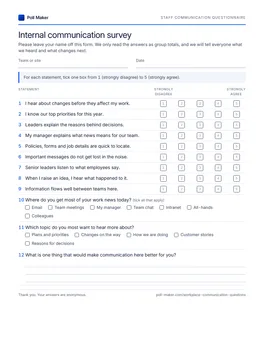
Staff communication questionnaire
Pen tick boxes for the core 12 fill the first sheet; the six optional sets come after.
Download PDF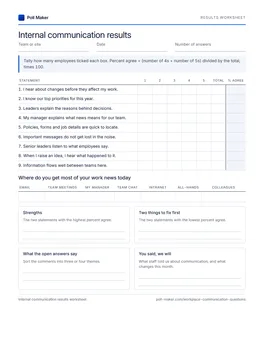
Results tally sheet
Count the forms by hand, turn each statement into a share who agree, count the news channels, and note the two fixes to make first.
Download PDFInternal comms survey questions, answered
What comes up when HR and comms teams plan the first round.
What should an internal communication survey include?
Four areas: whether news arrives in time and makes sense, which channels people use and prefer, how well managers pass information on, and whether staff views reach leaders and get an answer. Add one open question so people can name what matters to them.
What are the objectives of an internal communications survey?
Usually one or two of these: find out whether key messages land, choose which channels to keep, measure how managers and leaders communicate, give staff a voice, or set a baseline for a communication audit. Pick the objective before the questions, then use the chooser table above.
How is a communication audit different from a communication survey?
The survey is one part of the audit. An audit also lists every channel, reviews real messages and follows up with small group talks, so you can see why the survey scores look the way they do.
How often should we run it?
A full survey once a year, and the five-question pulse every month or quarter in between. Run the core again two to three months after any big change to see whether the explanation landed.
Should an employee communication survey be anonymous?
Yes. Use one link for everyone with no login, take paper forms back in a locked tray, and only report groups large enough that no one can be picked out. People are far more candid about their manager and leaders when they know answers cannot be traced.
Communication questions that miss, and sharper versions
A small change of wording decides whether a result points at a fix. The survey question guide covers every other question type.
How satisfied are you with internal communication?
I hear about changes before they affect my work.
An overall rating tells you that something is wrong but not what. A specific statement points straight at the fix.
Is communication from management clear and timely?
Leaders explain the reasons behind decisions.
My manager shares news soon after hearing it.
Two questions in one, about two groups of people. Nobody can answer a clear but late message honestly.
Don't you agree our town halls keep everyone informed?
How do you prefer to hear about big changes?
The weak version asks for a yes. The better one lets the town hall compete with every other channel on equal terms.
Trace how news really travels at work
Send the core 12 to every team by link, and print copies for colleagues who never see a screen at work. Our <a href="/Employee-Survey-Questions">employee survey questions</a> cover engagement, workload and pay as well.