Star rating and how likely questions, with a label for every point
A good star rating question names one thing and gives every star a word: 1 Very poor, 2 Poor, 3 Fair, 4 Good, 5 Excellent. Below are 32 rating questions customers can answer after an order or a visit, from stars to "how likely are you to recommend us", each ready to run as a survey or a live poll.
- 32questions
- 11in the core set
- 8answer scales, each word shown
- 2 minto answer the core
By Michael Hodge, BSc Psychology Updated September 2026
The words for each star, and for every other scale
Pick the scale that matches what you are asking, then print its words on every point. These are the eight used on this page.
| Scale | Words for each point | Ask it like this |
|---|---|---|
| Stars | Very poor, Poor, Fair, Good, Excellent | How would you rate the delivery? |
| How likely, 5 points | Very unlikely, Unlikely, Neutral, Likely, Very likely | How likely are you to buy from us again? |
| How likely, 0 to 10 | 0 Not at all likely, 10 Extremely likely | How likely are you to recommend us to a friend or colleague? |
| How often | Never, Rarely, Sometimes, Often, Always | How often is the item in stock? |
| Ease | Very difficult, Difficult, Neutral, Easy, Very easy | How easy was it to get what you came for? |
| Satisfaction | Very dissatisfied, Dissatisfied, Neutral, Satisfied, Very satisfied | How satisfied are you with our delivery options? |
| Importance | Not at all, Slightly, Moderately, Very, Extremely important | How important is fast delivery to you? |
| Agreement | Strongly disagree, Disagree, Neutral, Agree, Strongly agree | The full price was clear before I paid. |
Star labels that read as equal steps
Five stars with only a number leave each customer to decide what three means. Very poor, Poor, Fair, Good and Excellent climb in roughly even steps, which is what survey researchers recommend: labels that divide the range into equal units give more reliable answers.1 Start at one star, never zero, and make five the best every time.
Match the question to the words
"How would you rate" goes with the star words. "How likely are you to" needs the likely words, "how often" needs frequency words, and "how satisfied" needs satisfaction words. A stem and scale that disagree ("How likely are you to recommend us: Poor to Excellent") make customers stop and guess.
Stars in the survey builder
Open any set on this page in the builder and each rating question arrives as a 1 to 5 range. To show stars, click the gear icon on the question, go to Settings and set Type to Star Rating, then type the end words into Caption Low and High. The same Type menu also offers Net Promoter Score, discrete numbers and a slider. The online form builder starts empty if you would rather write your own.
Every rating question, with its answer labels
The core 11 is selected already. Bring in a full set, or choose questions one by one. Each row shows the exact words customers choose from and what their answer tells you, and most run as a live poll.
Core 11: after an order or a visit11 questions
Four star ratings, then one question in each of the other formats customers see most: ease, buying again, recommending on 0 to 10, expectations and how often they come. Two open answers explain the numbers.
-
Overall, how would you rate your order or visit today?
Very poor12345Excellent1 = Very poor, 5 = ExcellentThe headline star rating. Track the share of 4s and 5s from month to month, not just the average.
-
How would you rate the quality of what you bought?
Very poor12345Excellent1 = Very poor, 5 = ExcellentSeparates the product from the service, so a low overall score points somewhere.
-
How would you rate the service you got from our team?
Very poor12345Excellent1 = Very poor, 5 = ExcellentThe people side of the visit. Read it next to the open answers, which often name the person.
-
How would you rate the value for the price you paid?
Very poor12345Excellent1 = Very poor, 5 = ExcellentValue is judged, not measured: a fair price can still score low if quality or service slipped.
-
How easy was it to get what you came for?
Very difficult12345Very easy1 = Very difficult, 5 = Very easyEffort, asked as ease. A low score with good star ratings means the process, not the product, needs work.
-
How likely are you to buy from us again?
Very unlikely12345Very likely1 = Very unlikely, 5 = Very likelyA five-point how likely question about the customer's own next step, the plainest sign of loyalty.
-
How likely are you to recommend us to a friend or colleague?
0123456789100 = Not at all likely, 10 = Extremely likelyThe standard recommend question, on 0 to 10. It gives you a Net Promoter Score to compare over time.2
-
Compared with what you expected, today was:
Much worseA little worseAs expectedA little betterMuch betterA balanced scale with a true middle. It shows whether your promises and the visit line up.
-
How often do you buy from us?
First timeA few times a yearMonthlyWeekly or moreNumbers with a time frame, not "often". Lets you compare first-timers with regulars.
-
What is the main reason for your overall rating?
Open answerTurns the first star rating into something you can act on. Sort the answers by star level.
-
What one thing should we change first?
Open answerOne change, not a wish list. The answers cluster fast, and the biggest cluster is your next job.
Stars for each step6 questions
Add the steps your customers actually went through. Every one uses the same five words, so you can line the steps up and see which pulls the overall score down.
-
How would you rate the product details you read?
Very poor12345Excellent1 = Very poor, 5 = ExcellentPoor descriptions show up later as returns and support calls. This catches them at the source.
-
How would you rate paying at checkout?
Very poor12345Excellent1 = Very poor, 5 = ExcellentCheckout friction costs sales before any other question gets asked. Keep it on every online survey.
-
How would you rate the delivery or pickup?
Very poor12345Excellent1 = Very poor, 5 = ExcellentDelivery is often the step customers remember best, good or bad.
-
How would you rate the packaging?
Very poor12345Excellent1 = Very poor, 5 = ExcellentCovers damage, waste and first impressions in one rating. The open answers say which.
-
How would you rate our website or app?
Very poor12345Excellent1 = Very poor, 5 = ExcellentFor online orders. Pair it with the ease question in the core to find where people got stuck.
-
How would you rate our help when you got in touch?
Very poor12345Excellent1 = Very poor, 5 = ExcellentOnly for customers who got in touch. Route others past it so the score stays clean.
How likely questions6 questions
Each one asks about a single future action the customer controls. Use the five words for most, and the 0 to 10 version when you want a score to track.
-
How likely are you to try a new item within 3 months?
Very unlikely12345Very likely1 = Very unlikely, 5 = Very likelyA time frame turns a vague intention into a forecast you can check later.
-
How likely are you to join a rewards program?
Very unlikely12345Very likely1 = Very unlikely, 5 = Very likelyTests demand for a loyalty scheme before you pay to build it.
-
If prices rose by a tenth, how likely are you to stay?
Very unlikely12345Very likely1 = Very unlikely, 5 = Very likelyPrice sensitivity asked as a single concrete change. Compare regulars with first-timers.
-
How likely are you to post a public review of us?
Very unlikely12345Very likely1 = Very unlikely, 5 = Very likelyShows how many happy customers would post if asked, and so whether a review request is worth sending.
-
How likely are you to order online next time?
Very unlikely12345Very likely1 = Very unlikely, 5 = Very likelyUseful when you are moving customers online. Low scores from regulars are a warning.
-
How likely are you to recommend this product to a friend?
0123456789100 = Not at all likely, 10 = Extremely likelyThe recommend question aimed at one product. Run it next to the company version to see which one people rate.
How often questions5 questions
Use counts with a time frame for things you could tally, and the Never to Always words for things customers judge. The two kinds are shown side by side.
-
In the past three months, how many times have you ordered from us?
NoneOnce2 or 3 times4 to 6 times7 or moreCountable, so every customer means the same thing by each answer.
-
How often do you buy this kind of product from anyone?
WeeklyMonthlyEvery few monthsOnce a year or lessSizes the customer's whole habit, not just your share of it.
-
How often does your order arrive when promised?
Never12345Always1 = Never, 5 = AlwaysA judgment of reliability over time, where the Never to Always words fit well.
-
How often is the item you want in stock?
Never12345Always1 = Never, 5 = AlwaysStock problems cost repeat visits quietly. This makes them visible.
-
How often is a problem solved on your first contact?
Never12345Always1 = Never, 5 = AlwaysFirst-contact resolution from the customer's side of the conversation.
Satisfaction, importance and agreement wording4 questions
Three more five-word scales for when stars do not fit the question. Keep one scale per group of questions.
-
How satisfied are you with our delivery options?
Very dissatisfied12345Very satisfied1 = Very dissatisfied, 5 = Very satisfiedSatisfaction suits a choice you made available, where "how would you rate" sounds odd.
-
How satisfied are you with how we handled a return?
Very dissatisfied12345Very satisfied1 = Very dissatisfied, 5 = Very satisfiedOnly for customers who returned something. A strong result here wins back a bad first experience.
-
How important is fast delivery to you?
Not at all important12345Extremely important1 = Not at all important, 5 = Extremely importantImportance next to a star rating shows whether a weak spot actually matters to customers.
-
The full price was clear before I paid.
Strongly disagree12345Strongly agree1 = Strongly disagree, 5 = Strongly agreeAgreement works for a plain factual statement like this one. Avoid it for ratings of quality.
How to write rating questions customers answer the same way
Four habits make a star or how likely question mean the same thing to every customer who answers it.

Put a word on every point
Answers are more reliable when every point on the scale carries a word, not just the two ends, and people say they prefer scales labelled that way.1 Show the five words under the stars on screen and print them on paper. Numbers alone let one customer's 3 mean "fine" and another's mean "disappointing".

Keep five as the best answer everywhere
A scale that flips halfway through makes customers reread every label, and anyone skimming marks the wrong end. Word every question so that the high end is the good end: "how likely are you to stay" rather than "how likely are you to leave", and "how easy" rather than "how hard".
Share of Amazon ratings at 4 or 5 stars, 2005
Survey every customer, not just the ones who post
Public star reviews pile up at the two ends. On Amazon, 78 percent of book ratings in one study sat at 4 or 5 stars, with a cluster at 1 star and few in between, and the authors concluded that the average of such ratings is a poor guide to quality.3 A short survey sent after every order also hears from the customers in the middle, the ones who would never write a review.

Ask the rating directly, not as a statement to agree with
People tend to agree with whatever a statement says, and agree or disagree items are less valid and less reliable than the same question asked directly.1 "How would you rate the service you got from our team?" beats "The service was excellent" on an agree scale. Keep agreement for plain facts, such as whether the full price was clear before paying.
Want a fast read before you build a whole survey? Put one question on a screen by the till or in a chat and launch a live poll from it; the bars move as people tap. Making a poll covers QR codes, links and embeds. For more ideas beyond ratings, see the feedback survey questions.
Short enough for a receipt or a table card
A QR code on a receipt gets seconds of attention. These five fit on a phone screen: the overall stars, the recommend question, buying again, service and the reason behind the stars.
- 01Overall, how would you rate your order or visit today?
- 02How likely are you to recommend us to a friend or colleague?
- 03How likely are you to buy from us again?
- 04How would you rate the service you got from our team?
- 05What is the main reason for your overall rating?
Reading star ratings and the recommend score
Two numbers cover most customer surveys: the share of 4 and 5 star answers, and the Net Promoter Score from the 0 to 10 question. Here is each one worked through with example answers.
Stars: count each level before you average
Suppose 40 customers answered the overall star question. Tally them by star:
| Stars | Customers | Running total |
|---|---|---|
| 5 Excellent | 17 | 17 |
| 4 Good | 12 | 29 |
| 3 Fair | 5 | 34 |
| 2 Poor | 2 | 36 |
| 1 Very poor | 4 | 40 |
Twenty-nine of the forty chose 4 or 5 stars, which is the number to report and track. The average works out at 3.9, and it hides the four customers who gave one star. Read their open answers first: a cluster of one-star visits usually has a single cause you can fix. Star answers are ordered categories, so counts and the median say more than a mean; the page on levels of measurement explains why.
The recommend question: promoters minus detractors
Bain's method sorts the 0 to 10 answers into three groups: 9 and 10 are promoters, 7 and 8 are passives, and 0 to 6 are detractors. The score is the percent of promoters minus the percent of detractors, so it runs from minus 100 to plus 100.2 With 20 answers, 9 promoters and 4 detractors give 45 minus 20, a score of plus 25. Passives count in the total but in neither group.
Compare like with like
Set this month beside last month, or one store beside another, using the same questions in the same order. Split the results by the "how often do you buy from us" answer too: first-timers and weekly regulars rarely rate the same visit the same way.
Printable customer rating card and tally sheet
A card on the counter or with the bill reaches customers who will never scan a code. Each file fits one sheet of letter or A4 paper per page.
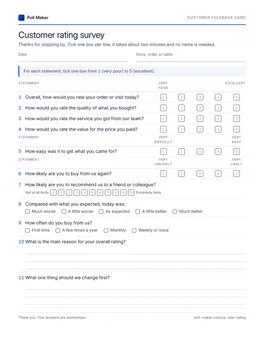
Customer feedback card
The core 11 on page one, with the end words above each run of tick boxes. The four optional sets come after it, each under its own heading.
Download PDF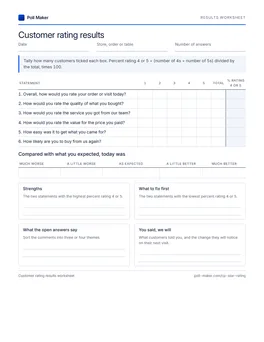
Rating tally sheet
Count the ticks for every rating, work out the share of 4s and 5s, and note what to fix first and what to tell customers.
Download PDFRating questions to fix before customers see them
Five slips that turn up on most feedback cards, with a better version of each. The guide to survey questions covers the same faults for other question types.
Rate us: 1 2 3 4 5
Overall, how would you rate your order or visit today? (Very poor
Poor
Fair
Good
Excellent)
No subject and no words. The better version names the thing being rated and labels every star.
How likely are you to recommend us and shop here again?
How likely are you to recommend us to a friend or colleague?
How likely are you to buy from us again?
Two actions in one question. A customer who would return but never recommend has no honest answer.
Do you shop with us often?
In the past three months, how many times have you ordered from us?
Words like "often" stand for different amounts to different groups of people, so compare counts instead.
Our staff were excellent. (Strongly disagree to Strongly agree)
How would you rate the service you got from our team?
A statement to agree with nudges people toward yes. Asking for the rating directly removes the nudge.
How many stars would you give our amazing new app?
How would you rate our website or app?
"Amazing" tells customers the answer you want. Neutral wording gets the rating they would really give.
Star and how likely questions, answered
For owners and teams writing their first customer feedback form.
What do the stars mean on a 5 star rating?
Give them words so everyone reads them the same: 1 star Very poor, 2 Poor, 3 Fair, 4 Good, 5 Excellent. Show the words under the stars online and print them on paper forms.
What is the how likely are you to recommend question?
"How likely are you to recommend us to a friend or colleague?", answered from 0, not at all likely, to 10, extremely likely. The share of 9s and 10s minus the share of 0s to 6s gives the Net Promoter Score.
Should I use 5 stars or a 0 to 10 scale?
Use 5 labelled stars for rating a visit, product or step: each point has a word and customers answer fast. Use 0 to 10 for the recommend question, because the Net Promoter Score is defined on it.
What are good answer choices for how often questions?
For anything you could count, give numbers with a time frame, such as None, Once, 2 or 3 times, 4 to 6 times and 7 or more in the past three months. For judgments, use Never, Rarely, Sometimes, Often and Always.
Is a star rating a Likert scale?
Not quite. Likert items measure agreement with a statement, while stars measure how good something was. The two share an ordered five-step shape, so handle them alike: count the answers at each level and report the median.
Put your rating questions in front of customers today
Open the core 11 in the builder, switch the ratings to stars, and print its QR code on the next receipt. Or print the feedback card and leave a stack by the door.