Strategic planning survey questions for staff, board, clients and donors
Ask staff, volunteers, board members, clients, donors and partners the same 11 questions about where your organization should go next, so their answers sit side by side. Then add each group's own set, test the draft plan with the people who shaped it, and check progress a year in.
- 38questions
- 11every group answers
- 5 minto answer the core
- 7sets by group and stage
By Michael Hodge, BSc Psychology Updated September 2026
The 38 planning questions, core plus one set per group
Beside each question sit its answer options and the planning decision it feeds. Tick the sets for the stakeholder groups on your list; those ticked questions are what the Open, Print and Copy buttons send.
The input core 1111 questions
Eleven questions any stakeholder can answer: their connection to you, whether the direction is right, six statements on mission, results, programs, reach, partners and voice, one priority pick and two open questions.
-
How are you connected to this organization?
StaffVolunteerBoardClientDonorPartnerSorts every later answer by group; client covers members, and partner covers neighbors. The gaps between groups are often the most useful finding.
-
Overall, is this organization heading in the right direction?
Right directionMostly rightWrong directionNot sureThe headline read. A cluster of "wrong direction" answers in one group tells the planning group where to start listening.
-
The need we exist to meet is as strong as ever.
Strongly disagree12345Strongly agree1 = Strongly disagree, 5 = Strongly agreeTests whether the mission still fits the world outside. A low score puts the mission statement itself on the agenda.
-
I can name a result this organization had last year.
Strongly disagree12345Strongly agree1 = Strongly disagree, 5 = Strongly agreeShows whether results reach people beyond the team. Low scores often mean the work is sound and the story is missing.
-
Our programs are the right mix for the years ahead.
Strongly disagree12345Strongly agree1 = Strongly disagree, 5 = Strongly agreeAbout the whole portfolio, not one program. Read it beside the open answers on what is changing.
-
People who could use our services know how to find us.
Strongly disagree12345Strongly agree1 = Strongly disagree, 5 = Strongly agreeReach. When clients and partners score this low, the plan may need outreach before it needs new programs.
-
We work well with groups that serve the same people.
Strongly disagree12345Strongly agree1 = Strongly disagree, 5 = Strongly agreePartnerships as others see them. Partners who score this low are an early warning worth a phone call.
-
People like me have a real say in our future.
Strongly disagree12345Strongly agree1 = Strongly disagree, 5 = Strongly agreeWhether planning feels open. Ask it again after the plan launches to see if the process changed minds.
-
Which area deserves the most time and money in our coming plan?
More of what worksReach new peopleBetter qualitySteadier fundingStronger teamOne pick forces the trade-off that rating every idea avoids. Tally it by group to see where priorities split.
-
Finish this sentence: Our community needs this organization to...
Open answerA vision prompt anyone can answer in a line. Sort the endings by theme; the largest themes are draft vision statements.4
-
What is changing in our community or field that the next plan must account for?
Open answerOpportunities and threats in plain words. Sort the answers into changes to use and changes to guard against.
Staff and volunteers4 questions
For staff and volunteers. They know whether a plan can be delivered, so ask about room, focus and obstacles.
-
I can see how my own work moves our goals forward.
Strongly disagree12345Strongly agree1 = Strongly disagree, 5 = Strongly agreeA low score means goals have not reached daily work yet. The new plan will need clearer links from goal to team.
-
Our workload leaves room to take on something new.
Strongly disagree12345Strongly agree1 = Strongly disagree, 5 = Strongly agreeCapacity in one line. If the answer is no, every new goal needs something else to stop.
-
How much of your week goes to work that no current goal covers?
Almost noneAbout a quarterAbout halfMost of itUnplanned work, measured. A lot of it means the next plan should say what the team will stop doing.
-
What would make the next plan easier to deliver in your role?
Open answerTurns staff input into conditions for success: tools, training, time or fewer priorities.
Board members5 questions
For board members, before the retreat. Their answers show where the board already agrees and where the first real debate will be.
-
Board members agree on the top two or three priorities.
Strongly disagree12345Strongly agree1 = Strongly disagree, 5 = Strongly agreeIf board members themselves disagree here, settle that first. It shapes every other session.
-
Our meetings leave enough time for strategy, not just reports.
Strongly disagree12345Strongly agree1 = Strongly disagree, 5 = Strongly agreeWhether the board has room to govern the plan once it exists.
-
I get the figures I need to judge progress on our goals.
Strongly disagree12345Strongly agree1 = Strongly disagree, 5 = Strongly agreeTells staff what the board will need in its yearly progress report.
-
In the coming years, the organization should mainly:
Hold steadyGrow in sizeFocus on fewer areasPartner or mergeThe scope decision in one question. A split board here is the first item on the retreat agenda.
-
What is the biggest decision this board must make in the next two years?
Open answerSurfaces the decisions board members expect the plan to settle, before anyone sets the agenda.
Clients, members and community5 questions
For the people the plan is ultimately for. Keep it short and send it where they already are: a waiting room, a newsletter, a text message.
-
The services I use here meet my needs well.
Strongly disagree12345Strongly agree1 = Strongly disagree, 5 = Strongly agreeThe users' view of quality, next to the staff view of capacity.
-
Getting help from this organization is simple.
Strongly disagree12345Strongly agree1 = Strongly disagree, 5 = Strongly agreeAccess as users live it. A low score points the plan at process before new programs.
-
In a typical month, how many times do you use what we offer?
Every weekEvery monthA few times a yearRarelySeparates regular users from occasional ones, whose needs often differ.
-
What do you need that no one nearby offers right now?
Open answerUnmet need in the users' own words: the raw material for new goals.
-
What would you miss most if this organization closed tomorrow?
Open answerStrengths in the words of the people who value them. Whatever clients name here belongs in the plan's foundations.
Donors and funders3 questions
For donors and funders. Three questions on where they see the need going and what would make them back the plan.
-
This organization is the right group to lead on this issue.
Strongly disagree12345Strongly agree1 = Strongly disagree, 5 = Strongly agreeStanding in the field, as funders see it. It tells you how far the plan can stretch.
-
Which result would most make you increase your support?
More people reachedDeeper lasting changeLower cost per resultNew programsShows which kind of goal will attract money, so the plan can report on it from the start.
-
Where do you see the biggest unmet need in this field over the next three years?
Open answerFunders see many organizations. Their answer is a view of the field from outside yours.
Feedback on the draft plan4 questions
Send these with the draft to everyone who answered the first round. In the builder, rename the goal options to match your draft.
-
The draft goals can be reached in the time the plan covers.
Strongly disagree12345Strongly agree1 = Strongly disagree, 5 = Strongly agreeRealism check. A low score from staff is worth more than a high score from anyone else.
-
I can see ideas from the first survey in this draft.
Strongly disagree12345Strongly agree1 = Strongly disagree, 5 = Strongly agreeWhether input feels used. People who see their ideas are more likely to back the finished plan.
-
Which draft goal matters most to you?
Goal 1Goal 2Goal 3Goal 4Goal 5Rename the options to your goals. The spread shows which goals have real support.
-
What is missing from the draft?
Open answerThe last chance to catch a gap before the board adopts the plan.
A year into the plan4 questions
For staff and board, twelve months after launch and every year after. Put the six core statements alongside to see what moved since the first round.
-
I know which plan goals are on track and which are behind.
Strongly disagree12345Strongly agree1 = Strongly disagree, 5 = Strongly agreeIf people cannot answer this, progress reporting is the first thing to fix.
-
The plan still guides the choices we make each month.
Strongly disagree12345Strongly agree1 = Strongly disagree, 5 = Strongly agreeWhether the plan is in use or on a shelf.
-
Should any goal change before next year?
Keep them allChange one or twoRethink severalNot sureA quick read on whether the plan still fits. "Rethink several" from many people calls for a formal review.
-
Which goal should change, and why?
Open answerThe reasons behind the answer above, in time for the yearly review.
About you (optional)2 questions
Optional. Ask these only if you will compare answers by tenure or age, and never report a group of fewer than five people.
-
How many years have you been involved with us?
Under 11 to 34 to 10Over 10Newcomers notice what long-timers stopped seeing. Compare their answers on programs and reach.
-
What is your age group?
Under 2525 to 4445 to 6465 or overPrefer not to sayShows whether the people you will serve in five years see things differently from those you serve now.
Turn the answers into the retreat agenda
Every plan has to settle a few big questions. This table shows which survey questions feed each one, and how to use the answers on the planning day.
| The plan must settle | Read these answers | Use on the day |
|---|---|---|
| Is our mission still right? | Q3 and Q10 | Pin the most common sentence endings beside the current mission statement. |
| What do we do best? | Q4 and Q25 | List the strengths that more than one group named. |
| What is changing around us? | Q11 and Q28 | Sort answers into changes to use and changes to guard against. |
| What comes first? | Q2, Q9 and Q19 | Show the priority tally group by group, and start where groups disagree. |
| Can we deliver it? | Q12 to Q15 | Check each proposed goal against the capacity answers before adopting it. |
| How will we know it worked? | Q33 to Q36 | Agree now which year-one answers would mean a goal is on track. |
ClearPoint suggests opening any strategy with two questions: where are we now and where do we want to be, and what obstacles lie in the path.5 The survey gives the room evidence for both before the discussion starts, so the first hour goes to decisions instead of opinions.
Four rules for a fair input round
Four habits that turn a pile of answers into something a planning group can use on the day.

Ask every group the same core
A plan is usually written by a few people in one room. A survey brings in everyone else: Funding for Good suggests surveying all staff, volunteers, clients, community partners and selected donors, and notes that comparing responses across groups "often reveals unexpected insights."1 Comparison only works when every group answers the same questions, which is why the core 11 is worded for all of them. Open the core plus one group's set in the builder for each group you invite, and give each group a separate link, so the answers come back already sorted.
How important is it that where you live offers the arts?
Make the priority question a choice
Rating ideas one at a time tends to produce a wall of agreement. When the Georgia Council for the Arts asked for input on its 2018 to 2023 plan, the survey drew more than 1,000 responses,2 and 97% called local arts opportunities important or very important.3 That is a strong mandate, and it cannot rank options. The same survey also asked for the three most pressing issues, and that question put funding for the arts clearly on top.3 Question 9 works the same way: one pick from five, tallied group by group.

Close the survey before the retreat
Plan backwards from the planning day. Allow two weeks for answers and one more to sort the open questions into themes, so the summary is on the table when the discussion starts. A survey works best beside other listening: the Georgia survey ran alongside four community meetings and many stakeholder interviews.2 Let the survey decide what those conversations dig into.
Show people their ideas in the draft
When the draft exists, send it back with the draft-plan set. Funding for Good advises telling staff how their input is shaping the plan, because people who feel heard are readier to carry the plan out.1 Question 30 measures exactly that: whether people can find ideas from the first round in the draft.
At an annual meeting or an all-staff day, put the direction question on the screen and let the room answer from their phones with the free online poll maker. The live result makes a strong opening for the retreat discussion.
Read the six core statements as one chart
Add the answer counts for the six statements, for everyone or for one group at a time. The chart marks the two weakest areas, ready to print for the planning session.
- 1Run the report for everyone, then once for each group. A statement that is strong overall but weak for clients or partners deserves its own discussion.
- 2Start with the two weakest statements. Each points at one part of the plan: mission, results, programs, reach, partners or voice.
- 3Put the priority tally beside the chart, group by group, before anyone argues for a favourite.
- 4Bring in the open answers last, sorted into themes, as the reasons behind the numbers.
Planning input
Matching the set to the stage of the plan
Most plans look three to five years ahead,5 and the survey has a job at three points along the way.
| Stage | Who answers | What to send |
|---|---|---|
| Before the planning retreat | Every group you can reach | The core 11, plus each group's own set |
| When the draft is ready | Everyone from the first round | Feedback on the draft plan, with Q2 on direction |
| Every year of the plan | Staff and board | A year into the plan, with Q3 to Q8 again |
ClearPoint recommends checking key goals monthly, the whole plan quarterly, and once a year whether the plan is still valid.5 The yearly survey feeds that last review; the monthly and quarterly checks run on your own progress figures.
The town hall version, in five questions
When a full survey is too much, these five still cover direction, priority, strengths, vision and change. Put them behind a QR code at an annual meeting, or send them to a group that rarely answers long surveys.
- 01Overall, is this organization heading in the right direction?
- 02Which area deserves the most time and money in our coming plan?
- 03What would you miss most if this organization closed tomorrow?
- 04Finish this sentence: Our community needs this organization to...
- 05What is changing in our community or field that the next plan must account for?
Reaching volunteers and clients without a link
Paper reaches people a link misses: clients in a waiting room, volunteers at a shift change, members at the annual meeting. Each PDF prints cleanly on US letter or A4.
Mailing it to one group? Tick the core and that group set, then
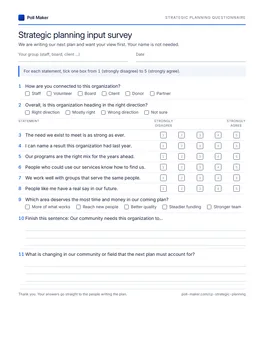
Stakeholder input questionnaire
Page one holds the shared core; the group and stage sets follow, each headed with who answers it.
Download PDF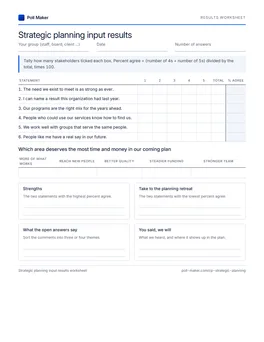
Input results worksheet
Count the paper answers, work out percent agree on the six statements, and tally the priority pick.
Download PDFWhen every priority comes back important
Four common planning survey questions, rewritten so the answers help the group decide something. For more wording fixes, see picking and wording survey questions.
How important is it that we expand our youth programs?
Which area deserves the most time and money in our coming plan?
Asked one idea at a time, nearly everything comes back important. A single pick shows what people would give up.
What are our strengths, weaknesses, opportunities and threats?
What would you miss most if this organization closed tomorrow?
What is changing in our community or field that the next plan must account for?
Four questions in one box. Most people answer the first part and stop; two plain questions cover the same ground.
Do you support the new strategic plan?
The draft goals can be reached in the time the plan covers.
What is missing from the draft?
Yes or no invites a polite yes. Ask about something readers can judge, and give them room to add.
Where do you see us in five years?
Finish this sentence: Our community needs this organization to...
A wide-open vision question gets vague answers. A sentence to finish gets short ones you can sort into themes.
What planning committees want to know
What planning committees ask before the first link goes out.
What questions should a strategic planning survey include?
Five kinds: whether the direction is right, what the organization does best, what is changing outside it, what should come first, and whether people feel they have a say. Questions only one group can answer, such as delivery capacity for staff or the scope decision for the board, go in that group's own set.
Who should take a strategic planning survey?
Everyone with a stake in the plan, not only the board and senior staff. Funding for Good lists staff, volunteers, clients, community partners and selected donors.1 ClearPoint makes the same point for companies: leaders make the final calls, and those calls should rest on input from managers and their teams.5
Should a strategic planning survey be anonymous?
Yes, for most groups. NASAA notes that surveys "afford anonymity and encourage candid feedback," which is much of their value in planning.2 Ask for the group, not the name, and invite anyone who wants to join a working group to sign up through a separate form.
Does strategic planning improve results?
On the evidence, yes. A meta-analysis of 87 correlations from 31 studies found a positive, moderate and significant effect of strategic planning on organizational performance, strongest on effectiveness: whether organizations achieve their goals.6
How often should a strategic plan be reviewed?
Check key goals monthly, the whole plan quarterly, and once a year whether the plan still holds, as ClearPoint recommends.5 Send the year-one set shortly before that yearly review.
Put the planning survey in front of every group
Load the planning survey into the builder with a set for each group you are asking, then give every group a separate link. Paper copies suit a board or member meeting.