Organizational structure survey questions for employees, with a manager span check
An organizational structure survey asks the people inside the structure where it slows their work: decisions made too far away, approvals that climb too many levels, work lost between teams. The core 12 works on its own; the optional sets go deeper where you need them.
- 39questions
- 12in the core set
- 5 minto answer the core
- 6structure dimensions mapped
By Michael Hodge, BSc Psychology Updated September 2026
39 questions on decisions, approvals and hand-offs
When the page loads, the twelve core questions are already in your survey. Six further sets cover reporting lines, decisions, the months after a restructure, work between teams, rules and managers' spans. Each row pairs a structure question with its answer format, plus what a weak result means for the structure.
The core 1212 questions
Ten statements, one per part of the structure people run into every week: decision level, approvals, speed, cross-team work, ownership, duplication, procedures, manager time, information and service. Then a vote on the biggest bottleneck and a single change, written by each person.
-
Decisions that affect my work are made at the right level.
Strongly disagree12345Strongly agree1 = Strongly disagree, 5 = Strongly agreeThe centralization question. A low score means decisions sit too far from the work, or too low to be coordinated.4
-
Routine requests get approved without climbing several levels.
Strongly disagree12345Strongly agree1 = Strongly disagree, 5 = Strongly agreeCounts layers from the inside. Everyday approvals that travel up the chain are the first cost of a tall structure.
-
Decisions I wait on usually arrive in time to be useful.
Strongly disagree12345Strongly agree1 = Strongly disagree, 5 = Strongly agreeSpeed, asked as usefulness. Slow and layered points to approvals; slow but flat points to unclear decision rights.
-
Getting work done with other teams is straightforward.
Strongly disagree12345Strongly agree1 = Strongly disagree, 5 = Strongly agreeCoordination across units: the part of a structure that documents and org charts show least well.3
-
For each kind of work we do, it is clear which team owns it.
Strongly disagree12345Strongly agree1 = Strongly disagree, 5 = Strongly agreeOwnership between teams. When it blurs, requests bounce from unit to unit and customers get passed around.
-
Two teams rarely end up doing the same work.
Strongly disagree12345Strongly agree1 = Strongly disagree, 5 = Strongly agreeDuplication is the visible sign of units drawn around history or people rather than around the work.
-
Our procedures help me do my job more than they slow me down.
Strongly disagree12345Strongly agree1 = Strongly disagree, 5 = Strongly agreeFormalization, judged by the person following the rules. Low scores point to rules that outlived their reason.
-
My manager has time for each person who reports to them.
Strongly disagree12345Strongly agree1 = Strongly disagree, 5 = Strongly agreeA span check from below. Where this is low across a unit, compare it with the manager set.
-
Information I need from other parts of the organization reaches me without chasing.
Strongly disagree12345Strongly agree1 = Strongly disagree, 5 = Strongly agreeShows whether the structure moves information sideways and down, not only up to leaders.
-
The way we are organized makes it easy to serve our customers.
Strongly disagree12345Strongly agree1 = Strongly disagree, 5 = Strongly agreeStructure should follow the work that matters most. Swap in patients, students or members if they are who you serve.
-
Which part of how we are organized slows your work down most?
Waiting for approvalsNot knowing who decidesHand-offs between teamsDuplicated workRules and paperworkA vote on the biggest bottleneck. The winner tells you which statements above to read first.
-
If you could change one thing about how we are organized, what would it be?
Open answerOne change per person. The answers group into a short list you can test against the ratings.
Reporting lines and levels4 questions
For organizations with dotted lines, shared teams or several sites. These show who people answer to and how far they sit from the top.
-
I know whose request wins when my managers disagree.
Strongly disagree12345Strongly agree1 = Strongly disagree, 5 = Strongly agreeThe matrix question. Without a clear tie-breaker, dual reporting turns into two competing to-do lists.
-
Leaders hear about front-line problems quickly.
Strongly disagree12345Strongly agree1 = Strongly disagree, 5 = Strongly agreeDistance from the top. Every extra layer is one more place where bad news can stall.
-
How many managers do you take direction from?
OneTwo, and one has the final wordTwo with equal sayThree or moreNot sureMaps dual reporting as people live it, which can differ from what the chart shows.
-
How many management levels sit between you and the most senior leader?
None or oneTwoThreeFourFive or moreNot sureCompare the answers with the real count. A pile of "Not sure" answers is a finding in itself.
Decisions and approvals4 questions
Add these when statements 1 to 3 come back weak. They show where decisions stall and roughly how long the wait is.
-
How long does a typical approval take in your area?
Same dayTwo or three daysAbout a weekMore than a weekIt varies too much to sayPuts a rough number on the wait, so you can compare areas and check again after a change.
-
My work rarely stops to wait for a sign-off.
Strongly disagree12345Strongly agree1 = Strongly disagree, 5 = Strongly agreeHow often work pauses, not how long. Frequent short stops still add up across a whole team.
-
Front-line staff can fix customer issues on the spot.
Strongly disagree12345Strongly agree1 = Strongly disagree, 5 = Strongly agreeTests whether authority sits where problems first show up.
-
It is clear which decisions belong to head office.
Strongly disagree12345Strongly agree1 = Strongly disagree, 5 = Strongly agreeFor a head office and its sites, or a group and its divisions. Grey areas here cause both delays and decisions made twice.
After a restructure4 questions
Send these about three months after a new structure starts, alongside the core 12, and compare the core with your baseline.
-
I understand why the organization was restructured.
Strongly disagree12345Strongly agree1 = Strongly disagree, 5 = Strongly agreeChecks that the reason reached the people living with the change. Consultants rank explaining the rationale among the harder parts of a redesign.3
-
I know where the work my old team used to do has gone.
Strongly disagree12345Strongly agree1 = Strongly disagree, 5 = Strongly agreeOrphaned work is the classic gap after a reorganization: tasks that belong to no box on the new chart.
-
The new structure has made my work easier than before.
Strongly disagree12345Strongly agree1 = Strongly disagree, 5 = Strongly agreeThe bottom line from the inside. Read it by area: a redesign can help one unit and burden its neighbour.
-
Compared with before the change, decisions now take:
Much less timeA little less timeAbout the sameA little more timeMuch more timeA direct before-and-after read on speed. Four in ten redesigns in one large executive survey set out to improve decision making.1
Work that crosses teams4 questions
Most structure problems live between units. Reach for this set when statements 4 to 6 are the weakest, or when projects keep stalling at hand-offs.
-
Teams I depend on understand what my team needs from them.
Strongly disagree12345Strongly agree1 = Strongly disagree, 5 = Strongly agreeInterdependence seen from one side. Ask it in every unit and the weak links show up in pairs.
-
Our targets fit the targets of teams we work with.
Strongly disagree12345Strongly agree1 = Strongly disagree, 5 = Strongly agreeClashing targets set neighbouring units against each other, however neatly the chart is drawn.
-
How do you usually get work done with other teams?
A formal hand-off or ticketRegular joint meetingsShared tools or boardsPersonal contactsGoing through managersTick all that applyReveals the informal structure. When personal contacts carry most of the load, the formal routes are not working.
-
Describe a piece of work that got stuck between teams or levels recently. Where did it stop?
Open answerOne real case points to the exact hand-off to redesign.
Rules, titles and flexibility4 questions
For organizations that feel too rigid or too loose. These separate structure that helps from structure that only adds steps.
-
Written procedures match how the work is really done.
Strongly disagree12345Strongly agree1 = Strongly disagree, 5 = Strongly agreeProcedures drift from practice. A gap here means people work around the official process.
-
Job titles here tell you what people actually do.
Strongly disagree12345Strongly agree1 = Strongly disagree, 5 = Strongly agreeTitles are the everyday map of who does what. When they mislead, people route work through whoever they happen to know.
-
We can pull a temporary team together quickly when something new comes up.
Strongly disagree12345Strongly agree1 = Strongly disagree, 5 = Strongly agreeA test of flexibility: can the structure regroup around a new problem without a formal reorganization?
-
When priorities change, the way work is divided changes with them.
Strongly disagree12345Strongly agree1 = Strongly disagree, 5 = Strongly agreeShows whether the division of work keeps up with strategy or lags a year behind it.
About you (optional)2 questions
Add these two when leaders want results by level or by location. Publish a group's numbers only when five or more of its people replied.
-
Which best describes your level?
Individual contributorTeam lead or supervisorManagerSenior leaderPrefer not to sayStructure looks different from each level. Gaps between levels are often the headline.
-
Where do you mainly work?
Head officeA regional office or siteRemotePrefer not to sayLets you compare head office with the sites where central decisions land.
People managers only5 questions
Only managers answer these. The five answers place each manager on the span ranges further down this page, next to the number of people they actually lead.
-
How many people report directly to you?
1 to 23 to 56 to 78 to 1011 to 15More than 15The actual span. The bands follow the ranges McKinsey gives for its five manager types.2
-
How much of your week goes on your own work rather than managing others?
Almost all of itMore than halfAbout halfLess than halfVery littleTime allocation. A manager who carries heavy work of their own can lead fewer people well.2
-
How standard is the process your team follows?
No set processLoose guidelinesGuidelines for most workOne standard processStandard or automatedProcess standardization. The more standard the work, the wider the span it can support.2
-
How similar is the work of the people who report to you?
Every job is differentMostly differentA mixMostly the sameAll the sameWork variety. Varied expert work needs a narrower span than a team doing one job.2
-
How long does a new team member take to work without close guidance?
A couple of weeksOne to two monthsAbout six monthsAbout a yearSeveral yearsSkills required, measured as time to self-sufficiency: the fourth factor in the span check.2
Six dimensions of structure, and where each is asked
Organizational research has described structure through a handful of dimensions since the Aston studies, which defined five: specialization, standardization, formalization, centralization and configuration.4 Later scales often work with complexity, centralization and formalization.6 This page turns them into six areas an employee can judge, with questions on each.
| Area | Questions | A low score points to |
|---|---|---|
| Decision level (centralization) | 1, 3, 17 to 20, 24 | Decisions made too high up, too slowly, or by nobody in particular |
| Layers and reporting lines | 2, 8, 13 to 16, 35 to 39 | Too many levels, or dual reporting with no tie-breaker |
| Division of work (specialization) | 5, 6, 10, 22 | Teams drawn around history, leaving overlaps and unowned work |
| Rules and procedures (formalization) | 7, 29, 30 | Procedures and titles that no longer match the work |
| Coordination across units | 4, 9, 25 to 28 | Silos: good teams that work badly together |
| Flexibility | 31, 32 | A structure built for last year's strategy |
Turning answers into area scores
Number the agree answers 1 to 5 and average the statements within each area; each statement here puts the healthy structure on the agree side, so no item needs reversing before you average. Report the approval-time question, the bottleneck vote and the manager set as shares of people who picked each answer. These are practical items, not a validated scale: if your study needs an established measure, the FAQ below names two published ones.
Getting a true picture of how you are organized
The org chart shows who reports to whom. It cannot show where work waits, loops back or gets done twice. Four habits get that picture from the people inside the structure.

Ask how work moves, not how the chart looks
In a survey of 176 organization design consultants, about one in five said understanding the formal reporting lines was often or always a challenge. For understanding how people collaborate and share information across units, the figure was 55%.3 That second picture lives in people's heads, so ask for it. Statements 4, 5, 6 and 9 and the cross-team set do exactly that, and question 28 has people name the hand-off where work last got stuck.
Organization design consultants who say each task is often or always a challenge
Take a baseline before the redesign starts
The same consultants named checking whether a new structure works as their most frequent challenge.3 A change is hard to judge with nothing to compare it against. In McKinsey's survey of 2,063 executives, 45% of successful redesigns had identified and tracked performance indicators for the change, against 8% of failed ones.1 Run the core 12 before design work begins, again about three months after the new structure goes live, and once more a year in.
Keep the job and the organization apart
Questions about a person's own job and questions about the organization measure different things. One study traced contradictory findings on structure and job satisfaction to measures that blended the two.7 Every statement in the core describes how the organization works. When the open answers keep coming back to unclear personal duties, follow up with our role clarity questionnaire.
Share the results before the new chart
Asking where the structure hurts creates an expectation, and buy-in decides a lot. Among executives whose redesigns were completed but failed, 52% cited active employee resistance, compared with 19% where the redesign succeeded; success was four times as likely where senior leaders told the change story in their own words as where there was no formal communication at all.1 Show people the bottleneck vote and the two weakest statements, say which of them the new structure should fix, and ask the same questions later so they can see whether it did.
Planning a leadership offsite? Open the first session with the bottleneck question on everyone's phones using a free one-question poll, and let the winning answer set the agenda. New to polls? The poll set-up walkthrough goes from the question to the shareable link.
Where the ten structure statements land
Fill in statements 1 to 10 from your tallies, one count per answer box. Bars order themselves from the best-rated part of the structure to the worst, the lowest two are marked, and the page prints cleanly for the leadership team.
- 1Key in the counts; the percent agreeing is worked out as you type.
- 2Group the bars by area with the dimensions table: decision level, layers, division of work, rules and coordination.
- 3Hold the two lowest statements up against the bottleneck vote and the approval times. Where all three agree, that is the constraint to work on.
- 4Pick the structural change meant to move those two statements, write the target down, and survey again three months after it lands.
Structure survey results
Worked example: reading one division's results
Made-up numbers for a 160-person operations division, to show how the report, the vote and the extra sets fit together.
| Statement | Share who agree |
|---|---|
| 1. Decisions made at the right level | 58% |
| 2. Routine approvals without climbing levels | 31% |
| 3. Decisions arrive in time | 35% |
| 4. Work with other teams is straightforward | 62% |
| 6. Two teams rarely do the same work | 66% |
| 8. Manager has time for each person | 71% |
Statements 2 and 3 are the two lowest, and the bottleneck vote agrees: "Waiting for approvals" won with 61 of the 148 votes. Question 17 shows most requests taking about a week. Coordination and duplication look healthy, so this is a vertical problem, not a silo problem.
The manager set explains why. Three supervisors each lead two or three people doing one standard process, which fits a span several times wider. Those small teams add a layer every request has to pass through. The fix is structural rather than a reminder to approve faster: merge the three teams under one supervisor, remove the layer, and let team leads sign off routine requests up to an agreed limit. Ask the core again three months later and watch statement 2 first.
Check every manager's span against the work
There is no single right number of direct reports. McKinsey sorts manager roles into five types by the work involved, each with its own typical span, set by four factors: the manager's own workload, how standard the process is, how varied the team's work is, and how long people take to learn it.2

| Manager type | What the work looks like | Typical span |
|---|---|---|
| Player/coach | Heavy work of their own; varied expert tasks; years to learn | 3 to 5 |
| Coach | Guidelines exist; several kinds of work; up to a year to learn | 6 to 7 |
| Supervisor | A standard process done in different ways; about six months to learn | 8 to 10 |
| Facilitator | Mostly standard, similar work; one to two months to learn | 11 to 15 |
| Coordinator | Highly standard or automated work; a couple of weeks to learn | More than 15 |
Read questions 36 to 39 together to choose the type that fits each manager, then set it beside the real span in question 35. Narrow spans on standard work stack up into extra layers; McKinsey reports that span reviews like this typically remove at least one.2 Wide spans on varied expert work leave managers with no time for anyone, which statement 8 in the core will show.
Before anyone redraws the chart, ask these five
A redesign about to start and no time for the full survey? These five give you a baseline on decision level, approvals, cross-team work and duplication, plus the bottleneck vote, in under two minutes. Ask them again once the new structure has settled.
- 01Decisions that affect my work are made at the right level.
- 02Routine requests get approved without climbing several levels.
- 03Getting work done with other teams is straightforward.
- 04Two teams rarely end up doing the same work.
- 05Which part of how we are organized slows your work down most?
Forms for the production floor and the road
Paper reaches people on production floors, in stores and on the road who rarely open a survey link. Hand the core out at a team briefing, allow a few quiet minutes, and have a colleague gather the forms face down.
Briefing one team at a time?
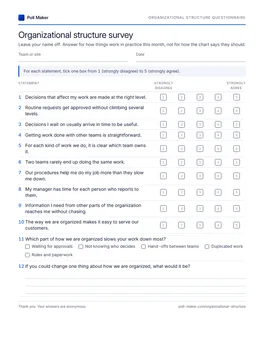
Organizational structure questionnaire
The twelve core items fill sheet one; later sheets hold the sets on reporting lines, decisions, life after a restructure, cross-team work and rules, with the manager span check printed separately at the end.
Download PDF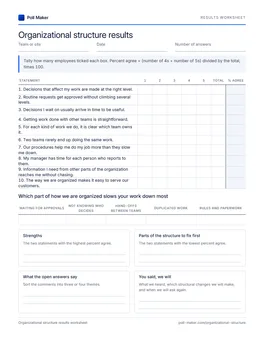
Structure results tally sheet
Tally statements 1 to 10, convert each tally into percent agreement, count the bottleneck votes and circle the two weakest areas.
Download PDFCommon questions from HR and org design teams
Short answers for HR, operations leads and students planning a structure review.
What is an organizational structure survey?
It asks employees how the organization's setup affects their daily work: where decisions are made, how many levels a request passes through, how work moves between teams and whether rules help or get in the way. It adds what the org chart leaves out, which is how the work actually flows.
What are the dimensions of organizational structure?
The Aston studies named five: specialization, standardization, formalization, centralization and configuration.4 Many later scales measure complexity, centralization and formalization.6 The dimensions table on this page maps every question to one of six practical areas built from them.
How do you assess an organization's structure?
Use three sources. Count what the chart shows (spans, layers, units), ask employees how the structure works for them with a survey like this one, then run interviews or workshops on the weakest areas. Few consultants struggle to document the formal reporting lines; how work crosses units is the part that needs asking.3
Should managers answer the same survey?
Yes. Everyone answers the core, which makes the levels comparable, and managers add the manager set about their own span. Keep it anonymous and hide results for any level or site with fewer than five answers.
Can I use these questions in a thesis or research project?
Yes, as an exploratory questionnaire: pilot it, check each area's reliability with Cronbach's alpha, and describe it as adapted from this page. If you need an established measure, two published options are the centralization items adapted from Hage and Aiken (alpha .84 in a study of 410 leaders of treatment organizations5) and, for universities, the OSS-U scale, tested with 655 faculty members.6
Loaded structure questions and cleaner versions
Weak structure questions ask people to judge the design itself. Better ones ask about something they deal with every week. The same test works on any topic in the library of survey questions.
Is our organizational structure effective?
Decisions that affect my work are made at the right level.
Getting work done with other teams is straightforward.
Effective at what? One rating mixes decision speed, coordination and cost, and a low score cannot say which to fix.
Which structure do we have: hierarchical, matrix, flat or divisional?
How many managers do you take direction from?
Few employees use these labels, and the answer is already on the chart. Asking about their own reporting line shows the matrix as people live it.
Is there too much bureaucracy here?
Routine requests get approved without climbing several levels.
Our procedures help me do my job more than they slow me down.
Bureaucracy is a loaded word that bundles layers and rules together. Two plain statements show whether layers or rules are doing the damage.
How satisfied are you with communication between departments?
Information I need from other parts of the organization reaches me without chasing.
Satisfaction invites a mood rating. A statement about chasing information points at the route that is broken.
Find where your structure slows the work
Put the core 12 online, send it before the next redesign conversation, and bring the two weakest statements to the table.