Change management survey questions that show whether staff are ready
Ask the people living through a change five things: do we need it, is it the right fix, can I do it, are leaders behind it, and will it be good for me. Start with the core 12 at the announcement, send a five-question pulse while it rolls out, and add the set for your stage.
- 37questions
- 12in the readiness core
- 5in the rollout pulse
- 5 minto answer the core
By Michael Hodge, BSc Psychology Updated September 2026
All 37 change management survey questions
The readiness core is ticked. Add the impact set at the announcement, the rollout set between rounds, the fatigue set when changes pile up, and the go-live set a few months after the switch. Beneath each question sit the answer choices people pick from, plus what a weak score would tell you.
The readiness core 1212 questions
Nine statements, one per belief or driver of support, then a one-word mood check and two open questions. Put the name of the change in the survey title so every answer is about the same thing.
-
I understand why we need to make this change.
Strongly disagree12345Strongly agree1 = Strongly disagree, 5 = Strongly agreeThe need for change. People who see no problem with today treat any change as a cost with no payoff.1
-
This change is the right fix for the problem.
Strongly disagree12345Strongly agree1 = Strongly disagree, 5 = Strongly agreeAgreeing that something must change is not agreeing with this change. A gap between the first two scores points at the solution, not the case for it.
-
I will be able to do my job well after the change.
Strongly disagree12345Strongly agree1 = Strongly disagree, 5 = Strongly agreeConfidence to cope. Low scores call for practice time and support before go-live, not more explanation.3
-
Senior leaders are fully behind this change.
Strongly disagree12345Strongly agree1 = Strongly disagree, 5 = Strongly agreeStaff watch what leaders do next. If leaders look half-hearted, people wait for the change to fade.
-
My manager can answer my questions about the change.
Strongly disagree12345Strongly agree1 = Strongly disagree, 5 = Strongly agreeSupport where it counts: the person staff ask first. A low score means managers were briefed late or thinly.
-
Overall, this change will be good for me.
Strongly disagree12345Strongly agree1 = Strongly disagree, 5 = Strongly agreePersonal value. Read it by team: the groups that lose the most from a change score lowest here, and deserve a straight answer.
-
I know what this change means for my own job.
Strongly disagree12345Strongly agree1 = Strongly disagree, 5 = Strongly agreeUncertainty about their own job is linked to strain. A team briefing that walks through each role is the quickest fix.5
-
People like me have a say in how it is rolled out.
Strongly disagree12345Strongly agree1 = Strongly disagree, 5 = Strongly agreeParticipation. Having a say in change decisions predicted openness to the changes in a reorganizing workplace.4
-
I have time in my week to learn the new way.
Strongly disagree12345Strongly agree1 = Strongly disagree, 5 = Strongly agreeCapacity. A change that lands on top of a full workload gets done badly or late, however much people support it.7
-
How do you feel about this change right now?
ReadyHopefulUnsureWorriedOpposedThe mood in one word. Watch how many move from unsure to hopeful between rounds; that shift is progress.
-
What is your biggest question or worry about this change?
Open answerYour FAQ, written by staff. Answer the most common five at the next team meeting.
-
What one thing would make this change work better for you?
Open answerOne thing per person keeps answers concrete. Sort them into themes and pick two you can act on this month.
Before it starts: impact on your work4 questions
Send these with the core soon after the announcement. They show which roles the change touches most, so the plan and the training go there first.
-
Which parts of your work will this change touch?
ToolsTasksMy teamLocationHoursPayNot sure yetTick all that applyAn impact map from the people who do the work. Many "Not sure yet" answers mean the change has not been explained at role level.
-
How big is this change for your day-to-day work?
Very smallSmallMediumLargeVery largeSize of impact by role. Put the large and very large groups first in line for training and floor support.
-
How have past changes here usually gone?
Very wellMostly wellMixedMostly badlyVery badlyChange history. A record of changes that stalled breeds cynicism about the next one, so name what will be different this time.11
-
What should the project team know about your work before the plan is final?
Open answerLocal knowledge the plan is missing: the month-end crunch, the workaround everyone relies on, the customer who will notice.
While it rolls out (every two to four weeks)5 questions
Short check-ins between the big rounds. Keep the wording identical each time so the lines on your chart mean something.
-
I know what happens next, and when.
Strongly disagree12345Strongly agree1 = Strongly disagree, 5 = Strongly agreeRollout clarity. It drops fast when dates slip and nobody says so.
-
Updates on this change are honest about problems.
Strongly disagree12345Strongly agree1 = Strongly disagree, 5 = Strongly agreeCandour. Staff already know what is going wrong; updates that skip it cost trust in every later message.
-
Problems I raise about the change get answered.
Strongly disagree12345Strongly agree1 = Strongly disagree, 5 = Strongly agreeWhether feedback goes anywhere. If this stays low, people stop raising problems and start working around them.
-
Since the last check-in, how do you feel about the change?
Much betterA bit betterThe sameA bit worseMuch worseDirection of travel, which a single snapshot cannot show. Two worse rounds in a row is your early warning.
-
What is getting in the way right now?
Open answerThis week's blockers, in staff words. Fix one and say so before the next check-in.
Change fatigue and workload4 questions
Add these when this is one of several changes at once, or when the open answers start to sound tired.
-
In the past 12 months, how many changes have affected your work?
None1 or 23 or 45 or moreNot sureHow often change arrives. Read the other answers by this split: the 5 or more group is where fatigue shows first.
-
Changes here are spaced out enough to settle in.
Strongly disagree12345Strongly agree1 = Strongly disagree, 5 = Strongly agreePacing. A low score says the problem is the portfolio of changes, not this one.6
-
When change adds work, some old work is dropped.
Strongly disagree12345Strongly agree1 = Strongly disagree, 5 = Strongly agreeWhether anything comes off the plate. Most employees say nothing does, which is why workload rises with every change.7
-
Which project or change would you pause, if you could?
Open answerStaff see the overlaps leaders miss. Repeated names on this list are candidates for a pause or a merge.
After go-live: adoption and results5 questions
Send these two to three months after the switch, alongside a repeat of the core, to learn whether the change stuck and what to keep for next time.
-
How much of your work do you now do the new way?
All of itMost of itAbout halfA littleNone yetReal adoption, not attendance at training. Everything below "Most of it" hides a reason worth finding.
-
I can see the benefits this change promised.
Strongly disagree12345Strongly agree1 = Strongly disagree, 5 = Strongly agreePromise against result, from the people doing the work. Compare it with the business case, line by line.
-
I would not want to go back to the old way.
Strongly disagree12345Strongly agree1 = Strongly disagree, 5 = Strongly agreeCommitment to the change itself, the attitude most closely tied to people actively backing it once the novelty wears off.9
-
Looking back, this change was well managed.
Strongly disagree12345Strongly agree1 = Strongly disagree, 5 = Strongly agreeEffectiveness of the change management itself, separate from whether the change was a good idea.
-
What lesson from this change should we keep for the next one?
Open answerThe keep list for your next change plan, written by the people on the receiving end.
For people managers (managers answer)4 questions
A short form for team leaders, sent a few days before staff hear the news. Staff ask their manager first, so this is where readiness starts.
-
I heard about the change before my team did.
Strongly disagree12345Strongly agree1 = Strongly disagree, 5 = Strongly agreeSequence. Managers who learn with their team cannot answer the first question anyone asks them.
-
I can answer the questions my team will ask.
Strongly disagree12345Strongly agree1 = Strongly disagree, 5 = Strongly agreeBriefing quality. Compare it with the staff score for "My manager can answer my questions about the change."
-
I can free up time for my team to learn it.
Strongly disagree12345Strongly agree1 = Strongly disagree, 5 = Strongly agreeWhether managers have the authority to protect learning time, or only the instruction to find it.
-
What do you need from the project team to lead this well?
Open answerA shopping list for the change team: scripts, dates, decisions, or cover for the busy week.
About you (optional)3 questions
Use these to split results. A team of three cannot stay anonymous, so fold tiny teams into their neighbours before reporting.
-
Which best describes your role?
Staff memberTeam leadManagerSenior leaderPrefer not to sayReadiness often falls with each level down. This split shows whether the message has travelled.
-
How long have you been with the organization?
Less than a year1 to 2 years3 to 5 years6 years or morePrefer not to sayLong-serving staff carry the memory of past changes, good and bad. Read the change-history answers by this split.
-
Which team, site or department are you in?
Open answerLets you report by area when the change reaches teams on different dates.
What each core statement measures
Armenakis and Harris spent 30 years studying why people back a change or resist it, and found five beliefs underneath.1 The first six statements measure those beliefs. The next three measure what feeds them day to day.
| Belief (what staff ask) | Statements | If it scores lowest |
|---|---|---|
| Need: do we have to change? | 1 | Show the facts that make standing still the bigger risk. |
| Right fix: is this the answer? | 2 | Explain the options you rejected and why. |
| Can do: can I manage it? | 3 | Practice time, a sandbox or a buddy before go-live. |
| Support: are leaders serious? | 4, 5 | Leaders use it first; brief managers before staff. |
| Value: what is in it for me? | 6 | Say what gets better and what gets harder, role by role. |
| Drivers: information, a say, time | 7, 8, 9 | Team briefings, a rollout working group, protected hours. |
Scoring it
Score one statement at a time. Its score is the number choosing either agree option, over the total who rated it. Compare the nine scores with each other rather than with another company. The lowest belief is the one holding support back, and the table says where to start.
A worked example
A finance team of 48 hears it is moving to a new expense system. At the announcement, 41 agree the old process has to go, but only 22 agree the new system is the right fix, and just 15 say they have time to learn it. The mood question splits between unsure and worried.
The need is accepted, so more speeches about why will not help. The team doubts the choice and has no room to learn. The project lead runs a demo that shows how two old pain points disappear, and the finance manager moves the month-end report deadline by two days to free a training slot. Four weeks later the pulse shows the time statement rising and most unsure answers turning hopeful.
Between rounds, a two-minute pulse
Between the big rounds, send these five every two to four weeks while the change rolls out. They cover what happens next, what it means for each job, time to learn, whether problems get answered, and what is in the way this week. It takes under two minutes.
- 01I know what happens next, and when.
- 02I know what this change means for my own job.
- 03I have time in my week to learn the new way.
- 04Problems I raise about the change get answered.
- 05What is getting in the way right now?
Let the survey steer the rollout
Four habits decide whether the survey steers the change or just records how it went.

Pulse little and often while it rolls out
Views on a change move week by week, and a single survey catches only one of those weeks. The change beliefs can be measured at any stage of a change,2 so ask the core 12 at the announcement and again after go-live, and send the five-question pulse between them. Same wording every round, same day of the week, results back to teams within days.
Employees who feel their voice is heard on change
Ask about the rollout, not only the idea
Employees get a say in what should change far more often than in how it happens. In Eagle Hill's 2025 survey, 57% felt heard on what change was needed but only 40% on how it would be rolled out to their team.7 That gap matters: in a reorganizing workplace, information about the changes and a part in the decisions both predicted openness to them,4 and taking part in decisions went with less uncertainty about people's own jobs.5 Statements 7 and 8 measure exactly this.

Take something off the plate
Change is extra work before it saves any. In the same survey, 45% of employees said change in the past year raised their workload, and 62% said their manager had taken no work away to give them time to adjust.7 Repeated change without relief shows up as change fatigue, which is linked to exhaustion and, through it, to lower commitment and plans to leave.6 Statement 9 and the fatigue set tell you where to make room first.
Name the change in every question
Most teams are living through more than one change at a time. "How do you feel about the changes?" gets an answer about all of them at once, and no team can do anything with it. Put the project name in the survey title and the first line, keep "this change" in each statement, and ask the fatigue questions separately when you want the wider picture.
At the meeting where the change is announced, take the room's mood before questions open. Project the one-word feeling question as a live mood poll, give the room thirty seconds to tap an answer, and repeat it at the close to see whether the talk moved anyone. There is a step-by-step poll guide for sharing it on screen.
Read the core as a readiness chart
Type in the counts for all five answers on the nine readiness statements. The weakest beliefs show up as the shortest bars and are flagged as the focus for your next round.
- 1Enter the counts from one round at a time. Each bar turns the two agree answers into a percent of all ratings for that line.
- 2Read the first two statements together. High need but low right fix means the case for change landed and the chosen solution did not.
- 3Build a chart for each team or role as well. Readiness is rarely even, and the lowest team is where to spend the next week.
- 4Pick the two lowest statements, name one action for each, and tell staff what you are doing before the next pulse goes out.
Readiness core statements
Four survey rounds across one change
A single survey on one day misses how views move. Plan four rounds before the change is announced.
| When | Send | What you learn |
|---|---|---|
| A few days before the news | Managers set (4) | Whether team leaders can answer the first questions |
| Within two weeks of the news | Core 12 + impact set | Which beliefs are weak, and which roles are hit hardest |
| Every two to four weeks | The five-question pulse, plus the rollout set as needed | Whether clarity and capacity are rising or slipping |
| Two to three months after go-live | Core 12 again + go-live set | Whether the change stuck, and what to keep |
Add the fatigue set to any round where the same people are living through several changes at once. If the change is a new system, test the release with a user acceptance testing questionnaire before go-live, and survey the classes that teach it with training feedback questions. For an AI rollout, the workplace set on our AI survey questions page asks how people actually use the new tools.
Change survey on paper, plus a tally sheet
For crews, wards, stores and shifts without a work email. Pass copies round at the start of a shift, gather them in a sealed envelope, and the tally takes about ten minutes. No resizing is needed for letter or A4 sheets.
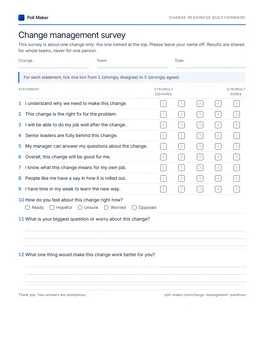
Change readiness questionnaire
Spaces for the change, team and date, then the readiness core, followed by the impact, rollout, fatigue, go-live and manager sets and About you.
Download PDF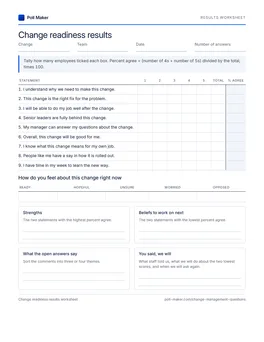
Readiness tally sheet
Count the mood answers, tally the nine core statements, convert each to percent agreeing, and write down the two weakest beliefs with an action for each.
Download PDFChange survey questions worth rewording
Four questions turn up on most home-made change surveys, and each one returns a reply too vague to use. For the wider rules, our survey question guide has examples for every question type.
Do you support the change?
I understand why we need to make this change.
This change is the right fix for the problem.
Support is the result. The beliefs underneath it tell you what to fix when it is low.
How do you feel about the recent changes?
How do you feel about this change right now? (with the change named in the title)
Plural changes blend every project of the year into one mood. Name one change and the answer becomes usable.
Was communication about the change clear and timely?
I know what this change means for my own job.
I know what happens next, and when.
It asks about clarity and timing at once, so a low score could be about either, and you cannot tell which.
Are you resistant to change?
What is your biggest question or worry about this change?
The label blames people and gets defensive answers. A question about worries brings out concerns you can answer.
Measuring change in a thesis or research study
Students searching for an organizational change management questionnaire usually need a validated scale they can cite. These are the published ones that match the sets on this page.
| What you want to measure | Published scale | Source |
|---|---|---|
| Readiness for change | Holt and colleagues, four readiness beliefs | Ref 3 |
| The five change beliefs | Change recipients' beliefs scale, 24 items | Ref 2 |
| Commitment to a change | Affective, continuance and normative scales | Ref 9 |
| Resistance as a trait | Resistance to change scale, four factors | Ref 10 |
| Change fatigue | Six-item change fatigue measure | Ref 6 |
Quote the items exactly as published, keep the original answer scale, and report Cronbach's alpha for your own sample. Ask the authors or the publisher before reusing a scale in print. The statements here are newly written rather than taken from those scales, so they suit a pilot, a class project or a workplace survey where you need plain wording more than published norms.
Describe your sample honestly: who was invited, how many answered, and when the survey ran relative to the change. A survey sent the week of the announcement and one sent after go-live are measuring different moments.
Before you send a change survey
Short answers for HR partners, change managers and project leads.
What questions should a change management survey ask?
Ask about the five beliefs behind support for a change: the need for it, whether it is the right fix, whether people can do it, whether leaders back it, and what it means for them.1 Add what the change means for each job, whether people have a say, and whether they have time to learn. Finish with a worry question and a one-thing-to-improve question.
How often should you run a change pulse survey?
Every two to four weeks while the change rolls out, with five questions or fewer and identical wording each time. Run the full core at the announcement and repeat it once go-live has settled, usually after two or three months, so you can compare the two.
Should a change management survey be anonymous?
Yes. Send a single shared link that needs no sign-in, gather paper copies in a sealed envelope, and only break results out for teams with enough people to hide any one answer. Staff tell you what is really going wrong only when their name stays off it.
How do you measure change management effectiveness?
Compare the core 12 before and after go-live, then add the go-live set: how much work is now done the new way, whether the promised benefits showed up, whether anyone wants the old way back, and whether the change was well managed. Put those next to your project measures such as usage, errors and cycle time.
What are IT change risk assessment questions?
They are a different job: the change owner answers them before a change advisory board approves a system change. Typical questions ask how many users are affected, whether it was tested outside production, whether a tested rollback plan exists, how much downtime it needs, whether it falls in a busy period, and whether the team has made this kind of change before. This survey sits next to that check and asks the people on the receiving end.
Do 70 percent of change initiatives really fail?
There is no solid evidence for that figure. A review of five published sources for it found no valid empirical data behind any of them.8 Measure your own change instead: the same core, asked before and after, tells you how this one is going.
Before the next team briefing
Name the change in the survey title, tick the sets for this stage, and send the link before the next team briefing. Print the questionnaire for anyone who works away from a screen.