Leadership effectiveness questionnaire
Ask a team what they see their leader do each week: set direction, decide on time, help people grow, win support and keep promises. The core 14 takes about five minutes, and the leader answers the same ten statements to compare.
- 38questions
- 14in the core set
- 5 minto answer the core
- 10statements the leader rates too
By Michael Hodge, BSc Psychology Updated September 2026
Team core, follow-up sets and the leader self-rating
The core 14 comes selected. Each optional set follows up one part of the core, and the self-rating repeats the ten statements for the leader to answer about themselves.
The core 1414 questions
Ten statements about what a leader does, an overall rating, a vote on what would help most, and two write-in boxes. Used alone, it already makes a full leadership survey.
-
My leader makes our team's goals clear.
Strongly disagree12345Strongly agree1 = Strongly disagree, 5 = Strongly agreeDirection, the base of the task statements. If people cannot say what the team is for, start here.
-
My leader plans so deadlines rarely surprise us.
Strongly disagree12345Strongly agree1 = Strongly disagree, 5 = Strongly agreePlanning as the team lives it: calm weeks or last-minute rushes.
-
My leader makes even hard decisions in good time.
Strongly disagree12345Strongly agree1 = Strongly disagree, 5 = Strongly agreeSeparates a careful leader from one who puts off the call while the team waits.
-
When I'm struggling with my work, my leader helps.
Strongly disagree12345Strongly agree1 = Strongly disagree, 5 = Strongly agreeSupport at the moment it counts, asked as an action rather than a feeling about the leader.
-
My leader helps me get better at my job.
Strongly disagree12345Strongly agree1 = Strongly disagree, 5 = Strongly agreeThe coaching statement. When it is low, add the coaching set to see which part is missing.
-
My leader gives credit where it is due.
Strongly disagree12345Strongly agree1 = Strongly disagree, 5 = Strongly agreeRecognition, and whether credit reaches the person who did the work.
-
My leader trusts me to decide how I do my work.
Strongly disagree12345Strongly agree1 = Strongly disagree, 5 = Strongly agreeRoom to decide. A low score often means close checking of work people already know how to do.
-
My leader explains why changes are happening.
Strongly disagree12345Strongly agree1 = Strongly disagree, 5 = Strongly agreeChange leadership from the desk. A change that arrives with no reason feels arbitrary, however sound it is.
-
My leader secures what our team needs from others.
Strongly disagree12345Strongly agree1 = Strongly disagree, 5 = Strongly agreeWork outside the team: winning resources, support and a hearing from the rest of the organization. In one study, staff who rated this highly also rated the team as performing better.3
-
My leader does what they say they will do.
Strongly disagree12345Strongly agree1 = Strongly disagree, 5 = Strongly agreeFollow-through, the everyday base of trust, and something a team can judge better than anyone.
-
Overall, how effective is your leader?
ExtremelyVeryModeratelySlightlyNot at allThe headline to track from round to round. The ten statements above explain why it sits where it does.
-
Which one of these would help you most right now?
Clearer goalsFaster decisionsMore coachingMore freedomHelp from aboveThe team picks the priority. Each option maps to a group of statements, so the vote points at a fix.
-
What does your leader do that helps you most?
Open answerNames what to protect. People answer this one generously, and it gives the leader something to keep.
-
What is one thing your leader could do differently?
Open answerOne thing, not a list. The answers tend to fall into two or three themes the leader can act on.
Coaching and one-to-ones4 questions
Add these when statement 5 scores low, or to see how well a leader coaches.
-
How often do you have a one-to-one with your leader?
WeeklyEvery two weeksMonthlyLess than monthlyNeverFrequency first: coaching cannot happen in conversations that are not taking place.
-
My one-to-ones cover my growth, not just tasks.
Strongly disagree12345Strongly agree1 = Strongly disagree, 5 = Strongly agreeA weekly meeting that only reviews tasks is a progress check, not coaching.
-
My leader's feedback is specific enough to act on.
Strongly disagree12345Strongly agree1 = Strongly disagree, 5 = Strongly agreeQuality over volume. Vague praise and vague criticism score the same here: low.
-
My leader helps me find my own answers.
Strongly disagree12345Strongly agree1 = Strongly disagree, 5 = Strongly agreeThe coaching habit itself, as opposed to handing out solutions.
Trust and fairness6 questions
For teams where statement 10 is weak, or where people write about favourites, blame or broken promises. The last two cover how the leader handles a bad week.
-
My leader treats everyone on the team fairly.
Strongly disagree12345Strongly agree1 = Strongly disagree, 5 = Strongly agreeFairness across the team. Compare it by tenure to see whether newer members feel it too.
-
I can safely disagree with my leader.
Strongly disagree12345Strongly agree1 = Strongly disagree, 5 = Strongly agreeWhether people speak up. Without it, the rest of this survey only hears the safe answers.
-
My leader owns up to their mistakes.
Strongly disagree12345Strongly agree1 = Strongly disagree, 5 = Strongly agreeA leader who admits mistakes makes it safer for the team to raise theirs early.
-
My leader follows the rules they set for the team.
Strongly disagree12345Strongly agree1 = Strongly disagree, 5 = Strongly agreeLeading by example, asked as something people can check for themselves.
-
My leader looks for the fix before the blame.
Strongly disagree12345Strongly agree1 = Strongly disagree, 5 = Strongly agreeWhen blame comes first, problems go quiet. This statement catches it early.
-
My leader shares bad news early.
Strongly disagree12345Strongly agree1 = Strongly disagree, 5 = Strongly agreeLate bad news leaves the team no time to respond. Early news leaves room to act.
The senior leadership team3 questions
The same employees, asked about the leaders above their own. Useful when a survey covers a whole department or company.
-
I trust the decisions senior leaders make.
Strongly disagree12345Strongly agree1 = Strongly disagree, 5 = Strongly agreeTrust at the top. Compare it with statement 3 to see where decisions stall.
-
Senior leaders explain where we are heading.
Strongly disagree12345Strongly agree1 = Strongly disagree, 5 = Strongly agreeDirection from the top. If this is low, team leaders are left to guess when they set goals.
-
Senior leaders live the values they talk about.
Strongly disagree12345Strongly agree1 = Strongly disagree, 5 = Strongly agreeWords against actions. A gap here undoes a lot of good work lower down.
About you (optional)1 questions
One question, only to compare newer and longer-serving team members. Leave it out in teams under ten.
-
How long have you worked with this leader?
Under 6 months6 to 12 months1 to 3 yearsOver 3 yearsPrefer not to sayNew team members answer from first impressions. Split the results only when each group is large.
The leader's self-rating10 questions
Answered by the leader, not the team: the ten core statements in the first person. Send it on its own, before the team results arrive.
-
I make our team's goals clear.
Strongly disagree12345Strongly agree1 = Strongly disagree, 5 = Strongly agreeCompare with statement 1. A leader who rates this higher than the team has found the first thing to fix.
-
I plan so deadlines rarely surprise the team.
Strongly disagree12345Strongly agree1 = Strongly disagree, 5 = Strongly agreeCompare with statement 2.
-
I make even hard decisions in good time.
Strongly disagree12345Strongly agree1 = Strongly disagree, 5 = Strongly agreeCompare with statement 3.
-
I help team members who are struggling.
Strongly disagree12345Strongly agree1 = Strongly disagree, 5 = Strongly agreeCompare with statement 4.
-
I help each team member get better at their job.
Strongly disagree12345Strongly agree1 = Strongly disagree, 5 = Strongly agreeCompare with statement 5, and with the coaching set if you ran it.
-
I give credit where it is due.
Strongly disagree12345Strongly agree1 = Strongly disagree, 5 = Strongly agreeCompare with statement 6.
-
I trust people to decide how they do their work.
Strongly disagree12345Strongly agree1 = Strongly disagree, 5 = Strongly agreeCompare with statement 7.
-
I explain why changes are happening.
Strongly disagree12345Strongly agree1 = Strongly disagree, 5 = Strongly agreeCompare with statement 8.
-
I secure what my team needs from others.
Strongly disagree12345Strongly agree1 = Strongly disagree, 5 = Strongly agreeCompare with statement 9.
-
I do what I say I will do.
Strongly disagree12345Strongly agree1 = Strongly disagree, 5 = Strongly agreeCompare with statement 10. The team sees broken promises that a leader has long forgotten.
Which behaviour each core question covers
Research on what effective leaders do sorts their behaviour into families: getting the task done, looking after relationships and leading change,1 with a fourth family for work outside the team.2, 3 The core samples every family a team can see, then adds follow-through.
| Family | What the team sees | Core questions |
|---|---|---|
| Getting the work done | Clear goals, forward planning, decisions made on time | 1 to 3 |
| Looking after people | Help when someone is stuck, coaching, credit, room to decide | 4 to 7 |
| Leading change | Reasons given for changes that affect the team | 8 |
| Working beyond the team | Resources, support and a hearing from the rest of the organization | 9 |
| Keeping their word | Promises kept | 10 |
| The verdict | How effective the leader is overall, and what would help most | 11 and 12 |
Read the families before single statements. A leader who scores well on looking after people and poorly on getting the work done needs a different plan from one with the opposite pattern, even when their overall ratings match. The priority vote in question 12 tells you which family the team wants worked on first: each option lines up with one row of this table.
Running a wider staff survey as well? Pay, workload and the rest of working life each have their own set among our employee survey questions.
Spot the behaviours the team rates lowest
Key in how many team members chose each answer to the ten statements. Agreeing always means the leader does it well, so the statements with the least agreement are where to start.
- 1Each bar is one statement, with the share who agreed or strongly agreed shown at its end.
- 2Group the bars by family: 1 to 3 getting the work done, 4 to 7 looking after people, 8 change, 9 outside the team, 10 keeping their word.
- 3Pick the two lowest statements, then check them against the priority vote in question 12.
- 4Print the report, take it to the next team meeting, and repeat the core a year later.
Leadership results
Run it so the answers lead somewhere
The questions are half the job. These four habits decide whether a leadership survey changes anything.

Hold results until enough people answer
One team member's view is a thin basis for judging anyone. In a meta-analysis, two direct reports rating the same person agreed at a correlation of only .30, lower than pairs of peers or bosses.6 An average of several answers is far steadier, and it keeps each person anonymous. Set a floor, say five replies, before the leader sees anything, and merge very small teams into one report.

Talk the results through with the team
What happens after the survey decides whether it helps. In a five-year study of 252 managers, those who met their direct reports to discuss the feedback improved more than those who did not, and each one improved more in the years they held that meeting.4 Share the two lowest statements, say what you will try first, and ask the team what would make the biggest difference.
Rate what people can see
A team cannot rate vision or character directly. It can see whether goals are clear, decisions come on time and credit lands with the right person, so every core statement names an action. Question 9 covers the work leaders do outside the team: when the staff of 233 managers rated it, representing the team and keeping watch on events outside it went with higher ratings of team performance and of how effective the manager was.3
Repeat it every year and check in between
Gains build round by round. Managers who started with poor or middling ratings improved across five yearly rounds of feedback.4 A major review of multisource feedback research concluded that leaders improve most when the results show a clear need to change, they believe change is possible, and they set goals and act on them.5 Close each round with one or two goals, then send the quarterly five to see if they are landing.
Want a quick read at your next team meeting? Run the priority question as a live poll: nobody has to put their name to a vote, so people pick what they really want more of. The how-to for polls covers sharing one in a chat or on a video call.
Set the leader's own view beside the team's
The self-rating set repeats the ten core statements in the first person. The leader answers it before seeing any team results, and the distance between the two views is where the useful conversation starts.
How closely two rating sources agree (mean correlation)
Expect the two views to differ. In a meta-analysis of multisource ratings, self-ratings and ratings from direct reports correlated at just .14, the weakest link between any two rating sources.6 That is exactly why it pays to ask both.
A worked example
Convert the team's answers to an average on the same 1 to 5 scale, then subtract the leader's own score.
| Statement | Leader | Team average | Gap |
|---|---|---|---|
| 1. Makes the team goals clear | 5 | 3.4 | 1.6 lower: blind spot |
| 3. Decisions in good time | 4 | 3.9 | Close |
| 5. Helps me get better at my job | 3 | 4.2 | 1.2 higher: hidden strength |
| 9. Gets us what we need from elsewhere | 4 | 2.8 | 1.2 lower: blind spot |
| 10. Does what they say they will do | 5 | 4.6 | Close |
This leader believes the goals are clear, and the team disagrees: that is the first conversation, starting with what feels unclear. The team also rates their coaching well above the leader's own score, so that habit is worth keeping on purpose. Treat a gap under half a point as agreement.
The quarterly leadership check-in
Between yearly rounds, every quarter, send just these five. They take a minute to answer and show whether the goals from the last round are landing.
- 01My leader makes our team's goals clear.
- 02My leader makes even hard decisions in good time.
- 03My leader helps me get better at my job.
- 04My leader does what they say they will do.
- 05Overall, how effective is your leader?
A sealed-envelope version for team meetings
Some teams answer more freely on paper. Hand the form out at a team meeting and have someone other than the leader collect it in a sealed envelope.
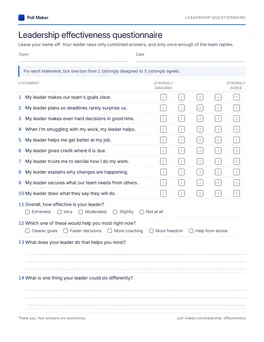
Leadership questionnaire
Sheet one holds the core 14 with pencil tick boxes. The optional sets follow, including the self-rating for the leader.
Download PDF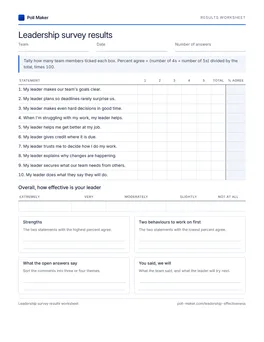
Leadership results worksheet
Count the paper answers statement by statement, find the percent agreeing, and tally the overall ratings on one sheet.
Download PDFLeadership questions that miss, and sharper versions
Each weak version asks for a verdict, a guess, two answers at once or a polite yes. Each fix asks about something the team has lived through. The survey questions guide has the general rules behind these fixes.
Is your leader a good leader?
My leader makes even hard decisions in good time.
A verdict tells a leader how they are liked, not what to change. A statement about one behaviour gives them something to do.
Does your leader communicate clearly and listen to the team?
My leader makes our team's goals clear.
I can safely disagree with my leader.
Two questions share one sentence. A team member who hears plenty but never gets heard cannot answer it truthfully.
How would you rate your leader's vision?
My leader makes our team's goals clear.
Vision is a trait people guess at. Knowing what the team is for is something every member can judge.
Don't you agree your leader supports the team well?
When I'm struggling with my work, my leader helps.
The weak version pushes people toward yes. The sharper one asks about a moment they will remember.
Questions HR teams and leaders ask
Short answers for whoever is planning the survey, and for leaders taking the self-rating.
How do you measure leadership effectiveness?
Ask the team whether they see the behaviours that matter, add one overall rating, and set both beside the team's results. The core 14 covers the first two: ten statements on direction, people, change, outside support and follow-through, then an overall rating and a priority vote.
Should a leadership survey be anonymous?
Yes. Collect no names, keep the About you question optional, and show a leader results only once at least five people have answered. Fold smaller teams into one report for the department.
Can a leader use this as a self-assessment?
Yes. The self-rating set turns the ten core statements into first-person questions. Answer it before reading the team's results, then compare the two the way the worked example shows.
Can I use these questions for a 360 review?
Yes. Send the core to direct reports, peers and the leader's own boss, and have the leader complete the self-rating. For peers and the boss, swap "my leader" for the person's name, and report each group separately.
How often should we run a leadership survey?
The full set once a year, and the quarterly five in between. After a new leader starts, wait about three months before the first full round so the team has something to rate.
See your leadership the way your team does
Send the core 14 to the team this week, answer the self-rating yourself before the replies come in, and take both to your next team meeting.