Post-acquisition and post-merger employee survey questions
After a deal closes, ask employees on both sides what it means for their role, whether leaders are being straight with them, whether decisions are fair, and whether the two companies are treated as equals. Send the core 12 in the first month, read every answer by the company people came from, and add sets for day one, pay, culture and retention.
- 38questions
- 12in the core pulse
- 5for the week of close
- 5 minto answer the core
By Michael Hodge, BSc Psychology Updated September 2026
The week the deal closes: five to beat the rumours
Rumours move fastest in the days after close. These five ask whether people know what the deal means for their role, trust what they are told, know what stays the same, get answers when they ask, and what they still need to hear. It takes about two minutes.
- 01I know what the acquisition means for my own role.
- 02Leaders are honest about what will and will not change.
- 03In week one, I knew what would stay the same for me.
- 04When I ask about the deal, I get a straight answer.
- 05What question about the acquisition has nobody answered for you yet?
Core pulse plus sets for pay, culture and staying on
The core 12 starts out selected. Add the day one set in the first month, pay and practical changes once HR policies merge, two cultures from about month three, staying or going through the first year, and the anniversary set at twelve months. Under every question sit the choices people pick from and why the result matters to an integration team.
The core 12 integration pulse12 questions
Eight statements people can judge from their own desk, the name they give for where they work, which company they came from, and two open questions. Repeat it unchanged at every milestone so the rounds compare.
-
I know what the acquisition means for my own role.
Strongly disagree12345Strongly agree1 = Strongly disagree, 5 = Strongly agreeThe first thing everyone wants to know. Until it is answered, most other news goes unheard.1
-
Leaders are honest about what will and will not change.
Strongly disagree12345Strongly agree1 = Strongly disagree, 5 = Strongly agreeChecks whether your realistic preview is landing. Saying what stays the same counts as much as announcing what moves.1
-
When I ask about the deal, I get a straight answer.
Strongly disagree12345Strongly agree1 = Strongly disagree, 5 = Strongly agreeWhether questions reach someone who can answer. A low score means staff are answering each other, and rumour fills the gap.
-
I expect to have a job here a year from now.
Strongly disagree12345Strongly agree1 = Strongly disagree, 5 = Strongly agreeJob security in plain words. Read it by team: a low score in a team you cannot afford to lose is your first retention risk.2
-
Decisions about who does what are being made fairly.
Strongly disagree12345Strongly agree1 = Strongly disagree, 5 = Strongly agreeFair process, asked separately from fair outcomes. People can live with a hard call when they can see how it was made.4
-
People from both companies are treated as equals.
Strongly disagree12345Strongly agree1 = Strongly disagree, 5 = Strongly agreeThe us-and-them question. Compare the two sides line by line: the side that feels taken over scores lower.3
-
What I valued about working here is being kept.
Strongly disagree12345Strongly agree1 = Strongly disagree, 5 = Strongly agreeA sense of continuity, which is what holds commitment for people from the company that was bought.3
-
Leaders from both companies work well together.
Strongly disagree12345Strongly agree1 = Strongly disagree, 5 = Strongly agreeStaff watch whether leaders cooperate across the old company line before they do it themselves.4
-
When someone asks where you work, which name do you give?
The combined companyMy old companyBoth namesDepends who asksIdentification in one tap. Ask it at every round: movement toward the combined name is integration you can count.3
-
Which company did you work for before the deal?
Acquiring companyAcquired companyJoined since the dealPrefer not to sayThe split you read every other answer by. Swap in the two real company names before you send it.
-
What question about the acquisition has nobody answered for you yet?
Open answerYour next FAQ, written by staff. Answer the five most common ones at the next all-hands.
-
What from the way your team worked before the deal should we keep?
Open answerThe keep list. It tells the integration team what to protect before a new process replaces it.
Day one and the first weeks5 questions
Send these with the core in the first month after close. They show how the news reached people and what they needed to hear first.
-
How did you first hear about the acquisition?
From my managerAll-staff meetingEmail from leadersNews or social mediaFrom a colleagueThe route the news took. If most people heard it from the press or a colleague, fix the channel before the next announcement.
-
When you first heard, what did you most want to know?
My jobMy payMy benefitsMy managerWhere I workCompany nameTick all that applyPersonal questions come first. The top two answers belong at the top of every briefing pack.
-
In week one, I knew what would stay the same for me.
Strongly disagree12345Strongly agree1 = Strongly disagree, 5 = Strongly agreeContinuity messages. People settle faster once they hear what is not changing.
-
I knew where to find answers about the deal.
Strongly disagree12345Strongly agree1 = Strongly disagree, 5 = Strongly agreeA named contact or an FAQ page. Without one, people ask each other and guesses travel.
-
What have you heard about the acquisition that you want confirmed or denied?
Open answerThe rumour list. Answer the common ones in public, including the ones that turn out to be true.
Pay, benefits and practical changes5 questions
Add these once HR starts moving people onto one set of pay scales, benefits, policies and systems, usually in the first few months.
-
Which of these have changed for you since the deal closed?
PayBenefitsJob titleManagerWork locationSystemsNothing yetTick all that applyA map of the change each person has actually felt so far. Hold it up against the integration plan.
-
Pay and benefit changes were explained in advance.
Strongly disagree12345Strongly agree1 = Strongly disagree, 5 = Strongly agreeThe order matters. A change people discover on a payslip costs trust that is slow to rebuild.
-
I know which HR policies apply to me now.
Strongly disagree12345Strongly agree1 = Strongly disagree, 5 = Strongly agreeLeave, expenses, hours, remote work. Two rulebooks running side by side confuse everyone.
-
Compared with before the deal, your pay and benefits overall are:
BetterAbout the sameWorseNot sure yetHow the package feels, which can differ from the spreadsheet. Many "Not sure yet" answers mean it needs explaining.
-
Which practical detail is still unclear to you?
Open answerSmall gaps such as system access, holiday carry-over or a new expense tool. Each one is quick to fix once named.
Two cultures, one company5 questions
Add these from about the third month. The first two use the four ways companies combine: side by side, blended, one taking on the other's ways, or something new for both.
-
Which best describes how the two companies are coming together?
Side by sideBlending bothAdopting the buyer's waysSomething new for bothNot sureWhat people see happening, in the four cultural end states Marks and Mirvis describe. Compare it with what leaders intend.5
-
Which of these would work best for your team?
Side by sideBlending bothAdopting the buyer's waysSomething new for bothNot sureWhat people would choose. Where it differs from the answer above, expect friction and explain the choice before it surfaces.5
-
I understand how decisions get made here now.
Strongly disagree12345Strongly agree1 = Strongly disagree, 5 = Strongly agreeWho signs off on what. Unclear decision rights slow everyday work down.
-
Working with people from the other company is easy.
Strongly disagree12345Strongly agree1 = Strongly disagree, 5 = Strongly agreeCollaboration across the old line. Read it by team to find the joins that are not holding.
-
What difference between the two companies slows your work down?
Open answerConcrete clashes, such as approvals, meeting habits or tools, that the integration team can fix one at a time.
Staying or going4 questions
For the first six to twelve months, while people decide whether the combined company is for them. Keep it anonymous so people can answer freely.
-
How long do you see yourself working here?
Under 6 months6 to 12 months1 to 2 yearsOver 2 yearsNot sureIntention to stay, in time bands you can track from round to round. Watch the share choosing under a year.
-
Since the deal was announced, have you looked at other jobs?
NoThought about itLooked at listingsAppliedPrefer not to sayAn early signal, well before anyone hands in notice. Report it only for groups large enough to stay anonymous.
-
What would make you more likely to stay?
Clear roleCareer pathPayKeep my managerKeep my teamFlexible workMore informationTick all that applyThe retention plan, as chosen by the people you most want to keep.
-
A leader has talked with me about my future here.
Strongly disagree12345Strongly agree1 = Strongly disagree, 5 = Strongly agreeWhether stay conversations are happening. Each takes an hour and is the easiest retention step to count.
One year on4 questions
Send these with the core around the first anniversary of the deal, to see what held and to carry lessons into the next acquisition.
-
The deal turned out the way leaders described it.
Strongly disagree12345Strongly agree1 = Strongly disagree, 5 = Strongly agreePromise against result. A low score points at early messages that oversold the deal.
-
Teams from the two companies now work as one.
Strongly disagree12345Strongly agree1 = Strongly disagree, 5 = Strongly agreeWhether the old line still shows in daily work. Read it next to the name question in the core.
-
Compared with before the deal, as a place to work this is:
Much betterBetterAbout the sameWorseMuch worseThe verdict in one line. Read it by side to see who gained and who lost.
-
What should leaders do differently in the next acquisition?
Open answerLessons from the people who lived through it, ready for the next integration plan.
About you (optional)3 questions
Only for splitting results. Merge small teams before reporting so nobody can be picked out.
-
Which best describes your role?
Individual contributorTeam leadManagerSenior leaderPrefer not to sayIntegration news tends to reach senior people first. This split shows how far down it has travelled.
-
How long had you worked at your company before the deal?
Under 1 year1 to 3 years4 to 9 years10 years or morePrefer not to sayLong-serving staff carry more of the old company's habits, so read the continuity statement by this split.
-
Which team, site or function are you in?
Open answerLets you report by area when the integration reaches parts of the business at different times.
What to send at each stage of the integration
Tie the rounds to the moments people feel, not to the calendar. Until the deal closes the two companies are still separate employers, so each one surveys only its own staff. The combined survey starts after close.
| When | What staff are asking | Send |
|---|---|---|
| The week the deal closes | Do I still have a job? Who is my manager? | The five-question pulse |
| Around day 30 | What is changing, and when? | Core 12 and the day one set |
| Around day 90 | Is this fair? Where do I fit? | Core 12, pay set, cultures set |
| Around month 6 | Do I want to stay? | Core 12 and staying or going |
| First anniversary | Did it work? | Core 12 and one year on |
Ask the core 12 in exactly the same words each round, so a rise or fall reflects the company and not a reworded question. Big news between rounds, such as a restructure or a site closure, earns its own short pulse that same week.
For the all-hands where leaders explain the deal, gather reactions with town hall meeting questions. If offices or plants are being combined, the employee relocation survey covers the move itself.
What merger research says about asking employees
What the merger research says about asking employees, turned into four habits.

Tell people what stays, not only what changes
Silence after an announcement gets filled with guesses. In a field experiment after a merger was announced, employees at one plant received a realistic merger preview, a program of realistic communications, while a second plant got limited information. The preview reduced the harmful effects of the merger, the effect held for the length of the study, and some measures returned to their levels from before the announcement.1 Statements 1 and 2 of the core check whether your own preview is working.
Left the buyer within a year of a startup acquisition
Start listening in the first weeks
The first year is when people decide. In US Census data on 3,700 acquired high-tech startups, 33% of the acquired employees left the buyer within a year, against 12% of comparable people the buyer hired the usual way, and the gap was widest in that first year.2 A survey at the anniversary arrives after most of those decisions. Send the five-question pulse in the week of close and the staying set by month six, while there is time to act on what it shows.

Split every result by the company people came from
The two sides do not live through the same deal. In two surveys of merged organizations, people from the dominant partner carried their old identification into the new company more readily, while for people from the dominated partner, differences between the two companies weighed more heavily on how far they identified with the new one. The thread was a sense of continuity.3 Questions 6, 7 and 9 measure that, and question 10 lets you read them side by side.
Ask how decisions are made, and watch the leaders
Willingness to cooperate in an integration rests on fairness. A study that surveyed employees four times during the Air France-KLM merger tracked how the weight of fair outcomes and fair processes shifted over time, and proposed that when people lack information on either, they judge by how leaders themselves cooperate across the old company line.4 Statement 5 asks about the fairness of role decisions and statement 8 about leaders working together. When both are low, the fix starts at the top.
At the first all-hands after close, ask the room which name they give for where they work. Put the name question to the room as an instant poll everyone answers by phone, then ask again at the anniversary meeting so everyone can see how far the answers have moved. New to live polls? Start with making your first poll.
Reading the answers by which company people came from
Every result on this page means more once it is split by question 10. People from the company that was bought and people from the buyer live through different deals, and an average of the two hides both.
| What you see | Likely reading | Try this |
|---|---|---|
| Acquired side lower on statements 6 and 7 | They feel taken over, and what they valued is going | Say what stays; give people from their side visible roles |
| Both sides low on statement 3 | Questions are not reaching anyone who can answer | A weekly open Q and A with a leader from each company |
| Buyer side lower on statement 1 | The buyer's own staff were left out of role briefings | Brief both sides on role changes, not only the team that was bought |
| People who joined since score highest | The new company works; the old lines cause the friction | Pair new joiners with long-serving staff from both sides |
A worked example
Say an integration team gets 120 answers at day 90: 70 from the acquired company, 45 from the buyer and 5 from people who joined since. On the statement about being treated as equals, 31 of the 70 from the acquired company agree, against 36 of the 45 from the buyer. Asked which name they give for where they work, 41 of the 70 still give their old company's name.
Averaged together, the equals statement looks middling. Split, it shows one side that feels absorbed rather than joined. The team keeps the acquired company's product name, moves two of its managers into integration roles and says so at the next all-hands. At the six-month round, it checks whether the gap on that statement has narrowed and whether fewer people give the old name.
Only split where every group is big enough that a single reply cannot be linked to its author. With five people who joined since the deal, fold them into the total rather than reporting them apart.
Integration health, split by company
Enter the count for every answer on the eight core statements. You get one bar per statement, with the two weakest flagged as your focus. Fill it in once per company to see the gap.
- 1Fill in one company at a time: first the answers from the acquired company, then the buyer's. Each bar is the share choosing agree or strongly agree.
- 2Compare the two charts statement by statement. The widest gap between the sides is an integration problem; a statement that is low for both sides is a leadership or communication problem.
- 3Read statements 6 and 7 next to the name question. If people from the acquired company score low on both and still use their old company name, they feel absorbed, not joined.
- 4Assign each of the two weakest statements to a named owner with a deadline, say what will change at the next all-hands, and check them again at the next milestone.
Core integration statements
For staff without a company email yet
Acquisitions often bring in people who do not have a company email address yet. Hand the questionnaire out at shift change, collect it in a sealed box that no manager from either company opens, and count it up with the tally sheet. Each file suits letter and A4 paper.
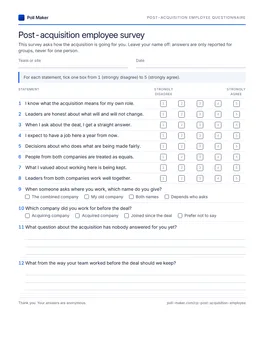
Post-acquisition questionnaire
Blanks for team and date, the twelve core items as tick boxes on the first sheet, then the day one, pay, cultures, staying and anniversary sets and About you.
Download PDF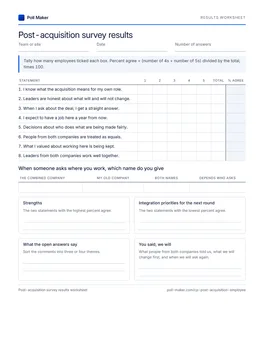
Integration tally sheet
Tally the name question and each of the eight core statements, turn the tallies into percent agreeing, and list the two lowest for action.
Download PDFMerger survey questions to rewrite before you send them
These four crop up on post-merger surveys again and again, and each gets an answer too vague to plan around. For more fixes like these, read the guide to wording survey questions.
Are you excited about the acquisition?
I know what the acquisition means for my own role.
It names the feeling leaders hope for. Worried people agree to be safe or skip it, and nobody learns what would help.
Do you feel informed and secure since the merger?
Leaders are honest about what will and will not change.
I expect to have a job here a year from now.
Being kept informed and feeling secure need different fixes, and one question cannot show which of the two is low.
How do you feel about the new culture?
Which best describes how the two companies are coming together? (Side by side ... Something new for both)
It assumes a single new culture already exists. Asking which way the companies are combining shows what people think is happening.
How would you rate the integration team?
Decisions about who does what are being made fairly.
Most employees never meet the integration team. They do feel its decisions, so ask about those.
Timing, anonymity and splits: merger survey FAQs
For HR partners and integration leads planning the first survey after a deal.
What questions should you ask employees after an acquisition?
Ask what the deal means for their role, whether leaders are honest about what changes and what stays, whether their questions get answered, whether they expect a job in a year, whether decisions are fair, and whether both companies are treated as equals. Add which company they came from, so every answer can be split, and two open questions.
When should you survey employees after a merger?
In the week the deal closes with a five-question pulse, then with the core at about 30 days, 90 days, six months and the first anniversary. Departures run highest in the first year,2 so the early rounds count most.
Should employees of the acquiring company take the survey too?
Yes. Their managers, systems and colleagues change too. Asking both sides the same questions is what makes the comparison by company possible, and it keeps the survey from feeling like a test of the people who were bought.
Should a post-acquisition survey be anonymous?
Yes. Use a link with no sign-in, keep paper copies in a sealed box, and break results out by team or side only where the group is too big for anyone to be spotted. The staying set in particular depends on people trusting that nobody can trace their answer.
How do you measure culture fit after a merger?
Measure how people experience the combination rather than scoring the gap between two cultures. A review of 46 studies covering 10,710 deals found that cultural differences affect integration, synergies and shareholder value in different and sometimes opposing ways.6 The two-cultures set asks which way the companies are coming together and which way people would choose; the gap between the two shows where friction will come from.
Get the first pulse out this week
Put both company names into question 10, tick the sets for your milestone, then share the link across the combined company. Print copies for the teams that are not on email yet.