Role clarity questionnaire for employees, with a results chart and printable copies
Role clarity means a person knows what their job is for, what comes first, what they may decide alone and how their work will be judged. These questions let each employee show you which of those is blurred for them. The core 12 is a four-minute survey.
- 34questions
- 12in the core set
- 4 minto answer the core
- 4research scales compared
By Michael Hodge, BSc Psychology Updated September 2026
All 34 role clarity questions
The core 12 is selected when the page loads. Four optional sets go deeper on goals, decision rights, clashing demands and the first months in a new job. Each row pairs a question with its response options and the signal it sends about the role.
The core 1212 questions
Nine statements on purpose, measures, priorities, decisions, boundaries and method, plus the three supports that keep a role clear. Then the part of the job people find least clear, and two questions in their own words.
-
I can say in one sentence what my role is for.
Strongly disagree12345Strongly agree1 = Strongly disagree, 5 = Strongly agreePurpose comes first. Someone who cannot put it into words tends to spend the week on whatever lands in the inbox.
-
I know how my manager will judge my work this year.
Strongly disagree12345Strongly agree1 = Strongly disagree, 5 = Strongly agreeThe measures behind the role. Research treats knowing your goals and knowing how to reach them as two separate kinds of clarity; this is the goal side.2
-
When tasks compete, I know which one comes first.
Strongly disagree12345Strongly agree1 = Strongly disagree, 5 = Strongly agreePriorities. A role can be clear on paper and still leave someone guessing every Monday morning.
-
I know which decisions I can make on my own.
Strongly disagree12345Strongly agree1 = Strongly disagree, 5 = Strongly agreeDecision rights. Uncertainty about authority is one of the classic signs of an unclear role, and it slows every approval.1
-
It is clear where my job ends and a teammate's begins.
Strongly disagree12345Strongly agree1 = Strongly disagree, 5 = Strongly agreeBoundaries. When this is low, work gets done twice or not at all, because each person assumes the other has it.10
-
I know the usual steps for the main tasks in my job.
Strongly disagree12345Strongly agree1 = Strongly disagree, 5 = Strongly agreeThe process side of clarity: knowing how the work gets done, not only what it is.2
-
My manager and I would describe my job the same way.
Strongly disagree12345Strongly agree1 = Strongly disagree, 5 = Strongly agreeChecks the role as sent against the role as received. A gap here explains a lot of the low scores above.
-
When my duties change, someone tells me what is new.
Strongly disagree12345Strongly agree1 = Strongly disagree, 5 = Strongly agreeRoles drift after every restructure, new hire or new tool. This shows whether anyone updates people when they do.
-
I hear often enough whether my work is on track.
Strongly disagree12345Strongly agree1 = Strongly disagree, 5 = Strongly agreeFeedback is how people find out a role has shifted. It goes with higher role clarity in the research.8
-
Which part of your role is least clear right now?
Goals and measuresPrioritiesDecision rightsWho does whatHow to do the workThe team names its own weak spot. Each option points back to one or two of the statements above.
-
Describe a recent task where you were unsure who owned it or how to do it.
Open answerOne real example beats a rating. It hands you a specific task, hand-off or decision to sort out.
-
What one change would make your role clearer?
Open answerAsks for one change, so the answers group into a short list of fixes rather than a wish list.
Goals and how work is judged5 questions
Reach for this set if statements 1 and 2 come back weak. It shows whether goals are missing, unwritten or out of reach.
-
I can find my current goals in writing.
Strongly disagree12345Strongly agree1 = Strongly disagree, 5 = Strongly agreeSpoken goals shift with every conversation. Written ones can be checked and argued about.
-
I know how my work feeds my team's goals this year.
Strongly disagree12345Strongly agree1 = Strongly disagree, 5 = Strongly agreeLinks the role to the team. People who see the link make better calls when priorities clash.
-
My targets measure things I can influence.
Strongly disagree12345Strongly agree1 = Strongly disagree, 5 = Strongly agreeA target outside a person's control is a source of stress, not clarity.
-
I know what excellent work looks like in my role.
Strongly disagree12345Strongly agree1 = Strongly disagree, 5 = Strongly agreeSeparates the minimum from the standard people are hoping for. Many roles only define the minimum.
-
My goals stay the same long enough to reach them.
Strongly disagree12345Strongly agree1 = Strongly disagree, 5 = Strongly agreeGoals that change every few weeks leave people clear on nothing for long.
Decision rights and hand-offs6 questions
For teams with a weak boundary score, or with comments about stalled approvals, duplicated work and tasks nobody picked up.
-
Each shared project has one named decision maker.
Strongly disagree12345Strongly agree1 = Strongly disagree, 5 = Strongly agreeShared projects without a single decider stall at every fork.
-
I know who to go to when a decision is above my level.
Strongly disagree12345Strongly agree1 = Strongly disagree, 5 = Strongly agreeThe escalation path. Without it, decisions wait for whoever happens to be in the room.
-
Work handed to me arrives with an owner and a deadline.
Strongly disagree12345Strongly agree1 = Strongly disagree, 5 = Strongly agreeHand-offs are where ownership most often goes missing between two people.
-
I rarely find two people doing the same task.
Strongly disagree12345Strongly agree1 = Strongly disagree, 5 = Strongly agreeDuplicated effort is the most visible cost of blurred boundaries.
-
When two teams both claim a task, or both avoid it, who settles it?
My managerTheir managerThe two of usA senior leaderNobody, it stallsOwnership disputes need a tie-breaker. Many "Nobody" answers mean the boundary work in the exercise below comes first.
-
Where does unclear ownership cost you time?
ApprovalsHand-offsShared requestsMeetingsCustomer issuesNone of theseTick all that applyShows where to draw the first line: the step that costs the most people the most time.
Conflicting demands4 questions
Role conflict is a separate problem from an unclear role: the job is clear, but its demands clash. Ask these when people describe being pulled two ways.
-
Two people ask me for things that cannot both be done.
Never12345Always1 = Never, 5 = AlwaysThe classic clash. Frequent answers here point to two managers or teams setting work without talking.5
-
I get work without the time or tools to finish it.
Never12345Always1 = Never, 5 = AlwaysA clash between the demand and the means. Often a planning fix rather than a people fix.
-
What one team wants from me clashes with another.
Never12345Always1 = Never, 5 = AlwaysCommon in shared services and matrix roles, where two groups each own part of one job.
-
When requests clash, I know who settles it.
Strongly disagree12345Strongly agree1 = Strongly disagree, 5 = Strongly agreeThe fix for most clashes is a named tie-breaker. This shows whether one exists.
New in the role4 questions
For people in their first few months, whether hired from outside or newly promoted. Send it around day 30 and again around day 90.
-
The job matches the one described when I said yes.
Strongly disagree12345Strongly agree1 = Strongly disagree, 5 = Strongly agreeA gap between the offer and the job is the fastest way to lose a new starter.
-
I know what I should achieve in my first 90 days.
Strongly disagree12345Strongly agree1 = Strongly disagree, 5 = Strongly agreeEarly goals give a newcomer something to aim at before the full picture arrives.
-
I know who to ask when I am unsure how things work here.
Strongly disagree12345Strongly agree1 = Strongly disagree, 5 = Strongly agreeAsking is how newcomers get clear. Research on new employees ties information seeking to higher role clarity.6
-
I have met the people whose work depends on mine.
Strongly disagree12345Strongly agree1 = Strongly disagree, 5 = Strongly agreeKnowing who relies on you makes the boundaries of the job concrete.
About you (optional)3 questions
Useful for comparing new and long-serving staff, or office and remote. Hide any group with fewer than five replies.
-
How long have you been in your current role?
Under 3 months3 to 12 months1 to 3 yearsOver 3 yearsPrefer not to sayClarity usually rises with time in a role. A long-serving group scoring low points to a structure problem.
-
Which best describes your level?
Individual contributorTeam leadManagerSenior leaderPrefer not to sayShows whether managers see their own roles as clearly as the people they lead.
-
Where do you do most of your work?
On siteHybridRemotePrefer not to sayRemote staff miss the overheard updates that keep a role current, so compare them with the office.
Role clarity scales used in research
Researchers usually measure role clarity through its opposite, role ambiguity: being unsure of your responsibilities, of what is expected of you and of the standard for success.5 Four published instruments come up again and again. Here is what each one covers, with a link to the source.
| Scale | What it measures | Size and format |
|---|---|---|
| Role Questionnaire, Rizzo, House and Lirtzman (1970)1 | Role ambiguity (scored in reverse for clarity) and role conflict, as two separate factors | 14 items: 6 ambiguity, 8 conflict |
| Goal and process clarity, Sawyer (1992)2 | Goal clarity (goals and responsibilities) and process clarity (how to reach them) | 10 items, 5 per part, rated for certainty |
| COPSOQ III, Burr and colleagues (2019)3 | Role clarity and role conflicts inside a wider workplace wellbeing survey | 3 role clarity items; tested with 23,361 employees in six countries |
| HSE Management Standards Indicator Tool4 | The UK Role standard: people understand their role, and demands on them are compatible | 35 items in total, rated from never to always12 |
The Role Questionnaire is the measure used most often in research on role stress.5 All four are published under copyright, so this page summarises them rather than reprinting their items. The core 12 statements are worded by us.
Scoring the core 12 for a report or thesis
Give each answer its number from 1 to 5 and take each person's mean of statements 1 to 9. To express it out of 100, subtract 1, divide by 4 and multiply by 100. Following Sawyer's split, you can also report a goal score (statements 1, 2 and 5) and a process score (statements 3, 4 and 6) side by side, with statements 7 to 9 as the supports that feed both.
| Score | One employee's answers | Result |
|---|---|---|
| Goal side | 5, 4, 2 | Mean 3.67 |
| Process side | 2, 3, 4 | Mean 3.00 |
| All nine | 5, 4, 2, 3, 2, 4, 4, 3, 4 | Mean 3.44, or 61 out of 100 |
This person knows what the job is for and how it will be judged, but scores 2 on priorities and 2 on the boundary with teammates. That calls for a weekly priority check and the boundary exercise further down this page, not a new job description.
One chart of where the role blurs
Type in the tallies for statements 1 to 9. The chart marks the two clearest and the two blurriest parts of the job, and it prints on one page for the team meeting.
- 1Every bar ends at the share of the team who agreed with that statement.
- 2Read the bars in groups: purpose and measures first, then priorities and decisions, then boundaries and method, then the three supports.
- 3Set the two lowest bars beside the vote on the least clear part of the role. Where they point the same way, begin there.
- 4Choose one role or one boundary to fix, run the team exercise below, and ask again in about three months.
Role clarity results
Catching unclear roles before they cost you
Unclear roles rarely announce themselves. They show up as duplicated work, stalled approvals and good people guessing. Four habits make the survey catch them early.

Probe the edges of the job
Most confusion lives where two roles meet, not in the middle of either one. The University of Minnesota's supervisor guide makes the point that the whole team needs to be clear on every member's role, not only their own; otherwise work may not get done because everyone assumes someone else is responsible.10 The core covers decision rights (statement 4) and boundaries (statement 5) for exactly this reason, and the decision rights set goes further.
How closely role clarity tracks outcomes for new employees
Clear roles go with better work
The payoff is well documented. A meta-analysis of 70 samples of new employees found that role clarity went with higher job satisfaction, commitment, performance and intention to stay.6 A second review found that role ambiguity has a clearer link with job performance (r = -.21) than role conflict does (r = -.07).7 Clarity is the lever to pull first.
Send it when roles move
Roles blur at predictable moments: a restructure, a merger of two teams, a new manager, a new system, a wave of hiring. Send the restructure five in the first fortnight, then the full core 12 about a month in, when people have met the new setup but have not yet built workarounds for it. Add the "New in the role" set for anyone in their first months, and repeat the core once or twice a year alongside your wider staff survey.
Pair the survey with feedback
Feedback is how people learn that a role has shifted. In a study of 170 employee and supervisor pairs, employees who saw a supportive feedback environment sought more feedback, reported higher role clarity and received higher performance ratings.8 Clarifying roles also pays at the level of whole offices: in a state agency with 45 offices, offices where roles were clarified more had higher work satisfaction and lower turnover.9
Short on time? Put the least clear part question to the team in a one-question poll during the next stand-up, then talk through the winning answer while everyone is still there. For stand-ups held on screen or in chat, this poll guide shows each way to share it.
Turn the results into a role everyone can describe
The survey shows where roles blur. This team exercise, adapted from the University of Minnesota's supervisor guide, redraws them in a single meeting.10

- Open with the results: the bottom two statements plus the vote on the least clear part of the role.
- Put up one sheet per person with their name on it. Everyone spends two or three minutes at each colleague's sheet, writing down what they believe that person's main responsibilities are.10
- Each person returns to their own sheet and corrects it in a second colour, so it shows the job they actually do.
- Go round the room: main responsibilities, what had to be corrected, and the hardest part of the role right now.
- Write each agreed role on one page: its purpose in a sentence, three to five outcomes with their measures, the decisions it owns, the decisions it recommends, and who it hands work to.
- Ask the core 12 again in about three months and compare the two lowest statements.
The guide suggests one to two hours for a group under ten, shortly after a major change. The corrections in step 3 are the valuable part: each one is a place where colleagues were working from a different picture of the job.
Right after a restructure: a five-question check
Teams change shape faster than job descriptions do. Send these five in the first two weeks after a reorganization, a merger of two teams or a new manager arriving, while people can still name what moved.
- 01When tasks compete, I know which one comes first.
- 02I know which decisions I can make on my own.
- 03It is clear where my job ends and a teammate's begins.
- 04When my duties change, someone tells me what is new.
- 05Which part of your role is least clear right now?
Role clarity questionnaire and results sheet as PDFs
Paper works for teams on the floor, in the field or on shifts. Pass the sheets round when a shift briefing opens and step outside while people answer; one team member collects them face down. Whether your office stocks letter paper or A4, the PDFs print cleanly.
Only need the core for one team? for the briefing.
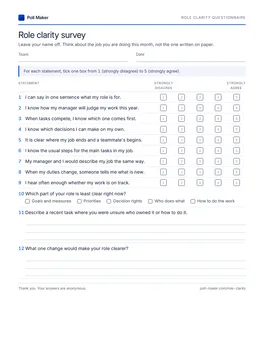
Role clarity questionnaire
Page one: the nine role statements, the least-clear vote and two write-in questions. After it: goals, decision rights, clashing demands and new starters.
Download PDF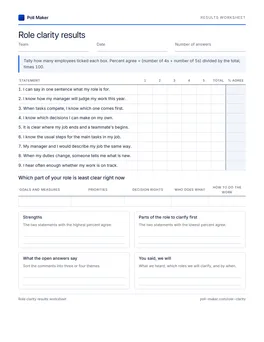
Role clarity results sheet
Count the paper answers for statements 1 to 9, turn each into a percentage who agreed, and tally the vote on the least clear part of the role.
Download PDFOne part of the role per question
Most weak role clarity items ask about clarity in general. Each fix below names one part of the role instead. The same habit, one thing per question, runs through our question-writing guide.
Are your roles and responsibilities clear?
I know which decisions I can make on my own.
It is clear where my job ends and a teammate's begins.
Roles and responsibilities bundles several things. Someone sure of their duties but unsure of their authority has to pick an answer that is half wrong.
Do you understand your job description?
My manager and I would describe my job the same way.
A job description can be perfectly understood and years out of date. The better version tests the job as it is done today.
How clear are your goals, from 1 to 10?
I know how my manager will judge my work this year.
Goals can feel clear to someone chasing the wrong ones. Asking how work will be judged checks the goal against the person who sets it.
Do you often feel confused at work?
Describe a recent task where you were unsure who owned it or how to do it.
Confused invites a mood rating. A real example names a task, a hand-off or a decision you can fix.
Role clarity questions managers ask
Quick answers for team leads and HR partners planning a first round.
What is role clarity?
Role clarity is how well a person understands what their job is for, what they are responsible for, how to do the work and how it will be judged. Researchers split it into goal clarity and process clarity.2 Its opposite, role ambiguity, is what most published scales measure.
How do you improve role clarity in the workplace?
Measure it, then fix the weakest part first. Write each role's outcomes and decision rights down, agree them with the manager and the team, and give feedback often. Research on role stress links lower ambiguity to feedback, a say in decisions and work people can see through from start to finish.5
How does role clarity relate to employee engagement?
Clear expectations are part of the base that engagement is built on. In Gallup's 2026 U.S. data, 49% of employees strongly agreed that they know what is expected of them at work, up two points on 2025.11 Studies of new employees also tie clearer roles to higher satisfaction and commitment.6
What is the difference between role ambiguity and role conflict?
Role ambiguity is missing information about the job. Role conflict is contradictory information, such as two people asking for things that cannot both be done.5 The two are measured separately, which is why the conflicting demands set sits apart from the core.
Should a role clarity survey be anonymous?
Yes for the team survey, so people can admit that they and their manager see the job differently. Keep names for the follow-up: the exercise and the one-page role summary only work when everyone can see whose role is being redrawn.
Make every role on the team easy to explain
Send the core 12 this week, then take the weakest two statements and the team vote into your next meeting.