Nurse satisfaction survey: staffing, teamwork and leaders on your unit
A good nurse survey asks about what nurses live with every shift: enough staff, leaders and physicians who listen, room to speak up, and a reason to stay. The twelve core items fit inside a short break; add a set when a unit needs more.
- 39questions
- 12in the core set
- 7Magnet areas
- 5 minto answer the core
By Michael Hodge, BSc Psychology Updated September 2026
Nursing survey questions by unit topic, 39 in all
Every row gives the exact wording, the answers nurses choose from, and what a nurse leader learns from the result. Add any set to the core with one tap, then take what you picked into the builder, onto paper, or into another survey tool as plain text.
The core 12: work on your unit12 questions
One overall satisfaction statement, eight statements spanning the seven Magnet satisfaction areas, a fix-first vote, an intent-to-stay item and a single open prompt. Sent alone, these twelve make a full nurse satisfaction survey.
-
Overall, I am satisfied with my job on this unit.
Strongly disagree12345Strongly agree1 = Strongly disagree, 5 = Strongly agreeThe headline number to track from round to round. The eight statements below explain what moves it.
-
On most shifts we have enough nurses to care for patients safely.
Strongly disagree12345Strongly agree1 = Strongly disagree, 5 = Strongly agreeStaffing, the area nurses rate lowest in work environment studies worldwide. Split it by shift before you read the total.5
-
I am proud of the care patients get on this unit.
Strongly disagree12345Strongly agree1 = Strongly disagree, 5 = Strongly agreeQuality of care as nurses see it from the bedside. Read a low score next to the missed-care question in the staffing set.
-
I can make the nursing decisions my license allows without waiting for permission.
Strongly disagree12345Strongly agree1 = Strongly disagree, 5 = Strongly agreeAutonomy. When it scores low, the open answers usually name the policy or the person in the way.
-
My nurse manager is easy to reach when I need help.
Strongly disagree12345Strongly agree1 = Strongly disagree, 5 = Strongly agreeAccess to leaders. Night and weekend nurses see the least of their manager, so read their answers separately.
-
Physicians here take it seriously when a nurse raises a concern about a patient.
Strongly disagree12345Strongly agree1 = Strongly disagree, 5 = Strongly agreeWorking relationships with physicians, asked about a moment every nurse can picture rather than "collaboration" in general.
-
When I fall behind, other nurses on my shift step in without being asked.
Strongly disagree12345Strongly agree1 = Strongly disagree, 5 = Strongly agreeNurse-to-nurse teamwork as something nurses watch happen, not a feeling about the team.
-
In the past year I have had real chances to grow my clinical skills.
Strongly disagree12345Strongly agree1 = Strongly disagree, 5 = Strongly agreeProfessional development. "Real chances" separates a course catalog from paid time to attend.
-
I can report an error or a near miss without fear of blame.
Strongly disagree12345Strongly agree1 = Strongly disagree, 5 = Strongly agreeSpeaking up about safety. When nurses fear blame, incident reports dry up and problems stay hidden.
-
If leaders could fix one thing first, what should it be?
StaffingSchedules and time offSupplies and equipmentSupport from leadersPay and benefitsThe vote that turns a survey into a to-do list. One pick per nurse gives a clear ranking, and it also works as a live poll at a staff meeting.
-
Where do you expect to be working a year from now?
On this unitAnother unit hereAnother employerLeaving nursingNot sureIntent to stay, split into its real options. A nurse moving to the next unit is still yours; one leaving nursing is not.
-
What one change would make your next shift better?
Open answerSmall and concrete on purpose. The answers are fixes a charge nurse or manager can make this month.
Staffing and your last shift5 questions
Questions about one real shift, which nurses recall more exactly than a typical week. Add them when the staffing statement scores low, or before a staffing request goes to finance.
-
On your last shift, how many patients were you assigned?
1 to 23 to 45 to 67 or moreNo patient assignmentThe patient load behind the staffing score. Among 10,184 hospital nurses, each extra patient per nurse went with 23% higher odds of burnout.1
-
On your last shift, what did you have to leave undone or rush for lack of time?
Talking with patientsPatient or family teachingCare plansMouth or skin careDocumentationNothingTick all that applyMissed care named task by task, which shows where short staffing reaches patients. "Nothing" is the answer you want to grow.
-
In the past month, how often did you stay past the end of your shift?
NeverOnce or twiceAbout once a weekMost shiftsUnplanned overtime. Set it beside the patient-load answer to see whether late finishes come from the load or from handoffs.
-
In the past month, how many times were you floated to another unit?
NeverOnce2 to 3 times4 or more timesFloating fixes one unit by stretching a nurse. High counts often explain low teamwork scores among the nurses who float.
-
The supplies and equipment I need are on hand.
Strongly disagree12345Strongly agree1 = Strongly disagree, 5 = Strongly agreeResources, the other half of the Magnet staffing area. Time spent hunting for a pump or a dressing is time away from patients.
Leadership and having a say4 questions
For shared governance councils and nurse leaders. These ask whether nurses can reach their leaders and change how the unit works.
-
My manager fixes what I raise or tells me why not.
Strongly disagree12345Strongly agree1 = Strongly disagree, 5 = Strongly agreeResponsiveness. Nurses accept a no with a reason; it is silence that drags this score down.
-
Nurses on this unit help decide how our practice changes.
Strongly disagree12345Strongly agree1 = Strongly disagree, 5 = Strongly agreeShared decision making: whether nurses shape the practice rules they work under, usually through a unit council.
-
Senior nurse leaders are regularly seen on this unit.
Strongly disagree12345Strongly agree1 = Strongly disagree, 5 = Strongly agreeVisibility of directors and the chief nursing officer. Compare day and night answers: rounding tends to happen in daylight.
-
Good work on this unit gets noticed and thanked.
Strongly disagree12345Strongly agree1 = Strongly disagree, 5 = Strongly agreeRecognition from peers and managers alike. The open answers show which one is missing.
Safety at work4 questions
Physical safety, reporting and handoffs. Keep this set anonymous, and publish its results only for groups too big to single anyone out.
-
I feel physically safe from patients and visitors at work.
Strongly disagree12345Strongly agree1 = Strongly disagree, 5 = Strongly agreeWorkplace violence is a retention issue as much as a security one. Split it by unit and shift, since the risk gathers in a few places.
-
I hear back after I report a safety problem.
Strongly disagree12345Strongly agree1 = Strongly disagree, 5 = Strongly agreeFeedback after a report. If reports disappear without a reply, nurses stop filing them.
-
Shift handoffs give me what I need to start my shift safely.
Strongly disagree12345Strongly agree1 = Strongly disagree, 5 = Strongly agreeHandoff quality. A low score points at the handoff format and timing before it points at people.
-
In the past 12 months, has a patient, visitor or coworker verbally abused or threatened you at work?
NoYes, onceYes, more than oncePrefer not to sayA count in a fixed window. If the yes answers are high, follow up with a separate harassment survey to learn who and where.
Growth and career3 questions
School, certification and a next step. Run it in the months before tuition and conference budgets are set.
-
I get support to earn a degree or certification.
Strongly disagree12345Strongly agree1 = Strongly disagree, 5 = Strongly agreeSupport for formal education, in money or in schedule. The open answers say which one is missing.
-
I can see a next step for my career here.
Strongly disagree12345Strongly agree1 = Strongly disagree, 5 = Strongly agreeCareer path. Read it with the question about next year: a nurse who sees no next step here is the one to talk to first.
-
Which of these would you most like to do in the next two years?
Earn a certificationGo back to schoolPrecept or teachMove into leadershipChange specialtyStay in my current roleTells educators what to plan for, and shows managers who wants to precept or lead before a post opens.
Your first year as a nurse4 questions
For nurses in their first year, asked at three, six and twelve months. Skip it for experienced staff.
-
Orientation got me ready for a full patient load.
Strongly disagree12345Strongly agree1 = Strongly disagree, 5 = Strongly agreeReadiness for a full load. Ask it when orientation ends and again at six months.
-
My preceptor had time to teach me on shift.
Strongly disagree12345Strongly agree1 = Strongly disagree, 5 = Strongly agreePreceptors usually carry patients of their own, so a low score here is a staffing question as much as a teaching one.
-
After hours, I know who to call about a patient.
Strongly disagree12345Strongly agree1 = Strongly disagree, 5 = Strongly agreeBackup when the unit is thin. Compare new nurses on nights with those on days.
-
What do you wish someone had told you in your first month on this unit?
Open answerGives the next orientation group its missing piece, in a new nurse's own words.
Thinking about staying3 questions
Retention questions for units with turnover to explain. Answers are only honest when nurses trust that nobody can trace them.
-
If you left this job, what would be the main reasons? Pick up to three.
Staffing or workloadPayScheduleMy managerExhaustionCareer moveFamily or relocationTick all that applyThe top two reasons across the unit show where retention money should go first.
-
How often do you finish a shift too worn out to enjoy your time off?
NeverRarelySometimesOftenAlwaysA plain-language check on exhaustion that nurses answer in seconds. Track the share answering often or always.
-
How likely are you to recommend this unit to a nurse friend as a place to work?
0123456789100 = Not at all likely, 10 = Extremely likelyA recommend score for the unit as an employer: the share answering 9 or 10 minus the share answering 0 to 6.
About you4 questions
Only for splitting results. Keep the bands broad, and show a breakdown only if at least five nurses sit in it.
-
What is your role?
Staff RNCharge RNLPN or LVNAdvanced practice RNOther nursing roleCharge nurses make the staffing calls, so read their answers apart from staff nurses'.
-
How long have you worked as a nurse?
Under 1 year1 to 2 years3 to 5 years6 to 10 yearsOver 10 yearsEarly-career nurses and veterans often want different things; this shows which group a problem belongs to.
-
Which shift do you usually work?
DaysEveningsNightsRotatingThe split that matters most on a 24-hour unit. The worked example on this page shows why.
-
What is your employment status?
Full timePart timePer diemAgency or travelAgency and per diem nurses see the unit from outside. Include them, then read their answers separately.
The seven Magnet satisfaction areas, question by question
Hospitals on the Magnet journey report nurse satisfaction in seven areas, using a vendor survey with national benchmarks.6,7 The core 12 covers all seven in original wording, so any unit can check where it stands in the months between those rounds.
| Magnet area | What nurses judge | Core statement | Go deeper with |
|---|---|---|---|
| Adequacy of resources and staffing | Enough nurses and supplies to give safe care | On most shifts we have enough nurses to care for patients safely. | Staffing set |
| Fundamentals of quality nursing care | Whether the care meets their own standard | I am proud of the care patients get on this unit. | Safety set |
| Autonomy | Freedom to act on their clinical judgment | I can make the nursing decisions my license allows without waiting for permission. | Leadership set |
| Leadership access and responsiveness | Reaching leaders and seeing concerns acted on | My nurse manager is easy to reach when I need help. | Leadership set |
| Interprofessional relationships | How physicians and other disciplines treat nursing input | Physicians here take it seriously when a nurse raises a concern about a patient. | Safety set (handoffs) |
| RN-to-RN teamwork and collaboration | Nurses backing each other up on a shift | When I fall behind, other nurses on my shift step in without being asked. | Staffing set |
| Professional development | Learning, certification and a next step | In the past year I have had real chances to grow my clinical skills. | Growth set |
These areas are worth watching. In a four-state study of 26,276 nurses in 567 hospitals, nurses at Magnet hospitals were 18% less likely to be dissatisfied with their job and 13% less likely to be highly burned out, and their work environments were measurably better.2
For the Magnet application itself, the vendor survey is given in full, as written.6 Use this set for unit check-ins, for units outside the application, and for teams that want to hear from nurses now. Magnet is a registered trademark of the American Nurses Credentialing Center; Poll Maker is not affiliated with ANCC.
Surveying a unit that never closes
Nurses work around the clock, so the survey has to as well. Four practices get answers from every shift and keep nurses answering next round.

Keep it open across a full rotation
A survey open for three weekdays mostly hears from day shift. Keep it open for two to three weeks so every rotation, weekend and per diem nurse gets a turn, and put it where nurses already are: a QR code at the time clock, a link in the unit group chat, and paper copies with a slotted box in the break room. Announce it at the night huddle as well as the day one.
How hospital nurses rate their work environment, by area
Give staffing its own questions
Staffing is where nurse surveys find the most to fix. Across published studies from 38 countries using the Practice Environment Scale, staffing and resource adequacy was the lowest-rated area on every continent, at 2.47 on a 1 to 4 scale.5 It also tracks the outcomes managers care about: among 10,184 hospital nurses, each additional patient per nurse went with 23% higher odds of burnout and 15% higher odds of job dissatisfaction.1 The staffing set asks about one real shift, so a manager walks into the staffing meeting with counts.

Post the results at huddle within a month
Pin the fix-first result and the weakest two statements to the unit board, name the change and the date it starts, then run the huddle five a month later to see whether it moved. The payoff is real: in a meta-analysis covering 165,024 nurses in 22 countries, better work environments went with about 29% lower odds of poor job outcomes for nurses and 35% lower odds of poor safety or quality ratings.4
Protect small groups
On a unit of 20 nurses, "nights, agency, under a year" can describe one person. Show a breakdown only if at least five nurses fall in it, merge smaller groups, and have someone outside the unit's management collect the paper copies. Say all of this in the invitation, because nurses decide how honest to be before they read the first question.
At the next staff meeting, turn the fix-first vote into a live staff poll: nurses answer from their phones and the ranking fills in while you talk. Our how-to for making a poll explains sending one to a Teams channel or a WhatsApp group, and closing it on a set date.
One sheet for the huddle board: strengths and focus areas
Key in how many nurses gave each rating on the nine statements. The report shows the spread on every statement, tags two strengths and the two areas to work on first, and fits on one printed sheet for the huddle board.
- 1Statement by statement, work out what share of the nurses who answered chose agree or strongly agree. Track that share from round to round.
- 2Look at the two lowest statements, then at the fix-first vote. When both point at staffing, add the staffing set next round.
- 3Split the staffing and manager statements by shift before drawing conclusions, as in the worked example below.
- 4Share the two focus areas and one change at huddle, then rerun the huddle five a month later.
Unit results
Worked example: reading one unit by shift
Unit totals can hide a shift in trouble. Here are 58 answers from an example 32-bed medical-surgical unit, split into day and night.
| Core statement | Day shift (34 nurses) | Night shift (24 nurses) | Whole unit (58) |
|---|---|---|---|
| Enough nurses to care for patients safely | 15 agree (44%) | 5 agree (21%) | 20 agree (34%) |
| Nurse manager easy to reach | 23 agree (68%) | 7 agree (29%) | 30 agree (52%) |
| Other nurses step in without being asked | 27 agree (79%) | 20 agree (83%) | 47 agree (81%) |
| Can report an error without fear of blame | 21 agree (62%) | 14 agree (58%) | 35 agree (60%) |
Read as one number, access to the manager looks middling. Split by shift, it is two different units: most day nurses can reach their manager and fewer than a third of night nurses can. The fix is practical, a named night contact and a manager who joins the night huddle once a month, and the next pulse shows whether it worked.
Teamwork is strong on both shifts, and nights edge ahead. Say so at huddle: nurses hear plenty about what is wrong, and naming what works keeps it going. Staffing is weak everywhere and weakest at night, so bring the patient-load and missed-care answers from the same nurses to the staffing meeting. Counts from one real shift carry more weight there than a rating alone.
A break-room questionnaire and a tally sheet
Printed forms left by the time clock, with a slotted box beside them, reach nurses who rarely open work email. Both files print on US letter and on A4.
Print only the sets your unit plans to use this round.
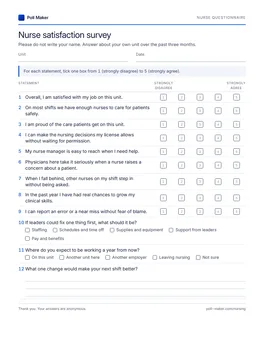
Nurse questionnaire
Nurses tick pencil boxes for the core 12 on the opening sheet. Optional sets print on the sheets behind it, so a unit prints only what it plans to use.
Download PDF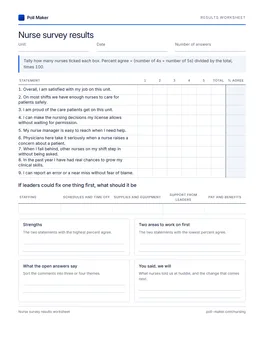
Unit tally sheet
Tally the nine statements, convert each one to a share agreeing, count fix-first votes and name two focus areas.
Download PDFPulse questions for the monthly huddle
In the months between full rounds, these five follow staffing, access to the manager, teamwork and speaking up, and gather one fix each time. Nurses answer them on a phone in under two minutes.
- 01On most shifts we have enough nurses to care for patients safely.
- 02My nurse manager is easy to reach when I need help.
- 03When I fall behind, other nurses on my shift step in without being asked.
- 04I can report an error or a near miss without fear of blame.
- 05What one change would make your next shift better?
Asking about a shift, not a feeling
Weak nurse survey items ask about a feeling in general instead of a moment on shift. The survey questions hub sets out the rules behind these fixes, with more weak and better examples.
Are you satisfied with staffing and scheduling?
On most shifts we have enough nurses to care for patients safely.
In the past month, how often did you stay past the end of your shift?
Two topics in one, and "satisfied" invites a shrug. Split them and ask about shifts nurses actually worked.
Do you feel supported?
When I fall behind, other nurses on my shift step in without being asked.
My nurse manager is easy to reach when I need help.
Supported by whom? Name the source of support and what it looks like, then a low score names who to talk to.
How would you rate your relationship with physicians?
Physicians here take it seriously when a nurse raises a concern about a patient.
A relationship is broad and personal. A concern about a patient is a moment every nurse has had, and the answer points at practice.
Do you plan to stay with us?
Where do you expect to be working a year from now?
A yes or no lumps a nurse moving to the next unit together with one leaving nursing. Separate options show who you can still keep.
For a capstone, EBP project or nursing thesis
Nursing students often need a questionnaire for a capstone, an evidence-based practice project or a thesis. Three choices decide how much the results can show.
Name the population and count the sample
Decide whose views you are measuring, such as RNs on three medical-surgical units, and invite every nurse on those units rather than whoever is on shift the day you visit. Record how many you invited and how many answered, and report both numbers.
Open with a consent statement
A line such as "Answering is up to you, and nobody will know which answers are yours. Leave blank anything you prefer not to answer, and stop whenever you like." Leave out names and employee numbers, and check what your school and the hospital review board require before anything goes out.
Choose original items or a published scale
Every question here is free to use and adapt. If your project needs a validated measure, the Practice Environment Scale of the Nursing Work Index scores the nurse work environment in five subscales.3 It is endorsed as a US national quality indicator and has been used in published studies from 38 countries, so your results can sit beside a large body of research.5 For new graduates, the Casey-Fink Graduate Nurse Experience Survey is a published option. Cite the authors and check the terms of use for either scale; neither scale's items appear on this page. For patients, clinics and communities, browse the other healthcare survey questions.
Nurse survey questions from managers and educators
Short answers for nurse managers, educators and nursing students.
What questions should be on a nurse satisfaction survey?
Cover the seven areas nurses judge a job on: staffing and resources, quality of care, autonomy, access to leaders, working with physicians, teamwork with other nurses, and professional development. Round it off with overall satisfaction, where they expect to work next year, the fix they want first and an open prompt. That is exactly how the core 12 above is built.
What is the Magnet nurse satisfaction survey?
Hospitals seeking Magnet recognition from the American Nurses Credentialing Center report RN satisfaction from a vendor survey with national benchmarks, organized in seven categories.6,7 The questions here follow the same seven areas in original wording, for unit check-ins between those rounds.
How often should you survey nurses?
Once a year for the whole set, and monthly or quarterly for the huddle five. Work environment surveys in hospitals are typically repeated every one or two years.5 Pick a rhythm you can act on: nurses who see nothing change between rounds stop answering.
Should a nurse survey be anonymous?
Yes. Leave names off, use broad bands for role, shift and experience, and hide any breakdown with fewer than five nurses in it. Paper copies should go into a slotted box collected by someone outside the unit's line management.
What is a general survey in nursing?
In nursing school, the general survey is the start of a patient assessment: the nurse's first overall observations of how a patient looks, moves, speaks and behaves, gathered from the moment the nurse enters the room.8 It is a clinical skill, not a questionnaire. This page covers the other kind of nursing survey, the one nurses answer about their work.
Can I use these questions in a clinic or long-term care?
Yes. Swap "physicians" for "providers" where it fits and drop the floating question if nobody floats. In senior living, pair it with the assisted living resident survey so staff and resident views sit side by side.
Ask your nurses this month
Your nurses can answer the twelve core items online, on a phone at break, or on printed forms left by the time clock.