Orientation feedback questions for new employees, with written examples
Ask new starters these questions as orientation ends to find out whether they left knowing their job, their people and the rules that apply to them. The core 12 fits in four minutes at the end of the day, a one-month set shows what stuck, and the written examples help anyone putting their own orientation feedback into words.
- 34questions
- 12for the end of orientation
- 7for one month later
- 4 minto answer the core
By Michael Hodge, BSc Psychology Updated September 2026
All 34 orientation feedback questions
Answer options are printed under every item, followed by why it earns its place. The end-of-orientation 12 starts selected; tick extra sets as needed, and the builder, the print view and the copy button all use your selection.
The end-of-orientation 1212 questions
Eight statements on the job, the people, the rules and how new starters feel about joining, one question on the amount of information, one on what helped most and two open questions. Hand it out in the last session.
-
I know what my job involves in my first few weeks.
Strongly disagree12345Strongly agree1 = Strongly disagree, 5 = Strongly agreeRole clarity, the first sign that a newcomer is settling in well. A low score means orientation stayed general.4
-
I know who to ask when I have a question about my work.
Strongly disagree12345Strongly agree1 = Strongly disagree, 5 = Strongly agreeShows whether new starters leave with names, not just an org chart. It predicts how fast they stop getting stuck.
-
Orientation made the goals of this organization clear.
Strongly disagree12345Strongly agree1 = Strongly disagree, 5 = Strongly agreeGoals and values are what orientation teaches best, so this should be one of your highest scores.3
-
I know the policies and safety rules for my role.
Strongly disagree12345Strongly agree1 = Strongly disagree, 5 = Strongly agreeThe compliance check. Ask it here so any gap is closed before someone needs the rule.
-
I got to meet people I will be working with.
Strongly disagree12345Strongly agree1 = Strongly disagree, 5 = Strongly agreeMeeting colleagues is a core job of orientation. A low score points at the agenda, not the new starter.3
-
I feel ready to start doing my job.
Strongly disagree12345Strongly agree1 = Strongly disagree, 5 = Strongly agreeConfidence to do the work. New starters who feel ready adjust faster and stay longer.4
-
Orientation was worth the hours it took.
Strongly disagree12345Strongly agree1 = Strongly disagree, 5 = Strongly agreeA plain value check. Read it next to the amount-of-information question to see whether the problem is length or content.
-
I feel good about my decision to join this organization.
Strongly disagree12345Strongly agree1 = Strongly disagree, 5 = Strongly agreeEarly commitment. Orientation attendees score higher on it, so a dip here is worth a conversation.3
-
The amount of information in orientation was:
Far too littleA little too littleAbout rightA little too muchFar too muchTells you which way to adjust. An average hides the split, so look at both ends.
-
Which part of orientation helped you most?
My teamMy roleGoals and valuesPay and policiesSystemsThe tourNames the session to protect when the agenda gets squeezed.
-
What question do you still have that orientation did not answer?
Open answerEach answer is something HR can reply to this week, and a gap to fill in the next agenda.
-
What is one thing we should change for the next group of new starters?
Open answerOne change, not a list. Sort the answers into themes and the top two become next month's edits.
Sessions and presenters4 questions
Add these when orientation runs over a full day or more, with several speakers, and you want to know which parts to keep.
-
Presenters explained jargon and acronyms clearly.
Strongly disagree12345Strongly agree1 = Strongly disagree, 5 = Strongly agreeJargon is the first thing that loses a new starter. This catches it by session.
-
There was enough time in each session to ask questions.
Strongly disagree12345Strongly agree1 = Strongly disagree, 5 = Strongly agreeA low score usually means sessions overran and the question time was cut.
-
Which formats worked well for you?
Talks from leadersSmall-group activitiesHands-on system practiceThe workplace tourQ and A panelVideosReading on my ownTick all that applyShows how to rebuild the agenda: fewer of the formats nobody ticks, more of the ones most people do.
-
Which session would you shorten or drop, and why?
Open answerGives the organizer permission to cut. New starters are specific when asked this directly.
Before and on day one5 questions
The practical side of starting: arrival, equipment, paperwork and pay. Add these when orientation happens on the first day, or when new starters mention it in the open answers.
-
Before day one, I knew where and when to arrive.
Strongly disagree12345Strongly agree1 = Strongly disagree, 5 = Strongly agreeTests the welcome message sent before the start date. It is the cheapest fix on the page.
-
My laptop, logins and desk were ready on arrival.
Strongly disagree12345Strongly agree1 = Strongly disagree, 5 = Strongly agreeMissing equipment costs a new starter their first days. A low score goes to IT and facilities, not HR.
-
Someone was ready to greet me when I arrived.
Strongly disagree12345Strongly agree1 = Strongly disagree, 5 = Strongly agreeA warm first hour sets the tone for the whole first week.2
-
New starter paperwork was easy to complete.
Strongly disagree12345Strongly agree1 = Strongly disagree, 5 = Strongly agreeForms and sign-offs. Low scores point to duplicated forms or unclear instructions.
-
I know how pay, leave and benefits work here.
Strongly disagree12345Strongly agree1 = Strongly disagree, 5 = Strongly agreeThe admin questions new starters are often shy to ask. Answer them in writing if this scores low.
Online and remote orientation4 questions
For orientation delivered over video, or for new starters who will work from home most of the time.
-
The video sessions ran without technical problems.
Strongly disagree12345Strongly agree1 = Strongly disagree, 5 = Strongly agreeSeparates a content problem from a connection problem before you rewrite anything.
-
I had time to talk with other new starters, not only listen.
Strongly disagree12345Strongly agree1 = Strongly disagree, 5 = Strongly agreeOnline sessions drift into broadcasts. This shows whether people actually met.
-
I know which tools my team uses to talk day to day.
Strongly disagree12345Strongly agree1 = Strongly disagree, 5 = Strongly agreeRemote starters need to know where conversations happen: chat, email or meetings.
-
How would you like orientation to run for the next group?
Fully in personMostly in personHalf and halfMostly onlineFully onlineFace-to-face sessions have given new starters a better grasp of the job and the company, so check what your people prefer.2
One month later7 questions
Send these around day 30, when new starters can judge whether orientation prepared them for the real job. The same link can go out again at 90 days.
-
What I learned in orientation has helped me in my job.
Strongly disagree12345Strongly agree1 = Strongly disagree, 5 = Strongly agreeThe transfer question: did the day turn into useful know-how once the work started?
-
My manager meets with me regularly.
Strongly disagree12345Strongly agree1 = Strongly disagree, 5 = Strongly agreeAt Cornell, new staff whose managers met with them regularly were far more likely to picture staying.1
-
My manager has explained how my work connects to the organization's goals.
Strongly disagree12345Strongly agree1 = Strongly disagree, 5 = Strongly agreeCarries the goals message from orientation into the team, where it sticks.1
-
I feel accepted by the people I work with.
Strongly disagree12345Strongly agree1 = Strongly disagree, 5 = Strongly agreeSocial acceptance, the third sign of a well-adjusted newcomer.4
-
The job matches what I was told before I accepted the offer.
Strongly disagree12345Strongly agree1 = Strongly disagree, 5 = Strongly agreeA low score points back to the job ad and the interviews, not to orientation.
-
Two years from now, where do you expect to be?
Here, in the same roleHere, in a different roleNot sure yetWorking somewhere elseThe question Cornell uses to link orientation with staying. Compare it across orientation groups.1
-
What do you know now that you wish orientation had told you?
Open answerThe best source of new agenda items. Answers are concrete after a month in the job.
About you (optional)2 questions
Add these for comparing intakes or teams. Edit both lists to fit your organization, and never report on a team so small its members stand out.
-
Where do you do most of your work?
On siteHybrid, on site and remoteFully remoteShows whether remote and hybrid starters get the same orientation as everyone else.1
-
Which area do you work in?
Operations or productionSales or customer serviceOffice or administrationTechnical or specialistManagementPrefer not to sayEdit the list to match your teams. Useful when one orientation serves very different roles.
Orientation feedback examples
Looking for words for your own feedback on an orientation program? These are the kinds of comments new starters write, sorted by type. Borrow them, or use them to see what a useful answer looks like.
Positive feedback on an orientation program
- "Meeting my team on the first morning meant I knew exactly who to ask by lunchtime."
- "The session on how my role supports our customers made the job click for me."
- "Having my laptop and logins ready on day one let me start real work on day two."
- "The Q and A with the managers was the most useful hour of the week. Please keep it."
- "Every session ended with time for questions, so nothing ran over and nobody felt rushed."
Constructive feedback that is easy to act on
- "Benefits and payroll came in one long talk. A short handout I could keep would help."
- "I would move the systems training to my first week in the team, when I actually need it."
- "Day two was mostly slides. A small-group task in the afternoon would break it up."
- "By Friday I still did not know who my buddy was. An introduction on day one would fix that."
Feedback about the presenters
- "The HR team explained every acronym, which made a big difference for someone new to the industry."
- "Hearing the director explain why the company exists was the highlight of the week."
How to write your own
Name the part you mean, say what it let you do, and suggest one change. "The workplace tour helped me find my way on day one, and adding the second building would help" is feedback an organizer can use tomorrow. Questions 11 and 12 in the set above invite exactly this kind of answer, and the feedback survey questions collection has sets for other sessions and events.
Making the next intake better than this one
Four habits turn a feedback form into a better orientation for the next group.

Collect it before people leave the room
The final session is the one moment when every new starter is in the same place with a few minutes free. Add a scan code that opens the survey to your closing slide, or pass round the printed form, and allow five minutes. Ask about the orientation itself while it is fresh; questions about the job can wait for the follow-up.
New Cornell staff who pictured themselves still there in two years
Show leaders what orientation is worth
Cornell University surveyed more than 800 new staff. Of those who had a formal orientation plan and an effective orientation, 93% pictured themselves still at Cornell two years later, against 58% of those who did not have them.1 Corning Glass Works found that new employees who attended a structured orientation were 69 percent more likely to stay up to three years.2 Question 8 and the two-year question in the one-month set let you watch the same link in your own organization.

Send the follow-up around day 30
Some answers only exist after a few weeks in the job: whether orientation helped with the work, whether the manager checks in, whether the job matches the offer. Cornell sends its new hire survey 60 to 90 days after the start date.1 The seven one-month questions fit the 30-day mark, and the same link can go out again at 90 days. Once people have settled in, move on to wider employee survey questions.

Get day one right first
Bauer's report puts the first day above every other: greet the new starter in person, have the desk and laptop working, take them to lunch.2 The five day-one questions check each of those, and they are the quickest fixes on the list. At Texas Instruments, new employees who went through an improved onboarding program were fully productive two months sooner.2
Curious how the day landed before the forms go round? Show question 9 to the group as a live poll, and new starters vote from their phones: too much, too little or about right. First time running one? Our poll set-up guide covers every step.
See the whole intake's answers on one page
Type in how many new starters chose each number. The chart ranks the eight statements, shows where the group agrees and where it splits, and names the two to work on before the next orientation.
- 1Enter the counts for each number. The chart turns them into percent agree: the Agree plus Strongly agree answers as a share of everyone in the intake who replied.
- 2Sort the statements by the four Cs. A weak connection score needs a buddy or a team lunch; a weak compliance score needs a clearer policy session.
- 3Read the answers to question 11 before anything else: every unanswered question is something HR can reply to by email this week.
- 4Open the next orientation by telling the new group one change that came from the last group's answers.
Orientation group results
Check all four Cs of onboarding
Talya Bauer's onboarding report for the SHRM Foundation describes four levels a good start covers: compliance, clarification, culture and connection.2 The questions on this page check each one, and each row below names the usual fix when a score comes back low.
| Area | What it covers | Questions that check it | If it scores low |
|---|---|---|---|
| Compliance | Rules, safety, pay and paperwork | 4, 20, 21 | Give a one-page summary to keep, and cover safety in the first session |
| Clarification | The job and what good work looks like | 1, 6, 30 | Book a manager meeting in week one with a written 30-day plan |
| Culture | Goals, values and how things get done | 3, 8, 28 | Bring in a leader to explain why the organization exists, not just its structure |
| Connection | The people and who to ask | 2, 5, 29 | Assign a buddy before day one and book a team lunch in the first week |
Judging the whole program rather than one intake, with goals, delivery and outcomes? The program evaluation questions are built for that job.
The last ten minutes of orientation
Only have a few minutes after the final session? These five check the job, the people, readiness and the amount of information, and leave room for the question nobody answered.
- 01I know what my job involves in my first few weeks.
- 02I know who to ask when I have a question about my work.
- 03I feel ready to start doing my job.
- 04The amount of information in orientation was:
- 05What question do you still have that orientation did not answer?
A form to hand out with five minutes to go
Paper suits the last session of an orientation: hand it out with five minutes to go and gather the forms in a box by the exit. The forms fit A4 and US letter sheets.
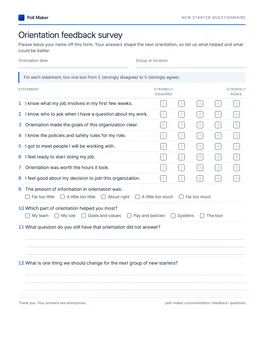
New starter questionnaire
The end-of-orientation 12 on page one, ready for a pen. The session, day-one, remote and one-month sets come after it.
Download PDF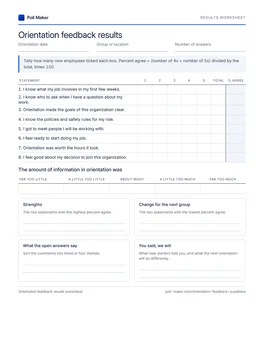
Results worksheet
Count the ticks for each of the eight statements, work out percent agree by hand, and write down the one change the next intake will see.
Download PDFQuestions that rate the lunch instead of the orientation
Three questions that often turn up on orientation forms, and sharper versions. Our survey questions hub explains each question type with examples.
Did you enjoy orientation?
I know what my job involves in my first few weeks.
Enjoyment rates the lunch and the icebreakers. The better version asks whether orientation did what it is for.
Were the presenters and materials clear and useful?
Presenters explained jargon and acronyms clearly.
Which formats worked well for you?
Two things in one question. Split it, and a low score tells you whether to fix the speakers or the slides.
How great was the welcome from your new team?
I got to meet people I will be working with.
"How great" nudges people toward a polite answer. A neutral statement about something that did or did not happen gets an honest one.
Orientation feedback: common questions
Short answers for HR teams and anyone writing feedback on an orientation.
What should I write in feedback for an orientation program?
Name the session or part you mean, say what it let you do, and suggest one change. "Meeting my team on day one meant I knew who to ask" tells an organizer far more than "great orientation". The orientation feedback examples above show positive and constructive versions.
What questions should you ask after new employee orientation?
Ask whether new starters now understand their job, know who to ask, know the rules that apply to them, feel ready to start and feel good about joining. Add how much information there was, what helped most and what they still want to know. That is the end-of-orientation 12.
When should you send an orientation feedback survey?
Twice. Hand out the core 12 in the last session while the day is fresh, then send the one-month set around day 30. Cornell University sends its new hire survey 60 to 90 days after the start date.1
Can I use these questions for a new student orientation?
Yes, with small edits. Change "job" to "course", "manager" to "adviser" and "team" to "classmates", and swap the paperwork statement for one about enrolment and student ID cards. The sessions and one-month sets work for students almost as written.
Should orientation feedback be anonymous?
Yes. New starters want to make a good first impression, so a named form gets polite answers. Leave the name field off, and when an intake is small, combine two or three intakes before you report.
Send it after your next orientation
Have the end-of-orientation 12 ready as a link on the final slide, and a pile of paper forms by the door for those who prefer a pen.