A work-life balance questionnaire that asks in both directions
A good work-life balance questionnaire checks both directions: whether work leaves room for the rest of life, and whether life leaves room for work. The core 12 asks both, plus flexibility and support, in about four minutes. Send it to a team, or answer it yourself and score your lowest pair.
- 35questions
- 12in the core set
- 4 minfor the core
- 5areas, scored in pairs
By Michael Hodge, BSc Psychology Updated September 2026
Core statements first, then the follow-ups they raise
Ticked from the start: the core 12. Each optional set answers a follow-up the core raises, and the note under every question says what a low score points to.
The core 1212 questions
Ten statements in five pairs (time, energy, home into work, flexibility and support), one overall question and one open change. It works on its own.
-
My hours leave enough time for life outside work.
Strongly disagree12345Strongly agree1 = Strongly disagree, 5 = Strongly agreeThe time side of work reaching into home. A low score here usually shows up again in the weekend and leave questions.
-
I rarely miss things I care about because of work.
Strongly disagree12345Strongly agree1 = Strongly disagree, 5 = Strongly agreeAsks about the cost, not the clock. Two people on the same hours can miss very different amounts.
-
Most days I finish work with energy to spare.
Strongly disagree12345Strongly agree1 = Strongly disagree, 5 = Strongly agreeStrain travels home even on normal-length days. This is the energy side of work reaching into home.
-
I can put work out of my mind after hours.
Strongly disagree12345Strongly agree1 = Strongly disagree, 5 = Strongly agreeMental switch-off. Evenings spent replaying the day are not rest, whatever the timesheet says.
-
Things outside work rarely get in the way of my job.
Strongly disagree12345Strongly agree1 = Strongly disagree, 5 = Strongly agreeThe other direction: home into work. Caring duties, health and family events show up here first.2
-
Personal worries rarely follow me into work.
Strongly disagree12345Strongly agree1 = Strongly disagree, 5 = Strongly agreeThe strain side of home into work. Read it with the caring set before you treat it as a work problem.
-
I can change when or where I work if I need to.
Strongly disagree12345Strongly agree1 = Strongly disagree, 5 = Strongly agreeFlexibility that is open to this person in practice, not what the policy promises. Compare it with the flexible working set.
-
I can take an hour or two off for personal matters.
Strongly disagree12345Strongly agree1 = Strongly disagree, 5 = Strongly agreeSmall, informal flexibility. In the CIPD Good Work Index 2025, 70% of UK workers said they could.3
-
My manager respects my life outside work.
Strongly disagree12345Strongly agree1 = Strongly disagree, 5 = Strongly agreeSupport aimed at life outside work. It goes with lower conflict more closely than general manager support.1
-
Flexible working is not held against anyone here.
Strongly disagree12345Strongly agree1 = Strongly disagree, 5 = Strongly agreeThe culture question. If using flexibility costs careers, people stop using it, whatever the policy offers.1
-
Overall, how well do work and the rest of your life fit together?
Very wellWellNot very wellNot at all wellThe headline number to track from round to round. Add the two "not" answers together for the share out of balance.
-
What one change would give you a better balance?
Open answerOne change keeps the answers concrete, and gives you a list of fixes in the words staff use.
Hours, leave and time off5 questions
Add these when questions 1 and 2 score low. They count hours, weekend work and the leave people really take.
-
How many hours did you work last week, counting work at home?
Under 3030 to 3940 to 4445 to 4950 or moreLast week is easier to recall than a typical week. Set the bands beside the answers to question 1.
-
How many of your last four weekends included some work?
NoneOneTwoThreeAll fourWeekend work is countable and memorable, and it lands on family and social time.
-
How much of last year's paid leave did you take?
All of itMostAbout halfUnder halfNoneUnused leave is balance given away. A team pattern here points at cover, not at the people.
-
What makes it hard to take time off?
WorkloadNo coverGuiltTimingCostNothingTick all that applyNames the barrier. Workload and cover need a staffing fix; guilt needs managers who take their own leave.
-
I can take leave at times that suit my life.
Strongly disagree12345Strongly agree1 = Strongly disagree, 5 = Strongly agreeChoice over timing matters as much as the number of days, for parents in school holidays above all.
Flexible working4 questions
Having an option and using it are different things. These four ask what is on offer, what people used and what they would take up.
-
Which of these have you used in the last 12 months?
Flexi-timeHome workingCompressed hoursPart timeTerm timeNoneTick all that applyUse, not availability. The national figures below give you something to set your totals against.3
-
Which would you use if they were offered?
Four-day weekCompressed hoursFlexi-timeHome workingPart timeNoneTick all that applyUnmet demand. Nationally, a four-day week was the most wanted option.3
-
I know which flexible options I can ask for.
Strongly disagree12345Strongly agree1 = Strongly disagree, 5 = Strongly agreeNobody uses an option they have never heard of. A low score is a communication fix.
-
In the last year, did you ask to change your hours or place of work?
Yes, agreedYes, partlyYes, refusedNoRefusals and partial answers show where requests stall. Report the counts, never who asked.
After-hours contact3 questions
For teams where question 4 scores low or the open answers mention messages at night.
-
Are you expected to reply to messages outside your hours?
NeverEmergencies onlySometimesUsuallySeparates the rule from the habit. Many replies happen because people assume they must.
-
On a normal evening, how often do you check work messages?
Not at allOnceA few timesMany timesThe habit side. High checking with low expectation is a gap a team agreement can close.
-
My team agrees on when messages can wait.
Strongly disagree12345Strongly agree1 = Strongly disagree, 5 = Strongly agreeA shared rule is easier to keep than a private one. Low scores suggest the team never set one.
Caring responsibilities4 questions
For workplaces with parents and carers. Answers here can point to individuals in a small team, so show this set only as organisation-wide totals.
-
Do you look after anyone outside work?
Young childrenOlder childrenAn older relativeSomeone ill or disabledNo oneTick all that applyLets you compare carers with everyone else on the ten core statements.
-
I can fit caring duties around my working hours.
Strongly disagree12345Strongly agree1 = Strongly disagree, 5 = Strongly agreeThe daily juggle. Low here but high on question 7 means flexibility exists but does not fit the caring pattern.
-
Last month, did caring make you late, leave early or miss work?
NoOnce2 or 3 timesMore oftenHome into work, counted. Useful next to absence records, without asking anyone to explain.
-
I know what leave I can take in a family emergency.
Strongly disagree12345Strongly agree1 = Strongly disagree, 5 = Strongly agreeEmergency leave rules tend to stay unclear until the day someone needs them.
What work gives and takes4 questions
Balance is not only conflict. These four ask what each side takes from the other, and what it gives back.
-
What gets squeezed first when work runs over?
SleepExerciseFamily timeFriendsHobbiesChoresNothingTick all that applyShows where the cost lands. Sleep and family time are the answers to act on first.
-
My job gives me skills that help me at home.
Strongly disagree12345Strongly agree1 = Strongly disagree, 5 = Strongly agreeWork into home can be good too: skills and confidence travel home. A high score is worth protecting.
-
What I do outside work makes me better at my job.
Strongly disagree12345Strongly agree1 = Strongly disagree, 5 = Strongly agreeThe positive side of home into work: interests, family and rest that feed the job.
-
Has your balance made you think about leaving this job?
NoNow and thenYes, seriouslyTies balance to retention without asking anyone to name a plan.
About you (optional)3 questions
Use these only to compare groups. Cut any that could single out one person in a small team.
-
Where do you do most of your work?
On siteHybridRemotePrefer not to sayPlace changes the problem: commute time for some, blurred evenings for others.
-
When do you usually work?
Regular daysShifts or rotaIt variesPrefer not to sayShift and rota staff answer the flexibility questions from a different starting point, so compare them separately.
-
Is managing a team part of your job?
YesNoPrefer not to sayInformal flexibility is easier for managers to get than for other staff. This shows whether that holds here.3
Which way is the pressure running?
Conflict between work and life runs both ways, and each way has a time side and an energy side. The core pairs map onto them, so the lowest pair tells you what kind of fix to try.
| Pair | What it looks like | Core questions |
|---|---|---|
| Work into home: time | Long or unpredictable hours crowd out plans, family and rest | 1 and 2 |
| Work into home: energy | Tiredness and worry come home, even after a normal day | 3 and 4 |
| Home into work | Caring, health or family events pull time and focus from the job | 5 and 6 |
| Flexibility | Room to change when and where the work gets done | 7 and 8 |
| Support | A manager and a culture that accept life outside work | 9 and 10 |
Published measures keep the two directions apart as separate scales,4 and a meta-analysis of flexible working found that the direction changes the result.2 In practice, a team that scores low on questions 1 and 2 needs a fix to hours and planning. Low scores on 5 and 6 point to cover, leave rules and the caring set.
When the time pair is low right across a team, the employee workload survey digs into deadlines, fair shares and the causes of overload.
The team balance report, lowest pairs first
Key in how many people gave each answer to the ten core statements. Agreeing always means better balance here, so the rows with the smallest agree share mark the pairs to work on.
- 1Every row is one statement, with the percent who agreed or strongly agreed at its right-hand end.
- 2Read the bars in pairs: 1 and 2 (time), 3 and 4 (energy), 5 and 6 (home into work), 7 and 8 (flexibility), 9 and 10 (support).
- 3The lowest pair is your focus. Look at the matching optional set before you settle on a fix.
- 4Tell the team which pair came out lowest and the fix you plan. Repeat the core three months later.
Work-life balance results
Four choices that make the answers useful
What you ask decides what you can fix. These four come straight out of the research on balance at work.

Ask it in both directions
Most balance surveys only ask how work spills into home. The published scales measure the reverse as well, as a separate score,4 and the direction matters: a meta-analysis of flexible working found different results depending on which way the conflict ran.2 Questions 5 and 6 cover the home side. A low score there calls for cover and leave rules, not shorter hours.
Link with lower work-to-family conflict, by kind of support (mean correlation)
Ask about support for life outside work
Support in general and support for life outside work are different things. Across 115 samples and 72,507 employees, a manager who backs people's lives outside work went with lower work-to-family conflict more closely (a correlation of -0.25) than general manager support did (-0.15). An organisation that accepts family and personal needs showed the strongest link of all, at -0.36.1 That is why questions 9 and 10 name life outside work instead of asking whether people feel supported.

Separate having flexibility from using it
A policy helps only the people who feel free to use it. The Allen meta-analysis found that using flexibility and having it available relate to conflict differently, and that the effects were small on their own.2 The CIPD found both sides of the story: 80% of UK workers with a formal flexible arrangement said it improved their quality of life, yet job sharing and term-time working were not available to most staff.3 Question 7 asks what is open to each person; the flexible working set asks what they used and what they would take up.
Compare the people with the least room to move
Flexibility is not spread evenly. Taking an hour or two off at short notice was easier for managers than for other staff, and easier for men than for women.3 Split your results by working pattern and role (questions 33 to 35), hand the paper form to shift staff, and publish results for a group only once it has plenty of replies.
Starting a team meeting? Put the overall fit question on screen and run a live poll while everyone is in the room. For a lighter weekly opener, the work question of the day list has plenty more, and our poll sharing guide covers chats and video calls.
Score your own balance in five minutes
Answering for yourself rather than a team? The ten core statements work as a personal self-check, scored in pairs.
- Score each statement: 5 if you strongly agree, 4 agree, 3 neutral, 2 disagree, 1 strongly disagree.
- Add up each pair: time (1 and 2), energy (3 and 4), home into work (5 and 6), flexibility (7 and 8) and support (9 and 10). Every pair lands between 2 and 10.
- Start with your lowest pair. If two pairs tie, pick the one you can change soonest.
| Pair total | Reads as | Next step |
|---|---|---|
| 8 to 10 | Mostly agree: this area works for you | Protect it |
| 6 or 7 | Mixed | Look again in a month |
| 2 to 5 | Mostly disagree | Start here |
A worked example
Say your pairs come out as time 4, energy 5, home into work 9, flexibility 8 and support 7. Life at home is not the pressure point, and flexibility is there. Work is taking the evenings. So the useful next step is the hours and weekend questions in the first optional set, then a conversation about which evening work could stop or move.
If the energy pair stays low for weeks, raise it with your manager or HR, or talk it through with your doctor.
Every three months: the balance pulse
Send these five every three months between full rounds. Time, energy, flexibility, the manager and the overall fit: enough to spot a slide while it is still easy to fix.
- 01My hours leave enough time for life outside work.
- 02Most days I finish work with energy to spare.
- 03I can change when or where I work if I need to.
- 04My manager respects my life outside work.
- 05Overall, how well do work and the rest of your life fit together?
How UK employees answered similar questions
The CIPD Good Work Index 2025 surveyed 4,951 UK workers.3 Three of its findings line up with questions on this page, so you can set your own results beside them.
| Question here | National figure (CIPD 2025) |
|---|---|
| 8: an hour or two off for personal matters | 70% felt able to take it |
| 18: flexible options used in the last 12 months | Home working 50%, flexi-time 38% |
| 19: options people would use if offered | Four-day week 45%, compressed hours 25%, flexi-time 20% |
Among people who had a formal flexible arrangement, 80% said it had improved their quality of life. The same survey found informal time off easier to get for managers than for other staff, and for men than for women.3 Question 35 lets you check the manager gap in your own workplace.
A worked example
Forty people answer question 8, and 22 agree or strongly agree. That is 55%, fifteen points under the national 70%, so short-notice time off is harder to get here than for the typical UK worker.3 The wording differs a little from the CIPD question, so treat a difference of two or three points as a tie, but fifteen points is a real place to start.
Standard work-life balance scales for a thesis
Writing a dissertation that has to compare with earlier studies? These published scales are the ones most often cited. Use them word for word, exactly as their authors wrote them, and check the permissions first.
| Scale | What it measures | Format |
|---|---|---|
| Work-Life Balance Self-assessment Scale (Hayman) | Work into personal life, personal life into work, and how each one feeds the other | 15 items, 7 points from not at all to all the time6 |
| Work-family and family-work conflict (Netemeyer and colleagues) | Conflict in each direction, as two short scales4 | 5 items each, answered on a 7-step agreement scale and summed to 5 to 359 |
| Multidimensional work-family conflict (Carlson and colleagues) | Time, strain and behaviour conflict in both directions | 18 items on a 5-point agree scale5 |
| Work-life balance (Brough and colleagues) | One overall judgement of balance | 4 items, tested with 6,983 workers in Australia and New Zealand7 |
| Family Supportive Supervisor Behaviors (Hammer and colleagues) | Emotional and practical help, role modelling and creative planning by the supervisor | 14 items8, with a 4-item short form10 |
Our core 12 is built for workplaces that want to act on their results rather than match published norms. It follows the same map, though: two directions, time and energy, then flexibility and support.
Shift and site staff: the work-life balance evaluation form
Some staff will never open a survey link on a work laptop. Print the form for them, give it out at a briefing or with payslips, and key the paper answers into the same totals.
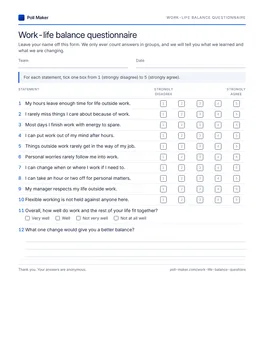
Work-life balance questionnaire
Every answer on sheet one is a pencil checkbox covering the core 12, with the optional sets printed on the sheets behind it.
Download PDF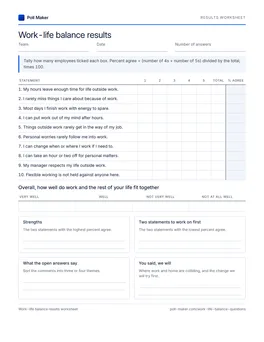
Balance results worksheet
Paper answers go here: tallies for the ten statements, their agreement rates, and a count for the overall fit question.
Download PDFBalance questions that go wrong, and better wording
All four weak versions appear on real work-life balance question lists. Our survey question writing tips cover the same traps for every question type.
Do you have a good work-life balance?
Overall, how well do work and the rest of your life fit together? (Very well, Well, Not very well, Not at all well)
Yes or no hides how far out of balance people are. Four graded answers measure the distance from balance and can be tracked round by round.
How often does work interfere with your personal life, and vice versa?
My hours leave enough time for life outside work.
Things outside work rarely get in the way of my job.
Two directions in one question. Someone squeezed by caring and someone squeezed by overtime give the same answer for opposite reasons.
Does the company offer enough flexibility?
I can change when or where I work if I need to.
Which of these have you used in the last 12 months?
The weak version asks staff to judge a policy. The better pair asks what is open to them and what they actually used.
Do you feel supported?
My manager respects my life outside work.
Support in general is the weaker signal. Support aimed at life outside work is the kind that goes with lower conflict.
Balance survey questions from HR and managers
Short answers for the people planning the survey, and for anyone taking it alone.
How do you measure work-life balance?
Ask about both directions (work into home and home into work), the time and energy each one takes, flexibility and support, then add one overall fit question. The core 12 does exactly that. Your own records of leave taken, weekend work and flexible working requests fill in the rest.
What is a standard questionnaire on work-life balance?
For research, the most cited are Hayman's 15-item self-assessment scale, the Netemeyer work-family and family-work conflict scales and Carlson's 18-item measure. The scales table above says what each one measures. For a workplace survey you plan to act on, the core 12 is shorter, and every item points at a fix.
Can I take this as a work-life balance quiz?
Yes. Answer the ten core statements for yourself, add them up in pairs and start with your lowest pair. The scoring steps and a worked example are in the self-score section.
Should a work-life balance survey be anonymous?
Yes. These questions touch family, health and caring, and people answer them frankly only when nothing can be traced back. Collect no names, ask as few About you questions as you can, and show the caring set only as totals for the whole organisation.
How often should we run it?
Yearly for all 35, and quarterly for the five-question pulse. Whenever the rules on hours, leave or flexible working change, repeat the core a few months on to check the change worked.
Find out where work and life collide
Send the core 12 to your team this week, print the evaluation form for shift and site staff, or answer it yourself and start with your lowest pair.