Anonymous harassment survey questions, plus a training quiz with answers
Employees answer the anonymous core 12 in about four minutes: what actually happens at work, and whether they would feel able to report it. After training, eight knowledge-check questions test what people took in, with every answer explained further down.
- 38questions
- 12in the anonymous core
- 4 minto answer the core
- 8quiz questions with answers
By Michael Hodge, BSc Psychology Updated September 2026
All 38 workplace harassment questions
We have pre-selected the anonymous core 12 for you. Add the report, training, knowledge-check, bullying or about-you set, or tick single questions. Every item shows its answer choices and why it is on the list.
The core 12: anonymous climate check12 questions
A behaviour checklist, what people saw and what they did about it, seven statements on reporting and respect, plus two questions answered in their own words. One anonymous link goes to everyone.
-
In the last 12 months, has anyone at work done any of these to you?
Slurs or identity jokesRemarks on my bodyLewd texts or imagesUnwanted touchingRepeated advancesThreatsNone of theseTick all that applyCounts behaviours, not the word "harassment". Many people never put that label on what happened to them, so a list of specific acts finds far more cases.1
-
In the last 12 months, have you seen any of these happen to a colleague?
Yes, more than onceYes, onceNoNot sureWitness answers show how visible the problem is, and they come from people with less at stake in answering.
-
If any of these happened to you, what did you do?
Formal reportTold a managerTold a colleagueTold no oneNot applicableSet this against the checklist to see your reporting gap. Most people who experience harassment never raise it with a supervisor.1
-
I know how to report harassment here.
Strongly disagree12345Strongly agree1 = Strongly disagree, 5 = Strongly agreeAwareness of the channel. A low score is a communication problem you can fix within weeks.
-
Reporting would not harm my career here.
Strongly disagree12345Strongly agree1 = Strongly disagree, 5 = Strongly agreeFear of retaliation is one of the main reasons people stay quiet. Expect this to be one of your lowest statements.1
-
A report would be kept confidential here.
Strongly disagree12345Strongly agree1 = Strongly disagree, 5 = Strongly agreeTrust in confidentiality. When it is low, concerns stay informal or are never voiced at all.
-
Managers act quickly on concerns raised.
Strongly disagree12345Strongly agree1 = Strongly disagree, 5 = Strongly agreeThe first response is what employees watch. Compare it with the After a report set.
-
My team speaks up when a remark goes too far.
Strongly disagree12345Strongly agree1 = Strongly disagree, 5 = Strongly agreeA bystander norm: whether coworkers step in, not only whether targets report.
-
Everyone here is treated with respect.
Strongly disagree12345Strongly agree1 = Strongly disagree, 5 = Strongly agreeThe broad climate statement. Split it by site or department to find where respect breaks down.
-
I feel safe from harassment by customers.
Strongly disagree12345Strongly agree1 = Strongly disagree, 5 = Strongly agreeSwap in clients, patients or visitors as fits. Third parties are a common blind spot, and the law counts non-employees as possible harassers.3
-
If you had a concern, what would make you more likely to speak up about it?
Open answerYour improvement list for the reporting system, written by the people who would have to use it.
-
What is one change that would make this a more respectful place to work?
Open answerOne change keeps answers concrete. Group them into themes and act on the largest.
After a report (only if you reported something)5 questions
For employees who reported an incident in the last two years. Put a yes or no question in front of this set so everyone else skips it.
-
Who did you report it to first?
HRMy managerAnother managerHotline or web formUnion or staff repShows which door people actually use, so you know which channel to train and staff first.
-
After you reported, were you treated worse by anyone at work?
NoYes, a littleYes, a lotNot sureRetaliation check. The EEOC task force cites a study in which 75% of employees who spoke out about mistreatment faced some form of it.1
-
The person I told took my concern seriously.
Strongly disagree12345Strongly agree1 = Strongly disagree, 5 = Strongly agreeThe first reaction shapes whether someone ever reports again, and whether they tell colleagues to.
-
I was kept up to date on what happened next.
Strongly disagree12345Strongly agree1 = Strongly disagree, 5 = Strongly agreeSilence after a report reads as inaction, even when an investigation is running.
-
Overall, my report was handled well.
Strongly disagree12345Strongly agree1 = Strongly disagree, 5 = Strongly agreeOne outcome number for the whole process. Read it with the two statements above it to see which step let people down.
Training and policy4 questions
Add these when you are deciding what the next round of training should cover.
-
When did you last take harassment prevention training here?
In the last year1 to 2 years agoOver 2 years agoNeverCoverage. Split the climate statements by this answer before you credit or blame the training.
-
Training taught me what to do as a bystander.
Strongly disagree12345Strongly agree1 = Strongly disagree, 5 = Strongly agreeAsks about the bystander skill, the part of training people most often say was missing.
-
I can find our harassment policy quickly.
Strongly disagree12345Strongly agree1 = Strongly disagree, 5 = Strongly agreeA policy nobody can find does little. This is quick to fix with one link on the intranet home page.
-
What should the next training session cover?
Open answerTopics people ask for are the ones they will pay attention to.
Bullying and incivility5 questions
Not all mistreatment is tied to a protected trait. Add these when the open answers describe shouting, exclusion or put-downs.
-
In the last 6 months, how often has someone at work shouted at you?
NeverOnce or twiceAbout monthlyWeekly or moreA plain behaviour count. Weekly answers on any bullying item deserve a closer look by team.
-
How often have you been left out of meetings or messages you needed?
NeverOnce or twiceAbout monthlyWeekly or moreExclusion is quieter than shouting and often goes unreported for longer.
-
How often has someone belittled your work in front of others?
NeverOnce or twiceAbout monthlyWeekly or morePublic put-downs are the incivility colleagues see, so they also shape the bystander norm.
-
How often has a colleague held back information you needed to do your job?
NeverOnce or twiceAbout monthlyWeekly or moreWork-related bullying that looks like a process problem until you ask about it.
-
Our disagreements stay about work, not people.
Strongly disagree12345Strongly agree1 = Strongly disagree, 5 = Strongly agreeThe positive side of the same picture, and a good statement to track by team.
About you (optional)4 questions
Add these when you plan to compare sites, roles or tenure. Leave out any split where a group is small enough to identify someone.
-
How long have you worked here?
Under 1 year1 to 3 years4 to 10 yearsOver 10 yearsPrefer not to sayNew starters often have not yet learned how to raise a concern.
-
Which best describes your role?
Staff memberTeam lead or supervisorManager or abovePrefer not to sayShows whether managers see a different workplace from the people they manage.
-
Where do you mostly work?
On siteHybridRemotePrefer not to sayRemote staff meet harassment in chat and on calls, which some policies still overlook.
-
How do you describe your gender?
WomanManIn another wayPrefer not to sayHarassment rates often differ by gender. Split results this way only when every group is large.
Knowledge check after training (answers below)8 questions
Keep these out of the anonymous survey: they test what people learned. Each why line starts with the correct answer, and the answer key further down gives the reason.
-
Can a single offensive joke be illegal harassment on its own?
Yes, every timeOnly if it is extremely seriousNo, neverAnswer: only if it is extremely serious. Isolated incidents rarely meet the legal bar, but one joke can still break your policy.3
-
Who can harass an employee at work?
Only a managerManagers and coworkers onlyAnyone, including customersAnswer: anyone. A supervisor, a coworker or a non-employee such as a client can be the harasser.3
-
Does harassment law apply to video calls and work chat?
Yes, remote work countsNo, only the workplaceOnly during office hoursAnswer: yes. Harassment can happen in virtual work settings as well as in person.2
-
Who can be the target of sexual harassment?
Only womenAnyone, whatever their sexOnly junior staffAnswer: anyone, whatever their sex. Sexual harassment also does not have to involve sexual desire.2
-
You report harassment, and the next week your shifts are cut. What is that?
A normal rota changeRetaliation, also illegalFine if the report failsAnswer: retaliation. Punishing someone for complaining is prohibited separately from the harassment itself.3
-
You and your manager clash over deadlines. Is that harassment under the law?
Yes, alwaysNot on its ownOnly if it is in writingAnswer: not on its own. A personality conflict is covered only when it is based on a protected trait such as race, sex or age.2
-
Must someone lose pay or their job before harassment is illegal?
YesNoAnswer: no. A hostile work environment can be unlawful with no loss of pay, hours or job.3
-
A coworker's comments make you uncomfortable. What is a good first step?
Say nothing and waitSay it is unwelcome, or report itWarn others on social mediaAnswer: tell the person it is unwelcome if you feel able to, or report it to your employer.2
Answer key for the knowledge check
The eight quiz questions with the correct answer and the reason. Answers follow US federal law as the EEOC explains it to employees; add your own policy's rule wherever it goes further.
| Question | Answer | Why |
|---|---|---|
| 1. One offensive joke | Only if extremely serious | "Petty slights, annoyances, and isolated incidents (unless extremely serious)" fall below the legal bar.3 Your policy can still forbid them. |
| 2. Who can harass | Anyone | A supervisor, a coworker, an agent of the employer or a non-employee.3 |
| 3. Video calls and chat | Yes | Unlawful harassment can happen in physical or virtual work settings.2 |
| 4. Target of sexual harassment | Anyone | Any person can be targeted, and the conduct need not involve desire.2 |
| 5. Shifts cut after a report | Retaliation | The laws bar retaliation against people who complain or take part in an investigation.3 |
| 6. Clash with a manager | Not on its own | Personality conflicts are covered only when based on a protected characteristic.2 |
| 7. Loss of pay or job | Not needed | Unlawful harassment can occur without economic injury or dismissal.3 |
| 8. First step | Say so, or report it | Tell the person the behaviour is unwelcome, or report it to your employer.2 |
Running it as a quiz
Hand it out or share the link at the end of the session, then walk through this table with the group. The questions most people miss tell you what the next session should repeat. Unlike the climate survey, a knowledge check can carry names if you need a training record.
The legal test in one sentence
Conduct becomes a hostile work environment when it is "so severe or so frequent that a reasonable person in your position would find the situation to be abusive."2 It is also unlawful when putting up with it becomes a condition of keeping the job.3
Where trust in reporting is weakest
Type in how many employees picked each point for c4 to c10. Agreement is the healthy answer on all seven, so the shortest bars show where trust in the system is weakest.
- 1For each statement, take the Agree plus Strongly agree count and divide it by the total number of answers. That share is the bar on the chart.
- 2Look first at knowing how to report (c4) and not fearing the fallout (c5). If one is high and the other low, the channel is known but not trusted.
- 3Set the checklist (c1) beside what people did (c3). Anyone who ticked an act but told only a colleague, or no one, is a case management never heard about.
- 4Group the written answers by theme before the leadership meeting, and bring two changes with owners and dates rather than a list of findings.
Harassment climate results
Whether staff believe it is safe to answer
The questions matter less than whether staff believe it is safe to answer them. Four decisions settle that.
Women reporting sexual harassment at work, by how the question was asked
Ask what happened, not whether it was harassment
The label hides most of the problem. In the surveys the EEOC task force reviewed, about 25% of women said they had been sexually harassed when the term was left undefined. When the same kind of survey asked about specific behaviours, such as unwanted sexual attention, the figure rose to about 60%.1 That is why the core opens with a checklist of acts and only uses the word harassment in the statements about reporting.
Make it safe to answer
Send one anonymous link to everyone, collect no names or emails, and let as few people as possible see raw answers. Say plainly in the introduction that the survey cannot start an investigation, and list the channels that can, so nobody mistakes an open answer for a formal report.

Measure the silence as well as the incidents
Most harassment never reaches anyone who could act on it. The task force found that roughly three out of four people who experienced harassment never talked to a supervisor, manager or union representative, and only 6% to 13% filed a formal complaint. The reasons it lists are fear of disbelief, inaction, blame and retaliation.1 Questions c3 to c7 put a number on each of those fears.

Act on the lowest scores, then run it again
What you change matters. A study of 805 companies over 32 years found that training managers to spot and step in on trouble was followed by more women in management, while grievance procedures, which surveys link to retaliation, were followed by fewer.4 The EEOC task force suggests repeating a climate survey once prevention work is in place, to check that change has happened and is holding.1 Share the results, name two changes, then repeat the core 12 twelve months on.
Teaching the session in a room or on a call? Turn one knowledge-check question into a live poll, let everyone vote, then reveal the answer from the key. Our walkthrough on making a poll shows how people join from a phone.
Between full rounds, track these five
Between full surveys, these five track what is happening, whether it gets reported, whether people fear the fallout, how managers respond and what would help.
- 01In the last 12 months, has anyone at work done any of these to you?
- 02If any of these happened to you, what did you do?
- 03Reporting would not harm my career here.
- 04Managers act quickly on concerns raised.
- 05If you had a concern, what would make you more likely to speak up about it?
Validated harassment and bullying scales for research
Looking for a workplace harassment scale questionnaire to download for a thesis? Two published instruments come up most often. Both belong to their authors and are not reproduced here.
| Scale | What it measures | Format |
|---|---|---|
| NAQ-R | Exposure to bullying at work: work-related, personal and physically intimidating acts | 22 items, Never to Daily5 |
| SEQ-DoD-s | Sexual harassment: sexist hostility, sexual hostility, unwanted sexual attention and coercion | 16 items, Never to Very often6 |
Getting permission
The Bergen Bullying Research Group says the Negative Acts Questionnaire is free to use for non-commercial research and asks researchers to contact them first.7 For the shortened Sexual Experiences Questionnaire, start from the paper by Stark and colleagues, which sets out the 16-item form and how it was tested.6
When this set fits better
Both scales count what happened to someone. Neither asks whether people know how to report, trust the process or saw retaliation, which is what an employer needs to act on. For a workplace check, use the core 12 here; for a study that must compare with published results, use a validated scale.
A sealed box in the break room for a week
Staff on the shop floor, in the warehouse or on the road may never open a work email. Leave printed forms and a sealed box in the break room for a week. Letter and A4 paper both work.
The knowledge check prints last. Leave those sheets out of a climate round.
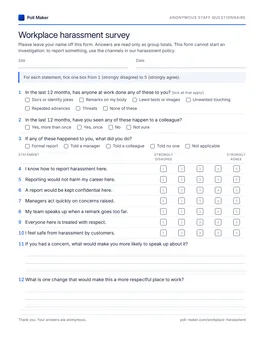
Staff questionnaire
The anonymous core 12 on the first sheet, with boxes to tick in pen, and the optional sets on the sheets after it. The knowledge check prints last, so it is easy to leave out of a climate round.
Download PDF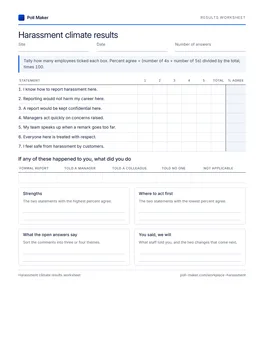
Tally and results sheet
Count the paper forms by hand, turn the seven statements into shares who agree, and write down the two places to act first.
Download PDFWeak harassment questions and what to ask instead
Wording decides what a sensitive survey finds. Our survey question examples cover every other question type.
Have you ever been sexually harassed at work?
In the last 12 months, has anyone at work done any of these to you? (a list of specific acts)
People who experienced the acts often do not use the label, so the direct question undercounts. A time window also stops old incidents from blurring this year's picture.
Do you feel safe and respected at work, and do you know how to report problems?
Everyone here is treated with respect.
I know how to report harassment here.
Three questions in one. Someone who feels respected but has no idea how to report cannot answer honestly.
Do you agree that our zero-tolerance policy keeps everyone safe?
Reporting would not harm my career here.
The weak version names the answer it hopes for. The better one asks about the fear that stops people from reporting.
Questions HR raises before sending it
Quick answers on the law, anonymity and what to do with what comes back.
What counts as harassment at work?
Under US federal law, harassment is unwelcome conduct based on race, color, religion, sex (including sexual orientation, transgender status or pregnancy), national origin, age 40 or older, disability or genetic information. It becomes unlawful when enduring it is a condition of the job, or when it is severe or pervasive enough to create a hostile environment.3 Most company policies also ban bullying that is not tied to any of these traits.
Should a workplace harassment survey be anonymous?
Yes, for the climate questions. Use one link for everyone, no login and no names, and never publish a breakdown small enough to point at one person. The knowledge check is different: it can carry names if you need proof of training.
What if someone describes an incident in an open answer?
Plan for it before launch. The introduction should say the survey cannot trigger an investigation and should list the reporting channels. If an answer describes a serious or ongoing incident, handle it under your policy for concerns raised anonymously, and repeat the reporting channels when you share the results.
How often should we run a harassment survey?
Once a year with the full set, and again a few months after a major change such as new training or a new reporting line. In between, the five-question pulse gives you a quick reading.
Do the answers in the knowledge check apply outside the US?
The survey questions work anywhere. The answer key follows US federal law, so in other countries swap in your local legal test and the wording of your own policy before you use the quiz.
Send the core 12 to your team
Open the anonymous core as an online survey, or print it for staff without a work email. More <a href="/Employee-Survey-Questions">employee survey questions</a> cover pay, workload and managers.