Questions to ask assisted living residents and the families who visit them
An assisted living survey asks residents how quickly help comes, how they are treated, and what they think of the meals, the activities, their safety and their say in daily life. Start with the resident core 12, add the activity questions, and send the family set to each resident's main contact.
- 38questions
- 12in the resident core
- 8for family members
- 5for memory care interviews
By Michael Hodge, BSc Psychology Updated September 2026
The 38 assisted living survey questions
All twelve resident core questions are selected to begin with. Add the activity, care or memory care sets for residents, and send the family set as a survey of its own. Beneath each question sit the choices residents pick from and why the answer matters.
The resident core 1212 questions
Ten statements on help, care, meals, activities, choice, safety, cleaning and complaints, one question on joining in, and one open question. Residents can answer them on paper, online or aloud with a volunteer.
-
When I ask for help, it comes in good time.
Strongly disagree12345Strongly agree1 = Strongly disagree, 5 = Strongly agreeResponse time as residents feel it. Read it beside the night call question in the care set to see whether nights are the problem.
-
The aides and nurses are kind and patient with me.
Strongly disagree12345Strongly agree1 = Strongly disagree, 5 = Strongly agreeHow care is given, not only whether it is done. Where it scores low, look in the open answers for the shift or task residents mention.
-
I get the help I need to bathe, dress and get around.
Strongly disagree12345Strongly agree1 = Strongly disagree, 5 = Strongly agreeThe daily help assisted living exists to give. A low answer points at a care plan to review, not at a general apology.
-
I enjoy the meals here.
Strongly disagree12345Strongly agree1 = Strongly disagree, 5 = Strongly agreeFood is one of the lowest scoring areas in Minnesota's statewide resident results, so expect a short bar and a long list of comments.7
-
I can find an activity here that suits me most days.
Strongly disagree12345Strongly agree1 = Strongly disagree, 5 = Strongly agreeAsks about fit, not the size of the calendar. A packed calendar of things residents do not want still scores low here.
-
I choose when I get up, eat and go to bed.
Strongly disagree12345Strongly agree1 = Strongly disagree, 5 = Strongly agreeDaily choice is what makes assisted living feel like home. Where it scores low, look first at fixed meal, bath and medicine rounds.
-
I feel safe in my room and around the building.
Strongly disagree12345Strongly agree1 = Strongly disagree, 5 = Strongly agreeFalls, strangers and night-time worries in one statement. Follow up every low answer in person, the same week.
-
My room and the shared spaces are kept clean.
Strongly disagree12345Strongly agree1 = Strongly disagree, 5 = Strongly agreeHousekeeping in residents' own words. Split it by wing or floor before you change a cleaning rota.
-
If I raise a problem here, it gets sorted out.
Strongly disagree12345Strongly agree1 = Strongly disagree, 5 = Strongly agreeWhether concerns lead anywhere. A low score here means other problems may be going unreported, so read it first.
-
I would recommend living here to a friend.
Strongly disagree12345Strongly agree1 = Strongly disagree, 5 = Strongly agreeAn overall verdict to set beside the specific statements. High here with low food and activity scores means loyal residents who still want change.
-
How often do you join in the activities here?
Most daysA few times a weekAbout once a weekRarelyNeverTaking part, next to enjoying it. Residents who answer rarely or never are the people to visit and ask why.
-
What is one thing that would make living here better for you?
Open answerOne change in the resident's own words. Group the answers into themes and bring the counts to the next residents' council.
Activities, outings and weekends6 questions
Residents answer these. Add them when attendance is falling, before you plan a new calendar, or when the core shows a low activity score and you need to know why.
-
I hear about activities in time to plan for them.
Strongly disagree12345Strongly agree1 = Strongly disagree, 5 = Strongly agreeA calendar residents cannot read, or never see, keeps attendance low whatever is on it.
-
Weekends here feel as full as weekdays.
Strongly disagree12345Strongly agree1 = Strongly disagree, 5 = Strongly agreeWeekends are where programs run thinnest. In Minnesota's pilot, weekend enjoyment was the weakest of all the activity answers.4
-
I get out on trips as often as I would like.
Strongly disagree12345Strongly agree1 = Strongly disagree, 5 = Strongly agreeOutings need a driver and an extra staff member, so they are easy to drop when the rota is short. This shows whether residents miss them.
-
Which of these would you join if they were offered?
MusicExerciseGamesOutingsFaith servicesGardeningCraftsTalksTick all that applyBuilds next season's calendar from residents' own picks. Compare the ticks with what runs today.
-
What stops you joining in more often?
Wrong timesNot my interestsPain or tirednessHard to hear or seeNot told in timeNothingTick all that applyEach reason has its own fix: new times, new activities, better seating and sound, or earlier notice.
-
When would you most like more to do?
MorningsAfternoonsEveningsWeekendsI have enough to doShows where the empty hours are. Evening and weekend answers are a staffing question as much as a program one.
Care, home and dining5 questions
Residents answer these too. Use them when the core points at care or daily life and you need detail before a care plan review or a menu change.
-
My medicines arrive at the right times.
Strongly disagree12345Strongly agree1 = Strongly disagree, 5 = Strongly agreeResidents notice a late or missed dose before anyone else. Treat any low answer as a question for the nurse, not only a score.
-
At night, how long does help take after you call?
Under 5 minutes5 to 15 minutesOver 15 minutesI have not calledA time is easier to act on than a rating. Check the answers against your call system log for the night shift.
-
The aides know how I like things done.
Strongly disagree12345Strongly agree1 = Strongly disagree, 5 = Strongly agreeConsistent care from people who know the resident's routine. Compare wings and shifts before drawing conclusions.
-
My apartment feels like my own home.
Strongly disagree12345Strongly agree1 = Strongly disagree, 5 = Strongly agreeFurniture, photos and privacy in one line. Where it scores low, ask in person which rule or habit gets in the way.
-
I have a say in what goes on the menu.
Strongly disagree12345Strongly agree1 = Strongly disagree, 5 = Strongly agreeChoice on the menu matters as much as taste. A food committee or a monthly menu vote is a simple way to answer a low score.
Family members answer these8 questions
Send these as a separate survey to each resident's main contact, one per resident. Families can report what they see on visits and what they are told, so every question sticks to that.
-
How often do you visit or call your relative?
Several times a weekAbout once a weekA few times a monthMonthly or lessFrequent visitors see more of daily life. It also flags residents with little family contact, who were less satisfied in Minnesota's statewide testing.3
-
Staff greet me warmly when I visit.
Strongly disagree12345Strongly agree1 = Strongly disagree, 5 = Strongly agreeHow the building feels to a visitor. Read it next to how often each family visits.
-
I hear quickly when my relative's health changes.
Strongly disagree12345Strongly agree1 = Strongly disagree, 5 = Strongly agreeFamily trust rests on hearing news from the community first, not from the resident days later.
-
On my visits, my relative is often doing something.
Strongly disagree12345Strongly agree1 = Strongly disagree, 5 = Strongly agreeThe visitor's view of activities. Families can report what they see on a visit; they can only guess how their relative feels about the program.
-
I know what activities are planned each week.
Strongly disagree12345Strongly agree1 = Strongly disagree, 5 = Strongly agreeIn Minnesota's pilot, the activity questions drew some of the highest "don't know" rates on the family survey. This shows whether the calendar reaches families at all.4
-
Activities here suit my relative's interests.
Strongly disagree12345Strongly agree1 = Strongly disagree, 5 = Strongly agreeFit, not quantity. A low score next to a full calendar means the program was planned for someone else.
-
I would recommend this community to another family.
Strongly disagree12345Strongly agree1 = Strongly disagree, 5 = Strongly agreeThe family verdict. Report it apart from the resident one, because family members tend to rate lower than residents.6
-
What would you like to see your relative doing more of?
Open answerThe activity question families answer best: specific, in their words, and full of ideas for the next calendar.
Memory care: a short interview5 questions
For residents who cannot manage a written form. Read each question aloud and show three answer cards; the resident can say, point or nod. Keep these answers apart from the written ones.
-
Are the people who help you kind to you?
Most of the timeSometimesHardly everThe core respect question in the plainest words. A resident who points to "hardly ever" needs a follow-up visit, not a tally mark.
-
Is the food good here?
Most of the timeSometimesHardly everShort enough to hold in mind while the cards are on the table.
-
Is there something fun to do most days?
Most of the timeSometimesHardly everAsks about activities in everyday words, which are easier to follow than "activities" or "programs".
-
When you ask for help, does someone come?
Most of the timeSometimesHardly everResponse time asked as a yes-or-no memory, not as a judgment of minutes.
-
Are you happy living here?
Most of the timeSometimesHardly everThe overall verdict. Note anything the resident adds in their own words beside the answer.
About you (optional)2 questions
Two questions that let you compare groups and decide which answers count as the resident's own.
-
How long have you lived here?
Under 6 months6 to 12 months1 to 3 yearsOver 3 yearsShows whether newer residents settle in as well as people who have lived here for years.
-
Who filled in this survey?
I did, on my ownI did, with help to read or writeSomeone answered for meCoreQ counts residents who had help reading or writing, but moves answers given by someone else out of the resident results.1
Where activity programs fall short: the weekend
Residents rate activities among the weakest parts of assisted living life,7 and one part of the week stands out.
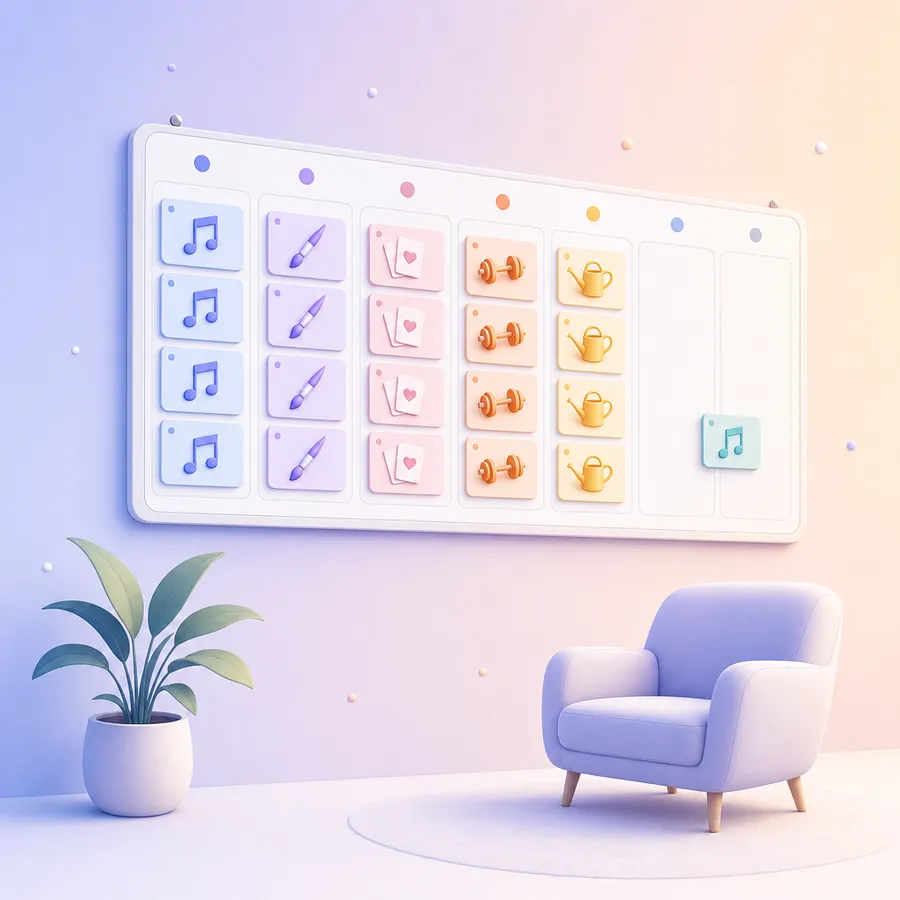
What residents said in Minnesota
In Minnesota's 2021 pilot of its assisted living resident survey, 58.4% of residents said they had enough to keep their mind active most of the time, and 41.6% said they liked the activities on offer. Only 18.9% said there was something they enjoyed doing on weekends most of the time, and 30.5% said rarely or never.4 Across the state's 2020 to 2023 results, engagement sat among the lowest scoring areas for residents, next to food.7
What families could not say
In the family version of the same pilot, 12.4% and 18.4% of relatives answered "not applicable or don't know" to its two activity questions.4 So the family set here asks what relatives see on their visits and whether they know what is planned, rather than how their relative feels.
Questions that point at a fix
Ask residents when they want more to do, what stops them joining in, and which activities they would join. Those three answers give you times, barriers and a wish list. Planning a whole new calendar? The senior activity interest survey goes deeper on hobbies, outings and fitness.
Getting answers from every resident, not just the ones who write
Who answers decides what the results say. Three habits bring in the residents that mailed forms miss, and keep family views separate from theirs.
Residents who took part, by how the survey was given
Sit down with residents instead of mailing forms
In Minnesota's statewide testing, 93% of residents approached in person took part, against 41% by phone and 20% by mail, and the ratings showed no pattern of difference between the three ways of asking.3 Ask volunteers, a chaplain or an outside interviewer to read the questions, never the aide who helps that resident every day. Oregon's rules point out that residents may answer differently when staff ask, and that family can sway answers too.2

Three answers and a card for residents with memory loss
Nearly half of assisted living residents have some cognitive impairment, yet in one study of 481 residents, satisfaction scores did not differ between those with and without dementia.5 Their views count. Minnesota's researchers found a three-point "how often" scale worked better than four points in memory care, with cards residents could point to, and they dropped hard-to-hear words such as "staff".3 The memory care interview above follows that pattern.
Give families their own survey
Send the family set to each resident's main contact, one per resident, the same way CoreQ samples families.1 Families often answer by mail more readily than residents: in Minnesota's pilot, 33.5% of family surveys came back against 26.7% of resident surveys.4 Report the two groups apart, because family members tend to rate the same home lower than residents do.6
Holding a family night or a residents' council? One question on the big screen gets the room talking: start a live poll and relatives vote from their own phones. Setting one up takes a minute with our poll making guide, and the question on when residents want more to do makes a lively first vote.
Ten resident statements, shortest bar first
Type in how many residents chose each point for the ten core statements. A 4 or 5 is good news throughout, which puts the problems in the shortest bars. Take the printed chart to the council, the family newsletter or your quality meeting.
- 1Tally the paper forms and the online answers together for each statement. The bars turn the counts into the share of residents who agreed.
- 2Start with the two shortest bars, then read the written answers about the same topics before you decide what to change.
- 3Keep read-aloud memory care interviews and family answers out of this chart, and look at them on their own.
- 4Post the chart where residents and families will see it, with one change you will make and the date you will make it.
Resident survey results
How this set sits alongside CoreQ and state reporting
Many communities already send a short national measure once a year, and some states require one. These questions go after it and explain the score.
| Program | What it asks for | How this page fits |
|---|---|---|
| CoreQ (AHCA/NCAL) | Four 1 to 5 ratings from residents (overall, staff, care, food) and three from families. Reported results need 20 valid answers and a 30% response rate.1 | Keep the CoreQ items first, worded exactly as your vendor supplies them, and put the resident core 12 after them. |
| Oregon quality metrics | Every assisted living and residential care facility reports a yearly resident satisfaction survey run by a third party. Answers are anonymous and residents answer without staff or family help.2 | Run the core 12 between the yearly rounds, and plan read-aloud interviews with your vendor for residents who cannot write. |
| Minnesota report card | A resident quality of life survey run every year, and a family satisfaction survey, both shown on a public report card.3 | The family set covers the same ground in new words. Send it separately to each resident's main contact. |
How the CoreQ score is worked out
CoreQ averages each person's ratings and counts them as satisfied when that average is 3 or higher. The score is the number satisfied divided by everyone with a valid answer.1 A made-up example: five residents average 2.5, 3.0, 3.5, 4.25 and 4.75, so four of the five count as satisfied and the score is 80 percent. Oregon wants the raw counts for each answer, not percentages, so keep the tally sheets.2
A single score says whether residents are satisfied. The questions on this page say why, which is what CoreQ's authors found extra questions were for: they did not change a community's score, but they did show where to improve.1
A card for the residents' council
Between full surveys, these five cover help, kindness, meals and activities, and leave room for one idea. Read them out at the council meeting, or print them on a single card for lunch.
- 01When I ask for help, it comes in good time.
- 02The aides and nurses are kind and patient with me.
- 03I enjoy the meals here.
- 04I can find an activity here that suits me most days.
- 05What is one thing that would make living here better for you?
Forms and a sealed box for residents who like paper
Plenty of residents would rather hold a form than open a link. Hand the forms out with a sealed box for returns, so nobody on shift sees the answers.
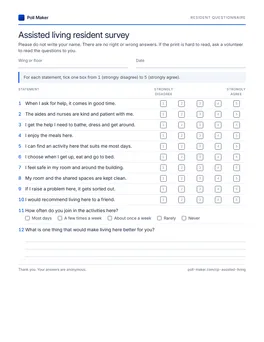
Resident questionnaire
The resident core 12 comes first, one box to tick per answer. The activity, care, family and memory care sets come after it on separate sheets, so print just the ones you plan to use.
Download PDF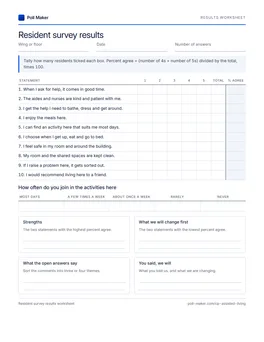
Results tally sheet
Tally the ten statements from the paper forms, find the share of residents who agreed with each, and total how often people join in activities.
Download PDFAssisted living questions that get vague answers, rewritten
Four fixes that apply to any resident or family question. For more examples by question type, browse our survey question examples.
How satisfied are you with our staff?
When I ask for help, it comes in good time.
The aides and nurses are kind and patient with me.
"Staff" covers everyone from the cook to the night nurse, so a low score cannot be acted on. Name the people and what they do.
Don't you love our new activity calendar?
I can find an activity here that suits me most days.
A leading question invites a polite yes from someone who depends on you every day. A neutral statement leaves room to disagree.
How are the food and the dining service?
I enjoy the meals here.
I have a say in what goes on the menu.
Two topics share one question, so a resident who likes the cooking but not the fixed menu has no honest answer.
Is your mother happy with the activities?
On my visits, my relative is often doing something.
I know what activities are planned each week.
Families cannot see how their relative feels, but they can report what they see and what they are told.
What administrators and family councils ask
For executive directors, activity directors and family liaisons planning their next resident or family survey.
What questions should an assisted living satisfaction survey include?
Cover how quickly help comes, how care is given, personal care, meals, activities, daily choice, safety, cleaning and whether problems get fixed, then an overall verdict and a question in the resident's own words. Those twelve make up the resident core above. Add the activity or care sets, or the family survey, when you plan to act on what they tell you.
Can residents with dementia take part?
Many can. In a study of 481 assisted living residents, satisfaction scores did not differ between residents with and without dementia.5 Interview them in person with the memory care set and three answer cards. CoreQ leaves out residents with severe impairment,1 so a read-aloud interview is how their views get counted in your own survey.
Should family members fill in the survey for a resident?
No. Answers a relative gives for a resident are family answers. CoreQ moves them out of the resident results,1 and Oregon does not let staff or family help residents with its yearly survey, not even by reading the questions.2 Send families their own survey instead.
How often should we survey residents and families?
At least once a year, which is what CoreQ asks for.1 Run it at the same time each year so the results compare, use the five council questions between rounds, and stop counting answers two months after the forms go out, as CoreQ does.1
Is this the same as a state assisted living survey?
No. In licensing, a survey is the state's inspection. Minnesota's health department, for example, surveys every assisted living facility at least once every two years without advance notice,8 and its surveyors interview residents and their representatives.9 A satisfaction survey is your own, and it tells you what residents think before anyone else asks them.
Does this work in a nursing home or care home?
Yes, with small edits. Change "apartment" to "room", and add questions on therapy and nursing care if residents come for rehab. The family set and the memory care interview work as they are. Other patient and care surveys are in our healthcare survey questions.
Sit down with residents this month
Load the resident questions into the survey builder today, choose any extra sets, and print forms for everyone who would rather use a pen.