Safety culture questionnaire for employees, from the crew to the supervisor
A safety culture survey asks the people doing the work how safety holds up when a job runs late, whether near misses get reported, and whether anyone can stop an unsafe task. Allow about four minutes for the core 12, by phone or on paper, and one role question sets the office view beside the view from the floor.
- 38questions
- 12in the core set
- 4 minto answer the core
- 6optional sets
By Michael Hodge, BSc Psychology Updated September 2026
The complete safety culture question bank
Every core question is already selected. Pick more sets or rows as needed; the selection then goes to the survey builder, a printout or your clipboard. Each question lists what respondents choose from and the problem a low score usually signals.
The core 1212 questions
Nine statements a worker can judge from what happens on shift, a count of shortcuts seen in the past month, a role question for the office versus floor comparison, and one write-in. Sent alone, it is a complete safety perception survey.
-
My supervisor puts safety ahead of the schedule.
Strongly disagree12345Strongly agree1 = Strongly disagree, 5 = Strongly agreeThe pressure test. Most rules hold on a quiet day; this shows what happens when the job runs behind.
-
Hazards I report get fixed, not just written down.
Strongly disagree12345Strongly agree1 = Strongly disagree, 5 = Strongly agreeWhether reporting pays off. OSHA lists the share of worker-reported hazards acted on within 48 hours as a leading indicator.2
-
I can stop an unsafe job without getting in trouble.
Strongly disagree12345Strongly agree1 = Strongly disagree, 5 = Strongly agreeStop-work authority as crews experience it, not as the policy states it. A low score means the policy is not believed.
-
People here report near misses, even minor ones.
Strongly disagree12345Strongly agree1 = Strongly disagree, 5 = Strongly agreeA near miss is a free warning. When near misses go unreported, the first sign of a hazard is an injury.
-
Incidents here lead to fixes, not blame.
Strongly disagree12345Strongly agree1 = Strongly disagree, 5 = Strongly agreeJust culture in one line. OSHA names investigations that blame individuals as a reason workers stop taking part.1
-
My training covered the tasks I actually do.
Strongly disagree12345Strongly agree1 = Strongly disagree, 5 = Strongly agreeRelevance, not hours. Generic induction slides pass an attendance check and fail this one.
-
The right PPE is on hand when the job needs it.
Strongly disagree12345Strongly agree1 = Strongly disagree, 5 = Strongly agreeAvailability at the point of work. A full store room far from the job still means gear gets skipped.
-
My coworkers speak up when they see unsafe work.
Strongly disagree12345Strongly agree1 = Strongly disagree, 5 = Strongly agreePeer norms. Supervisors see a fraction of each shift; coworkers see all of it.
-
We are asked before changes are made to our work.
Strongly disagree12345Strongly agree1 = Strongly disagree, 5 = Strongly agreeWorker participation, the element OSHA places beside management leadership. Crews follow procedures they helped shape.1
-
In the past month, how often did you see a safety step skipped to get work done?
NeverOnce or twiceEvery weekMost daysNot sureThe behaviour count no audit catches. Tally it on the worksheet, and run it as an anonymous poll at a toolbox talk.
-
Which best describes your role?
Front lineSupervisorManagerContractorPrefer not to sayThe perception-gap split. In one study, managers rated safety climate higher than workers did, and the size of that gap tracked the injury rate.4
-
What is one unsafe thing here that people have stopped noticing?
Open answerSurfaces risks that have become normal. The answers make a ready-made list for the next site inspection.
Leaders and supervisors5 questions
Add this set when question 1 scores low, or before a leadership safety walk. It shows whether commitment is visible from the floor.
-
Senior managers walk the site and ask about hazards.
Strongly disagree12345Strongly agree1 = Strongly disagree, 5 = Strongly agreeVisible leadership. Walkarounds that ask questions tell crews that safety is part of the job, not a poster.
-
My supervisor briefs us on hazards before a new job.
Strongly disagree12345Strongly agree1 = Strongly disagree, 5 = Strongly agreeThe pre-job brief is where hazard knowledge changes hands. Low scores point to rushed starts.
-
Managers follow the same safety rules as everyone.
Strongly disagree12345Strongly agree1 = Strongly disagree, 5 = Strongly agreeCrews notice who the rules apply to: the hard hat left in the site office, the shortcut taken on a visit.
-
Our output targets leave enough time to work safely.
Strongly disagree12345Strongly agree1 = Strongly disagree, 5 = Strongly agreeSeparates supervisor intent from planning. If the targets are the problem, coaching supervisors will not fix it.
-
My supervisor thanks people who raise safety issues.
Strongly disagree12345Strongly agree1 = Strongly disagree, 5 = Strongly agreeOSHA recommends recognising people for reporting near misses, and rewarding rather than disciplining those who raise problems.1
Hazards and equipment in your job5 questions
The workplace safety side: what people face each week, faulty equipment, housekeeping, procedures and fatigue. Compare the answers with your written risk assessments.
-
Which of these do you face in a normal week?
LiftingVehiclesHeightsChemicalsNoiseMachinesTick all that applyA hazard map drawn by the people exposed. Sort the ticks by shift or area and check each one has a risk assessment.
-
Faulty equipment is taken out of use quickly.
Strongly disagree12345Strongly agree1 = Strongly disagree, 5 = Strongly agreeTag-out in practice. Slow removal is how a known defect becomes an incident.
-
Walkways and work areas are kept clear.
Strongly disagree12345Strongly agree1 = Strongly disagree, 5 = Strongly agreeSlips and trips start here, and a cluttered floor tells new starters what normal looks like.
-
Written procedures match how the job is really done.
Strongly disagree12345Strongly agree1 = Strongly disagree, 5 = Strongly agreeThe gap between work as written and work as done. Low scores mark procedures to rewrite with the crew.
-
How often do you work while too tired to be at your best?
NeverRarelySometimesOftenAlwaysFatigue, asked as a frequency. Read it by shift and by hours worked so any fix lands on the right rota.
Reporting and learning6 questions
Use this set when near-miss reports are rare or the injury log looks too clean. It finds where reports stall and what puts people off.
-
I know how to report a hazard or near miss.
Strongly disagree12345Strongly agree1 = Strongly disagree, 5 = Strongly agreeThe basic check. If people do not know the route, nothing else in this set can work.
-
I hear back after I report a safety problem.
Strongly disagree12345Strongly agree1 = Strongly disagree, 5 = Strongly agreeOSHA advises reporting back to workers routinely and often about the action taken on their concerns.1
-
Reporting an injury would not count against my crew.
Strongly disagree12345Strongly agree1 = Strongly disagree, 5 = Strongly agreeCatches bonuses and safe-days boards that punish reporting. OSHA flags incentive prizes that a report could put at risk.1
-
Lessons from incidents elsewhere reach my crew.
Strongly disagree12345Strongly agree1 = Strongly disagree, 5 = Strongly agreeLearning across shifts and sites: an incident on one line is a warning for every line that does the same work.
-
In the past year, did you decide not to report a safety event?
NoYes, a near missYes, an injuryYes, bothPrefer not to sayMeasures underreporting directly. Where safety climate was poor, one construction study found 81% of eligible injuries went unreported.3
-
What would most likely stop someone reporting a near miss?
Nothing wouldPaperworkFear of blameNothing changesSeems too minorNames the barrier to remove first. Each answer has its own fix: a shorter form, a no-blame rule, faster feedback or examples of what counts.
Training and new starters4 questions
For sites with high turnover, seasonal peaks or agency crews. Everyone can answer it; compare the answers by time in the job (question 38).
-
I was shown the safe way to work in my first week.
Strongly disagree12345Strongly agree1 = Strongly disagree, 5 = Strongly agreeWorkers in their first month on the job were over four times as likely to have a lost-time claim as those with more than a year.10
-
Training is in a language I understand well.
Strongly disagree12345Strongly agree1 = Strongly disagree, 5 = Strongly agreeOSHA lists language as a barrier to taking part. Read it by crew where several languages are spoken.1
-
I could explain our emergency plan to a new starter.
Strongly disagree12345Strongly agree1 = Strongly disagree, 5 = Strongly agreeA harder test than knowing the plan exists, because it asks for the detail.
-
Training is updated when equipment or tasks change.
Strongly disagree12345Strongly agree1 = Strongly disagree, 5 = Strongly agreeOSHA recommends extra training when equipment or processes change, and whenever a worker is assigned a new task. This checks that it happens.1
Food safety culture (food handlers answer)4 questions
For kitchens, food plants and stores that handle open food. The four statements follow the GFSI food safety culture dimensions and sit well beside a hygiene audit.
-
I know which food safety steps matter most in my job.
Strongly disagree12345Strongly agree1 = Strongly disagree, 5 = Strongly agreeHazard and risk awareness, the dimension GFSI says sets food safety culture apart from the wider company culture.6
-
Hygiene rules hold on busy shifts too.
Strongly disagree12345Strongly agree1 = Strongly disagree, 5 = Strongly agreeConsistency. A rule that bends at peak time teaches everyone that it is optional.6
-
I would stop the line if a food safety check failed.
Strongly disagree12345Strongly agree1 = Strongly disagree, 5 = Strongly agreeThe food version of question 3: whether handlers feel able to halt production for a failed check.
-
New products come with clear food safety steps.
Strongly disagree12345Strongly agree1 = Strongly disagree, 5 = Strongly agreeAdaptability. Food safety culture is tested when something changes, not on an ordinary day.6
About you (optional)2 questions
Two splits: shift and time in the job. Drop any split whose group is so small that answers could be traced to a person.
-
Which shift do you usually work?
DayEveningNightRotatingPrefer not to sayNight and weekend crews work with fewer managers around, so compare shifts before you average them.
-
How long have you worked here?
Under 3 months3 to 12 months1 to 5 yearsOver 5 yearsPairs with the new starter set. Compare the first group with everyone else.
What makes crews say what really happens on shift
Four practices decide whether people tell you what really happens on shift, or what they think you want to hear.

Run it on paid time, in the languages people speak
OSHA's recommended practices warn that worker participation is suppressed when language, education or skill levels are ignored, or when people fear what speaking up will cost them, and they suggest holding safety meetings during regular working hours.1 Give every shift ten paid minutes, translate the questionnaire for each language spoken on site, and offer paper and a phone link side by side. Ask someone outside the management chain, such as HR or the safety committee, to collect the forms, as the NBAA survey guide recommends.7
Eligible injuries left unreported, by company safety climate
Read the injury log next to the survey
A low injury rate can mean a safe site or a silent one. On one large US construction site, Probst and colleagues compared 38 contractors' OSHA logs with their medical claims: companies with a poor safety climate left 81% of eligible injuries unreported, against 47% at companies with a positive climate.3 So when the survey says near misses go unreported (question 4) and the log looks spotless, believe the survey. The reporting set then measures how big the gap is.

Split every answer by role
Managers and crews rarely see the same site. In 26 Colombian construction firms, site managers rated safety climate higher than supervisors and workers did. No group's own score was linked to the injury rate, but the distance between workers and managers was: wider gaps went with higher three-year injury rates.4 Question 11 records each person's role for exactly this reason. Fill the report once for managers and once for the front line, and start with the statement where the two sit furthest apart.
Report back fast, then track leading indicators
The NBAA guide describes two messages to staff: a thank-you from senior leadership with a first look at the raw results as soon as the survey closes, then the improvement areas and action plans within a set period.7 Pick two fixes, give each an owner, and count one leading indicator every month until the next survey. OSHA's guide to leading indicators lists survey scores on management commitment and the survey participation rate among its examples.2
Opening a toolbox talk? Put the shortcut question (question 10) up as a live poll. Each person answers on their own phone, so nobody has to raise a hand, and the crew sees the count straight away. For other quick openers, borrow from these meeting poll questions.
Safety culture results for the safety committee
Log how many crew members landed on each point of the nine safety statements, from Strongly disagree through to Strongly agree. Every statement is phrased so that agreement means safe practice, which makes the shortest bar your starting point. Print the page for the next committee meeting.
- 1A bar shows the share who picked 4 or 5. A 3 does not count as agreement: those people are still undecided.
- 2Fill the report once with managers' answers and once with the front line's (question 11). The statement with the widest gap is where the two groups are describing different sites.
- 3Count the shortcut answers (question 10) on the paper sheet, and read the weekly and daily ones next to statement 1 on schedule pressure.
- 4Sort the write-ins to question 12 by hazard, then walk those places with the safety committee before the next inspection.
Safety culture results
Where your answers sit on the safety culture ladder
Patrick Hudson describes five stages a safety culture moves through, building on Ron Westrum's earlier model.5 Use the ladder to read the pattern in your results, not as a score: find the row that sounds most like your lowest statements and your write-ins.
| Stage | Hudson's description, in short | What it can look like in your answers |
|---|---|---|
| Pathological | Safety is a problem workers cause; the aim is not to get caught. | Questions 3 and 5 score lowest, and write-ins talk about blame. |
| Reactive | Safety matters, but action only follows an incident. | Questions 2 and 4 are low, and the reporting set shows events kept quiet. |
| Calculative | Systems and data drive safety, imposed from the top. | Training and PPE score well; question 9 on being asked lags behind. |
| Proactive | The workforce starts to take the initiative. | Questions 3, 8 and 9 score high, and managers and crews answer alike. |
| Generative | Everyone takes part, and people stay uneasy even when things look fine. | High scores across the core, yet question 12 still names specific hazards. |
Hudson calls the top rung's habit chronic unease, a guard against complacency.5 It is the reason to keep question 12 even when every bar is long: a crew that can still name the risk everyone walks past is doing its job.
Reaching crews who never open company email
Plenty of crews never open company email, and they are often the people closest to the hazards. Print the questionnaire for a pre-shift talk, have forms dropped into a closed box, then key each paper form into the online survey so nothing is counted twice. Both Letter and A4 paper work.
Running only the toolbox five at a pre-shift talk?
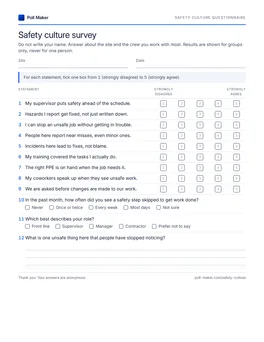
Safety culture questionnaire
Sheet one carries a header line for site and date, then all twelve core questions as tick boxes. Sheets two onward hold the six optional sets.
Download PDF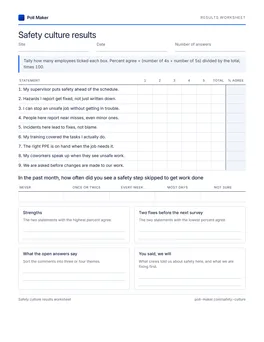
Safety culture tally sheet
Add up the paper forms statement by statement, convert the counts to a share agreeing, tally how often shortcuts were seen, and record your first two fixes.
Download PDFThe toolbox talk version, once a month
Between full surveys, run these five at a toolbox talk each month: schedule pressure, stop-work, near misses, shortcuts seen and the hazard nobody notices any more. The trend shows whether last quarter's fixes reached the floor.
- 01My supervisor puts safety ahead of the schedule.
- 02I can stop an unsafe job without getting in trouble.
- 03People here report near misses, even minor ones.
- 04In the past month, how often did you see a safety step skipped to get work done?
- 05What is one unsafe thing here that people have stopped noticing?
Turn low scores into leading indicators
OSHA's leading indicators guide sums it up: a good program uses leading indicators to drive change and lagging ones, such as injury rates, to check it worked.2 Pair each weak statement with something you can count every month.
| If this is low | Count each month | Owner |
|---|---|---|
| Q2 hazards fixed | Reported hazards with a first action inside 48 hours, as a share of all reports | Maintenance lead |
| Q4 near misses | Near-miss reports received, by crew | Safety manager |
| Q1 schedule pressure | Jobs re-planned or paused for safety, and the people thanked for it | Operations manager |
| Q9 asked first | Procedures reviewed with the crew that uses them | Supervisors |
| Q6 training fits | New starters paired with an experienced buddy for their first month | Training lead |
Worked example
Say 22 of 40 front-line workers agree that hazards they report get fixed, while 9 of 10 managers do. The safety committee picks one indicator from the table: hazard reports with a first action inside 48 hours. It starts at about half of all reports, and the maintenance lead posts the monthly figure on the crew notice board. Six months later the figure is well above half, and the next survey shows whether front-line agreement on question 2 has moved with it.
OSHA adds that views of management commitment can be slow to change, so give an indicator more than one cycle before you judge it.2 More surveys for the same workforce sit with the other employee survey questions.
What safety managers ask before the first survey
Quick answers on timing, anonymity, response rates and other sectors.
What is a safety culture survey?
A questionnaire that asks employees how safety works where they are: whether pressure bends the rules, whether hazards and near misses get reported and fixed, and whether people can stop unsafe work. It is also called a safety climate or safety perception survey. The NBAA guide explains the word climate: a survey captures a snapshot of how people see safety right now.7
How often should we run a safety culture survey?
Run all 38 questions yearly, with the toolbox talk five each month in between. OSHA recommends evaluating a safety and health program at least annually,1 and NBAA suggests building a perception survey into your safety management system at least every three years.7 Rerun the core after a big change, such as a new owner, site or shift pattern.
What response rate do we need?
NBAA suggests aiming for 80 to 100 percent in a department of 10 to 20 people, and at least a third in larger ones, with every discipline and management represented.7 Paid time and a paper option bring in the crews an email link misses.
Should a safety culture survey be anonymous?
Yes. OSHA recommends an anonymous option even for everyday hazard reports, to reduce fear of reprisal.1 Leave names off the form, let someone outside the management chain collect paper copies, and skip any breakdown small enough to point to one person.
Is this the same as the AHRQ patient safety culture survey?
No. AHRQ's SOPS Hospital Survey measures how hospital staff see patient safety, and CMS asks hospitals to run a culture of safety survey every year, or every two years with a pulse survey in between.8 This page measures workers' own safety on the job. A hospital can run both: the AHRQ survey for patients, this one for staff injuries and hazards.
Can we use it for a food safety culture assessment?
Yes, for the people side of it. Add the food safety set, whose four statements follow the GFSI dimensions of hazard and risk awareness, consistency, people and adaptability, and read the results next to your audit and hygiene records.6
Safety questions that invite polite answers, rewritten
Each fix swaps a judgement for something a worker has seen happen. For wording on other topics, start at the survey question library.
Do you feel safe at work?
I can stop an unsafe job without getting in trouble.
People here report near misses, even minor ones.
A feeling is hard to act on. Behaviours a crew has watched give you something to change.
Don't you agree our safety training is excellent?
My training covered the tasks I actually do.
A leading question with a flattering word built in. Neutral wording about real tasks gets a straight answer.
Is safety equipment available and well maintained?
The right PPE is on hand when the job needs it.
Faulty equipment is taken out of use quickly.
It bundles two questions. A worker with a full glove box and a broken hoist cannot answer it truthfully.
How would you rate management's commitment to safety?
My supervisor puts safety ahead of the schedule.
Senior managers walk the site and ask about hazards.
Commitment is a judgement. What a supervisor does when the job runs late is something every worker has seen.
Find out what the floor already knows
Send the core 12 to phones this week, hand paper copies to crews off the network, and put the office and floor results side by side at the next safety committee.