Women empowerment survey questions on decisions, money, movement and voice
The strongest women empowerment questions ask about real decisions, not feelings: who decides about her health care, whether she has money of her own, whether she can go out alone and whether her views count. The first three questions use the DHS wording, so your group's answers can sit beside your country's national figure.
- 37questions
- 12in the core
- 6 minfor the core on a phone
- 18+women, about their own lives
By Michael Hodge, BSc Psychology Updated September 2026
All 37 questions, grouped by what they measure
Each item lists the choices a respondent picks from, plus why the answer matters. Twelve core items are ticked already; add whichever sets your program or thesis needs and the survey counter keeps the total.
The core 12: decisions, money, movement and voice12 questions
Three DHS decision questions, one about an account in her own name, six statements and two about time and change. Together they touch all three parts of Kabeer's definition: resources, agency and achievements.
-
Who usually makes decisions about health care for yourself?
MeMe and my husband or partnerMy husband or partnerSomeone elseThe first of the three DHS decision questions, in the DHS form, so your figure compares with your country's.4
-
Who usually makes decisions about large household purchases?
MeMe and my husband or partnerMy husband or partnerSomeone elseShows who holds the purse strings for the things that cost the most.
-
Who usually makes decisions about visits to your family or relatives?
MeMe and my husband or partnerMy husband or partnerSomeone elseFreedom to keep her own family ties. With questions 1 and 2 it gives the DHS all-three-decisions score.
-
Do you have a bank or mobile money account in your own name?
Yes, and I use itYes, but rarelyNoMoney in her own name is a resource she controls. Asking about use separates a working account from one opened for a program.
-
I can decide how to spend money I earn or receive.
Strongly disagree12345Strongly agree1 = Strongly disagree, 5 = Strongly agreeControl over income, the step after having it. A low score next to a yes on the account question points to who really holds the card.
-
If I need a doctor, I can go without asking permission.
Strongly disagree12345Strongly agree1 = Strongly disagree, 5 = Strongly agreeFreedom of movement asked through one concrete trip, which is easier to answer accurately than a general question.2
-
When my family makes a big decision, my view counts.
Strongly disagree12345Strongly agree1 = Strongly disagree, 5 = Strongly agreeVoice at home. It picks up influence the who-decides questions miss when decisions are shared.
-
I am comfortable speaking up at a community meeting.
Strongly disagree12345Strongly agree1 = Strongly disagree, 5 = Strongly agreeVoice in public life, the community end of the leadership domain in the WEAI.7
-
I can go to see a friend without asking anyone first.
Strongly disagree12345Strongly agree1 = Strongly disagree, 5 = Strongly agreeA trip that matters only to her. Mobility asked through a named outing like this one was among the strongest signs of agency in the research behind this set.9
-
I feel safe walking alone in my area after dark.
Strongly disagree12345Strongly agree1 = Strongly disagree, 5 = Strongly agreeSafety sets the limit on every other freedom here. Where it is low, the movement score is low for a reason.
-
On most days, how much time do you have for yourself?
NoneUnder 1 hour1 to 2 hoursOver 2 hoursTime is one of the five WEAI domains. A woman with no hour of her own has little room to use the other freedoms.7
-
What is one change that would give you more say over your own life?
Open answerNames the barrier in her own words. Sort the answers into a few themes before planning anything.
Money, work and property5 questions
For savings groups, cash transfer and livelihood programs, where money of her own is the outcome you want to move.
-
In the last 12 months, how were you paid for your work?
CashCash and goodsGoods onlyNot paidDid not workSeparates paid work from unpaid work on a family farm or business, which rarely brings money of her own.
-
Who usually decides how the money you earn is used?
MeJointly with my partnerMy husband or partnerSomeone elseNo earningsControl over her own earnings, the income domain of the WEAI.7
-
Do you own a house or land, alone or with someone else?
AloneJointlyBothNoProperty is the resource that lasts. SDG indicator 5.a.1 tracks ownership of farmland by sex.6
-
Do you have a mobile phone that you use yourself?
Yes, my ownYes, a shared oneNoPhone ownership by sex is SDG indicator 5.b.1, and a phone of her own opens banking and information.6
-
I could borrow money for a business if I needed to.
Strongly disagree12345Strongly agree1 = Strongly disagree, 5 = Strongly agreeAccess to credit, asked as a real option rather than as knowledge of lenders.
At work (women in paid work answer)5 questions
Only for women with a job. An employer or staff network can send this set with the About you questions and nothing else.
-
Women and men in the same job here get the same pay.
Strongly disagree12345Strongly agree1 = Strongly disagree, 5 = Strongly agreePerceived pay fairness. Check it against the pay records before acting on it.
-
I can ask for a raise without being treated worse.
Strongly disagree12345Strongly agree1 = Strongly disagree, 5 = Strongly agreeVoice about pay and progress, the place where women most often stay silent at work.
-
Women here have a real chance of reaching senior roles.
Strongly disagree12345Strongly agree1 = Strongly disagree, 5 = Strongly agreeThe workplace end of SDG indicator 5.5.2, the share of women in managerial positions.6
-
My working hours fit around my caring duties.
Strongly disagree12345Strongly agree1 = Strongly disagree, 5 = Strongly agreeWhere paid work and unpaid care collide. Read it next to the open answer below.
-
What one change at work would help women here move up?
Open answerTurns the ratings into a short list of fixes the employer can act on.
Community and public life4 questions
For programs that build leadership, or for a study of women in local decision making.
-
In the last 12 months, how many community meetings have you attended?
None1 or 23 to 5More than 5Participation counted, not rated. A count is easier to answer accurately than "how active are you?"
-
Are you a member of a savings group, cooperative or women's group?
Yes, with a roleYes, a memberNoMembership and leadership in groups, the heart of the WEAI leadership domain.7
-
When women speak at local meetings, people take them seriously.
Strongly disagree12345Strongly agree1 = Strongly disagree, 5 = Strongly agreeBeing heard, not only being in the room.
-
I know where to go if my rights are not respected.
Strongly disagree12345Strongly agree1 = Strongly disagree, 5 = Strongly agreeLegal awareness. A low score has a quick fix: tell women where help is and how to reach it.
Health decisions (ask in private)3 questions
Personal questions. Ask them in a private interview or let her tap the answers on a phone herself, and make every one skippable.
-
Who usually decides whether you use family planning?
MeJointly with my partnerMy husband or partnerSomeone elseDoes not applyContraceptive use is one of the three decisions in SDG indicator 5.6.1.6
-
In the last 12 months, what stopped you getting health care you needed?
NothingCostDistanceNeeded permissionOther reasonSeparates money and distance from permission, which only she can report.
-
I can get health information I trust when I need it.
Strongly disagree12345Strongly agree1 = Strongly disagree, 5 = Strongly agreeInformation is a resource, and outreach can close the gap quickly.
Views on women's roles4 questions
Beliefs about what women should do. Ask men the same four in a separate round and the gap between the two groups becomes a finding in itself.
-
A woman should be free to work outside the home.
Strongly disagree12345Strongly agree1 = Strongly disagree, 5 = Strongly agreeThe norm behind most of the money questions. Low agreement explains low paid work.
-
Men should do an equal share of the housework.
Strongly disagree12345Strongly agree1 = Strongly disagree, 5 = Strongly agreeHousework is the hidden cost behind the time question in the core.
-
Girls deserve the same chance to finish school as boys.
Strongly disagree12345Strongly agree1 = Strongly disagree, 5 = Strongly agreeViews on the next generation, often more open than views on women now.
-
People around me would back a woman starting a business.
Strongly disagree12345Strongly agree1 = Strongly disagree, 5 = Strongly agreeWhat she thinks others believe. Perceived norms can hold women back even when their own views are open.
About you4 questions
Short and last. Question 35 matters most: DHS figures count only women who are married or living with a partner.
-
How old are you?
18 to 2425 to 3435 to 4950 or olderDHS figures cover women aged 15 to 49, so keep the 50+ group apart when you compare.4
-
Are you married or living with a partner?
MarriedLiving with a partnerNeitherFilter on this before comparing questions 1 to 3 with a DHS figure.4
-
How far did you go in school?
Never wentPrimarySecondaryCollege or universityEducation is a resource in its own right and often explains the other answers.
-
Where do you live?
City or townVillage or rural areaNational surveys report town and country separately, so this makes the comparison fairer.
Discussion questions for a women's group
For a circle, workshop or panel, where talking works better than a form. Each circle prompt opens up one area the survey measures, so a group can talk first and answer the survey after, or the other way round.
For a women's circle or workshop
- Think of a decision made in your home this year. Who made it, and how did you feel about the result?
- If some money were yours alone to decide on tomorrow, what would you do with it?
- Where would you like to go on your own that you do not go now? What stops you?
- When did someone last ask your opinion and then act on it?
- What skill would you learn if you had one free hour every day?
- Which woman in this community do you admire for speaking up, and what did she do?
- What do the men in your life believe about women earning money, and how do you know?
- What would make this area safer for women after dark?
- If this group could change one rule, habit or service, which would it be, and who would we need to convince?
For a panel or an International Women's Day event
- What was the first choice you made that was entirely your own, and what did it change?
- Which practical change has done most for the women you work with: childcare, transport, an account in her own name, or something else?
- What did you have to unlearn before you asked for a raise, a loan or a seat at the table?
- Where have you seen a program measure the wrong thing, and what should it have counted instead?
- What is one thing everyone in this room could do differently next week?
From talk to numbers
Send the survey once before the group starts meeting and once when its sessions end. The conversations explain why things are the way they are; the two rounds of answers show whether anything has moved.
Asking safely about power at home
Questions about who holds power at home are sensitive everywhere. These four habits come from researchers who field them for a living.

Ask where nobody else can hear
Who asks, and who is listening, changes what a woman says. J-PAL's field guide tells researchers to "consider enumerator identity carefully, create private spaces for interviews, and/or use technologies that allow respondents to answer privately."2 A woman interviewer for women respondents is its advice on sensitive topics. A survey link she opens alone on her own phone gives the same privacy without an interviewer at all.
Ask about a real decision, not a feeling
"Do you feel in control of your life?" invites a polite answer. In a J-PAL evaluation in Bangladesh, 16 percent of women told the standard DHS question that they decide about their own health care alone or jointly, yet nearly a quarter of that group could not take a sick child to a doctor until their husband came home.2 In a study of 209 married women in India, five questions about named purchases, outings and a child's health care matched in-depth interviews more closely than an average of all 63 questions tried (a correlation of 0.54 against 0.46), and none of the general questions made the top five.9 So the core keeps the three DHS questions for comparison and puts a trip to the doctor and a visit to a friend beside them. When the two kinds disagree, read the trips first.
Try the wording on a few women first
Cognitive interviews with women in Bangladesh found the questions were generally understood, yet some women answered the wrong part of a question, did not understand a key phrase, or were uncomfortable with a topic.8 Read each question to a handful of women like the ones you will survey and ask them to put it in their own words. Reword whatever trips them up, and translate the answer choices as carefully as the questions.
Ask men the same questions, separately
Husbands and wives in the same household often give different answers to the DHS decision questions. J-PAL reports that researchers found systematic differences on large purchases and the use of the husband's earnings across many countries.2 If your program works with couples, ask men the decision questions and the beliefs set in their own interview, never with their wife present, and compare the two sets of answers.
At a women's group meeting, one question on a screen gets people talking faster than a form does. Project any single-choice item as a live poll and everyone votes from her own phone; the free-time question makes a gentle opener. Never run one before? Start with these poll basics.
Which question measures what
Proposals and funders ask for this table: each part of the idea, the questions that measure it, and the standard figure you can set your results beside.
| What it measures | Questions | Compare with |
|---|---|---|
| Decisions at home | 1, 2, 3, 7 | DHS: a say in all three decisions4 |
| Control of money | 5, 14 | WEAI income domain7 |
| Money and property of her own | 4, 13, 15, 16, 17 | SDG 5.a.1 (farmland), 5.b.1 (mobile phone)6 |
| Movement and safety | 6, 9, 10 | Your group a year later |
| Voice and leadership | 8, 23 to 26 | WEAI leadership domain7 |
| Fairness and seniority at work | 18 to 22 | SDG 5.5.2, women in managerial positions6 |
| Time of her own | 11 | WEAI time domain7 |
| Health decisions | 27 to 29 | SDG 5.6.1, one of its three decisions6 |
| Beliefs about women | 30 to 33 | The same four asked of men |
Where the three dimensions come from
Naila Kabeer describes women's empowerment as gaining "the ability to make strategic life choices" and splits it into resources, agency and achievements.1 Her warning for anyone writing a questionnaire: a single indicator only means something once you know which of the three it stands for. Money in an account is a resource; deciding how to spend it is agency. Achievements are the outcomes your program hopes for, such as income, health or schooling, so add your own outcome measures next to this set.
Score the three decision questions the DHS way
A woman counts as having a say in all three decisions when she answers "Me" or "Me and my husband or partner" to questions 1, 2 and 3. Only women who are married or living with a partner go into the count.4
Married women with a say in all three household decisions
A worked example
A savings group surveys 60 women. Question 35 shows that 48 of them are married or living with a partner, so 48 is the denominator. Of those 48, 30 chose "Me" or "Me and my husband or partner" on all three questions. 30 divided by 48 is 0.625, so 63 percent of the group has a say in all three decisions.
A woman who skipped one of the three stays among the 48 but cannot be counted among the 30. The DHS keeps missing answers as their own category rather than dropping them.4
Reading it against the national figure
The chart shows how widely the answers to these three questions differ from one country to the next.5 A group that joined a program because its members wanted change will rarely match a random national sample, so the fairest yardstick is often your own group asked again twelve months later, in the same season and by the same interviewers.
Chart the six statements for your group
Tally how many women chose 1, then 2, and so on up to 5, for each of the six statements, and type the counts in. The chart shows which freedoms are widest in your group and which two to work on first, ready to print for a board or a funder.
- 1Percent agree on a statement means the women who picked 4 or 5 out of all women who answered it. The panel works that out once you type the counts.
- 2Compare the six bars with one another. A group can score high on voice at home and low on safety after dark, and that gap says where the next session should go.
- 3Split results by age or marital status only where every subgroup holds enough women that no single answer could be traced.
- 4Take the chart back to the women who answered and ask what they make of the two shortest bars. Their reading belongs in your report.
Group results
A questionnaire to print for interviews
Plenty of women's surveys are still asked face to face with a pen and a clipboard. The questionnaire prints the core 12 on its first sheet and the optional sets after it, and the worksheet turns a pile of paper answers into percentages in one sitting.
Going into the field? for each interviewer.
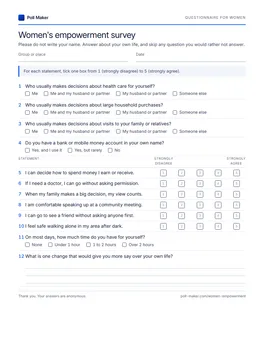
Interview questionnaire
Sheet one prints the core 12 as plain questions an interviewer reads out while the respondent points to her answer. Every optional set follows under its own heading.
Download PDF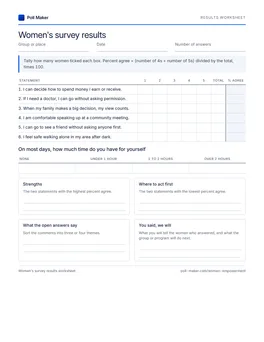
Results worksheet
Tally the six statements and the free-time question by hand, then write down the two strongest and two weakest areas.
Download PDFQuestions that sound right but measure nothing
Each of these four shows up in nearly every draft we see. The survey question library has examples for every other topic.
Do you feel empowered?
Who usually makes decisions about health care for yourself?
If I need a doctor, I can go without asking permission.
A feeling has no fixed meaning, so answers cannot be compared. A named decision and a named trip can.
Do you and your husband make decisions together and agree on spending?
Who usually makes decisions about large household purchases?
Two questions in one, and it assumes she has a husband. The better version lets every woman answer and keeps the DHS form.
Are women treated equally in your community?
When women speak at local meetings, people take them seriously.
Equality is too broad to rate. The better statement describes something she has seen happen.
How much money do you earn, and do you control it?
In the last 12 months, how were you paid for your work?
Who usually decides how the money you earn is used?
An exact amount is hard to recall and easy to refuse, and the question mixes earning with control. Two short questions keep them apart.
Women empowerment questions and answers
For researchers, program staff and group leaders planning a first round.
What is women empowerment?
In Naila Kabeer's definition, the one most measurement work starts from, it is the process by which women who have been denied the ability to make strategic life choices gain that ability.1 A survey cannot see the process itself, so it asks about what shows it: resources she holds, choices she makes and the outcomes that follow.
How is women's empowerment measured in a survey?
Mostly through concrete decisions and resources rather than feelings. The DHS asks who decides about her own health care, large purchases and visits to family.4 The WEAI covers five domains: agricultural production, productive resources, income, community leadership and time.7 The core 12 here takes the DHS questions and adds money, movement, voice, safety and time.
What are the types of women empowerment?
There is no single official list. J-PAL's catalogue of survey questions sorts them into seven areas: economic, social, intimate partner and family, political and civic, psychological, education and health.3 Kabeer's three dimensions, resources, agency and achievements, cut across all seven.1
Can I use these questions for a thesis?
Yes. Keep questions 1 to 3 exactly as they are if you want to compare with DHS data, pilot the whole set with a few women from your sample before fieldwork, and use the table above to show which dimension each question measures.
Is it safe to ask women these questions?
Yes, with care. Ask in private, keep names off the forms, make the health and beliefs sets optional, and have a local contact ready to refer anyone who asks for help during the interview. Questions about violence are left out on purpose: WHO advises adding them to a survey built for other purposes only when its ethical and methodological requirements can be met, including trained interviewers and referral to local support.10
Send the core 12 this week
Share it as a link women open on their own phones, or take printed copies into the field for face-to-face interviews.