The employment status question, its standard answers and short versions
Ask "Which of the following best describes your current employment status?" and offer ten answers: employed full time, employed part time, self-employed or freelance, unemployed and looking for work, unemployed and not looking, student, retired, homemaker or carer, unable to work, and prefer not to say. Below: the full block, short versions, the official sequence and what each answer means.
- 10answer options
- 5in the core block
- 23questions in all
- 1 minto answer the core
By Michael Hodge, BSc Psychology Updated September 2026
All 23 employment status questions
The core five are ticked. Add a whole version below, or tick single questions, then open your pick in the builder, send it to the printer, or paste it into Google Forms or Word. Under each one: the answer list and the thing its result tells you.
The core employment block5 questions
Five questions that fit at the end of almost any survey: the status question itself, usual hours, who you work for, side work and the kind of work you do.
-
Which of the following best describes your current employment status?
Employed full timeEmployed part timeSelf-employed or freelanceUnemployed, looking for workUnemployed, not looking for workStudentRetiredHomemaker or carerUnable to workPrefer not to sayThe standard question. Every option describes one situation, so you can split every other answer in the survey by work status.1
-
How many hours a week do you usually work, across all your jobs?
None1 to 1415 to 3435 to 4445 or moreHours settle what full time means. The 35-hour line matches the one official US figures use, so you can draw it yourself.1
-
In your main job, do you work for an employer or for yourself?
For an employerFor myselfBoth about equallyI do not have a jobSeparates employees from the self-employed, which changes how people answer questions about pay, hours and benefits.
-
Besides any main job, did you earn money from side work in the past month, such as gig, freelance or casual jobs?
YesNoPrefer not to sayPicks up paid work people leave out when they hear the word job. It also finds people with a second income.4
-
Which of these best describes the kind of work you do, or did most recently?
Managers and businessProfessionalTechnicalOffice and adminSales and serviceCare and healthSkilled tradesFactory and transportNever workedThe occupation question in nine broad groups. It is enough to compare office, hands-on and service work without coding job titles.
Short versions4 questions
Use one of these when the survey only has room for a single line, or when you are screening people before the main questions.
-
Are you currently doing any paid work?
YesNoThe fastest screener. Use it to route workers to job questions, not as your only employment measure.
-
Which best describes you right now?
WorkingLooking for workStudentRetiredSomething elseFive answers that cover most people. It fits a poll, a sign-up form or a phone screen without scrolling.
-
Which of these describe you right now?
Working for an employerSelf-employedLooking for workStudentCaring for familyRetiredTick all that applyTick all that apply, so a student with a job or a retiree who consults can say both.
-
Which best describes what you do now?
Studying onlyStudying and workingWorking onlyNeitherThe version for student, graduate and alumni surveys, where study and work overlap all the time.
The labour-force sequence5 questions
Five questions asked in order, the way national labour surveys sort people into employed, unemployed and outside the labour force. Use them when your results will be compared with official figures.
-
Last week, did you do any work for pay or profit, even for one hour?
YesNoOne hour of paid work in the reference week counts as employed under the international standard. A yes ends the sequence.2
-
Last week, did you have a job or business you were away from, for example on leave or off sick?
YesNoPeople on holiday, sick leave or parental leave still have a job. Without this question they look unemployed.1
-
In the past four weeks, did you do anything to find paid work?
YesNoActive searching in the last four weeks is the test for unemployment. It asks what people did, not what they call themselves.1
-
If a job were offered to you now, could you start within two weeks?
YesNoAvailability is the third test. Searchers who could not start soon are counted outside the labour force.3
-
What is the main reason you are not looking for paid work?
StudyingLooking after family or homeIllness or disabilityRetiredAnother reasonSplits everyone outside the labour force into groups you can report, using the same reasons official surveys use.3
For people not in work3 questions
Add these for job seekers, community programs and needs assessments. Route only people who are not working to them.
-
How long have you been without paid work?
Under 3 months3 to 6 months6 to 12 monthsOver a yearNever had a paid jobSeparates a short gap between jobs from long-term unemployment, which needs different help.
-
What kind of work are you looking for?
Full timePart timeEitherMy own businessNot lookingTells a program whether to match people to full-time roles, part-time roles or self-employment support.
-
Have you had a regular paid job before?
YesNoFirst-time job seekers need different support from people returning to work.
Job details for people in work6 questions
For workforce, HR and market research surveys where most people have a job. Route people who are not working past this set.
-
Which industry is your main job in?
Health or social careEducationRetail or hospitalityMaking or buildingOffice or financePublic sectorOtherIndustry is where you work; the kind-of-work question is what you do there. Ask both when you compare sectors.
-
What kind of contract do you have in your main job?
PermanentTemporaryThrough an agencyCasual or on callNo contractJob security shapes how people answer questions about pay, training and plans.
-
Where do you do most of your work?
At a workplaceHome and workplaceFrom homeOn the moveRemote, hybrid and on-site workers often need different things from an employer or a product.
-
How many paid jobs do you have right now?
NoneOneTwoThree or moreCounts people with more than one job, a group standard questions tend to miss.4
-
Would you like to work more hours than you do now?
YesNoNot sureFinds people who work part time but want more, a group a status question alone cannot show.
-
What is your job title?
Open answerAn open job title lets you code occupations in detail later, or check answers to the kind-of-work question.
Which version of the question fits your survey
Choose by the decision the answer feeds. All of them sit comfortably at the end of a survey.
| Your survey | Use | Why it fits |
|---|---|---|
| Customer or market research | The status question on its own | One line gives you a clean segment |
| Community or needs assessment | Core block plus the not-in-work set | Shows who needs help to find work |
| Workforce or HR survey | Job details for people in work | Everyone works, so ask how |
| Student or alumni survey | Studying and working version | Study and work overlap |
| Research compared with national data | The labour-force sequence | Sorts people the official way |
| Quick poll or screener | The five-answer short version | Fits one screen |
Surveying only your own staff? Skip the status question, since everyone works for you, and use the job details set with the employee survey questions for the rest.
What each answer option means
Clear meanings make the question easy to answer and easy to analyse. They also settle which box to tick when you are the one filling in a form.
| Answer | Who picks it |
|---|---|
| Employed full time | Usually works 35 hours a week or more, counting all jobs. That is the line US labour statistics use.1 |
| Employed part time | Usually works fewer than 35 hours a week for an employer. |
| Self-employed or freelance | Works for profit or fees in their own business, trade, practice or farm, including gig and contract work, even while the business is not yet making money.1 |
| Unemployed, looking for work | Has no paid work, has looked for a job in the past four weeks and could start soon.2 |
| Unemployed, not looking for work | Has no paid work and is not searching right now, for example while taking a break or after giving up for a while. |
| Student | Study is the main activity. A student who also has a paid job counts as employed in official figures,3 so tell students with jobs which box you want, or use the tick-all version. |
| Retired | Has stopped working and is not looking. A retiree who still does paid work picks the working option that fits. |
| Homemaker or carer | Unpaid care of a home, children or a relative is the main activity. |
| Unable to work | Cannot work because of a long-term illness or disability. |
Filling in a form that asks this?
Pick the line that describes most of your week right now. If you have a job, choose employed full time or part time by your usual hours, or self-employed if you work for yourself. Only choose unemployed if you have no paid work at all.
Where employment questions go wrong
Three choices decide whether the answers split your results cleanly or leave you guessing who is who.

Give the question a time frame
Right now is the time frame most surveys need, and the core block uses it. Official surveys go further and ask about last week: one hour of paid work in that week counts as employed, and so does having a job you were away from.2 Ask about usual hours rather than last week's hours when you want to know who works full time, because one short week can make anyone look part time.

Let every person fit one answer
The word "best" in "best describes" does real work: it asks for one main situation. The international standard sorts people in a fixed order, with any paid work first, then looking for work, then everything else.2 Follow the same order when you group results. When overlaps matter more than one clean segment, as with students who work or retirees who consult, switch to the tick-all version in the short set.

Name side work in the question
Many people who earn money from gigs and casual jobs do not think of it as "work" or "a job", so a survey that relies on those words misses them.4 A Bureau of Labor Statistics study estimated that counting this work would lift the number of people with more than one job by 3.0 to 20.7 percent.4 That is why the core block asks about gig, freelance and casual work by name.
Want a quick read of who is in the room at a meetup, a class or a webinar? Ask the five-answer version as a live poll and watch the split appear as people vote. First time running one? See how polls get shared by link or embed.
Employment questions that confuse people, fixed
These four versions turn up on forms everywhere. Each fix keeps the question short. More weak-and-better pairs sit in our tips on picking survey questions.
Are you employed? (Yes / No)
Which of the following best describes your current employment status? (all ten answers)
Two boxes hide students, retirees and freelancers, and a no lumps job seekers in with people who are not looking.
Employment status: Employed / Part time / Student / Unemployed
Employed full time
Employed part time
Self-employed or freelance
...and the other seven answers above
Part-time workers are also employed, so the first two answers overlap. Say full time and part time.
Are you unemployed?
In the past four weeks, did you do anything to find paid work?
People read unemployed in different ways. Asking what they did gives everyone the same test.
Do you work full time?
How many hours a week do you usually work, across all your jobs?
Full time means 35 hours to one person and 40 to another. Hour bands let you draw one line for everybody.
On paper for intake desks and events
For intake forms, drop-in sessions and paper surveys handed out at events. It is sized for US letter and fits A4 too.
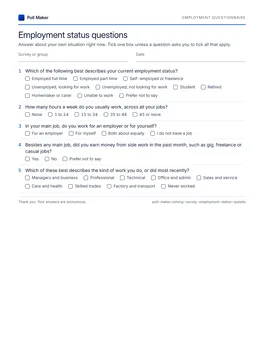
Employment questionnaire
Page one holds the core block as tick-box questions. The short versions, the labour-force sequence and both routed sets come after it, so you can stop printing wherever your form ends.
Download PDFEmployment status questions people ask
Short answers for survey writers, and for anyone staring at the question on a form.
How do I answer "What is your current employment status?"
Choose the option that describes your situation today. With a job, pick employed full time (usually 35 hours a week or more) or part time. If you work for yourself, pick self-employed. With no paid work, pick unemployed and looking, or the option that fits best: student, retired, homemaker or carer, or unable to work.
What are the standard answer options for employment status?
Employed full time, employed part time, self-employed or freelance, unemployed and looking for work, unemployed and not looking, student, retired, homemaker or carer, unable to work, and prefer not to say.
Is a student with a part-time job employed?
In official statistics, yes: paid work comes first. In your own survey, decide what you need and say so in the question, or use the tick-all version so students can choose both.
Should employment status be single choice or tick all that apply?
Single choice when you want one clean segment to split results by, which is most surveys. Tick all when overlaps are the point, for example in student or older-adult surveys.
Where should the employment question go in a survey?
At the end, with the other background questions, so it does not colour the answers before it. Put it first only when you use it to screen people or route them to different questions.
Add the employment question to your survey
Open the core block in the builder, add a version from the sets above, and your survey has a work status question people answer in seconds.