Wellness questionnaire for adults: 36 questions across the eight areas of wellness
Good wellness questions look at the whole person: body, feelings, friends, mind, work, money, surroundings and sense of purpose. In the core 12, every one of those eight areas gets its own statement, joined by a general health rating and the CDC's mental health days question. It takes an adult about four minutes, which suits a staff wellness program, a gym or a community group.
- 36questions
- 12in the core
- 4 minto answer the core
- 8areas of wellness
By Michael Hodge, BSc Psychology Updated September 2026
The 36 health and wellness questions
Every question shows its options and why it earns a place. The core 12 starts selected; add a set for the areas you plan to act on, then open it online, print it or copy the wording.
The wellness wheel 1212 questions
One general health question, one statement for each of the eight dimensions, a count of hard days, a focus area and one open question. Scored on its own, it draws a full wellness wheel.
-
How would you rate your health overall right now?
ExcellentVery goodGoodFairPoorThe same five answers the CDC uses, so your group can be set beside national data. A single rating like this tracked mortality across 22 cohort studies.3
-
My body has enough energy for a normal day.
Strongly disagree12345Strongly agree1 = Strongly disagree, 5 = Strongly agreePhysical wellness asked as what the body lets someone do, which a group survey can ask without weight or diagnoses.
-
Hard feelings rarely take over my whole day.
Strongly disagree12345Strongly agree1 = Strongly disagree, 5 = Strongly agreeEmotional wellness: whether someone can feel a bad moment and still get on with the day.
-
If things went wrong, I know who I would call.
Strongly disagree12345Strongly agree1 = Strongly disagree, 5 = Strongly agreeSocial wellness in its most useful form. A low score marks the people a program most needs to reach.
-
Something I am learning keeps my mind curious.
Strongly disagree12345Strongly agree1 = Strongly disagree, 5 = Strongly agreeIntellectual wellness. It is the dimension most surveys forget, and one of the cheapest to support.
-
My work, studies or volunteering feel worthwhile.
Strongly disagree12345Strongly agree1 = Strongly disagree, 5 = Strongly agreeOccupational wellness covers any daily role, so retirees, students and volunteers can all answer.
-
Money worries rarely keep me up at night.
Strongly disagree12345Strongly agree1 = Strongly disagree, 5 = Strongly agreeFinancial wellness as felt pressure, not income. Nobody has to share a figure to answer it.
-
I feel safe in the places where I live and work.
Strongly disagree12345Strongly agree1 = Strongly disagree, 5 = Strongly agreeEnvironmental wellness starts with being safe and feeling safe, as SAMHSA defines it.1
-
I know what matters most to me in life.
Strongly disagree12345Strongly agree1 = Strongly disagree, 5 = Strongly agreeSpiritual wellness in plain words: meaning and values, with or without religion.
-
In the past 30 days, on how many days was your mental health not good (stress, low mood or worry)?
None1 to 45 to 1314 or moreThe CDC counts 14 or more days as frequent mental distress, so the top band gives a share you can compare with the national figure.6
-
Which area would you most like to feel better about?
Body and energyFeelings and stressFriends and familyLearningWork or studiesMoneyHome and safetyMeaning and purposePeople often pick a different area from their lowest score. When they do, start with the one they chose.
-
What one change would make the biggest difference to how you feel day to day?
Open answerThe answers turn a wheel of scores into a short list of things people would actually use.
Body and energy4 questions
Add these when a program offers health checks, activity sessions or support for people living with pain.
-
In the past 30 days, on how many days was your physical health not good (illness or injury)?
None1 to 45 to 1314 or moreThe physical partner of the mental health days question. Fourteen or more days marks frequent physical distress.6
-
I can do the physical things my day asks of me.
Strongly disagree12345Strongly agree1 = Strongly disagree, 5 = Strongly agreeFunction rather than fitness. It fits a 25-year-old and an 80-year-old equally well.
-
Aches or pain rarely stop me doing what I want.
Strongly disagree12345Strongly agree1 = Strongly disagree, 5 = Strongly agreePain that limits a day pulls down almost every other dimension, so it is worth asking directly.
-
When did you last have a routine check-up?
Under a year ago1 to 2 years agoOver 2 years agoNot sureTells a program whether a screening day or a reminder would reach people who have fallen out of routine care.
Mind and mood4 questions
For emotional and intellectual wellness in more depth, when stress or burnout is the reason for asking.
-
In the past two weeks, how often have you felt stressed?
NeverRarelySometimesOftenAlwaysA frequency, not a yes or no. Everyone feels stress; what matters is how much of the fortnight it filled.
-
I bounce back fairly quickly after a bad day.
Strongly disagree12345Strongly agree1 = Strongly disagree, 5 = Strongly agreeRecovery is a skill a program can teach. A low score with high stress shows who would gain most.
-
I notice early when stress starts to build.
Strongly disagree12345Strongly agree1 = Strongly disagree, 5 = Strongly agreeEarly warning is the first step in most stress courses, so this shows whether one is needed.
-
How often do you do something just for fun?
Most daysA few times a weekAbout once a weekLess oftenPlay and hobbies feed emotional and intellectual wellness at once. Less often than weekly is a clear signal.
After a wellness program (participants answer)5 questions
Send these to people who took part in a wellness program, challenge or health fair, alongside the core 12 so you can compare with the first round.
-
Which parts of the program did you use?
TalksChallengesCoachingHealth checksOnline toolsNoneTick all that applyShows what people actually used, which is rarely what got the most promotion.
-
The program fitted around my week.
Strongly disagree12345Strongly agree1 = Strongly disagree, 5 = Strongly agreeTiming and format decide who takes part at all. A low score explains a low sign-up.
-
I changed at least one habit because of it.
Strongly disagree12345Strongly agree1 = Strongly disagree, 5 = Strongly agreeThe outcome question: did anything change, in the participant's own view?
-
How likely are you to recommend this program to a friend or colleague?
0123456789100 = Not at all likely, 10 = Extremely likelyA 0 to 10 score you can track from one round to the next.
-
What should the program offer next time?
Open answerParticipants are the best source of the next idea. Sort the answers by dimension.
Work, money and home5 questions
For occupational, financial and environmental wellness: the practical pressures that sit behind many low scores.
-
My workload leaves me energy for life outside it.
Strongly disagree12345Strongly agree1 = Strongly disagree, 5 = Strongly agreeWorkload is where occupational wellness most often breaks, and it drags down body and mood with it.
-
I could pay an unexpected bill this month.
Strongly disagree12345Strongly agree1 = Strongly disagree, 5 = Strongly agreeA concrete test of money slack that people can answer without sharing income or savings.
-
I feel in control of my money.
Strongly disagree12345Strongly agree1 = Strongly disagree, 5 = Strongly agreeControl, not wealth. It points to budgeting help rather than a pay question.
-
I can get outside or to green space when I want.
Strongly disagree12345Strongly agree1 = Strongly disagree, 5 = Strongly agreeAccess to nature and fresh air is part of environmental wellness that a workplace or campus can change.
-
My home is a good place to rest.
Strongly disagree12345Strongly agree1 = Strongly disagree, 5 = Strongly agreeNoise, crowding or an unsafe home show up here long before anyone says them out loud.
People and purpose4 questions
For social and spiritual wellness, when a group feels isolated or is going through a big change.
-
How often do you feel lonely?
NeverRarelySometimesOftenAlwaysAsked directly and plainly. People answer this more openly than a string of hints about their social life.
-
Most weeks I see people I care about.
Strongly disagree12345Strongly agree1 = Strongly disagree, 5 = Strongly agreeContact in person or on a call. A low score with low loneliness usually means a busy stretch, not isolation.
-
There is a club, team or group where I feel at home.
Strongly disagree12345Strongly agree1 = Strongly disagree, 5 = Strongly agreeBelonging beyond family: a club, a faith group, a team, a neighbourhood.
-
My days connect to something I believe in.
Strongly disagree12345Strongly agree1 = Strongly disagree, 5 = Strongly agreePurpose shows up in ordinary days, not only in big decisions. This asks whether it does.
About you (optional)2 questions
Useful when age bands or daily roles matter to the plan. Keep each subgroup large enough to stay anonymous.
-
What is your age?
18 to 2930 to 4445 to 6465 or overPrefer not to sayMental distress runs higher in younger adults nationally, so age bands help you read the days question.4
-
How do you spend most of your week?
WorkingStudyingCaring for familyRetiredSomething elseLets you read the occupational statement against each person's main daily role.
The eight dimensions of wellness, one core question each
SAMHSA's wellness model splits wellbeing into eight connected parts. Here is what each covers and the core statement that measures it.
| Dimension | What it covers | Core statement |
|---|---|---|
| Physical | Energy, activity, sleep, food and health care | Enough energy for a normal day |
| Emotional | Coping with stress, expressing feelings, enjoying life | Hard feelings rarely take over |
| Social | Friends, family and community | I know who I would call |
| Intellectual | Learning, creativity, new ideas | Learning keeps my mind curious |
| Occupational | Meaning from work, study or volunteering | My daily role feels worthwhile |
| Financial | Income, debt, savings and feeling secure | Money worries rarely keep me up |
| Environmental | Safe, pleasant places to live and work | I feel safe where I live and work |
| Spiritual | Meaning, values, purpose and peace | I know what matters most to me |
The dimensions lean on each other. SAMHSA's own example: money worries bring anxiety, anxiety turns into physical problems and trouble at work, and a person can end up questioning their sense of purpose.1 That chain is why a wellness survey with only body questions misses most of the picture.
Need more depth on one area? The lifestyle survey questions count daily habits such as sleep hours, fruit and vegetables and alcohol, and the work-life balance questionnaire goes further into hours and workload. Other health topics are grouped under our healthcare survey questions.
Printable wellness questionnaire and wheel worksheet
For health fairs, group sessions and coaching intakes where paper is quicker than a link. They print cleanly on A4 or US letter.
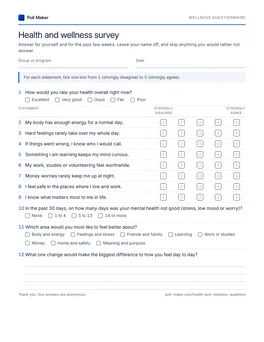
Wellness questionnaire
Page one holds the wellness wheel 12 as tick boxes. Each deeper set follows on its own; print only the ones you need.
Download PDF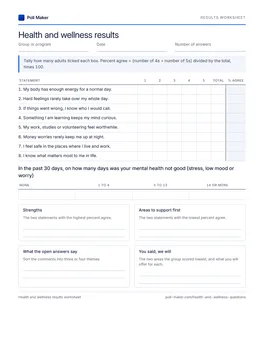
Group results worksheet
Count the answers to each dimension statement, turn them into percent agree, tally the mental health days and choose two areas to act on.
Download PDFScoring a wellness wheel, for one person or a whole group
The eight core statements give each dimension a score from 1 to 5. Plot them on eight spokes and the uneven parts of the wheel are plain to see.
For one person
Give each statement its point value, from strongly disagree as 1 up to strongly agree as 5. If you added a module, average its statements with the core statement for the same dimension. Mark each score on its spoke and join the dots.
A worked example. Priya scores physical 4, emotional 2, social 5, intellectual 3, occupational 4, financial 2, environmental 4 and spiritual 3. Her two lowest spokes are emotional and financial. She picked "Money" as the area to work on, and her open answer says "a plan for paying off my card". Start there: fixing the money worry is also the likeliest way to lift the emotional score.
For a group
Find the percent of the group choosing 4 or 5 on each statement. The report below does it for you and marks the lowest two. For the mental health days question, take the people in the "14 or more" band as a share of all its answers.
A worked example: 40 people answer, and 9 of them report 14 or more days. That is 22.5% of the group. The national figure for US adults in 2024 was 15.6%,4 so this group is carrying more strain than average, and stress support belongs near the top of the plan. The measure describes a group. It does not diagnose anyone in it.
Chart the group's wellness wheel
Type in how many answers landed on each number, for each of the eight dimension statements. Agreement always means the healthier answer, so the dimensions with the least agreement need support first. Print the chart for the people planning your wellness offer.
- 1Tally the eight dimension statements from the core. The report turns each count into the share who agree.
- 2Read the two lowest dimensions next to the focus-area question. Where people's own choice and the lowest score match, the case for acting is strong.
- 3Check the mental health days tally beside the emotional statement. A high share at 14 or more days with low emotional scores calls for stress support first.
- 4Repeat the core after the program and compare the new chart with the first one.
Wellness wheel
Running a wellness survey people answer honestly
Four choices decide whether the answers describe how people really are or how they think they should be.

Cover all eight areas before going deep on one
Most health surveys stop at the body. SAMHSA describes wellness as being healthy in eight dimensions of life, each one affecting the others.1 The core gives every dimension a single statement, so an unexpected low area (money, loneliness, an unsafe home) shows up before you spend a whole survey on exercise.
US adults with 14 or more poor mental health days a month
Count hard days, and put the number in context
The CDC's Healthy Days questions ask how many of the past 30 days someone's physical or mental health was not good.2 A count of days is easier to answer truthfully than a rating of "your mental health", and it lines up with national data: 15.6% of US adults reported 14 or more poor mental health days in 2024, up from 11.2% in 2015.4

Leave medical details out and report only totals
Weight, diagnoses and medication belong in a clinic form, not in a wellness survey run by an employer, school or club. Send an anonymous link, publish figures only for groups of at least ten people, and say so in the first line of the survey. People answer the loneliness and money questions candidly once they know that.

Show the wheel back, then ask again
Share the group's lowest two areas and one thing you will do about each. Eight to twelve weeks later, send the same core 12 and the program set. The general health question is worth watching closely: in a meta-analysis of 22 cohorts, people who rated their health "poor" had about twice the mortality risk of those who said "excellent".3
Starting a wellness session or a team huddle? Put one question on screen and launch it as a quick poll; people answer on their phones. The general health question works well because everyone can answer it in a second. The poll making guide walks through the rest.
Five wellness check-in questions
For a weekly or monthly check-in with a client, a team or yourself, these five fit in about a minute yet still cover health, energy, feelings, support and one next step.
- 01How would you rate your health overall right now?
- 02My body has enough energy for a normal day.
- 03Hard feelings rarely take over my whole day.
- 04If things went wrong, I know who I would call.
- 05What one change would make the biggest difference to how you feel day to day?
Fixes to make before the wellness survey goes out
Each weak question below is common on wellness surveys. Our survey questions guide shows how to repair weak items of every type.
What is your current weight and BMI?
My body has enough energy for a normal day.
Weight is sensitive, people skip it, and it tells a group program very little. Energy for the day is something a program can change.
How is your physical and mental health?
How would you rate your health overall right now?
In the past 30 days, on how many days was your mental health not good?
Two questions in one. Someone fit but struggling has no honest answer.
Are you stressed? (Yes / No)
In the past two weeks, how often have you felt stressed?
Almost everyone says yes. A frequency shows who is stressed now and then and who is stressed most days.
Are you happy with your work-life balance and finances?
My workload leaves me energy for life outside it.
I feel in control of my money.
Two dimensions in one sentence, and "happy" invites a polite answer. Split them and ask about something concrete.
Wellness survey questions people ask
Short answers for wellness leads, coaches, teachers and anyone checking in on themselves.
What are the 8 dimensions of wellness?
Physical, emotional, social, intellectual, occupational, financial, environmental and spiritual. SAMHSA uses these eight, adapted from Swarbrick (2006), and they are the backbone of most wellness wheels. The core 12 above has one statement for each.
What are good wellness check-in questions?
Keep a check-in to five: general health, energy, how feelings are going, who you would call, and one change that would help. They take a minute, so you can repeat them weekly and see a trend.
How do you score a wellness questionnaire?
Give each dimension a score from 1 to 5 from its statement, average in any module statements for the same dimension, and draw the scores on an eight-spoke wheel. For a group, use the percent who agree with each statement and act on the lowest two.
Is this a validated wellness assessment?
No. The questions are original, apart from the two CDC days questions, and are built for programs, coaching and class projects. For clinical or research use, the WHO-5 Well-Being Index is a short published scale with strong validity evidence.5
Can an employer or school run a health and wellness survey?
Yes, as long as it stays anonymous and reports only group totals. Leave out weight, diagnoses and medication, and tell people up front how the results will be used. For school-age students, the student health survey is written in their words.
Check in on your group this month
Open the wellness wheel 12 in the builder, pick the extra sets for areas you can support, and send the link today. Running a session instead? Print the questionnaire and the worksheet.