What students and parents think of school lunch, in 39 questions
A school lunch survey asks students how the food tastes, whether there is enough of it and enough choice, whether they get time to sit and eat, and what one change they want. The core 10 below does that in about three minutes.
- 39questions
- 10in the core
- 3 minto answer the core
- Grade 3to grade 12
By Michael Hodge, BSc Psychology Updated September 2026
The lunch question bank, from the menu to the tray check
The core 10 comes pre-selected. Bolt on the menu, lunch line, tray check, cafeteria or parents set, or tick lines one at a time. Every lunch question shows the choices students tick and why the cook or principal would care.
The core 1010 questions
Where lunch comes from and how often students eat it, six statements about the food and the time to eat it, a forced choice, then an open question. It fits into the last minutes of a lunch period.
-
On a normal school day, where does your lunch come from?
The school cafeteriaPacked from homeBought off campusI skip lunchIt changes day to daySplits the room before any rating. Read every later answer by this one: students who pack or skip are the ones a menu change has to win over.
-
How many days a week do you eat the school lunch?
Every day3 or 4 days1 or 2 daysLess than once a weekNeverParticipation in the students' own count. Track it term by term, because the lunch program's budget rides on it.
-
School lunch tastes good on most days.
Strongly disagree12345Strongly agree1 = Strongly disagree, 5 = Strongly agreeLiking the food is the second most common reason students give for eating school lunch, after being hungry.1
-
There is enough food to fill me up.
Strongly disagree12345Strongly agree1 = Strongly disagree, 5 = Strongly agreePortion size as the student feels it. Read it by grade: the same tray can fill a fourth grader and leave a tenth grader hungry.
-
I can find something I want to eat most days.
Strongly disagree12345Strongly agree1 = Strongly disagree, 5 = Strongly agreeVariety judged on the day, not across the menu calendar. A low score says the choices reach too few students.
-
School lunch includes foods my family eats at home.
Strongly disagree12345Strongly agree1 = Strongly disagree, 5 = Strongly agreeFamiliarity. It is one of five views of lunch, with liking, amount, variety and healthfulness, that went with eating school lunch more often among 1,230 middle and high school students.4
-
School lunch is good for my health.
Strongly disagree12345Strongly agree1 = Strongly disagree, 5 = Strongly agreeHealthfulness as students see it. Read it beside the taste statement to learn whether the menu needs better cooking or a better story.
-
I have enough time to sit down and eat my lunch.
Strongly disagree12345Strongly agree1 = Strongly disagree, 5 = Strongly agreeTime at the table, not the length of the lunch period. Students with 25 minutes or more to eat ate more of their main dish, vegetables and milk.2
-
Which ONE change would make school lunch better for you?
Better-tasting foodBigger portionsMore choicesMore time to eatA shorter lineForces a pick between the fixes, so the tally puts them in order. The open question after it says how.
-
What would make you want to eat school lunch more often?
Open answerReaches the students who pack or skip. They name what keeps them away, which no rating can show.
Time to eat and the lunch line4 questions
For timetable decisions: how long students really get at the table, how long they queue and where recess falls.
-
After you get your food, how many minutes do you have to eat?
Less than 1010 to 1415 to 1920 to 2425 or moreSeated time in bands. Students with at least 25 minutes at the table picked up fruit more often than those with under 20.2
-
If you buy school lunch, how long do you usually wait in line?
Less than 5 minutes5 to 9 minutes10 to 14 minutes15 minutes or moreThe line is where lunch time goes. A longer wait in one lunch period points to staffing or the order classes arrive.
-
Does recess come before or after your lunch?
Before lunchAfter lunchNo recessNot sureFor elementary and middle schools. When three Utah elementary schools moved recess before lunch, students ate 54% more fruit and vegetables.3
-
How often do you leave food because time ran out?
NeverOnce in a whileAbout half the timeMost daysTies waste to the clock. If this is common, more seated time may cut waste faster than a new recipe.
Right after lunch: the tray check5 questions
Hand it out at the tray return or ask it in the first class after lunch, while the meal is fresh. Run it for a week and it doubles as a food waste study.
-
If you took a main dish today, how much of it did you eat?
All of itMost of itAbout halfA littleNoneAsked straight after lunch, even third graders report what they ate closely enough to count.6
-
If you took vegetables today, how much did you eat?
All of itMost of itAbout halfA littleNoneVegetables are the most thrown-away part of a school lunch, so this is where a new recipe or a taste test pays off first.1
-
If you took fruit today, how much did you eat?
All of itMost of itAbout halfA littleNoneFruit is easy to take and easy to leave. Try it sliced, chilled or in a cup and ask again.
-
If you took milk today, how much did you drink?
All of itMost of itAbout halfA littleNoneMilk comes second only to vegetables for waste on lunch trays nationally. Ask about flavor and temperature before changing the order.1
-
If you left food today, what was the main reason?
Did not like itToo muchNo timeNot hungryAte it allTurns the tray check into a to-do list: taste goes to the kitchen, time goes to the timetable.
The cafeteria itself5 questions
For the dining room and the people in it: tables, seats, staff, fairness and noise.
-
The tables are clean when I sit down.
Strongly disagree12345Strongly agree1 = Strongly disagree, 5 = Strongly agreeCleanliness at the moment it matters. A low score in later lunch periods points to the gap between sittings.
-
I can find a seat with my friends.
Strongly disagree12345Strongly agree1 = Strongly disagree, 5 = Strongly agreeLunch is social time too. Low scores usually cluster in one crowded period, so compare periods before adding tables.
-
The cafeteria staff are friendly to me.
Strongly disagree12345Strongly agree1 = Strongly disagree, 5 = Strongly agreeThe people serving lunch set the tone of the room. High scores here are worth passing straight to the kitchen team.
-
Everyone is treated the same in the lunch line.
Strongly disagree12345Strongly agree1 = Strongly disagree, 5 = Strongly agreeChecks that free and paid meals look alike. In a San Francisco pilot, school lunch participation rose after separate a la carte lunch offerings were removed.8
-
I can talk with my friends at lunch without shouting.
Strongly disagree12345Strongly agree1 = Strongly disagree, 5 = Strongly agreeNoise, asked the way students notice it. Compare lunch periods before blaming the room.
About you (optional)2 questions
Useful when you want results split by grade band or lunch period. Leave out any group with just a handful of students in it.
-
What grade are you in?
Grade 3 to 5Grade 6 to 8Grade 9 to 12Prefer not to sayElementary students eat school lunch at higher rates than older students, so read results by grade band, not as one school number.1
-
Which lunch period do you have?
FirstSecondThirdFourth or laterLine length, seats, food temperature and clean tables can all change by period. This shows which period needs the fix.
Parents and guardians (parents answer)8 questions
A short set for families, sent home or by email. It covers what students cannot: packed lunches, cost and what the school tells home.
-
How many days a week does your child eat the school lunch?
Every day3 or 4 days1 or 2 daysLess than once a weekNeverThe family view of participation. Read the rest of this set by it, since families of daily eaters and of non-eaters want different things.
-
When your child takes a packed lunch, what is the main reason?
My child prefers food from homeTaste or choice of school foodAllergy or special dietCostNot enough time to eatA child preferring food from home is the reason parents give most for skipping school lunch. The other answers are the ones a school can change.1
-
School lunches are healthy.
Strongly disagree12345Strongly agree1 = Strongly disagree, 5 = Strongly agreeParents who see school meals as tasty and healthy have children who eat them more often.5
-
School lunch saves our family time and money.
Strongly disagree12345Strongly agree1 = Strongly disagree, 5 = Strongly agreeThe family benefit. Parents who saw school meals saving money, time and stress had children who took part more.5
-
I know what my child is served at school each day.
Strongly disagree12345Strongly agree1 = Strongly disagree, 5 = Strongly agreeMenu communication. A low score is fixed with a menu that reaches home, such as a weekly email, not with a new recipe.
-
Paying for school meals, or applying for free meals, is simple.
Strongly disagree12345Strongly agree1 = Strongly disagree, 5 = Strongly agreeCovers the meal account and the application form. Leave it out where every student eats free.
-
What matters most to you about school lunch?
Healthy foodFood my child will eatLow cost or freeFoods from our cultureEnough time to eatOne priority per family. Compare it with the students' one-change vote to see where the two agree.
-
What would you like the school to tell you about lunch?
Open answerFamilies ask about the menu, ingredients, allergy handling or payments. Each answer is a newsletter item.
What lunch research says to ask about
Four findings from school meal studies, and where each one sits in the survey.

Count minutes at the table, not the bell schedule
The lunch period and the time to eat are not the same thing, because the line uses up part of it. In one district where lunch periods ran 20 to 30 minutes, students ended up with anywhere from 10 to 33 minutes to eat. Those with at least 25 minutes took fruit more often (57% against 44% for students with under 20) and ate more of their main dish, vegetables and milk.2 Recess timing counts too: when three elementary schools moved recess before lunch, fruit and vegetable eating rose 54%.3 The core asks whether students have time to sit and eat; the time set turns that into minutes, line waits and recess order.
Share of each food thrown away from school lunch trays
Ask what came back on the tray
The food students leave shows what to fix first. USDA's national study observed 6,253 lunch trays in 165 schools and found vegetables, milk and fruit thrown away most, main dishes least.1 Students can report this themselves: a paper recall that third to fifth graders filled in right after lunch closely matched what trained observers recorded.6 The tray check asks about four foods in under a minute, and a week of it shows your own cafeteria's pattern.

Offer a new food more than once
First impressions of a new food are not the final word. In a cafeteria tasting program, first, third and fifth graders tried four fruits or four vegetables on alternate weeks for eight weeks. Children who began by disliking them liked every item more by the end, and still did at follow-ups four and ten months later.7 Let the menu vote pick the candidates, then give the winner several tastings before the survey judges it.
Hear from students who pack or skip
The students missing from the cafeteria have some of the most useful answers. Nationally, students who eat school lunch say they do it mainly because they are hungry, like the food or find it convenient, and the top reason for not eating it is preferring lunch from home.1 Hand the survey out in class rather than in the lunchroom so packed-lunch students answer too, then read the variety and familiar-foods statements by where lunch comes from. Among 1,230 middle and high school students, better views of lunch quantity, variety, healthfulness and familiarity went with eating it more often.4
Down to a few new dishes? Put the menu question on the cafeteria screen as a quick lunch poll and let students vote by Friday. The poll how-to page covers setting one up and sharing its link.
Find the first job for the kitchen
Copy in the tallies for every point, counted by hand off the paper copies or read off the online results. Every bar is the share of students agreeing with that statement, and the shortest one names the first job for the kitchen or the timetable.
- 1Any tick in box 4 or box 5 counts as agreement, and the panel turns those ticks into a percent of the students who rated that line.
- 2Make a second chart for students who eat school lunch twice a week or less. Their lowest bars explain the empty seats.
- 3Line the lowest bar up with the one-change vote and the open answers. If all three agree, you have found the first change.
- 4Post the chart by the serving line with the change you picked, then ask the same statements again next term.
Lunch results
From menu vote to taste test
The survey tells you what students want. A taste test tells you whether the kitchen's version of it works. Here is the loop, start to finish.
- Vote. Put three to five dishes your kitchen can make into the menu question and leave it open for a week, online or as a live poll.
- Taste. Serve small samples of the top two at lunch. The food tasting questions give students a short card to score each sample.
- Taste again. Offer the winner more than once before you judge it. Children in a cafeteria tasting program liked fruits and vegetables more after repeat tastes, and still did ten months later.7
- Check the trays. Once it is on the menu, run the tray check for a week and see how much of it comes back.
- Say so. Put the result on the menu board: "You voted, it is on Thursdays." It is the best invitation to the next survey.
Homeroom copies, so packers and skippers answer too
Hand the paper version out in homeroom so students who pack lunch or skip it answer too. Any school printer handles it, and a pencil is all students need.
The parents set prints on its own sheet, ready to go home in backpacks.
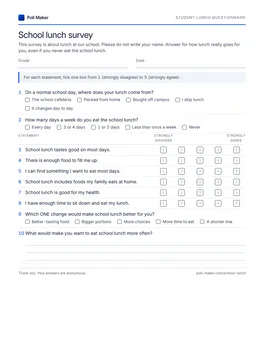
Student lunch questionnaire
The core 10 fills page one with tick boxes and one written answer. The menu, time, tray check and cafeteria sets follow, and the parents set prints on its own sheet to send home.
Download PDF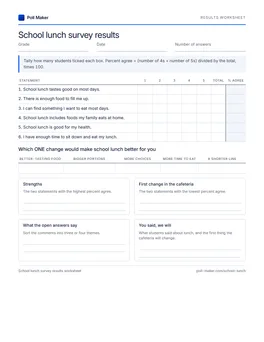
Results worksheet
Tally the six lunch statements and the change vote with a pencil, turn each tally into a percent that agree, and note the first change for the cafeteria at the bottom.
Download PDFEvery month at the tray return: the same five
Ask the same five every month, from a QR code at the tray return or in homeroom, and within a term you can see whether a menu or timetable change landed: taste, amount, choice, time to eat and the change students want most.
- 01School lunch tastes good on most days.
- 02There is enough food to fill me up.
- 03I can find something I want to eat most days.
- 04I have enough time to sit down and eat my lunch.
- 05Which ONE change would make school lunch better for you?
A lunch survey plan for student councils and class projects
Students running their own cafeteria survey get fairer, more complete answers with a plan. This one covers what a teacher or advisor will ask about.
| Decision | What to do | Why |
|---|---|---|
| Who to ask | Every grade and every lunch period, including students who pack lunch or skip it | A survey handed out in the lunch line misses the students the menu is not reaching |
| How to hand it out | Paper in homeroom or a link shared in class, on one day, with a teacher's OK | One day in class reaches nearly everyone, not just the keenest |
| Keeping it fair | No names, neutral wording, a choice for every opinion, nothing about who gets free meals | Students write what they think when nobody can trace it back |
| Testing it | Pilot it with a handful of students from another class and reword anything they stumble on | One confusing question can spoil a whole column of answers |
| Counting | Percent agreeing per statement, the one-change tally, and three or four themes from the open answers | All of it fits on one poster or slide |
| Presenting | Meet the food services director before you start, then bring back the results and one or two requests | A director who helped shape the survey has a stake in acting on it |
For surveys about the rest of school life, from the library to school safety, browse education survey questions.
Cafeteria questions that leave the kitchen guessing
Cafeteria surveys keep asking these four, and the answers leave the kitchen guessing. The same repairs work for other survey questions by topic.
How satisfied are you with the school lunch program?
School lunch tastes good on most days.
I have enough time to sit down and eat my lunch.
One satisfaction score blends the food, the line and the clock. Separate statements tell the kitchen and the timetable which problem is theirs.
Is the food tasty and healthy?
School lunch tastes good on most days.
School lunch is good for my health.
Taste and health in one breath. Lunch can be healthy but bland, and a student who thinks so is stuck between yes and no.
Do you get free or reduced-price lunch?
Everyone is treated the same in the lunch line.
Asking who gets free meals singles students out and tells you nothing about the lunch. Ask about fair treatment instead.
Don't you love our new pizza day?
Which new dish should go on the menu next?
A leading question collects polite yeses. A vote between real options shows what students would pick.
Before you survey the lunchroom
Quick answers for cafeteria managers, principals, student councils and parents.
What are 10 good survey questions about school food for students?
The ten in the core set above: where lunch comes from, how many days a week students eat it, six statements on taste, enough food, choice, familiar foods, health and time to eat, the one change they would pick, and what would get them eating it more often. Students finish in about three minutes.
How do you survey parents about school lunch?
Use the parents and guardians set: eight questions on how often their child eats school lunch, why they pack one, whether meals seem healthy and good value, and what they want to hear from school. Send it home by email or in the newsletter, apart from the student survey, and set the family answers beside what the students said.
How can a school find out which lunch option students prefer?
Run a poll. Put three to five dishes in the menu question, share it on the cafeteria screen or in homerooms, and close it after a week. A poll gives a clear winner faster than a full survey.
How do taste tests and surveys improve cafeteria menus?
The survey picks the candidates and the taste test proves them. Students vote on new dishes, taste the top ones more than once, and the tray check shows whether the winner gets eaten once it is on the menu.
Does this work for a school canteen or a college dining hall?
Yes. In the builder, swap "school lunch" for "the canteen" or "the dining hall". For college students, drop the recess question and the parents set; the rest fits as it is.
Ask the lunchroom before the next menu
Send the core 10 to the builder and drop its link into the homeroom announcements, or print a class set for the week the new menu starts.