A tourism questionnaire for visitors as they leave
A tourism questionnaire should find out why people came, how long they stayed, who came with them, what the visit was like and whether they will return. The 12-question visitor core covers all of that and takes about four minutes to answer. Add the sets on planning, spending, attractions and responsible travel when you need them.
- 34questions
- 12in the visitor core
- 4 minto answer the core
- Day tripsand overnight stays
By Michael Hodge, BSc Psychology Updated September 2026
Why they came, what they spent: 34 questions
The visitor core comes ticked. Tick a whole set or just the lines you want. Each question shows the choices a visitor picks from plus what a tourism office learns from it. Send the finished set by link or QR card, print it for fieldwork, or paste it into another survey tool.
Visitor core12 questions
Three facts about the trip, six statements about the visit, the two loyalty questions and one open answer. Ask it on the last day, or as people leave.
-
What is the main purpose of this trip?
Holiday, leisure or recreationVisiting friends or relativesBusiness or a work eventEducation or trainingHealth or wellnessReligion or pilgrimageSomething elseOne main purpose per trip, in the categories official tourism figures use, so your split can sit next to the national one.1
-
How many nights are you spending here on this trip?
None, it is a day trip1 to 3 nights4 to 7 nights8 to 14 nightsMore than 14 nightsSeparates day visitors from overnight tourists, and gives you the nights to divide spending by.1
-
Including you, how many people share the costs of this trip?
Just me2 people3 or 4 people5 or 6 people7 or moreThe size of the travel party. Without it, a group total cannot become spending per visitor.1
-
Overall, I am satisfied with my visit.
Strongly disagree12345Strongly agree1 = Strongly disagree, 5 = Strongly agreeThe single answer most closely tied to coming back and recommending. Read the other five statements to see why it is high or low.3
-
It was easy to get around once I arrived.
Strongly disagree12345Strongly agree1 = Strongly disagree, 5 = Strongly agreeTransport, parking and walking routes in one statement. Split it by how people travelled here to see whether visitors without a car struggle.
-
I felt safe during my visit.
Strongly disagree12345Strongly agree1 = Strongly disagree, 5 = Strongly agreeVisitors weigh safety quietly and rarely write about it, so ask it directly.
-
The things I did here were worth what I paid.
Strongly disagree12345Strongly agree1 = Strongly disagree, 5 = Strongly agreeValue rather than price. A cheap place can still feel poor value, and an expensive one can feel fair.
-
Local people made me feel welcome.
Strongly disagree12345Strongly agree1 = Strongly disagree, 5 = Strongly agreeHospitality from shop staff, drivers and residents, which no single business controls.
-
The visit lived up to what I expected before I came.
Strongly disagree12345Strongly agree1 = Strongly disagree, 5 = Strongly agreeCompares the trip with your own marketing. A low score here and a high one on value means the promise is too big.
-
How likely are you to recommend this destination to a friend?
0123456789100 = Not at all likely, 10 = Extremely likelyThe loyalty question that still counts when a visitor never returns. Track the share who answer 9 or 10 season by season.3
-
Do you plan to visit again?
Yes, within a yearYes, in the next few yearsMaybeProbably notNoAsked apart from recommending, because a visitor from far away may love the place and still never come back.
-
What one thing would have made your visit better?
Open answerOne change, in the visitor's words. Sort the answers into piles; the largest pile is next season's first job.
Your trip and how you planned it6 questions
For tourism offices and marketers who need to know how visitors choose, book and travel.
-
How did you first hear about this destination?
Friends or familySocial mediaSearch engine or travel websiteTravel agent or tour operatorGuidebook, magazine or TVI have been here beforeTick all that applyShows which channels bring people in. Compare it with where your marketing budget goes.
-
What made you choose this destination?
Scenery and natureHistory and cultureFood and drinkAn event or festivalGood pricesClose to homeFriends or family live hereTick all that applyThe reasons to lead with in your marketing, straight from people who picked you.
-
How far ahead did you decide to take this trip?
Less than a week1 to 4 weeks1 to 3 monthsMore than 3 monthsTells you when to advertise. Short lead times favour last-minute offers; long ones favour early booking.
-
How did you travel here?
CarPlaneTrainBus or coachBoat or ferryBicycle or on footThe main mode of transport, one of the standard trip facts. Car-heavy answers make parking a priority.1
-
Where are you staying on this trip?
Hotel or resortVacation rentalB&B or guesthouseHostelCampsite or RV parkWith friends or relativesNot staying overnightVisitors who stay with friends or relatives often pay nothing for a bed, which changes what they spend.1
-
How did you book your accommodation?
Directly with the hotel or hostThrough a booking website or appThrough a travel agent or tour operatorI did not need to bookShows how much of your visitors' booking runs through outside sites, and who a local business needs to be listed with.
What your group spent4 questions
Ask these on the last day, while the receipts are still in a pocket. Together with party size, they give you spending per visitor.
-
About how much has your group spent here in total, not counting travel to get here?
Under $100$100 to $249$250 to $499$500 to $999$1,000 or moreThe group total, easier to recall than one person's share of shared bills. Change the currency and bands to fit your area.1
-
Which of these did your group spend money on here?
AccommodationFood and drinkLocal transportAttractions, tours and activitiesShoppingA package booked in advanceTick all that applyThe spending categories official tourism statistics use, so you can see which local businesses gain from visitors.1
-
Compared with what you planned, did you spend:
Much lessA little lessAbout what I plannedA little moreMuch moreSpending well over plan points to high prices or good extras; read it next to the value statement.
-
Was any part of this trip a package, with travel and accommodation sold together?
Yes, a packageNo, booked separatelyNot surePackage spending is paid before the trip, often outside the area, so keep it apart when you add up local spending.1
Attractions and activities6 questions
For destinations with several sights, or an attraction that wants the wider picture of the day.
-
What did you do during your visit?
SightseeingMuseums or heritage sitesBeaches, parks or natureEating outShoppingAn event or festivalOutdoor sport or adventureTick all that applyThe activity mix. A big share in one activity shows what the place is really known for.
-
Which place or activity was the highlight of your visit?
Open answerNames what to feature in your photos and itineraries, in the words visitors use.
-
Opening hours of the places I wanted to see suited my plans.
Strongly disagree12345Strongly agree1 = Strongly disagree, 5 = Strongly agreeOpening hours are one of the cheapest things to change once you know they clash with visitors' days.
-
Signs and visitor information were easy to find and follow.
Strongly disagree12345Strongly agree1 = Strongly disagree, 5 = Strongly agreeCovers maps, signs and the visitor centre. Split it by first-time and repeat visitors; newcomers depend on signs most.
-
The places I visited were easy to access for everyone in my group.
Strongly disagree12345Strongly agree1 = Strongly disagree, 5 = Strongly agreeSteps, paths and toilets for children, older visitors and anyone with limited mobility.
-
I could enjoy the places I visited without heavy crowds.
Strongly disagree12345Strongly agree1 = Strongly disagree, 5 = Strongly agreeCrowding by season. Split it by month to see when capacity is the problem.
Travelling responsibly3 questions
For ecotourism, national parks and places planning a sustainable tourism strategy. These ask what visitors did, not how green they feel.
-
How did you mostly get around during your stay?
Walking or cyclingPublic transportMy own carA rental carTaxi or ride shareTour bus or shuttleLocal travel is where a visit's footprint and traffic come from, and it is easy to measure.
-
How often did you choose locally owned shops and restaurants?
NeverRarelySometimesOftenAlwaysTells you how much visitor spending stays with local businesses.
-
I would visit outside the busiest months if there were good reasons to.
Strongly disagree12345Strongly agree1 = Strongly disagree, 5 = Strongly agreeTests appetite for off-season travel, the first step in spreading visitors across the year.
About you (optional)3 questions
Add these for splitting results by market or age. Keep each reported group big enough that no visitor stands out.
-
Where do you live?
In this regionElsewhere in this countryIn another countrySeparates local, domestic and international visitors, the three groups tourism figures report on.1
-
How old are you?
18 to 2425 to 3435 to 5455 to 6465 or olderPrefer not to saySatisfaction, activities and spending often split by age. Keep the bands wide.
-
Not counting this one, how many overnight trips have you taken in the past 12 months?
None1 or 23 to 56 or moreSeparates frequent travellers, who compare you with many places, from people on their one trip of the year.
Clipboard fieldwork at gates and visitor centres
On a street, at a festival gate or in a visitor centre, a clipboard reaches people who would never open a link. Both PDFs are laid out for letter or A4 sheets.
Out at a gate or a car park?
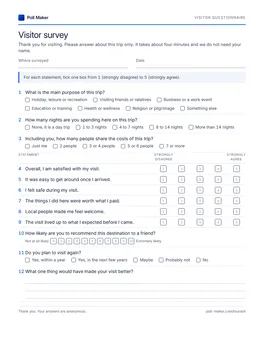
Visitor questionnaire
The visitor core with tick boxes on the first page, then the planning, spending, attractions, responsible travel and About you sets. Take along just the sets your study uses.
Download PDF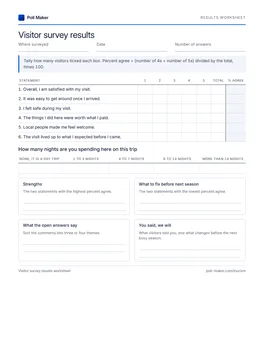
Results worksheet
Tally the six visit statements and the nights question by hand, convert each to a percentage, and note the one thing to fix first.
Download PDFFour decisions that shape a visitor survey
A tourism survey is only as good as where, when and how it is asked. Four habits from official tourism statistics and visitor research.
Main purpose of international tourist arrivals, 2018
Ask for one main purpose, in the standard categories
Every trip has one main purpose, even when people do several things.1 Worldwide, 56% of international arrivals in 2018 were for leisure, recreation and holidays, 27% for visiting friends and relatives, health, religion and other reasons, and 13% for business.2 Use the same categories and you can say whether your place draws more business travel or family visits than the norm, which changes what you promote.

Survey on the way out, not weeks later
Visitors forget details fast. The UN's tourism statistics guidance warns that asking people to report trip spending over a long or distant period brings recall bias.1 Catch them at the end of the trip: at checkout, at the station, at the visitor centre, or with a QR code card handed over on the last evening. An email the next day is the latest that still works.

Count the group before you count the money
Families and friends pool their money, so official statistics record each visitor's travel party and its size.1 Ask for the group's spending and the number of people sharing it, then divide. Asking one person to guess their own share of a shared hotel bill gives a figure nobody can check.

Ask about returning and recommending separately
Satisfaction is the strongest predictor of tourist loyalty. A meta-analysis of 242 studies found it correlated with intention to revisit (r = 0.59) and with intention to recommend (r = 0.58).3 The two answers still part ways for real visitors: someone on a once-in-a-lifetime trip may never return but will send friends. Keep both questions, and read them next to satisfaction.
For a quick answer from past guests or people at an event stand, one question is enough. Ask whether they plan to come back as a live poll for visitors on a screen or in your social posts. Our guide to making a poll walks through QR codes, links and embeds.
Answers that line up with official tourism figures
National statistics offices describe every trip with the same few facts. Ask for them the same way and your local numbers can be compared with the national ones.
| Question on this page | What official statistics call it | What it lets you do |
|---|---|---|
| Main purpose of this trip | Main purpose of a tourism trip (one per trip) | Compare your purpose split with national figures |
| How many nights | Tourist (overnight visitor) or same-day visitor | Count day visitors and overnight tourists separately |
| How many people share the costs | Travel party and its size | Turn group spending into spending per visitor |
| What your group spent money on | Tourism expenditure by product | See which local businesses gain from visitors |
| Where you are staying | Type of accommodation, paid or unpaid | Plan beds and explain low spenders |
| Where you live | Domestic or inbound visitor | Split local, national and international markets |
The definitions come from the UN's International Recommendations for Tourism Statistics 2008.1 A visitor is anyone on a trip outside their usual surroundings for under a year, for any purpose other than being employed where they go; a tourist is a visitor who stays at least one night. If your survey feeds a funding bid or a council report, these are the terms reviewers will expect.
How visitors rated the six parts of the trip
Type how many visitors chose each point on the six visit statements. A visitor who agrees with any of them had a good time on that count, so the shortest bar points to what visitors want fixed before next season.
- 1Enter the tally for every point on every statement; each bar then shows the share of visitors on the agreeing side.
- 2Split the results by main purpose or by day visitors and overnight tourists. Groups often rate the same place very differently.
- 3Put value next to expectations. Good value with unmet expectations points at your marketing, not the place itself.
- 4Read the one-thing answers last. A couple of visitor quotes beside the lowest bar will persuade a council faster than the chart alone.
Visitor core results
Working out spending per visitor
Visitor spending is the number councils and funders ask for first. Three core questions and one from the spending set produce it.
A worked example
A family of four stays three nights and chooses the $500 to $999 band. Take the middle of the band, about $750, and divide it by the four people sharing the costs: $187.50 per visitor for the trip. Divide again by the three nights and you get about $62.50 per visitor per night. For the open top band, use the lowest value, $1,000, so the estimate stays cautious.
Add it up across the sample
Work out the figure for every overnight group, then take the median rather than the average, because a handful of big spenders pull an average up. Do the same for day visitors on their own, since they have no nights to divide by. Keep package trips aside: much of that money was paid before the trip, often to a company outside your area.1
Why bands and a group total
A group total is easier to recall than one person's share of shared bills, and a band is quicker to answer than an exact sum. Asking for categories at the same time (accommodation, food and drink, local transport, activities, shopping) shows where the money lands without asking anyone to add up receipts.
At the car park gate: a one-minute version
At a car park, a station or the visitor centre door, people give you a minute at most. These five capture why they came, how long they stayed, how it went, whether they would recommend you and the fix they want.
- 01What is the main purpose of this trip?
- 02How many nights are you spending here on this trip?
- 03Overall, I am satisfied with my visit.
- 04How likely are you to recommend this destination to a friend?
- 05What one thing would have made your visit better?
For a tourism research project or thesis
Tourism questionnaires are a favourite for dissertations and class projects. Four decisions make the difference between data you can defend and a pile of forms, and one note covers studies of residents.
Stand where visitors leave
Intercept people at exits, the station, the visitor centre or hotel checkout, when the trip is nearly over and they can answer every question. Asking on arrival only gets plans, not experiences.
Spread your sessions
Visitors on a Saturday in August are not the same people as visitors on a wet Tuesday in March. Survey on weekdays and weekends, mornings and afternoons, and in more than one month if you can. Ask every third or fifth person who passes, not whoever looks friendly.
Say who you are and keep it anonymous
Open with one sentence: your name, your college, no names collected, and visitors may skip any question or stop. Interview adults only unless a parent consents. Carry the printed questionnaire on a clipboard; it is quicker to hand over than a phone on a busy street.
Pick a comparison before you start
Numbers become findings when two groups differ: first-time and repeat visitors, day trippers and overnight tourists, or domestic and international visitors. The core already asks what you need for all three splits.
Studying residents instead?
If your project is about how tourism affects a town, the people to ask are residents, not visitors, and they need their own questionnaire. UN Tourism published a draft model questionnaire on residents' perceptions of tourism in 2025 that covers impacts, crowding and support.4
Tourism questions to reword before you send
Each weak version is common in student and council questionnaires. For weak-and-better pairs on other subjects, see our survey question examples.
Did you enjoy your trip?
Overall, I am satisfied with my visit.
What one thing would have made your visit better?
Almost everyone says yes to enjoyment. A rated statement gives you a number to track, and the open question gives you the fix.
How much money did you spend?
About how much has your group spent here in total, not counting travel to get here?
Including you, how many people share the costs of this trip?
The weak version leaves out whose money, where and whether the flight counts. The pair gives a total you can divide per visitor.
How were the transport and accommodation?
How did you travel here?
It was easy to get around once I arrived.
It asks about getting here and sleeping here at once. A visitor happy with the hotel but stuck without a bus has no honest answer.
Would you come back and recommend us?
Do you plan to visit again?
How likely are you to recommend this destination to a friend?
Returning and recommending are different decisions, and far-away visitors often do only the second.
For destination teams and tourism students
For tourism offices, attractions and students planning a visitor survey.
What questions should a tourism questionnaire include?
The main purpose of the trip, how many nights, how many people are in the group, how satisfied visitors are and why, whether they would recommend the place and return, and one open question on what to improve. Add spending, planning and activity questions when your report needs them.
How long should a tourist survey be?
Twelve questions, about four minutes, suits a survey done on the street or at an exit. Online, after the trip, you can add a set or two. For a one-minute interview use the five questions in the exit interview section.
What is the difference between a tourist and a visitor?
In official statistics a visitor is anyone taking a trip outside their usual surroundings for under a year, for any purpose other than a job there. A tourist is a visitor who stays at least one night; a visitor who goes home the same day is a same-day visitor.1
Where is the best place to survey tourists?
Where the trip ends: station platforms, car parks, visitor centres, hotel checkout or the exit of a big attraction. People have finished their visit and can answer every question, including spending.
Can I use these questions for a thesis?
Yes. Load the questions into the builder or print them, keep the wording, and cite the page and its sources in your methods chapter. The research project section above covers sampling and consent.
Catch visitors before they head home
Load the visitor core, tick the sets your report needs, then hand out a QR card at the exit or take the printed questionnaire onto the street.