Festival survey questions for attendees as they leave the site
A festival survey asks the people who came what drew them, how the site worked and whether they will come back. The 11-question attendee survey takes about four minutes at the exit gate. Add sets for the line-up, food, safety or visitor spending when you need them.
- 37questions
- 11in the attendee survey
- 4 minat the exit gate
- 7optional sets
By Michael Hodge, BSc Psychology Updated September 2026
All 37 festival survey questions
The 11 attendee questions come pre-selected. Bring in a full set for the program team, the site crew or your funders, or pick single questions. Under every question sit its options and what an organizer learns from them. Send your pick online, print it for the gates, or paste the text into Google Forms or Microsoft Forms.
The attendee survey11 questions
Two questions on who came and why, five statements on the day itself, two on coming back, then room for the best moment and one change. Use it at the exit gate on the last afternoon, or email it the morning after.
-
Counting this year, how many times have you been to this festival?
This was my first timeTwice3 to 5 times6 times or moreFirst-timers notice the signs, queues and toilets that regulars have learned to work around. Read every other answer for the two groups separately.
-
What was the main reason you came?
The line-upTime with friendsA family day outFood and drinkLocal cultureSomething elseFestivals draw people for different reasons; at one rock festival, being with the group came first. The split tells you what to put on next year's poster.2
-
The performances were worth coming for.
Strongly disagree12345Strongly agree1 = Strongly disagree, 5 = Strongly agreeIn a study of one downtown festival, entertainment quality was the only attribute that fed straight into satisfaction and plans to return. If one statement has to move, make it this one.1
-
Signs and site maps made it easy to find my way around.
Strongly disagree12345Strongly agree1 = Strongly disagree, 5 = Strongly agreeWayfinding. Compare first-timers with regulars before you order new signs.
-
Queues for the gate, food and bars were short enough.
Strongly disagree12345Strongly agree1 = Strongly disagree, 5 = Strongly agreeOne statement for every queue keeps the core short. When it scores low, the one-change answers point to the gate, the food stalls or the bars.
-
The toilets were clean when I used them.
Strongly disagree12345Strongly agree1 = Strongly disagree, 5 = Strongly agreeThe most basic amenity on site. More units, better placement or extra cleaning rounds can fix a low score by next year.
-
I felt safe the whole time I was at the festival.
Strongly disagree12345Strongly agree1 = Strongly disagree, 5 = Strongly agreeCovers the crowds, the lighting and the walk out after dark. A low score goes to the top of the list, above everything else.
-
How likely are you to recommend this festival to a friend or family member?
0123456789100 = Not at all likely, 10 = Extremely likelyScored as a Net Promoter Score: the share answering 9 or 10 minus the share answering 0 to 6. Keep the wording the same every year so the scores compare.7
-
Do you plan to come back next year?
DefinitelyProbablyNot sure yetProbably notDefinitely notThe quality of the entertainment had the strongest pull on plans to return in festival research, so read this beside the performances statement. Follow up the not-sure group first.1
-
What was the best moment of the festival for you?
Open answerNames what to keep, and hands the marketing team quotes in festival-goers' own words.
-
What one change would make next year's festival better?
Open answerOne change, not a wish list. Sort the answers into piles such as toilets, queues, sound or prices, and count each pile.
The line-up and stages4 questions
For the program team. It starts with what people actually saw, so nobody rates a stage they never visited.
-
Which of these did you see or do?
Main stage actsSmaller stagesFood and drink stallsArts and crafts marketWorkshops or talksChildren's activitiesTick all that applyMost festivals mix several art forms. Use this answer to read each rating below only among the people who saw that part.4
-
There was always something on that I wanted to see or do.
Strongly disagree12345Strongly agree1 = Strongly disagree, 5 = Strongly agreeFinds the gaps in the schedule. A low score beside high performance scores means good acts, badly spread across the day.
-
I could hear the performers clearly from where I stood.
Strongly disagree12345Strongly agree1 = Strongly disagree, 5 = Strongly agreeSound is a site decision as much as a stage one: speaker placement and wind change it from one end of the field to the other.
-
Did acts you wanted to see play at the same time?
Yes, more than onceYes, onceNoClashes are a scheduling fix. Repeated clashes point to two stages booking acts for the same fans.
Next year's festival3 questions
For programming and marketing. The last question doubles as a live vote on the stage screens between acts.
-
What would make you more likely to come next year?
A bigger headline actMore local actsLower pricesMore for childrenMore food choiceBetter transportTick all that applyA ranked wish list from the people most likely to buy again. Compare what first-timers chose with what regulars chose.
-
How did you first hear about this year's festival?
Social mediaFriends or familyPosters or flyersLocal news or radioFestival website or emailShows where next year's promotion money will reach people. Split it by first-timers and regulars.
-
Which kind of act would you most like more of next year?
Local bandsBig-name headlinersComedyDJs and danceFamily showsFive options, so it runs as a live poll on a screen or on social media as well as in the survey.
Food, drink and water3 questions
For whoever books the stalls and runs the bars. Ask everyone, not only people who bought something.
-
I could find food that suited my diet.
Strongly disagree12345Strongly agree1 = Strongly disagree, 5 = Strongly agreeVegetarian, vegan, halal, gluten-free and allergy needs in one line. A low score points to a gap in the stall mix.
-
Food and drink prices felt fair for a festival.
Strongly disagree12345Strongly agree1 = Strongly disagree, 5 = Strongly agreeThe words "for a festival" set the yardstick, so the answer compares your stalls with other events rather than with a supermarket shelf.
-
Free drinking water was easy to find.
Strongly disagree12345Strongly agree1 = Strongly disagree, 5 = Strongly agreeOn a hot day this is a safety question as much as a comfort one.
Travel, tickets and getting in3 questions
For operations and the box office. Leave out the value statement at a free festival.
-
How did you travel to the festival today?
CarBus, train or shuttleWalked or cycledTaxi or rideshareAnother wayPlans parking, shuttle runs and bike racks for next year, and gives you a travel footprint if a sponsor asks for one.
-
Getting through the gate was quick.
Strongly disagree12345Strongly agree1 = Strongly disagree, 5 = Strongly agreeEntry is the one part of the day everybody shares. Split it by arrival time to find the hour that needs more gate staff.
-
My ticket was good value for what the festival offered.
Strongly disagree12345Strongly agree1 = Strongly disagree, 5 = Strongly agreeValue, from the people who paid. Read it beside the performances statement before you change prices.
Where visitors came from and what they spent (for funders)7 questions
For grant reports, sponsors and the council. These seven feed a figure for the new money the festival brought into the area; the worked example further down shows the sums.
-
Where do you live?
In this townRest of the regionRest of the countryAbroadSpending by local residents was already in the area, so it stays out of an economic impact figure.5
-
Was the festival the main reason for your trip to this area?
Yes, the main reasonOne of several reasonsNo, I was here anywayI live hereVisitors who were in the area anyway, or moved a planned trip to match the dates, would have spent the money regardless. This question finds them.5
-
On how many days did you come to the festival, counting today?
1 day2 days3 days4 or more daysTurns gate admissions into different people. Three days of gate counts can add up to far more admissions than there were people.5
-
Where are you staying tonight?
At homeHotel, motel or B&BFestival campsiteHoliday rentalWith friends or familyVisitors in paid accommodation tend to spend more than those staying with friends or going home, so each group gets its own average.5
-
How many nights are you spending in the area?
None1 night2 nights3 nights or moreAccommodation is usually the largest single item of visitor spending, and nights are what it is counted in.5
-
Including you, how many people does your spending cover?
Just me2 people3 or 4 people5 or more peopleA parent usually pays for the children. Dividing the total by this number stops a family's spending from being read as one visitor's.5
-
About how much will you spend in this area on this trip, for everyone your spending covers? Leave out festival tickets; include food, drink, shopping, fuel and accommodation.
Open answerOne round total is quicker to answer than a list of categories, and nobody needs receipts.
Crowds, comfort and access4 questions
For the safety officer and the site manager. These four show where the site needs more space, shelter or signs.
-
Crowds near the stages felt well managed.
Strongly disagree12345Strongly agree1 = Strongly disagree, 5 = Strongly agreeSplit the answers by stage and by time of day to find the crush points, then plan barriers, stewards and exits around them.
-
There were enough places to rest out of the sun or rain.
Strongly disagree12345Strongly agree1 = Strongly disagree, 5 = Strongly agreeRead it by age band and by who came with them, so you can see whether older visitors or parents with small children went without shade or a seat.
-
I knew where to go for first aid or help.
Strongly disagree12345Strongly agree1 = Strongly disagree, 5 = Strongly agreePeople only look for help when something has gone wrong. A low score means the signs or the staff were hard to spot.
-
The site worked for everyone in my group, including anyone with access needs.
Strongly disagree12345Strongly agree1 = Strongly disagree, 5 = Strongly agreePaths, viewing areas, toilets and parking for disabled visitors and anyone pushing a stroller, asked for the whole group.
About you (optional)2 questions
Only for comparing groups. Leave off anything you will not analyse, and publish results only for groups large enough to keep each person anonymous.
-
How old are you?
16 to 2425 to 3435 to 5455 or olderPrefer not to sayWide bands are enough to see whether younger and older festival-goers had a different day.
-
Who came with you?
I came alonePartnerFriendsFamily with childrenAdult familyA club or groupFamilies with young children, groups of friends and people on their own need different things from the same site.
Habits borrowed from festival and tourism research
Four habits drawn from festival research and from the survey guidance tourism agencies give event organizers.
Art forms presented at US outdoor arts festivals
Ask what they saw before asking how good it was
Festivals rarely offer one kind of act. Of the 1,413 US outdoor arts festivals in the NEA's national study, 81% presented music, 67% visual arts and crafts, 42% dance and 41% folk or traditional arts.4 Someone who spent the afternoon at the craft market cannot rate the main stage. The line-up set opens by recording what each person saw, so you read every rating only among the people it applies to.

Score the show apart from the toilets
A study of a downtown festival compared three kinds of attributes: programs, amenities and entertainment quality. All three shaped how visitors rated the overall experience, but entertainment quality had the strongest effect, and it was the only one that fed straight into satisfaction and plans to come back.1 That is why the core rates the performances in a statement of their own, apart from signs, queues and toilets. Fix a weak amenity score for comfort; guard the performances score for the crowd you want back.
Find out who travelled because of the festival
Councils and sponsors often ask what a festival brings into the local economy. Spending by residents does not count, because that money was already in the area. Nor does spending by visitors who were in town for something else, or who moved a planned trip to match the festival dates.5 Two questions in the funders set sort every respondent: where they live, and whether the festival was the main reason for the trip.
Choose people by a count at the gate, collect at the exit
Hand a form to every fifth person or group coming through the gate, whoever they are, so the friendly-looking ones are not the only voices. Then set up a table near the exits with a sign, pencils and a labelled box for the finished forms. Offer a thank-you such as a prize draw or a small festival souvenir, and pick something every festival-goer would value rather than a prize only some of them want.6 Count the forms you hand out and the ones that come back, so the report can say how many people took part.
Between acts, put a single question up on the stage screens and let the whole field vote. Try a live festival poll on which kind of act to book more of next year, then show the results before the next set. For Instagram, Facebook or a group chat, the poll making walkthrough shows where to post it.
Which part of the day to fix before next year
Enter the tallies from paper forms or the totals your online survey reports. The chart ranks the five statements by how many festival-goers agreed, and the weakest one becomes next year's first job.
- 1Agreement means choosing Agree or Strongly agree. Type the counts for each statement and the panel turns them into shares as you go.
- 2Run it again for first-timers alone, since they have not yet learned the shortcuts regulars use.
- 3Read the shortest bar next to the one-change answers, which often name the exact queue, stage or toilet block.
- 4Show the chart to crew, stallholders and volunteers at the debrief, along with the one fix you will make before next year.
Attendee survey results
Turning answers into a spending figure for funders
The funders set feeds a standard calculation. It counts only new money: spending by people who came to the area because of the festival.
| Step | Answer it uses | Worked example |
|---|---|---|
| Start with admissions | Gate counts or ticket scans | 12,000 admissions over three days |
| Turn admissions into people | Days attended, averaged | 1.5 days each: 8,000 people |
| Take out local residents | Where do you live? | 45% local: 4,400 visitors left |
| Take out visitors here anyway | Main reason for the trip | 1 in 5 was here anyway: 3,520 left |
| Multiply by spend per person | Group spend divided by people covered | $70 each: about $246,000 new |
The steps follow the eventIMPACTS method for measuring the economic impact of events.5 The example numbers are ours, for illustration. Before the last step, split visitors by where they stayed: people in hotels, campsites and rentals spend differently from day visitors, so work out an average for each group, multiply, and add the results.
How many forms you need
Survey guidelines written for Canadian tourism agencies set a minimum of 200 completed surveys from out-of-town groups before you estimate their spending, and 200 for each group if you want to report visitors from your own province or state and from further away separately.6 Out-of-town visitors are scarcer than locals, so the same guidelines suggest asking every out-of-town group you meet to take a form, and only every tenth local group, for example.
Start from a true attendance count
Each step multiplies from the admissions total, so a generous crowd estimate inflates the spending figure by the same factor.5 Where there are no ticket scans, put a counter with a clicker at each entrance for set time slots rather than estimating by eye,6 and say in the report how the count was made.
Forms for the exit table, and a sheet to count them
Paper keeps working on a festival field where the signal drops and phones run flat. Print a stack for the exit table and a worksheet for counting them afterwards; the layout suits A4 or US letter paper.
Short on table space at the exit? and leave the rest online.
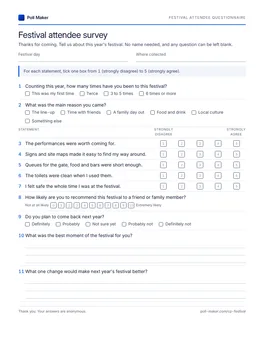
Festival attendee questionnaire
Page one carries the 11 attendee questions as tick boxes for a pencil. The seven optional sets come after it; leave off the pages you skip.
Download PDF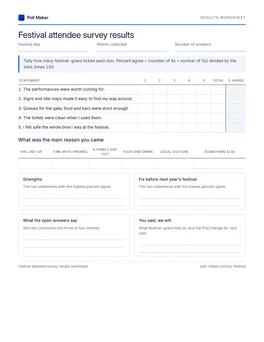
Results worksheet
Mark each paper answer to the core's five statements and the reason question, convert the totals to shares of festival-goers, and note next year's first fix.
Download PDFA QR code on the big screen, five questions long
Between acts, a QR code on the stage screens or a card handed out at the exit reaches people with a phone already in hand. Keep that version to five: first visit or not, the performances, the recommend score, coming back and the one change.
- 01Counting this year, how many times have you been to this festival?
- 02The performances were worth coming for.
- 03How likely are you to recommend this festival to a friend or family member?
- 04Do you plan to come back next year?
- 05What one change would make next year's festival better?
A festival experience study for coursework
Tourism and event management students often need a festival experience questionnaire with a research question behind it. The questions on this page already support three.
| Your question | Festival items | Analysis |
|---|---|---|
| Does the show or the site bring people back? | Five core statements, plans to return | Return plans among those who agreed with each statement, then among the rest |
| Do groups come for different reasons? | Main reason, who came, age | Chi-square test of reason by group |
| Do first-timers see a different festival? | Times attended, five statements | Percent agree for first-timers and regulars |
Expect the motives to change from one festival to the next. Group togetherness led at a rock festival marketed mainly to students,2 while cultural exploration rated high with every visitor group at a cultural festival in Turkey.3 Treat the main-reason options as a starting list and add the draw that is special to your festival.
Ask the organizers for permission before you collect on site, and survey adults. Head the questionnaire with a short consent note: your name and course, the purpose of the festival study, no names collected, every question optional. Then choose people with the gate count from the guide above, not by who looks willing.
Festival questions that need rewording
Four familiar festival-form questions, and why each one gives you replies you cannot use. For fixes on other topics, browse the survey questions library.
How amazing was this year's line-up?
The performances were worth coming for.
"Amazing" leans people toward a yes. A neutral statement rated on a scale gives a score you can compare from year to year.
How satisfied were you with the food, toilets and entry?
I could find food that suited my diet.
The toilets were clean when I used them.
Getting through the gate was quick.
Three parts of the site in one rating. Someone who loved the food and queued an hour to get in has no honest answer.
Did you spend money in town during the festival?
Including you, how many people does your spending cover?
About how much will you spend in this area on this trip?
A yes or no gives a funder nothing to multiply. An amount and the number of people it covers turn into spending per visitor.
Will you come back next year and tell your friends?
Do you plan to come back next year?
How likely are you to recommend this festival to a friend or family member?
Two decisions in one. A visitor who lives far away can love the festival, recommend it and still not return.
What festival organizers ask about surveys
Short answers for organizers, event officers and students running a festival study.
What questions should a festival survey include?
Start with how many times people have come and their main reason, then short statements on the performances, finding the way, queues, toilets and safety. Finish with the recommend score, plans to return and two open questions: the best moment and one change. The line-up, food, access and visitor spending sets are there when you need more.
When should you send a post-festival survey?
On site, hand out paper forms or show a QR code on the last afternoon, while people are still there. Online, email ticket buyers the next morning while the weekend is fresh, and close the survey about a week later.
How many festival-goers should you survey?
Spread the forms across every day, time slot and gate, because a Saturday night crowd and a Sunday morning crowd are different people. For a visitor spending estimate, aim for at least 200 completed surveys from out-of-town groups; at that size a yes or no result is accurate to about 7 points either way, 19 times out of 20.6
How do you get people to fill in a festival survey?
Make it easy and make it worth their while: a table by the exits with a sign, pencils and a box, a QR code on the stage screens, and a prize draw or souvenir that any festival-goer would want.6 Keep the on-site version short; the 11 attendee questions take about four minutes.
How do you measure the economic impact of a festival?
Count admissions, turn them into different people, take out local residents and visitors who were in the area anyway, then multiply by spending per person. The funders set on this page asks every question the calculation needs, and the worked example above shows the sums.5
How long should a festival survey be?
On site, one printed page: the 11 attendee questions take about four minutes. A QR code between acts works best at five questions. The morning-after email can carry more, so add one or two optional sets there, such as the line-up set for the program team or the funders set for a grant report.
Ask festival-goers while the weekend is fresh
Open the attendee survey in the builder and add the sets your teams need, or print forms for the exit table and put the QR code on the stage screens.