Airline customer satisfaction survey questions for one named flight
Ask passengers about one named flight: what happened to it, nine statements from booking to landing, the 0 to 10 recommend score and one change. The core 12 takes about three minutes. Add sets for delays, the airport, the cabin and bags.
- 39questions
- 12in the core set
- 3 minto answer the core
- 6optional sets
By Michael Hodge, BSc Psychology Updated September 2026
Every passenger question, booking to bag claim
The core 12 arrives selected. Bolt on the delay, airport, on-board, bags or service-moment set, or tick single rows. Every row lists the answers a passenger picks from and what that answer tells the team that owns it.
The core 12, about one named flight12 questions
What happened to the flight, nine statements that follow the trip from booking to landing, the recommend score and one open answer. Put the flight in the invitation, and each passenger rates the same journey.
-
Which best describes this flight?
On time15 to 59 min late1 to 3 hours late3+ hours lateCancelledThe answer every other score is split by. The first band follows the US DOT definition: a flight counts as on time when it arrives less than 15 minutes after schedule.4
-
Booking this flight was straightforward.
Strongly disagree12345Strongly agree1 = Strongly disagree, 5 = Strongly agreeThe first step of the trip. When it scores low, the open answers tend to name the culprit: fare rules, add-on fees or the app.
-
Check-in went smoothly, online or at the airport.
Strongly disagree12345Strongly agree1 = Strongly disagree, 5 = Strongly agreeCovers the app, the kiosk and the counter in one line. If it falls, the open answers and the greeting check in the service moments set show where.
-
Boarding was orderly.
Strongly disagree12345Strongly agree1 = Strongly disagree, 5 = Strongly agreeGate staff, overhead bins and the clock all meet at boarding. A drop here alongside more gate-checked bags points to bins filling before the last groups board.
-
The airline kept me updated about my flight.
Strongly disagree12345Strongly agree1 = Strongly disagree, 5 = Strongly agreeUsefulness of flight information rose from 71 to 82 out of 100 between the 2025 and 2026 ACSI airline benchmarks, one of the two biggest gains. Read it for delayed passengers first, because that is when updates count.1
-
The cabin crew were helpful when I needed them.
Strongly disagree12345Strongly agree1 = Strongly disagree, 5 = Strongly agreeHelp given, not smiles. A passenger who needed nothing can answer Neutral, which keeps the score honest.
-
My seat was comfortable enough for a flight of this length.
Strongly disagree12345Strongly agree1 = Strongly disagree, 5 = Strongly agreeSeat comfort ranked last of 21 parts of the trip in the 2026 ACSI airline benchmarks, at 76 out of 100. Split it by cabin before blaming the seat itself.1
-
The cabin and restroom were clean.
Strongly disagree12345Strongly agree1 = Strongly disagree, 5 = Strongly agreeJudged in the first minutes on board, before anyone has served a drink. A low score belongs to turnaround time and the cleaning contract, not to crew training.
-
This flight was worth the fare I paid.
Strongly disagree12345Strongly agree1 = Strongly disagree, 5 = Strongly agreeValue, not price. Read it by cabin, since a basic fare and a business fare buy very different trips.
-
I trust this airline to look after me if something goes wrong.
Strongly disagree12345Strongly agree1 = Strongly disagree, 5 = Strongly agreeLevel of trust is one of the seven parts of the trip JD Power scores in its airline study. It looks ahead to the next booking, so it doubles as a loyalty signal.2
-
How likely are you to recommend this airline to a friend or colleague?
0123456789100 = Not at all likely, 10 = Extremely likelyA 0 to 10 score you can follow month by month. Report it by route or station once each has enough answers that one rough flight cannot swing it.
-
What one change would make your next flight with us better?
Open answerOne change, in the passenger's own words. Sort the answers by question 1 before reading, so one bad delay does not drown out everything else.
When the flight ran late or was cancelled5 questions
Show these only to passengers who picked a late or cancelled answer on question 1. They separate the delay itself from how the airline handled it.
-
Were you told why the flight was late or cancelled?
Yes, clearlyYes, vaguelyNoIn a study at Sao Paulo's main airport, only delays with an internal cause lowered passengers' ratings of the airport; weather delays did not. A clear reason tells passengers which kind they had.5
-
How did you first hear about the delay or cancellation?
App alertText or emailAt the gateOn boardI found out myselfShows which channel reaches people first. Each "I found out myself" is an alert that never went out or never arrived.
-
Updates came early enough for me to change my plans.
Strongly disagree12345Strongly agree1 = Strongly disagree, 5 = Strongly agreeTiming, not accuracy. An alert ten minutes before boarding can be perfectly correct and still no use.
-
Were you told you could have a refund instead of a new flight?
YesNoNot sureUnder US refund rules, a cancellation or a domestic arrival three or more hours late lets passengers who turn down the alternative get their fare back, and airlines must tell them. This checks the message lands.7
-
During the wait, were you offered food, a hotel or other help?
Yes, it helpedYes, little helpNoDid not need itSeparates the delay from how people were looked after during it. Read the open answers of each group side by side to see what the care changed.
On board: bins, Wi-Fi, food and screens5 questions
For flights long enough to have a service. Leave out anything your aircraft does not offer.
-
I found room for my carry-on bag near my seat.
Strongly disagree12345Strongly agree1 = Strongly disagree, 5 = Strongly agreeOverhead space runs out before boarding ends. Read it with the gate-check question in the service moments set.
-
How did the onboard Wi-Fi work for you?
Worked wellPatchyPaid, did not workDid not use itNot offeredIn-flight internet rose 20% in the 2026 ACSI airline ratings, the biggest jump of any part of the trip. Follow up every "Paid, did not work" answer first: that passenger paid for something they did not get.1
-
How would you rate the food and drink you had on board?
Very poor12345Excellent1 = Very poor, 5 = ExcellentRated only by those who had something. On short hops with a snack service it says little, so keep it for longer flights.
-
How would you rate the entertainment on this flight?
Very poor12345Excellent1 = Very poor, 5 = ExcellentCovers seat-back screens and streaming to the passenger's own device. Low scores from people who never found the streaming page point to signage, not content.
-
Which one of these would most improve your next flight?
More legroomFree Wi-FiA free checked bagBetter foodFaster boardingA forced choice shows what passengers value when they cannot have everything. It also works as a quick live poll with any group of travelers.
At the departure airport5 questions
The same passenger, asked about the terminal rather than the airline. Separate lines let the airport and the airline each see their own scores.
-
How long did you wait in the security line?
Under 10 min10 to 19 min20 to 29 min30 min or moreDid not use itThe bands stop at the 29-minute mark because the US DOT treats a screening line longer than that as a security delay.4
-
Signs made it easy to find my gate.
Strongly disagree12345Strongly agree1 = Strongly disagree, 5 = Strongly agreeWayfinding in one line. Split it by how often people fly: regulars know the way, so low scores from first-timers are the ones to act on.
-
The terminal and its restrooms were clean.
Strongly disagree12345Strongly agree1 = Strongly disagree, 5 = Strongly agreeThe building's cleanliness, kept apart from the aircraft's so each operator sees its own result.
-
I could buy decent food and drink near my gate.
Strongly disagree12345Strongly agree1 = Strongly disagree, 5 = Strongly agreeIn the Sao Paulo airport study, good food and drink ratings softened the effect of a delay on satisfaction, so this is a delay question as much as a retail one.5
-
The airport Wi-Fi worked well enough to use.
Strongly disagree12345Strongly agree1 = Strongly disagree, 5 = Strongly agreeThe other amenity that softened delays in the same study. Cheap to fix, and noticed at every gate.5
Service moments: did it happen?5 questions
Yes-or-no checks on moments that station and cabin managers control. They give each team a count to work on, not a mood.
-
Were you greeted when you reached the check-in counter or bag drop?
YesNoDid not use oneA plain fact a station manager can coach on, where a check-in rating only shows how people felt.
-
Did boarding start at the time shown on your boarding pass?
YesNo, it started lateNot sureSeparates a late boarding call from a late departure, which usually have different owners.
-
Did you have to check your carry-on bag at the gate?
YesNoNo carry-onCounts the gate-checked bags behind a low bin-space score. A rising count points to boarding order or bag-size checks at the door.
-
Were you offered a drink during the flight?
YesNoFlight too shortShows whether the planned service happened, flight by flight, without asking anyone to grade the crew.
-
Was the restroom stocked with soap and paper when you used it?
YesNoDid not use itCatches a supply gap that a cleanliness rating blurs. Split it by route to find the flights that need a mid-flight check.
Bags, fees and complaints3 questions
Three questions that line up with how problems are counted: mishandled bags, fees nobody saw coming, and contacts about the trip.
-
How did your checked bag arrive?
On time, no damageLateDamagedLost or still missingNo checked bagThe categories the US DOT uses for mishandled bags: delayed, damaged, lost or pilfered. Any answer but the first should trigger a follow-up.4
-
I knew what my bags would cost before I reached the airport.
Strongly disagree12345Strongly agree1 = Strongly disagree, 5 = Strongly agreeA fee surprise is a value problem that starts at booking. Read it next to the value statement in the core.
-
Did you contact us about a problem with this trip?
NoYes, it is sortedYes, still waitingIn the 2026 ACSI study, 33% of business passengers and 16% of leisure passengers had complained. Every "still waiting" is a passenger to call back.1
About you and this trip4 questions
Trip reason and cabin are the two splits the national airline studies report, so they come first. Keep every group big enough that no passenger can be picked out.
-
What was the main reason for this trip?
BusinessLeisureVisiting family or friendsOtherBusiness and leisure passengers can judge the same flight differently: in the 2026 ACSI study, business passengers were about twice as likely to have complained.1
-
Which cabin did you fly in?
Basic economyEconomyPremium economyBusiness or firstJD Power scores each cabin separately; in 2026 first and business averaged 717 against 627 for economy and basic economy on its 1,000-point scale. Compare each cabin with itself over time.2
-
How many flights have you taken in the past 12 months?
This is my first2 to 56 to 1112 or moreFrequent flyers compare you with last month and with rivals; first-timers compare you with what they expected. Read their comments separately.
-
Are you a member of our loyalty program?
Yes, with statusYes, basic memberNoACSI credits part of American's 2026 rise to how customers rated its loyalty program. Splitting by status shows whether your best customers see the same airline as everyone else.1
Short enough to finish at the baggage carousel
Sent by text or app a few hours after arrival: what happened to the flight, updates, the crew, the recommend score and one change. Short enough to finish at the baggage carousel.
- 01Which best describes this flight?
- 02The airline kept me updated about my flight.
- 03The cabin crew were helpful when I needed them.
- 04How likely are you to recommend this airline to a friend or colleague?
- 05What one change would make your next flight with us better?
Lessons from how a large carrier surveys its passengers
Four practices drawn from airline research and from the way a large carrier runs its own program.

Name the flight, the date and the cabin
American Airlines has described drawing random samples each month of customers who flew in the previous week or two, and telling each one exactly which flight to evaluate. It reported response rates of 30 to 40 percent from samples drawn from its frequent flyer list.3 Naming the flight turns a general opinion of the airline into a report on one trip that a station or crew base can act on. Put the flight number, date, route and cabin at the top of the email or text.
Flights that were not on time, April 2025 (share of all flights)
Record what happened to the flight before reading any score
In April 2025, 79.5% of flights by the largest US airlines arrived on time; most of the rest were held up by late-arriving aircraft, the airline's own crew or maintenance, air traffic and airport conditions, weather or cancellation.4 Those passengers answer the same survey in a different mood. In 13,071 passenger questionnaires at Sao Paulo's main airport, passengers rated the airport lower when their flight was delayed, but only when the delay had an internal cause; weather delays made no significant difference.5 Question 1 captures what happened, so on-time and delayed passengers can be reported side by side.

Give the airport its own questions
The same study found that unhappiness with the airline spilled over into how passengers rated the airport.5 A passenger stuck at a gate blames whoever is standing in front of them. Asking about the terminal on separate lines, as the airport set does, lets each operator see its own scores and makes it easier to notice when one is carrying the other's problem.
Call back the passengers who complained
Complaints are part of airline travel: in the 2026 ACSI study, 33% of business passengers and 16% of leisure passengers had complained, and those who complained rated their airline higher than complainers a year earlier (77 and 72, up from 73 and 64).1 The complaint question in the bags set asks whether the passenger contacted you and whether it is sorted. Send every "still waiting" answer to customer relations the same day, and record the outcome beside the response from that passenger.
Leading a group trip or running a company travel program? Ask travelers one thing at a time: launch a live poll from any single-choice question above and drop the link in the group chat. For sharing options, see making and sharing a poll.
Reading scores by flight status: a worked example
A delayed passenger can mark down parts of the trip the delay never touched, so a month of storms drags the whole survey down. Split the results by question 1 and the real problems separate from the bad luck.
Example numbers: 400 passengers answered in one month, 300 whose flight was on time and 100 whose flight was late or cancelled. Each cell shows the share of that column who agreed.
| Statement | On time | Late or cancelled |
|---|---|---|
| The airline kept me updated about my flight | 81% | 44% |
| I trust this airline to look after me if something goes wrong | 76% | 49% |
| The cabin crew were helpful when I needed them | 85% | 82% |
| My seat was comfortable enough for a flight of this length | 61% | 59% |
What the split shows
Updates fall by 37 points and trust by 27 when the flight goes wrong, so that fix belongs to the disruption playbook: earlier alerts, a clear reason and the refund choice. The crew and seat statements barely move. The seat is a product issue that better communication will never cover. Blended into one column, the month would simply look middling everywhere.
Why the mix matters from month to month
A stormy month puts more passengers in the right-hand column and drags the overall score down even when nothing about the service changed. Report the on-time column as your service trend, the delayed column as your recovery trend, and print the share of delayed respondents beside both.
Turn passenger answers into a one-page station report
Type the count of passengers at each point, 1 to 5, for the nine core statements; the panel sorts them and marks the two weakest. Run it once for on-time flights and once for delayed ones.
- 1Agreement is the count of 4s and 5s on a statement over the number of passengers who rated it. The panel calculates it live.
- 2Fill the panel twice, first with on-time passengers and then with everyone who picked a late or cancelled answer on question 1, and print both.
- 3Statements that fall only for delayed flights point to disruption handling. Statements that stay low either way, often the seat, point to the product.
- 4Send the two lowest statements to the station, crew base or product team that owns them, with three passenger comments that explain them.
Passenger results
Ratings or yes-or-no checks? Use both
A rating tells you how a passenger felt. A yes-or-no check tells a station manager what happened. American Airlines' managing director of customer research described asking about thirty "did this happen?" questions, because "I can't go to a manager and say his efficiency score needs to come up two points."3
| Moment | Rating in the core | Yes-or-no check |
|---|---|---|
| Check-in | Check-in went smoothly, online or at the airport. | Were you greeted when you reached the check-in counter or bag drop? |
| Boarding | Boarding was orderly. | Did boarding start at the time shown on your boarding pass? Did you have to check your carry-on bag at the gate? |
| Cabin | The cabin and restroom were clean. | Was the restroom stocked with soap and paper when you used it? |
| Service | The cabin crew were helpful when I needed them. | Were you offered a drink during the flight? |
How the pair works
When a rating slips, the check beside it shows which moment slipped with it. A weaker boarding score plus more gate-checked carry-ons says the bins are full before the last groups board, and the gate team can change the boarding order. A weaker boarding score with boarding still starting on time points somewhere else, such as announcements or the jet bridge.
Keep checks to what the passenger saw
Ask only about moments a passenger witnessed for themselves. A question they would have to guess at, such as whether the aircraft was cleaned between flights, adds noise to an otherwise hard number.
How US airlines scored with passengers in 2026
Two national studies published airline satisfaction scores in spring 2026. Both are indexes, not percentages, so use them to see where the industry stands and which parts of the trip they track, never as a target for your own percent agree.
ACSI Travel Study 2026 (0 to 100)
| Airline | 2026 score | 2025 score |
|---|---|---|
| Delta | 79 | 77 |
| American | 78 | 73 |
| JetBlue | 78 | 77 |
| Southwest | 77 | 80 |
| Alaska | 75 | 76 |
| United | 75 | 73 |
| Frontier | 69 | 65 |
| Spirit | 66 | 69 |
| All airlines | 76 | 74 |
Source: ACSI Travel Study 2026, published by the American Customer Satisfaction Index LLC. The industry score of 76 sits one point below its 2024 high. Across 21 parts of the trip, the mobile app's reliability rated highest at 85 and seat comfort lowest at 76.1
JD Power 2026 North America Airline Satisfaction Study (1,000-point scale)
Source: JD Power, which surveyed 10,914 passengers from March 2025 to March 2026. First and business class averaged 717, premium economy 682 and economy and basic economy 627. Southwest led economy with 670, Delta led premium economy with 736 and JetBlue led first and business with 759.2
Where this survey asks what the studies measure
JD Power scores seven parts of the trip: airline staff, digital tools, ease of travel, level of trust, the on-board experience, the pre- and post-flight experience and value for the price paid.2 The core covers staff with the crew statement, digital tools with booking and updates, ease of travel with check-in and boarding, trust and value with their own statements, and the on-board experience with the seat and cleanliness statements. The airport and bags sets cover the time before and after the flight.
Forms for lounges, regional gates and charters
Paper works where phones are packed away: in a lounge, at a regional gate, or on a charter where the crew hands out forms before landing. Collect them at the door and key them in with the flight number.
Handing out only the core at the gate? and keep the delay set for flights that ran late.
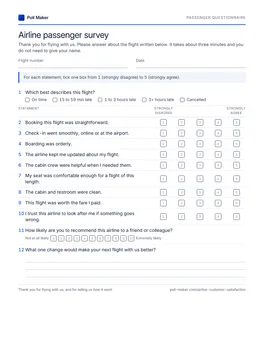
Passenger questionnaire
Sheet one carries all twelve core items plus boxes for the flight number and date. Delays, airport, cabin, bags, service moments and traveler details continue behind it.
Download PDF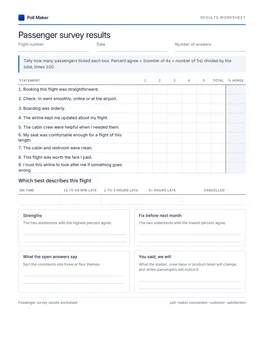
Station tally sheet
Add up a week of paper forms with a pen, find the agreement level per statement, count flight status, and pick the two weak spots for next month.
Download PDFFour airline survey questions that mislead, rewritten
Common wordings from airline feedback forms, each with a version passengers can answer honestly. The survey question library adds five general rules in the same weak and better form.
How satisfied were you with our punctuality and friendly crew?
Which best describes this flight?
The cabin crew were helpful when I needed them.
Two unrelated things in one question. A passenger with a late flight and a lovely crew has no honest answer.
Please rate your overall flight experience.
The airline kept me updated about my flight.
My seat was comfortable enough for a flight of this length.
An overall rating shows the mood but not the cause. Specific statements tell you which team owns the problem.
How much did you enjoy our award-winning service today?
The cabin crew were helpful when I needed them.
"Award-winning" and "enjoy" lead the answer. Ask about something the passenger saw happen.
Were you satisfied with our delay information? (asked of everyone)
Which best describes this flight?
Were you told why the flight was late or cancelled?
Passengers whose flight was on time have no delay to rate, and their Neutral answers dilute the real score. Ask the status first and show delay questions only when they apply.
Before you survey your own passengers
Short answers for customer experience teams, station managers and researchers.
What questions should an airline customer satisfaction survey include?
Start with what happened to the flight, then one statement for each step of the trip: booking, check-in, boarding, updates, the crew, the seat, cleanliness, value and trust. End on likelihood to recommend, scored 0 to 10, and a single open prompt. That dozen is the core set above; bolt on the delay, airport or bags set as needed.
How do airlines measure customer satisfaction?
Mostly by emailing recent passengers about a named flight. American Airlines has described inviting random samples of up to 25,000 passengers at a time, a couple of times a month, and telling each one which flight to evaluate.3 The industry is also scored from outside, by the ACSI on a 0 to 100 scale1 and by JD Power on a 1,000-point scale.2
Which airline has the highest customer satisfaction?
In the ACSI Travel Study 2026, Delta scored highest at 79 out of 100, with American and JetBlue next at 78.1 JD Power ranks by cabin: in 2026 Southwest led economy, Delta led premium economy and JetBlue led first and business.2
When should the survey go out after a flight?
Within a day or two, while details are fresh, and no later than about two weeks; American Airlines has described sampling passengers who flew in the previous week or two.3 After a delay or cancellation, wait until the passenger has reached their destination rather than surveying them while they are still stuck.
How can passengers tell a survey email really comes from the airline?
A genuine survey names the flight, date and route, comes from the airline's usual address and links to its own website. It never asks for a password or payment details to claim a reward. Put those details in your invitation and more passengers will trust it enough to answer.
Can I use this questionnaire for research on airline service quality?
Yes. The questions touch all five dimensions of AIRQUAL, a service quality scale made for airlines: airline tangibles, terminal tangibles, personnel, empathy and image.6 The wording is original, so describe it as an adapted instrument and cite AIRQUAL for the dimensions. Collect in the departure lounge or by email after the flight, and record flight status for every respondent.
Put the survey on your next departure
Open the twelve core items in the builder, turn on whichever sets fit your routes, and send the link with the flight number up front.