Museum visitor survey questions for the exit, tours, members and access
A museum visitor survey asks people on their way out why they came, what held their interest, what they learned, how easy the day was and whether they would tell a friend to go. Eleven exit questions handle all of that in about four minutes. When you need more, add a set for one exhibition, tours, members or access.
- 39questions
- 11in the exit survey
- 4 minfor the exit survey
- 6sets to add
By Michael Hodge, BSc Psychology Updated September 2026
Exit survey, tours, members and access: every question
Your survey begins with the 11 exit questions selected. Tick extra sets, or single lines, for an exhibition, a tour program or members. Beneath each question: the answers visitors pick from, and what a curator or visitor services team learns from them. Send the selection online, hand it out on paper at admissions, or paste it into a different tool.
The exit survey11 questions
Three facts about the visit, five statements about the day, the recommend question and two open questions. Ask them as people leave, or in an email the same evening.
-
Including today, how many times have you visited this museum?
This is my first visitTwice3 to 5 timesMore than 5 timesFirst-time and repeat visitors judge the same galleries differently. Split every other answer by this one before you read it.
-
What was the main reason for your visit today?
To see or learn something newTo bring someone elseTo see a place I had heard ofFor my work, study or hobbyTo relax and rechargeAnother reasonEach answer stands for one of the five visit motivations in John Falk's research, and each group wants a different day from you.1
-
Who came with you today?
AlonePartner or friendsWith childrenOther adultsSchool or tour groupCompany changes the pace and what gets read aloud. Among people whose last arts outing was an art exhibit, 37% went with friends.2
-
The exhibits held my interest.
Strongly disagree12345Strongly agree1 = Strongly disagree, 5 = Strongly agreeThe heart of the visit. When it scores low, the answers about what to change usually name the galleries.
-
I learned something new today.
Strongly disagree12345Strongly agree1 = Strongly disagree, 5 = Strongly agreeLearning is the reason visitors give most often, so this is the promise most of them came to have kept.2
-
Labels and panels were easy to read and understand.
Strongly disagree12345Strongly agree1 = Strongly disagree, 5 = Strongly agreeSize, lighting, length and language in one line. A low score sends you to the exhibition set for detail.
-
It was easy to find my way around.
Strongly disagree12345Strongly agree1 = Strongly disagree, 5 = Strongly agreeWayfinding. First-time visitors feel it most, so set their score beside the repeat visitors' score.
-
Staff and volunteers made me feel welcome.
Strongly disagree12345Strongly agree1 = Strongly disagree, 5 = Strongly agreeThe welcome at the desk and in the galleries, from the people visitors actually meet.
-
How likely are you to recommend this museum to a friend or relative?
0123456789100 = Not at all likely, 10 = Extremely likelyScored as a Net Promoter Score: the share who answer 9 or 10 minus the share who answer 0 to 6.4
-
What is one object, room or moment you will remember from today?
Open answerWhat visitors name without a prompt tends to match what drew the most people in tracking studies, so this list shows what worked.3
-
What one change would have made your visit better?
Open answerAsking for a single fix keeps answers short and specific. Group them by gallery or service and count each group.
One exhibition in detail7 questions
For curators and exhibition teams judging one show. Name the show in the survey heading, so nobody answers about the wrong rooms.
-
I came away knowing what the exhibition was about.
Strongly disagree12345Strongly agree1 = Strongly disagree, 5 = Strongly agreeTests the main message. Compare it with the one idea the team wanted visitors to leave with.
-
The rooms followed an order that made sense to me.
Strongly disagree12345Strongly agree1 = Strongly disagree, 5 = Strongly agreeLayout and story. A low score often explains a show that visitors leave half seen.
-
The hands-on and digital displays worked when I tried them.
Strongly disagree12345Strongly agree1 = Strongly disagree, 5 = Strongly agreeA maintenance question as much as a design one, and one of the quickest to fix.
-
How much of the exhibition did you see?
All or nearly allMore than halfAbout halfLess than halfA self-reported version of what tracking studies call diligent visitors: people who stop at more than half of the displays.3
-
About how long did you spend in the exhibition?
Under 10 minutes10 to 20 minutes20 to 40 minutesOver 40 minutesTracking studies put the average exhibition visit at about 20 minutes, so these bands sit either side of that mark.3
-
The amount of reading on the labels was:
Too littleAbout rightToo muchTells a label writer which way to edit. Read it next to how much of the show visitors saw.
-
What question did the exhibition leave you wanting to ask?
Open answerShows what the show sparked, and hands the learning team topics for talks and tours.
Tickets, comfort and access7 questions
For front-of-house and operations teams: getting in, seats, crowding, access and whether the day felt worth it.
-
How did you get in today?
Ticket booked onlineTicket bought hereFree entryMember entryGroup or school bookingLets you compare walk-in and pre-booked visitors, and shows who can be reached by email afterwards.
-
Getting from the door to the first gallery was quick.
Strongly disagree12345Strongly agree1 = Strongly disagree, 5 = Strongly agreeThe queue, the desk and the cloakroom in one line: the first ten minutes colour everything after them.
-
There were enough places to sit and rest.
Strongly disagree12345Strongly agree1 = Strongly disagree, 5 = Strongly agreeSeating is cheap to add and matters most to older visitors and parents.
-
The galleries felt comfortable, even at busy times.
Strongly disagree12345Strongly agree1 = Strongly disagree, 5 = Strongly agreeCrowding and temperature. Split it by time of day to see when capacity is the problem.
-
The museum met the access needs of my whole group.
Strongly disagree12345Strongly agree1 = Strongly disagree, 5 = Strongly agreeStep-free routes, lifts, toilets and seating for everyone in the party, not only the person answering.
-
The visit was worth the time and money it cost me.
Strongly disagree12345Strongly agree1 = Strongly disagree, 5 = Strongly agreeValue, which works for free museums too: travel and a day off still cost something.
-
Which of these did you use today?
CafeShopCloakroomAudio guide or appPrinted mapBaby changingTick all that applyShows which services are worth improving first, and gives the shop and cafe a share of visitors to plan around.
Tours, talks and workshops (people who joined one answer)4 questions
Only for visitors who took part in a tour, talk or workshop. Send it to the booking list, or hand it out as the session ends.
-
What did you join today?
Guided tourTalk or lectureWorkshop or classFamily activitySomething elseKeeps the answers apart by format, since a family craft session and an evening lecture succeed in different ways.
-
The guide or speaker made the subject come alive.
Strongly disagree12345Strongly agree1 = Strongly disagree, 5 = Strongly agreeDelivery rather than knowledge: most guides know their subject, fewer bring it to life.
-
There was time for my questions.
Strongly disagree12345Strongly agree1 = Strongly disagree, 5 = Strongly agreeVisitors who get to ask rate sessions higher. A low score usually means the talk ran long.
-
The length of the session was:
Too shortAbout rightToo longThe one answer that tells you which way to change the schedule.
Members (members answer)4 questions
Only for members. Their answers shape renewals and the benefits you offer next year.
-
How long have you been a member?
Under 1 year1 to 2 years3 to 5 yearsOver 5 yearsFirst-year members renew least reliably, so read their answers on their own.
-
Which member benefits have you used in the past year?
Free entryMember eventsShop or cafe discountGuest passesMember magazineNone yetTick all that applyBenefits nobody uses are not selling the membership. Benefits many use are the ones to lead with.
-
How likely are you to renew your membership?
DefinitelyProbablyNot sureProbably notDefinitely notAn early warning for the membership team. Follow up the "not sure" group before their renewal date.
-
What would make your membership better value?
Open answerIdeas for next year's benefits, in members' own words.
What would bring you back3 questions
For programming and marketing teams: what would bring visitors back sooner, and when they want to come.
-
Which of these would bring you back sooner?
A new exhibitionEvening openingsTalks and toursFamily activitiesWorkshopsOnline eventsTick all that applyA ranked list of reasons to return, from the people most likely to act on them.
-
When would you most like to visit?
Weekday daytimeWeekday eveningWeekend daytimeWeekend eveningTests demand for late openings before you pay for the staff to run them.
-
What subject or story would you like this museum to show next?
Open answerExhibition ideas from the audience, and a sense of which topics would bring new people in.
About you (optional)3 questions
Use these to compare local and out-of-town visitors or age groups. Skip any you will not analyse.
-
How old are you?
16 to 2425 to 3435 to 5455 to 6465 or olderPrefer not to sayWide bands are enough to see whether younger adults experience the museum differently.
-
Where do you live?
Under 30 minutes awayElsewhere in this regionElsewhere in this countryIn another countrySeparates locals, who can come back often, from visitors who may come once.
-
Not counting today, how many museums or galleries have you visited in the past 12 months?
None1 or 23 to 56 or moreSeparates regular museum-goers, who compare you with other museums, from people new to museums altogether.
Where to ask: exit, tablet, email or after a tour
The same questions give different answers depending on where visitors meet them. Pick the place first, then the set.
| Where you ask | Who you hear from | What to send |
|---|---|---|
| Paper or a QR sign by the way out | A spread of the day's visitors, walk-ins included | The exit survey, plus one set at most |
| A tablet in the lobby | Visitors who choose to stop, often the most delighted and the most annoyed | The five email questions; standing up, eleven feels long |
| An email the evening after | Everyone who booked online or holds a membership | The exit survey, with the members set for members |
| At the end of a tour or workshop | The people in that session | The tours set and the recommend question |
Mix two places if you can. An exit survey on a busy Saturday and an email to online bookers in the same week show whether walk-ins and planners had the same day.
A stack of forms and a box by the exit
A stack of questionnaires and a box by the exit reach visitors who never open an email. The layout suits either A4 or US letter stock.
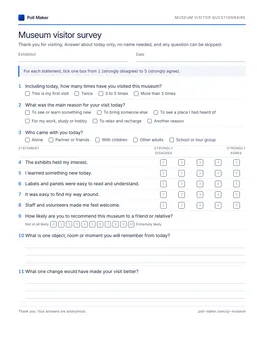
Museum visitor questionnaire
The 11 exit questions fill page one, laid out for a pencil and a clipboard. The six optional sets follow, so leave off any you skip.
Download PDF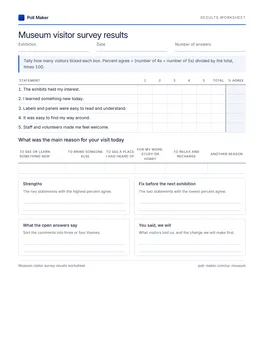
Results worksheet
Count the five visit statements and the reason question on paper, convert the counts to shares of visitors, and write down the first fix.
Download PDFRunning a museum survey that shapes the next exhibition
Four habits from visitor studies, the research field museums use to evaluate their exhibitions.

Ask why they came before you ask how it went
Visitors arrive with different jobs for the day. John Falk sorts them into five motivations: explorers follow their curiosity, facilitators come for someone else, experience seekers want to see a place they have heard about, professionals and hobbyists bring a specific goal, and rechargers want calm.1 A crowded gallery spoils a recharger's morning and barely registers with a parent busy with children. The reason question lets you read every score by motivation. Ask it rather than guessing from the group: a parent with children can still be an explorer.
Reasons given for the latest art exhibit visit
Expect learning to top the list
When their latest arts outing was an art exhibit, 88% of US adults named learning new things as a reason, 73% wanted to see high-quality art, 72% wanted to visit the place itself and 68% came to spend time with friends or family.2 Most visitors give several reasons at once, so the statement about learning something new speaks to nearly everyone you ask.

Ask what stayed with them
Memory is a sturdy signal. In one tracking study, visitors leaving the exhibition named 37 of its exhibits unprompted, 43% of the total, and they were mostly the same exhibits that had drawn the most people.3 The open question about one object, room or moment gives you that list without a stopwatch. It comes before the question about what to change, so visitors answer it while the good parts are fresh.
Choose visitors by rota, not by mood
Stand at the exit and approach every fifth adult who passes, at set times on weekdays and weekends. People picked because they look approachable, or who volunteer themselves, describe a narrower day than the one most visitors had. Note the refusals as well, so you can say how many people you asked.
Thinking about evening openings or a new weekend program? One question settles it. Ask your followers in a quick visitor poll on your social channels or website. The poll how-to covers where to send it.
Find the part of the visit to fix first
Type in the paper tallies or the counts from your online results. Each bar is the proportion of visitors who agreed, and the shortest bar is the first thing to work on.
- 1Take each statement in turn and total its 4s and 5s. Divide that by the visitors who rated it; the panel here does the arithmetic live.
- 2Run the chart again for first-time visitors on their own. Signs, labels and the welcome usually matter most to them.
- 3Put the weakest statement next to the what-to-change answers. Visitors usually name the cause themselves.
- 4Show the chart to front-of-house staff and volunteers, and name the single fix planned before the next opening.
Exit survey results
Reading results by visitor motivation
The reason-for-visit question turns one average into five smaller stories. Split the five statements by it once each group has enough answers to compare.
| Main reason chosen | A good day for them | Scores to watch first |
|---|---|---|
| To see or learn something new (explorer) | New things to find and room to wander | Exhibits held my interest; learned something new |
| To bring someone else (facilitator) | The people they brought had a good time | Finding the way; seats and access in the comfort set |
| To see a place I had heard of (experience seeker) | Seeing the highlights and feeling they have been | Finding the way; the recommend score |
| For my work, study or hobby (professional or hobbyist) | Depth, detail and expert answers | Labels and panels; the exhibition and tours sets |
| To relax and recharge (recharger) | Quiet, space and an unhurried pace | Comfort at busy times; places to sit |
The five groups come from John Falk's research on why people visit museums.1 The answer options are our plain-language version, so visitors can pick one without knowing the labels in brackets. Motivations can shift during a single visit, which is why the question asks for the main reason today.
Judging one exhibition
Add the exhibition set when a show opens or before it closes, and compare the answers with benchmarks from exhibition tracking studies.
Benchmarks from tracked exhibitions
Beverly Serrell's database of tracking-and-timing studies puts the average exhibition visit at about 20 minutes, and shows smaller exhibitions being explored more fully. She also counts diligent visitors, people who stop at more than half of the displays. Their share averaged 26% across 50 exhibitions in her later analysis, and she rates a show as exceptionally well used when more than 51% of its visitors are diligent.3
A worked example
Of 120 visitors who answer how much of the exhibition they saw, 18 choose all or nearly all and 36 choose more than half: 54 of 120, or 45 in every 100 visitors, say they saw more than half. A self-reported share is not a tracked one, so use it for direction: compare this show with your last one, asked the same way. If many visitors also found the labels too long, shorten the text before you add objects.
Pair the survey with a stopwatch
Evaluators almost always run tracking alongside exit interviews and questionnaires, because each catches what the other misses. At one museum, tracking showed visitors hurrying through a long-running gallery, while the exit questionnaires showed they still valued and understood its main ideas.3 If a volunteer can spare a morning, time a few dozen visitors through the show and set the timings beside these answers.
A short version for the email the day after
Many museums email every ticket buyer the evening after a visit. Keep that email to five questions: how often they have been, whether the exhibits held them, the recommend score, the moment they remember and the one change.
- 01Including today, how many times have you visited this museum?
- 02The exhibits held my interest.
- 03How likely are you to recommend this museum to a friend or relative?
- 04What is one object, room or moment you will remember from today?
- 05What one change would have made your visit better?
Museum questions that come back vague, and better versions
Four questions museums often ask that return answers too vague to use. More subjects are covered in our survey questions by topic.
Did you enjoy your visit?
The exhibits held my interest.
What is one object, room or moment you will remember from today?
Nearly everyone says yes to enjoying a day out. A statement about the exhibits and a named memory show what actually worked.
How would you rate our exhibits, staff and facilities?
The exhibits held my interest.
Staff and volunteers made me feel welcome.
It was easy to find my way around.
Three things in one rating. A visitor who loved the galleries and got lost twice has no honest single answer.
Were the exhibit labels informative?
Labels and panels were easy to read and understand.
The amount of reading on the labels was: too little, about right, too much.
"Informative" invites a polite yes. Ease of reading and the amount of text point to a change a designer can make.
Would you visit again and become a member?
Which of these would bring you back sooner?
How likely are you to renew your membership?
Two decisions in one, and the second only fits members. Ask what would bring visitors back, and keep renewal for the members set.
Questions from curators and visitor services staff
Short answers for visitor services, curators, marketing teams and museum studies students.
What questions should a museum visitor survey include?
Why people came, who they came with and how long they stayed, then five statements on the exhibits, learning, labels, wayfinding and welcome. Finish with the recommend question and two open questions: one thing they will remember and one change. Add sets for a single exhibition, tours or members when you need them.
How long should a museum survey be?
About four minutes, the length of the 11 exit questions, works at the door or by email. A lobby tablet needs fewer, so use the five email questions there. Adding sets one by one keeps the survey from sprawling.
When should a museum send a post-visit survey?
The same evening or the next morning, while the day is still clear. Send it from your booking system to everyone who bought a ticket online, and leave it open for about a week.
How do you measure the success of an exhibition?
Decide before opening what visitors should leave knowing, then check it with the exhibition set: how much of the show they saw, whether they got the main idea and what they remember. Tracking adds timing; Serrell rates an exhibition as exceptionally well used when more than half its visitors stop at more than half its displays.3
Can a survey show whether visitors feel they belong?
Yes, with an instrument built for it. The Cultural Institution Belonging Instrument, from researchers at Chicago's Museum of Science and Industry, was tested with 333 guests leaving a science museum,5 and its authors made it free to use.6 Run it as its own survey rather than adding it to this one.
Can students use these questions for a museum project?
Yes. Ask the museum for permission first, stand at the exit rather than in the galleries, and survey adults unless a parent agrees. The reason, visit count and recommend questions give you three ways to split the answers in your write-up.
Hear from visitors before the next show opens
Open the exit survey in the builder with your exhibition or members set attached. Then prop a QR sign by the exit, or leave printed copies and a pen at admissions.